We unleash your business potential by maximize the business innovation.
Send EmailHydroxylamine Sulfate, Hydroxylammonium Sulfate, Oxammonium Sulfate, Hydroxyazanium Sulfate, HAS, 10039-54-0
HYDROXYLAMINE SULFATE (HAS)
Hydroxylamine Sulfate / Hydroxylammonium Sulfate / Oxammonium Sulfate / Hydroxyazanium Sulfate
CAS Number: 10039-54-0
EC Number: 233-118-8
1. IDENTIFICATION INFORMATION
| Property | Information |
|---|---|
| Chemical Name | Hydroxylammonium Sulfate |
| Common Name | Hydroxylamine Sulfate |
| Other Names | Hydroxyl Ammonium Sulfate, Oxammonium Sulfate, Hydroxyazanium Sulfate, Bis(hydroxylammonium) sulfate |
| Trade Abbreviation | HAS (especially BASF) |
| Chemical Formula | (NH₂OH)₂·H₂SO₄ or H₈N₂O₆S |
| Molecular Weight | 164.13 g/mol |
| CAS Number | 10039-54-0 |
| EC Number (EINECS) | 233-118-8 |
| Appearance | White, slightly hygroscopic crystalline solid |
| Purity | ≥99.0% (available in industrial and analytical grades) |
2. PHYSICAL PROPERTIES
| Property | Value |
|---|---|
| Physical State (20°C) | Solid (crystalline) |
| Appearance | White, slightly hygroscopic crystalline powder |
| Odor | Slightly characteristic |
| Molecular Weight | 164.13 g/mol |
| Melting Point | ~170°C (decomposes) |
| Density (20°C) | 1.88 g/cm³ |
| Solubility in Water (20°C) | 58.7 g/100 mL (high) |
| Solubility in Hot Water | Higher |
| Solubility in Ethanol | Very slightly soluble or insoluble |
| Solubility in Ether | Very slightly soluble or insoluble |
| Solubility in Organic Solvents | Very slightly soluble or insoluble |
| pH (1% aqueous solution, 20°C) | ~3.6 (acidic) |
| Apparent Decomposition Onset | Above 120°C |
| Strong Exothermic Decomposition Range | 138-177°C |
| Hygroscopicity | Slightly hygroscopic |
3. CHEMICAL PROPERTIES
| Property | Information |
|---|---|
| Chemical Formula | (NH₂OH)₂·H₂SO₄ or H₈N₂O₆S |
| Molecular Weight | 164.13 g/mol |
| Chemical Class | Hydroxylamine salt (inorganic sulfate) |
| Functional Group | Hydroxylamine (NH₂OH) and sulfate (SO₄²⁻) |
| Stability | Stable under normal conditions |
| Stability Warning | Decomposes rapidly upon contact with alkalis, strong oxidizers, and heat |
| Reaction with Alkalis | Forms free hydroxylamine (can lead to explosive reactions) |
| Reaction with Strong Acids | No reaction with sulfuric acid |
| Effect of Metal Ions | Decomposition accelerates in presence of iron, copper ions |
| Reducing Property | Strong reducing agent |
| Nucleophilic Property | Acts as aminohydroxy (NH₂OH) source in nucleophilic reactions |
| Incompatible Materials | Strong alkalis (NaOH, KOH), strong oxidizers (nitric acid, peroxides, perchlorates, chlorates), iron and copper salts, hot surfaces |
Reaction Equations:
Reaction with Alkali (Free Hydroxylamine Formation - DANGEROUS):
(NH₂OH)₂·H₂SO₄ + 2 NaOH → 2 NH₂OH + Na₂SO₄ + 2 H₂O
Oxime Formation (with Aldehyde/Ketone):
R₂C=O + (NH₂OH)₂·H₂SO₄ → R₂C=N-OH + (NH₄)₂SO₄ + H₂O
Metal Ion Reduction (Example: Silver):
2 Ag⁺ + 2 NH₂OH → 2 Ag⁰ + N₂ + 2 H₂O + 2 H⁺
4. PRODUCTION PROCESS
| Method | Description |
|---|---|
| Raschig Process (Industrial) | Reaction of ammonium nitrite with sulfuric acid and ammonium sulfate |
| Nitroalkane Hydrolysis | Production of hydroxylamine salts via nitroalkane hydrolysis |
| Purification | Crystallization, recrystallization |
| Drying | Controlled drying conditions |
| Commercial Forms | Crystalline powder, technical grade, analytical grade |
5. AVAILABLE FORMS AND SPECIFICATIONS
| Form | Purity | Description | Applications |
|---|---|---|---|
| Technical Grade | ≥99.0% | White crystalline powder | Industrial syntheses, polymer, textile |
| Analytical Grade | ≥99.5% | High purity crystals | Pharmaceutical intermediates, laboratory |
| High Purity | ≥99.9% | Ultra pure | Sensitive syntheses, research |
Typical Specifications (Technical Grade):
| Parameter | Specification | Test Method |
|---|---|---|
| Assay (Hydroxylamine sulfate) | ≥99.0% | Titration |
| Appearance | White crystalline powder | Visual |
| Melting Point | ~170°C (decomposes) | DSC |
| pH (1% solution) | 3.4 - 3.8 | Potentiometric |
| Sulfate (SO₄) | ≤0.1% | Gravimetric |
| Chloride (Cl) | ≤0.01% | Colorimetric |
| Iron (Fe) | ≤10 ppm | ICP |
| Heavy Metals (as Pb) | ≤20 ppm | ICP |
| Loss on Drying | ≤0.5% | Gravimetric |
| Ash Content | ≤0.1% | Gravimetric |
6. APPLICATIONS
6.1. Organic Syntheses and Pharmaceutical Intermediates
| Application | Function |
|---|---|
| Oxime Synthesis | Production of oximes from aldehydes/ketones (purification and derivatization) |
| Hydroxamic Acid Synthesis | Key intermediate |
| N-Hydroxy Intermediates | Synthesis of pharmaceutical compounds |
| Aldehyde/Ketone Purification | Removal of impurities via oxime formation |
Usage Rate: Depends on reaction stoichiometry; typically 1.0-1.2 equivalents of HAS per aldehyde/ketone
Example Recipe (Benzaldoxime Synthesis):
-
100 g benzaldehyde
-
95 g hydroxylamine sulfate
-
250 mL water
-
Slowly add 80 g sodium hydroxide solution (40%)
-
React at 0-5°C for 2 hours
-
Yield: >90%
6.2. Polymer and Rubber Industry
| Application | Function |
|---|---|
| Shortstopper | Terminates radical reactions in emulsion polymerization |
| Color Stabilizer | Provides color stability in synthetic rubber |
| Antioxidant | Prevents oxidative degradation |
| Vulcanization Accelerator | Auxiliary agent |
Usage Rate:
-
Shortstopper in SBR (Styrene-Butadiene Rubber): 0.05-0.2% based on monomer weight
-
Color stabilizer/antioxidant: 0.1-0.3% based on dry rubber
Example Recipe (SBR Emulsion Polymerization Shortstopper Solution):
-
Prepare 10% aqueous HAS solution
-
Dose 0.1-0.2 kg active HAS per 100 kg dry rubber when latex reaches 60-65% conversion
-
Can be buffered to pH 7-8 with dilute ammonia
6.3. Textile and Fiber Industry
| Application | Function |
|---|---|
| Peroxide Neutralization | Removes residual peroxide after bleaching |
| Whiteness Stabilization | Stabilizes whiteness |
| Anti-Chlorine Treatments | Chlorine-free alternative |
Usage Rate: 1-3 g/L (based on bath ratio), 40-60°C for 20 minutes
Example Recipe (Peroxide Neutralization):
-
2 g/L HAS
-
0.5 g/L non-ionic wetting agent
-
Adjust pH to 4.0-4.5 with acetic acid
-
Treat fabric at 50°C for 15-20 minutes, then rinse
6.4. Metal Surface Treatment and Corrosion Prevention
| Application | Function |
|---|---|
| Oxide Removal | Removes oxide layer from copper alloys |
| Passivation | Passivation baths for metal surfaces |
| Corrosion Inhibitor | In combination with EDTA or other complexing agents |
| Metal Precipitation | Reducing agent for precipitation of mercury and silver |
Usage Rate:
-
Copper brightening/oxide cleaning bath: 5-15 g/L HAS + 20-50 g/L sulfuric acid
-
Corrosion inhibitor (closed circuit cooling water): 50-200 mg/L HAS (typically combined 1:1 with EDTA)
Example Recipe (Copper Oxide Cleaning):
-
10 g/L HAS
-
30 mL/L concentrated sulfuric acid
-
Immerse for 1-5 minutes at 25°C
-
Rinse thoroughly with water
6.5. Photographic and Film Industry
| Application | Function |
|---|---|
| Color Stabilizer | Additive in color photographic emulsions |
| Antioxidant | Stabilizer in bath solutions |
| Developer Stabilizer | Stability in developer solutions |
Usage Rate: Typical 1-5 g/L level in developer solutions
6.6. Agrochemicals and Pharmaceutical Industry
| Application | Function |
|---|---|
| Pesticide Intermediate | Synthesis of herbicide, insecticide, and fungicide active ingredients |
| Oxime Ether Derivatives | Key intermediate in pesticide production |
| Veterinary Pharmaceuticals | Animal health products |
| Antibiotic Modification | Side chain modification |
Usage Rate: Process specific; typically 1-1.5 equivalents of HAS per substrate in laboratory-scale studies
6.7. Enzyme Reactivation and Biochemistry
| Application | Function |
|---|---|
| Enzyme Reactivation | Reactivation of enzymes such as acetylcholinesterase |
| Hydroxylamine Source | Source of hydroxylamine in biochemical studies |
Usage Rate: Typically used at 0.1-1 mM concentration. Prepare 100 mM HAS stock solution and dilute with appropriate buffer.
6.8. Water Treatment and Wastewater Management
| Application | Function |
|---|---|
| Heavy Metal Reduction | Reduces heavy metal contamination from metal complexes |
| Metal Precipitation | Auxiliary reducing agent for metal precipitation |
Usage Rate: 50-500 mg/L depending on oxidation-reduction potential of wastewater
6.9. Soap, Fatty Acids, and Cosmetics
| Application | Function |
|---|---|
| Color Stabilizer | Color stability in soaps and fatty acids |
| Antioxidant | Delays oxidative degradation of fatty acids |
Usage Rate: 0.1-0.5% based on total fatty acid mixture. Added during refining at 60-80°C.
6.10. Rocket Propellants and Energetic Materials
| Application | Function |
|---|---|
| Hydroxylammonium Nitrate (HAN) Production | Starting material |
| Solid Rocket Propellants | Converted to nitrate salts as oxidizer |
Note: Commercial HAS is not used directly; its derivative hydroxylammonium nitrate (HAN) is used in formulations. HAS is the starting material for this derivative.
7. ALTERNATIVE PRODUCTS AND COMPARISON
| Alternative | Advantages | Disadvantages | VS HAS |
|---|---|---|---|
| Hydroxylamine Hydrochloride (NH₂OH·HCl, CAS: 5470-11-1) | Very high water solubility (>80 g/100 mL), more acidic | Chloride ion corrosion risk, stress corrosion cracking in stainless steel | HAS is superior when chloride-free conditions required |
| Hydroxylamine Phosphate (NH₂OH·H₃PO₄) | Chloride-free, phosphate buffering effect | Lower solubility, higher cost, limited availability | HAS preferred for economy and availability |
| Hydrazine Sulfate (N₂H₄·H₂SO₄) | Strong reducing agent, oxygen scavenger | Toxic, suspected carcinogen, volatile hydrazine vapor, strict regulations | HAS is much safer |
| Sodium Sulfite / Sodium Bisulfite (Na₂SO₃ / NaHSO₃) | Cheap, widely available, common in food/textile | Cannot form oximes, only reducing agent, SO₂ release | HAS is unique for oxime synthesis |
| Ascorbic Acid (Vitamin C) | Non-toxic, environmentally friendly | High cost, narrow effective pH range, cannot form N-OH bonds | Not an alternative for HAS chemical reactivity |
Overall Assessment: HAS has a unique position as both a reducing agent and a nucleophilic aminohydroxy source. It is superior to hydrochloride in chloride-intolerant reactions, more selective than sulfites when milder reducing agents are needed, and advantageous over hydrazine derivatives in terms of cost and safety.
8. STORAGE AND HANDLING
| Parameter | Information |
|---|---|
| Storage Conditions | Cool (below 25°C), dry, well-ventilated area |
| Container Requirements | Tightly closed containers (HDPE, polypropylene, stainless steel) |
| Protect from | Direct sunlight, alkalis, strong oxidizers, metal dusts, combustible materials |
| Shelf Life | 12-24 months (unopened, original packaging, proper storage) |
| Hygroscopicity | Slightly hygroscopic |
| Incompatible Materials | Strong alkalis, strong oxidizers, iron and copper salts, hot surfaces |
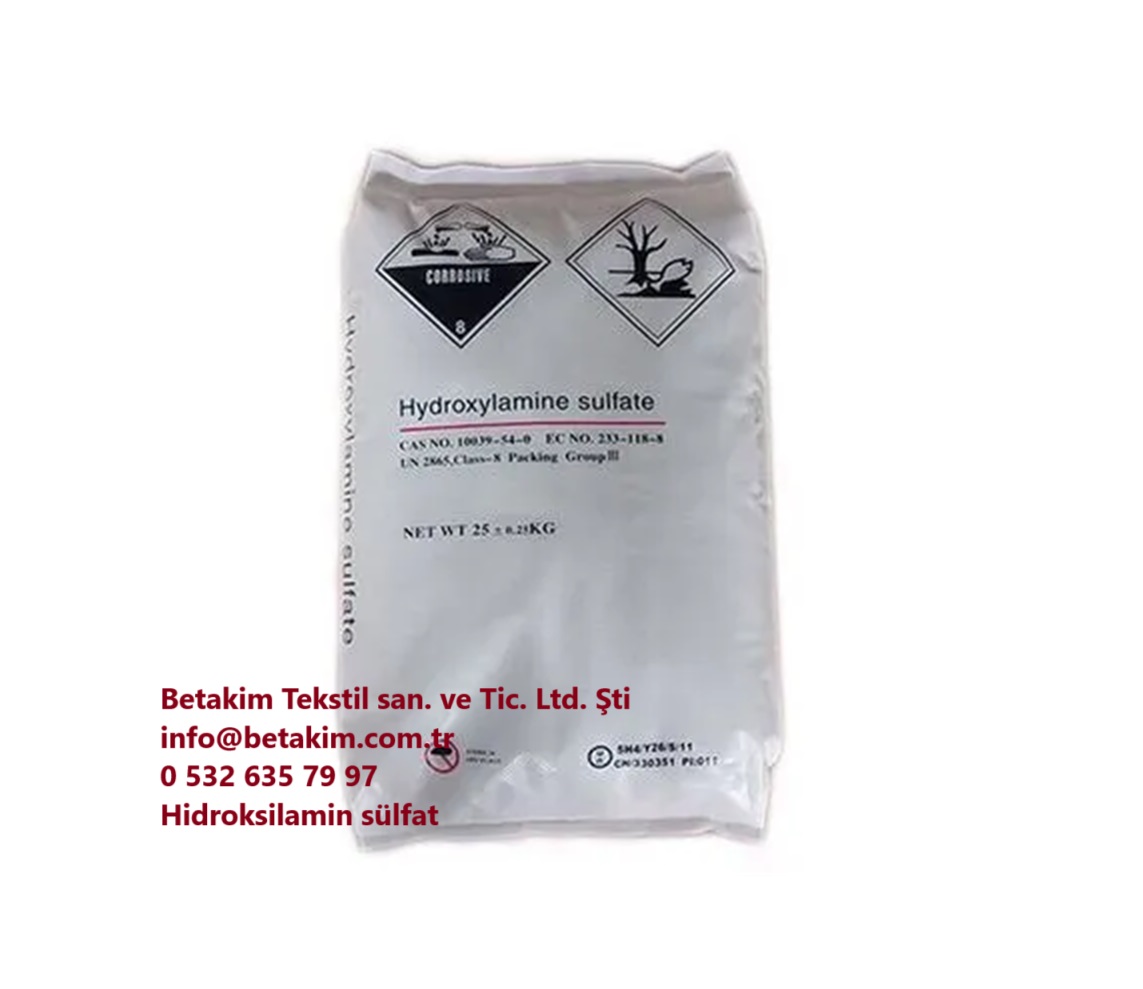
| Packaging Options | 25 kg bag, 25 kg drum, 500 kg FIBC, 1000 kg FIBC |
Handling Notes:
-
Add slowly to cold or lukewarm water; NEVER add to hot water or directly to alkali solutions
-
Slight heat is released during dissolution; add while stirring
-
Concentrated solutions (>25%) should not be stored for long periods (may decompose)
-
Explosion-proof electrical installation and temperature monitoring recommended for large quantities
-
Begins to decompose rapidly above 120°C; operate below 100°C for long-term heating processes
-
Take precautions against pressure build-up in closed systems
9. SAFETY AND HEALTH INFORMATION (GHS CLASSIFICATION)
| Hazard Class | Category |
|---|---|
| Acute Toxicity (Oral) | Category 4 (H302) |
| Acute Toxicity (Inhalation) | Category 4 (H332) |
| Skin Irritation | Category 2 (H315) |
| Eye Irritation | Category 2 (H319) |
| Skin Sensitization | Category 1 (H317) |
| Target Organ Toxicity (Single exposure) | Category 3 (H335) |
| Acute Aquatic Toxicity | Category 1 (H400) |
| Chronic Aquatic Toxicity | Category 1 (H410) |
10. HAZARD STATEMENTS (H-CODES)
| Code | Statement |
|---|---|
| H302 | Harmful if swallowed |
| H315 | Causes skin irritation |
| H317 | May cause an allergic skin reaction |
| H319 | Causes serious eye irritation |
| H332 | Harmful if inhaled |
| H335 | May cause respiratory irritation |
| H400 | Very toxic to aquatic life |
| H410 | Very toxic to aquatic life with long lasting effects |
11. SAFETY STATEMENTS (P-CODES)
| Code | Statement |
|---|---|
| P261 | Avoid breathing dust/fumes |
| P280 | Wear protective gloves, protective clothing, eye protection |
| P301+P312 | IF SWALLOWED: Call a POISON CENTER or doctor if you feel unwell |
| P302+P352 | IF ON SKIN: Wash with plenty of water |
| P304+P340 | IF INHALED: Remove person to fresh air and keep comfortable for breathing |
| P305+P351+P338 | IF IN EYES: Rinse cautiously with water for several minutes. Remove contact lenses if present and easy to do. Continue rinsing |
| P312 | Call a POISON CENTER or doctor if you feel unwell |
| P333+P313 | If skin irritation or rash occurs: Get medical advice/attention |
| P337+P313 | If eye irritation persists: Get medical advice/attention |
12. TOXICOLOGICAL INFORMATION
| Parameter | Value |
|---|---|
| Oral LD50 (rat) | ~800-1200 mg/kg |
| Dermal LD50 (rabbit) | >2000 mg/kg |
| Inhalation LC50 (rat) | >0.5 mg/L (4 hours) |
| Skin Irritation | Irritating |
| Eye Irritation | Irritating |
| Skin Sensitization | May be sensitizing |
| Mutagenicity | Limited evidence |
| Carcinogenicity | IARC: Not classified |
Health Effects:
| Exposure | Effect |
|---|---|
| Acute (Inhalation) | Respiratory tract irritation, coughing, shortness of breath |
| Acute (Skin Contact) | Redness, irritation, allergic reaction |
| Acute (Eye Contact) | Redness, pain, tearing |
| Acute (Ingestion) | Nausea, vomiting, diarrhea |
| Chronic | Allergic skin reactions |
13. FIRST AID MEASURES
| Exposure Route | Action |
|---|---|
| Inhalation | Remove to fresh air. Give oxygen if breathing difficulty. Seek immediate medical attention. |
| Skin Contact | Remove contaminated clothing. Wash with soap and plenty of water for at least 15 minutes. Seek medical attention. |
| Eye Contact | Rinse immediately with plenty of water for at least 15 minutes. Remove contact lenses. Seek immediate medical attention. |
| Ingestion | Rinse mouth. Do NOT induce vomiting. Drink plenty of water. Seek immediate medical attention. |
14. FIRE FIGHTING MEASURES
| Parameter | Information |
|---|---|
| Fire Hazard | Not combustible, but decomposes when heated |
| Extinguishing Media | Water spray, CO₂, dry chemical powder, foam |
| Special Hazards | Thermal decomposition produces toxic gases (nitrogen oxides, sulfur oxides) |
| Protective Equipment | Self-contained breathing apparatus (SCBA), full protective clothing |
15. ENVIRONMENTAL INFORMATION
| Parameter | Information |
|---|---|
| Aquatic Toxicity | Very toxic to aquatic life (H400, H410) |
| Biodegradability | Biodegradable |
| Bioaccumulation | Low potential |
| Mobility in Water | High (very soluble) |
| Waste Disposal | Dispose according to local regulations. Dilute solutions can be slowly inactivated with sodium hypochlorite or hydrogen peroxide in acidic medium. Do not discharge directly to sewers. |
16. TRANSPORT INFORMATION
| Parameter | Information |
|---|---|
| UN Number | 2865 |
| Hazard Class | 8 (Corrosive substance) |
| Packing Group | III |
| Proper Shipping Name | HYDROXYLAMINE SULFATE |
| Marine Pollutant | Yes |
| ADR/RID Label | 8 |
| EMS | F-A, S-B |
17. REGULATORY INFORMATION
| Region | Status |
|---|---|
| EU | REACH registered; approved for industrial use |
| Türkiye (KKDİK) | Mandatory compliance; registration required |
| USA (TSCA) | Listed |
| Canada (DSL) | Listed |
| Australia (AICS) | Listed |
| Japan (ENCS) | Listed |
| Korea (KECL) | Listed |
| China (IECSC) | Listed |
18. OTHER NAMES AND SYNONYMS
| Name |
|---|
| Hydroxylammonium Sulfate |
| Hydroxyl Ammonium Sulfate |
| Oxammonium Sulfate |
| Bis(hydroxylammonium) sulfate |
| Hydroxyazanium Sulfate |
| HAS (BASF trade abbreviation) |
Database Identifiers:
| Database | Identifier |
|---|---|
| CAS | 10039-54-0 |
| EC | 233-118-8 |
| MDL | MFCD00044858 |
| PubChem CID | 25006 |
| RTECS | NC5425000 |
| UN | 2865 |
| Beilstein | 6015848 |
19. FREQUENTLY ASKED QUESTIONS (FAQ)
Q1. How should hydroxylamine sulfate be stored safely?
Store in a cool, dry, well-ventilated area below 25°C, away from direct sunlight. Do not store with alkalis, strong oxidizers, metal dusts, or combustible materials. Keep containers tightly closed. Explosion-proof electrical installation and temperature monitoring are recommended for large quantities.
Q2. What should be considered when preparing solutions?
Add slowly to cold or lukewarm water; NEVER add to hot water or directly to alkali solutions. Slight heat is released during dissolution; add while stirring. Concentrated solutions (>25%) should not be stored for long periods as they may begin to decompose.
Q3. Which materials are incompatible with HAS?
Strong alkalis (NaOH, KOH), strong oxidizers (nitric acid, peroxides, perchlorates, chlorates), iron and copper salts, hot surfaces. Contact with alkalis forms free hydroxylamine, which is highly unstable and can explode.
Q4. How should waste be disposed of?
Dispose at a chemical waste treatment facility in accordance with local regulations. Dilute solutions can be slowly inactivated with sodium hypochlorite or hydrogen peroxide in acidic medium. Do not discharge directly to sewers.
Q5. What to do in case of skin or eye contact?
Skin contact: Wash with plenty of soap and water. Eye contact: Rinse immediately with plenty of water for at least 15 minutes with eyelids open and seek immediate medical attention. The slightly acidic and reducing nature may cause irritation to sensitive tissues.
Q6. What is the shelf life of hydroxylamine sulfate?
12-24 months under recommended storage conditions in unopened original packaging. Acidity may increase slightly over time due to gradual decomposition. Periodic purity analysis is recommended.
Q7. Why is the sulfate salt preferred over hydroxylamine hydrochloride?
HAS is preferred when chloride ions adversely affect the process (stainless steel corrosion, chloride-sensitive catalysts, purity requirements in pharmaceutical synthesis). It is also generally more economical than the hydrochloride salt.
Q8. What concentration of aqueous solution is ideal for general use?
10-20% stock solutions are common for general use. More concentrated solutions should be used within a short period. The saturation limit at 20°C is approximately 37% (58.7 g/100 mL), but precipitation and viscosity issues may occur at this concentration.
Q9. What is the maximum temperature for processes requiring heating?
HAS begins to decompose rapidly above 120°C. Therefore, it is recommended to operate below 100°C for processes requiring prolonged heating. Take precautions against pressure build-up in closed systems.
Q10. What is the role of HAS in analytical chemistry?
HAS is used in qualitative/quantitative determination of aldehydes and ketones through its oxime-forming capacity. It is also used in gravimetric determination of some metal ions (e.g., silver, mercury) by reduction to elemental form.
20. SUMMARY AND IMPORTANT WARNINGS
SUMMARY:
Hydroxylamine sulfate (HAS, (NH₂OH)₂·H₂SO₄, CAS 10039-54-0) is a white, slightly hygroscopic crystalline solid. It has high water solubility (58.7 g/100 mL at 20°C) and a slightly acidic character (pH ~3.6 in 1% solution). It possesses unique chemical reactivity as both a strong reducing agent and a nucleophilic aminohydroxy source. Major applications include organic synthesis (oxime, hydroxamic acid, and N-hydroxy intermediate production); polymer and rubber industry (shortstopper and antioxidant); textile industry (peroxide neutralization); metal surface treatment (oxide removal and corrosion inhibition); agrochemical and pharmaceutical synthesis (intermediates); water treatment; and soap/cosmetic applications.
Key Properties:
| Property | Value |
|---|---|
| Appearance | White, slightly hygroscopic crystalline solid |
| Chemical Formula | (NH₂OH)₂·H₂SO₄ or H₈N₂O₆S |
| Molecular Weight | 164.13 g/mol |
| Melting Point | ~170°C (decomposes) |
| Density | 1.88 g/cm³ (20°C) |
| Water Solubility | 58.7 g/100 mL (20°C) |
| pH (1% solution) | ~3.6 |
| Shelf Life | 12-24 months |
| Primary Use | Oxime synthesis, polymer, textile, metal treatment |
Main Application Areas:
| Industry | Applications |
|---|---|
| Organic Synthesis | Oximes, hydroxamic acids, N-hydroxy intermediates |
| Polymer and Rubber | Shortstopper, color stabilizer, antioxidant |
| Textile | Peroxide neutralization, whiteness stabilization |
| Metal Treatment | Oxide removal, corrosion inhibitor |
| Agrochemicals | Pesticide intermediate (oxime ether derivatives) |
| Pharmaceuticals | Pharmaceutical intermediate, antibiotic modification |
| Water Treatment | Heavy metal reduction and precipitation |
| Soap and Cosmetics | Color stabilizer, antioxidant |
| Photography | Color stabilizer, antioxidant |
Key Safety Points:
-
IRRITANT: Causes skin and eye irritation (H315, H319)
-
ALLERGIC REACTION: May cause allergic skin reaction (H317)
-
HARMFUL: Harmful if swallowed or inhaled (H302, H332)
-
ENVIRONMENTAL TOXICITY: Very toxic to aquatic life (H400, H410)
-
EXPLOSION RISK WITH ALKALIS: Contact with alkalis forms explosive free hydroxylamine
-
THERMAL DECOMPOSITION: Decomposes above 120°C; strong exothermic decomposition at 138-177°C
-
USE PPE: Gloves, safety goggles, dust mask
-
STORAGE: Below 25°C, dry, away from alkalis and oxidizers
IMPORTANT WARNINGS:
Reaction with Alkalis (EXPLOSION RISK): Hydroxylamine sulfate forms free hydroxylamine (NH₂OH) when in contact with alkalis (NaOH, KOH). Free hydroxylamine is highly unstable and can lead to explosive reactions. NEVER mix with alkalis or store in alkaline environments.
Thermal Stability: HAS begins to decompose rapidly above 120°C. Strong exothermic decomposition occurs in the range of 138-177°C. Therefore, operate below 100°C for processes requiring prolonged heating. Take precautions against pressure build-up in closed systems.
Interaction with Metal Ions: Decomposition accelerates in the presence of metal ions such as iron and copper. Use stainless steel or plastic containers to prevent corrosion of metal equipment. HAS is preferred over the hydrochloride salt in chloride-sensitive environments.
Oxime Synthesis: HAS reacts with aldehydes and ketones to form oximes. This reaction is widely used for purification and derivatization of carbonyl compounds. Typical stoichiometry uses 1.0-1.2 equivalents of HAS per aldehyde/ketone.
Shortstopper: In emulsion polymerization (especially SBR production), HAS is an effective shortstopper for terminating radical reactions. It is dosed when polymerization reaches 60-65% conversion.
Peroxide Neutralization: In the textile industry, residual peroxide remaining on fabric after bleaching is neutralized with HAS. This process stabilizes whiteness and prevents damage during further processing. Typical conditions: 2 g/L HAS, 50°C, 15-20 minutes.
Hydroxylamine Hydrochloride vs Sulfate: HAS is preferred over the hydrochloride salt when chloride ions adversely affect the process (stainless steel corrosion, chloride-sensitive catalysts, purity requirements in pharmaceutical synthesis). It is also generally more economical.
Safe Alternative to Hydrazine: HAS is a much safer reducing agent compared to hydrazine sulfate. While hydrazine is a suspected carcinogen with volatile vapor risks, HAS can be used safely in solid form. However, HAS is not as strong a reducing agent as hydrazine; selection should be based on application.
Solution Preparation: HAS releases slight heat when dissolved in water. Always add slowly to cold or lukewarm water; never add to hot water or directly to alkali solutions. Concentrated solutions (>25%) should not be stored for long periods as decomposition may occur.
Chloride-Free Reducing Agent: HAS is a chloride-free reducing agent and hydroxyl source. This property provides a major advantage in reactions with chloride sensitivity (e.g., in stainless steel reactors or with chloride-sensitive catalysts).
Important Disclaimer: This Technical Data Sheet (TDS) is for informational purposes only. For complete safety, handling, storage, and regulatory compliance information, always refer to the official Safety Data Sheet (SDS) provided by the manufacturer/supplier. Strongly avoid contact with alkalis and high temperatures when working with HAS.