We unleash your business potential by maximize the business innovation.
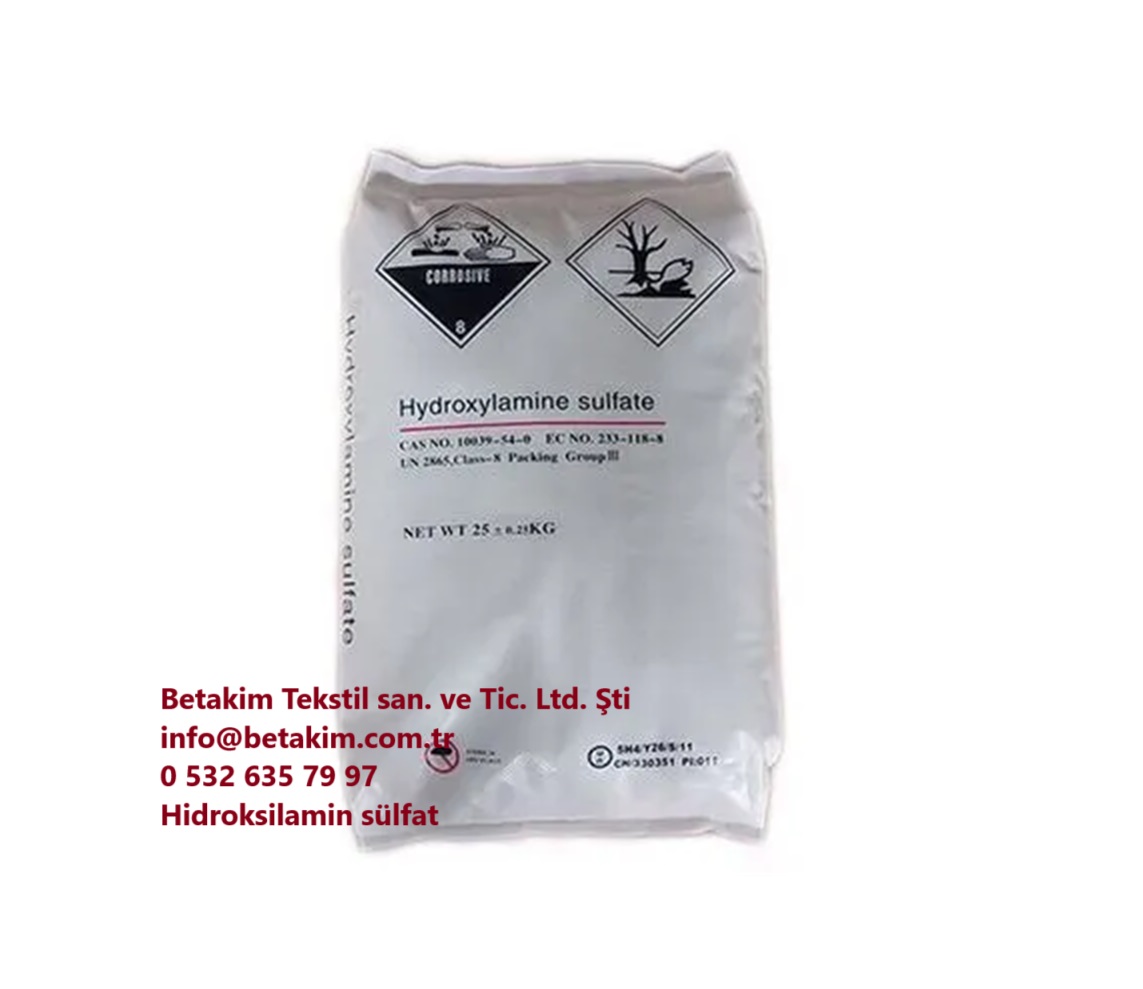
Send EmailHydroxylamine Sulfate, Hydroxylammonium Sulfate, Hydroxyazanium Sulfate, Oxammonium Sulfate, HAS, 10039-54-0
HYDROXYLAMINE SULFATE
1. PRODUCT DEFINITION AND CHEMICAL IDENTITY
Chemical Name: Hydroxylammonium sulfate
Common Name: Hydroxylamine sulfate
CAS Number: 10039-54-0
Molecular Formula: (NH₂OH)₂·H₂SO₄ or H₈N₂O₆S
Molecular Weight: 164.13 g/mol
Appearance: White, slightly hygroscopic crystalline solid
Purity: Typically ≥99.0% (available in industrial and analytical grades)
2. PHYSICAL AND CHEMICAL PROPERTIES
Melting Point: Approximately 170 °C (with decomposition)
Density: 1.88 g/cm³ (at 20 °C)
Solubility in Water: 58.7 g/100 mL (at 20 °C); higher in warm water
Solubility (other): Slightly soluble or insoluble in ethanol, ether, and organic solvents.
pH (1% aqueous solution, 20 °C): ~3.6
Apparent Decomposition Onset: Above 120 °C; strong exothermic decomposition in the range of 138–177 °C.
Stability: Stable under normal conditions. Decomposes rapidly on contact with alkalis, strong oxidizers, and heat. In the presence of alkali, the release of free hydroxylamine can lead to explosive reactions.
Reactivity: Does not react with sulfuric acid; however, concentrated bases liberate free hydroxylamine. Decomposition is accelerated in the presence of metal ions such as iron and copper.
3. OTHER NAMES AND SYNONYMS
-
Hydroxylamine sulfate
-
Hydroxylammonium sulfate
-
Bis(hydroxylammonium) sulfate
-
Oxammonium sulfate
-
Hydroxyazanium sulfate
-
HAS (A common commercial abbreviation, e.g., by BASF)
4. INDUSTRIAL APPLICATIONS, USAGE RATES, AND EXAMPLE FORMULATIONS
4.1. Organic Synthesis and Pharmaceutical Intermediates
Purpose: Used as a reducing agent and a hydroxyl-source in the synthesis of oximes, hydroxamic acids, and N-hydroxy intermediates. Also used for aldehyde/ketone purification via oxime formation.
Usage Rate: Depends on reaction stoichiometry; typically 1.0–1.2 equivalents of HAS per aldehyde/ketone group. Example: For 1 mol of benzaldehyde, approximately 1.05 mol of HAS (approx. 172 g) is used with a suitable base.
Example Formulation (Benzaldoxime Synthesis): Dissolve 100 g of benzaldehyde and 95 g of hydroxylamine sulfate in 250 mL of water. While stirring, slowly add 80 g of a sodium hydroxide solution (40%) at 0–5 °C. React for 2 hours. Yield >90%.
4.2. Polymer and Rubber Industry
Purpose: Used as a shortstopper to terminate radical reactions in emulsion polymerization. Acts as a color stabilizer and antioxidant in synthetic rubber, and as an auxiliary agent in vulcanization accelerator systems.
Usage Rate:
-
Shortstopper for Styrene-Butadiene Rubber (SBR): 0.05–0.2% by weight of monomer.
-
As a color stabilizer/antioxidant: 0.1–0.3% (on solid rubber).
Example Formulation (SBR Shortstopper Solution): Prepare a 10% aqueous HAS solution. When the polymerization reaches 60-65% conversion at the reactor outlet, dose 0.1–0.2 kg of active HAS per 100 kg of dry rubber. The system can be buffered to a pH of 7-8 with dilute ammonia.
4.3. Textile and Fiber Processing
Purpose: Used after bleaching, especially for wool and cotton goods, to remove residual peroxide and stabilize whiteness. Serves as a chlorine-free alternative in anti-chlor treatments.
Usage Rate: 1–3 g/L (depending on bath ratio), at 40–60 °C for 20 minutes.
Example Formulation (Peroxide Neutralization): 2 g/L HAS, 0.5 g/L non-ionic wetting agent, pH adjusted to 4.0–4.5 with acetic acid. Treat fabric at 50 °C for 15–20 minutes, followed by rinsing.
4.4. Metal Surface Treatment and Corrosion Inhibition
Purpose: Used in oxide removal and passivation baths for non-ferrous metals (especially copper alloys). Serves as a corrosion inhibitor in combination with EDTA or other chelating agents. Used as a reducing agent in the precipitation of mercury and silver.
Usage Rate:
-
Copper brightening/oxide removal bath: 5–15 g/L HAS + 20–50 g/L sulfuric acid.
-
Corrosion inhibitor (closed-loop cooling water): 50–200 mg/L HAS, often combined with EDTA at a 1:1 ratio.
Example Formulation (Copper Oxide Removal): 10 g/L HAS, 30 mL/L concentrated sulfuric acid, immerse at 25 °C for 1–5 minutes, then rinse thoroughly with water.
4.5. Photography and Film Industry
Purpose: Used as a color-balancing additive in color photographic emulsions and as an antioxidant/stabilizer in processing bath solutions.
Usage Rate: Typically at levels of 1–5 g/L in developer solutions.
4.6. Agricultural Chemicals and Pharmaceutical Industry
Purpose: A key intermediate in the synthesis of herbicide, insecticide, and fungicide active ingredients, particularly oxime ether-derived pesticides. Also used in the production of veterinary drugs and in side-chain modifications of certain antibiotics.
Usage Rate: Process-specific; generally 1–1.5 equivalents of HAS relative to the substrate in laboratory-scale syntheses.
4.7. Enzyme Reactivation and Biochemistry
Purpose: Serves as a hydroxylamine source in laboratory settings for the reactivation of certain enzymes, such as acetylcholinesterase.
Usage Rate: Typically works within a concentration range of 0.1–1 mM. A 100 mM HAS stock solution is prepared and diluted with an appropriate buffer.
4.8. Water and Wastewater Treatment
Purpose: Can be used as an auxiliary reducing agent to reduce or precipitate heavy metal pollution originating from metal complexes.
Usage Rate: Trials are conducted in the range of 50–500 mg/L, depending on the oxidation-reduction potential (ORP) of the wastewater.
4.9. Soap, Fatty Acids, and Cosmetics
Purpose: Added to soaps and fatty acids as a color stabilizer and antioxidant to delay oxidative rancidity.
Usage Rate: 0.1–0.5% (based on total fatty acid mixture). Added during the refining stage at 60–80 °C.
4.10. Rocket Propellants and Energetic Materials
Purpose: High-purity HAS is a starting material for hydroxylammonium nitrate (HAN), which is used as an oxidizer in solid and liquid rocket propellant formulations. Commercial HAS itself is not used directly.
5. ALTERNATIVE PRODUCTS AND COMPARISON
5.1. Hydroxylamine Hydrochloride (NH₂OH·HCl, CAS: 5470-11-1)
Pros: Much higher water solubility (>80 g/100 mL); preferred in applications where chloride ions do not affect the process. Has a more acidic character (pH ~2.5).
Cons: Chloride ions can cause problems in corrosion-prone environments and chloride-sensitive catalytic reactions. There is a notable risk of stress corrosion cracking on stainless steel equipment.
Comparison with HAS: HAS provides a chloride-free alternative due to its sulfate counter-ion. Its thermal stability is slightly lower than the hydrochloride salt. In organic synthesis, sulfate ions are often inert, making HAS an economical and safe choice.
5.2. Hydroxylamine Phosphate (NH₂OH·H₃PO₄)
Pros: Also a chloride-free option; the phosphate moiety can provide a buffering effect.
Cons: Lower water solubility than HAS; commercial availability is more limited, and cost is generally higher. Thermal stability is similar to HAS.
5.3. Hydrazine Sulfate (N₂H₄·H₂SO₄)
Pros: A powerful reducing agent, widely used as an oxygen scavenger in boiler water chemistry.
Cons: Toxic, a suspected carcinogen, and carries a high risk of forming volatile hydrazine vapor. Its use is subject to very strict regulations. Compared to HAS, it is a far more hazardous reducing agent. HAS is a safer alternative for medium-strength applications.
5.4. Sodium Sulfite / Sodium Bisulfite (Na₂SO₃ / NaHSO₃)
Pros: Inexpensive, abundant, and widely used in food and textiles.
Cons: Operates only as a reducing agent and is not a hydroxylamine source. It cannot participate in reactions like oxime formation. May release sulfur dioxide. Can only replace HAS in some limited antioxidant/reducing agent roles.
5.5. Ascorbic Acid (Vitamin C) and Derivatives
Pros: Non-toxic, environmentally friendly reducing agent. Used as an antioxidant in food and cosmetics.
Cons: Higher price than HAS, with a narrow effective pH range. Cannot provide the specific chemical reactivity (N-OH bond formation) of HAS. Therefore, it is not an alternative in synthetic chemistry.
5.6. Erythorbic Acid and Sodium Erythorbate
Pros: Similar to ascorbic acid; used as a preservative in meat products and a reducing agent in metal chelation.
Cons: Similarly, cannot perform specific hydroxylamine reactions. May only be considered as a HAS substitute in some antioxidant applications.
General Assessment: HAS holds a unique position as both a reducing agent and a nucleophilic aminohydroxy source. The choice of alternative depends entirely on the target application: in reactions with no chloride tolerance, HAS is superior to the hydrochloride; where a milder reducing agent is needed, it is more selective than sulfites; and it is advantageous over hydrazine derivatives in terms of cost and safety.
6. FREQUENTLY ASKED QUESTIONS
Q1. How should hydroxylamine sulfate be stored safely?
It must be kept in a cool, dry, well-ventilated area below 25 °C, away from direct sunlight. Do not store near alkalis, strong oxidizers, metal powders, or combustible materials. Containers must be tightly closed. For bulk quantities, explosion-proof electrical installations and temperature monitoring are recommended.
Q2. What precautions should be taken when preparing a solution?
Add the solid slowly to cold or lukewarm water, never to hot water or directly into alkaline solutions. Slight heat is released during dissolution, so add while stirring. It is not advisable to store concentrated solutions above 25% for long periods, as they may begin to decompose.
Q3. Which materials are incompatible?
Strong alkalis (NaOH, KOH), strong oxidizers (nitric acid, peroxides, perchlorates, chlorates), iron and copper salts, and hot surfaces. Contact with alkali liberates free hydroxylamine, a compound that is highly unstable and can explode.
Q4. How should waste be disposed of?
Dispose of via a licensed chemical waste disposal facility in accordance with local regulations. Dilute solutions can be rendered inert in an acidic medium by slowly adding sodium hypochlorite or hydrogen peroxide. Do not discharge directly into the sewer system.
Q5. What should be done in case of skin or eye contact?
For skin contact, wash with plenty of soap and water. For eye contact, rinse cautiously with water for at least 15 minutes, keeping the eyelids open, and seek immediate medical attention. Its slightly acidic and reducing nature can cause irritation to sensitive tissues.
Q6. What is the shelf life of hydroxylamine sulfate?
Under recommended storage conditions in an unopened original container, the typical shelf life is 12–24 months. It may slowly decompose over time, increasing sulfate acidity. Periodic purity analysis is recommended.
Q7. Why is the sulfate salt preferred over hydroxylamine hydrochloride?
HAS is preferred when chloride ions would negatively impact the process (e.g., stainless steel corrosion, chloride-sensitive catalysts, purity requirements in pharmaceutical synthesis). It is also generally more economical than the hydrochloride salt.
Q8. What is the ideal concentration for an aqueous stock solution?
Stock solutions of 10–20% are common for general use. More concentrated solutions should be used quickly. The saturation limit is about 37% at 20 °C, but precipitation and viscosity issues can occur at this concentration.
Q9. What is the maximum temperature for processes requiring heating?
HAS begins to decompose rapidly above 120 °C. Therefore, for long-duration heating, working below 100 °C is recommended. Precautions must be taken against pressure build-up in closed systems.
Q10. What is the role of HAS in analytical chemistry?
Its capacity to form oximes is utilized in the qualitative and quantitative determination of aldehydes and ketones. It is also used in the gravimetric determination of some metal ions (e.g., silver, mercury) by reducing them to their elemental state.