We unleash your business potential by maximize the business innovation.
Send EmailManganese Sulfate Anhydrous, Manganese Sulphate Monohydrate, Manganese Sulfate Tetrahydrate, 7785-87-7, 10034-96-5, 10101-68-5
MANGANESE SULFATE (MnSO₄)
Manganese(II) Sulfate / Manganous Sulfate
CAS Numbers: 7785-87-7 (Anhydrous), 10034-96-5 (Monohydrate), 10101-68-5 (Tetrahydrate)
EC Number: 232-089-9
1. IDENTIFICATION
| Property | Anhydrous | Monohydrate | Tetrahydrate |
|---|---|---|---|
| Chemical Name | Manganese(II) Sulfate | Manganese(II) Sulfate Monohydrate | Manganese(II) Sulfate Tetrahydrate |
| Synonyms | Manganous sulfate, Manganese sulfate | Manganese sulfate monohydrate | Manganese sulfate tetrahydrate |
| Chemical Formula | MnSO₄ | MnSO₄·H₂O | MnSO₄·4H₂O |
| Molecular Weight | 151.00 g/mol | 169.02 g/mol | 223.06 g/mol |
| CAS Number | 7785-87-7 | 10034-96-5 | 10101-68-5 |
| EC Number (EINECS) | 232-089-9 | 232-089-9 | 232-089-9 |
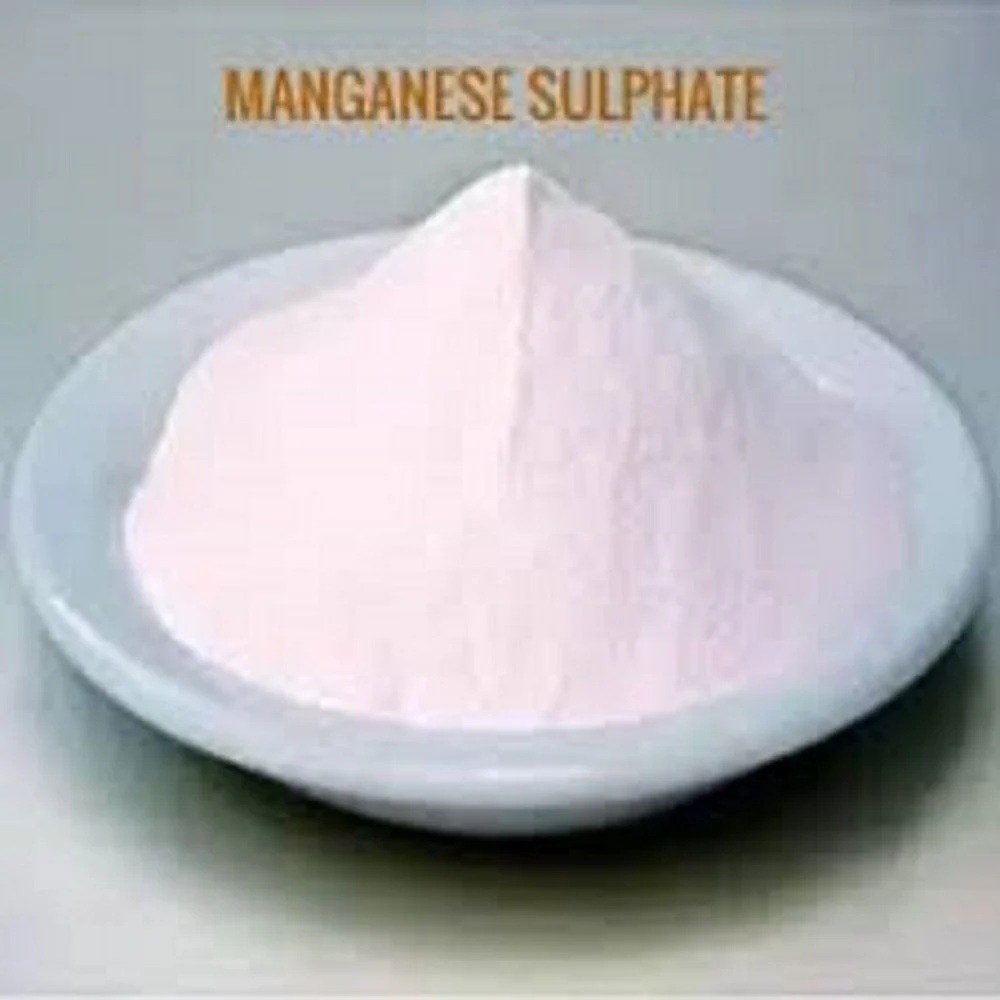
| Appearance | White to pale pink crystals | White to pale pink crystalline powder | Pale pink crystals |
| Odor | Odorless | Odorless | Odorless |
2. PHYSICAL PROPERTIES
| Property | Anhydrous | Monohydrate | Tetrahydrate |
|---|---|---|---|
| Physical State (20°C) | Solid (crystalline powder) | Solid (crystalline powder) | Solid (crystals) |
| Appearance | White to pale pink powder | White to pale pink powder | Pale pink crystals |
| Molecular Weight | 151.00 g/mol | 169.02 g/mol | 223.06 g/mol |
| Density (20°C) | 3.25 g/cm³ | 2.95 g/cm³ | 2.11 g/cm³ |
| Melting Point | 700°C (decomposes) | Decomposes on heating (loses H₂O at 100-125°C) | Decomposes on heating |
| Decomposition Temperature | >700°C (to MnO + SOₓ) | >700°C (to MnO + SOₓ) | >700°C (to MnO + SOₓ) |
| Solubility in Water (20°C) | ~50-70 g/100 mL | ~50-70 g/100 mL | ~50-70 g/100 mL |
| Solubility in Methanol | Slightly soluble | Slightly soluble | Slightly soluble |
| Hygroscopicity | Low to moderate | Low to moderate | Low to moderate |
| pH (5% solution) | 4.5 – 6.5 (slightly acidic) | 4.5 – 6.5 (slightly acidic) | 4.5 – 6.5 (slightly acidic) |
3. CHEMICAL PROPERTIES
| Property | Information |
|---|---|
| Chemical Formula | MnSO₄ (anhydrous basis) |
| Molecular Weight | 151.00 g/mol (anhydrous) |
| Manganese Content (Anhydrous) | ~36.4% Mn |
| Manganese Content (Monohydrate) | ~32.5% Mn |
| Manganese Content (Tetrahydrate) | ~24.6% Mn |
| Oxidation State | Mn(II) – can be oxidized to Mn(III), Mn(IV), Mn(VII) |
| Stability | Stable under normal conditions |
| Thermal Decomposition | MnSO₄ + Heat → MnO + SO₂ + SO₃ (above 700°C) |
| Incompatible Materials | Strong oxidizing agents, alkalis (precipitates Mn(OH)₂), strong reducing agents |
Decomposition Reaction:
MnSO₄ + Heat → MnO + SO₂↑ + SO₃↑ (above 700°C)
4. FORMS & GRADES
| Form | CAS | Purity (Typical) | Primary Applications |
|---|---|---|---|
| Anhydrous (7785-87-7) | 7785-87-7 | ≥ 98% | Laboratory, industrial processes, high-purity applications |
| Monohydrate (10034-96-5) | 10034-96-5 | ≥ 98% | Agriculture (fertilizer), animal feed, battery precursor – most common |
| Tetrahydrate (10101-68-5) | 10101-68-5 | ≥ 98% | Less common; specialty chemical applications |
5. APPLICATIONS
5.1. Agriculture (Micronutrient Fertilizer) – Primary Use
| Application | Function |
|---|---|
| Micronutrient Fertilizer | Provides manganese for plant growth |
| Alkaline Soil Correction | Foliar application corrects manganese deficiency in high-pH soils |
| Foliar Spray | Rapid correction of deficiency symptoms |
| Soil Application | Less effective in alkaline soils (Mn becomes unavailable at high pH) |
| Compatibility | Works well with acidic fertilizers for improved uptake |
Deficiency Symptoms:
-
Interveinal chlorosis (yellowing between veins)
-
Stunted growth
-
Poor seed/fruit development
5.2. Animal Feed (Micronutrient Supplement)
| Application | Function |
|---|---|
| Feed Additive | Provides essential manganese for enzyme function |
| Bone Development | Supports skeletal growth and maintenance |
| Reproduction | Essential for reproductive health in livestock |
| Recommended Dosage | Consult veterinarian or animal nutrition specialist |
5.3. Battery Industry
| Application | Function |
|---|---|
| Li-ion Battery Cathode Precursor | Raw material for NMC (Nickel Manganese Cobalt) cathodes |
| Lithium Manganese Oxide (LMO) Production | MnSO₄ + Li₂CO₃ → LiMn₂O₄ |
| Electrolyte Additive | In some battery formulations |
Reaction for LMO:
2 MnSO₄ + Li₂CO₃ + O₂ → LiMn₂O₄ + 2 SO₃ + CO₂
5.4. Water Treatment
| Application | Function |
|---|---|
| Iron/Manganese Removal | Coagulant aid for removal of iron and manganese from water |
| Oxidation Catalyst | Catalyzes oxidation of dissolved contaminants |
| Scale Control | In some treatment formulations |
Note: Manganese sulfate is not directly used for "water enhancement" but as a treatment chemical for iron/manganese removal.
5.5. Metallurgy & Alloys
| Application | Function |
|---|---|
| Precursor for Manganese Metal | Electrolytic production of manganese metal |
| Alloying Additive (Precursor) | Source of manganese for alloy production |
| Ferromanganese Production | Raw material for ferromanganese smelting (indirect) |
Important Note: In steelmaking, manganese is added as ferromanganese (FeMn) or silico-manganese (SiMn), not as MnSO₄. MnSO₄ is a precursor or intermediate.
5.6. Chemical Industry
| Application | Function |
|---|---|
| Catalyst | Oxidation catalyst in chemical reactions |
| Reagent | Analytical chemistry reagent |
| Pigment Production | Raw material for manganese-based pigments |
| Electrolytic Manganese Dioxide (EMD) | Precursor for battery-grade MnO₂ |
6. SECTORAL SUITABILITY
| Sector | Suitability | Notes |
|---|---|---|
| Agriculture | High | Micronutrient fertilizer for Mn-deficient soils |
| Animal Feed | High | Essential trace mineral supplement |
| Battery Industry | High | Cathode precursor for Li-ion batteries (NMC, LMO) |
| Water Treatment | Medium | Coagulant aid, iron/manganese removal |
| Chemical Industry | Medium | Catalyst, reagent, pigment precursor |
| Metallurgy | Indirect | Precursor only; not used directly in alloys |
| Food / Pharmaceutical | Not suitable | Toxic in high doses; not approved as food additive |
| Environmental | Moderate | Waste management critical; avoid environmental release |
7. QUALITY SPECIFICATIONS (TYPICAL – Monohydrate)
| Parameter | Fertilizer Grade | Feed Grade | Battery Grade |
|---|---|---|---|
| Purity (MnSO₄·H₂O) | ≥ 98.0% | ≥ 98.0% | ≥ 99.5% |
| Manganese (Mn) Content | ≥ 31.5% | ≥ 31.5% | ≥ 32.0% |
| Chlorides (Cl) | ≤ 0.01% | ≤ 0.01% | ≤ 0.005% |
| Iron (Fe) | ≤ 0.01% | ≤ 0.01% | ≤ 0.001% |
| Heavy Metals (as Pb) | ≤ 0.005% | ≤ 0.005% | ≤ 0.001% |
| Arsenic (As) | ≤ 0.0005% | ≤ 0.0005% | ≤ 0.0001% |
| Cadmium (Cd) | – | – | ≤ 0.0001% |
| Water Insolubles | ≤ 0.05% | ≤ 0.05% | ≤ 0.01% |
| pH (5% solution) | 4.5 – 6.5 | 4.5 – 6.5 | 4.5 – 6.5 |
8. STORAGE & HANDLING
| Parameter | Information |
|---|---|
| Storage Conditions | Cool, dry, well-ventilated area |
| Container Requirements | Tightly closed, moisture-proof containers (HDPE, lined drums, plastic bags) |
| Protect From | Moisture, strong oxidizing agents, alkalis |
| Shelf Life | 12-24 months (when stored properly in unopened packaging) |
| Hygroscopicity | Low to moderate; hydrate forms may lose water at high temperatures |
| Incompatible Materials | Strong oxidizing agents, alkalis (precipitates Mn(OH)₂) |
| Packaging Options (Powder) | 25 kg bags, 50 kg drums, 500 kg/1000 kg FIBC (big bags) |
9. SAFETY & HEALTH INFORMATION
GHS Classification
| Hazard Class | Category |
|---|---|
| Acute Toxicity (Oral) | Category 4 (H302) |
| Acute Toxicity (Inhalation) | Category 4 (H332) |
| Specific Target Organ Toxicity (Repeated exposure) | Category 1 (H372) – nervous system |
| Chronic Aquatic Toxicity | Category 2 (H411) |
Hazard Statements (H-Codes)
| Code | Statement |
|---|---|
| H302 | Harmful if swallowed |
| H332 | Harmful if inhaled |
| H372 | Causes damage to organs (nervous system) through prolonged or repeated exposure |
| H411 | Toxic to aquatic life with long-lasting effects |
Precautionary Statements (P-Codes)
| Code | Statement |
|---|---|
| P261 | Avoid breathing dust |
| P264 | Wash thoroughly after handling |
| P270 | Do not eat, drink or smoke when using this product |
| P271 | Use only outdoors or in a well-ventilated area |
| P280 | Wear protective gloves and eye protection |
| P301+P312 | IF SWALLOWED: Call a POISON CENTER if you feel unwell |
| P302+P352 | IF ON SKIN: Wash with plenty of water |
| P305+P351+P338 | IF IN EYES: Rinse cautiously with water for several minutes |
Toxicological Information
| Parameter | Value |
|---|---|
| Oral LD50 (rat) | ~1,500 – 2,000 mg/kg (moderate toxicity) |
| Inhalation LC50 (rat) | Not established |
| Skin Irritation | Mild irritant |
| Eye Irritation | Mild to moderate irritant |
| Chronic Effects | Manganism (neurological disorder) from prolonged high-level exposure |
Health Effects:
-
Acute (Ingestion): Nausea, vomiting, abdominal pain
-
Acute (Inhalation): Respiratory tract irritation
-
Chronic: Prolonged exposure may cause manganism (similar to Parkinson's disease)
First Aid Measures
| Exposure Route | Action |
|---|---|
| Inhalation | Remove to fresh air. Seek medical attention if respiratory irritation occurs. |
| Skin Contact | Wash with plenty of water and soap. Remove contaminated clothing. |
| Eye Contact | Rinse immediately with plenty of water for at least 15 minutes. Seek medical attention. |
| Ingestion | Rinse mouth. Do NOT induce vomiting. Drink water. Seek immediate medical attention. |
Personal Protective Equipment (PPE)
| Equipment | Recommendation |
|---|---|
| Respiratory Protection | Dust mask (N95) when handling powder |
| Hand Protection | Chemical-resistant gloves (nitrile) |
| Eye Protection | Safety glasses with side shields |
| Body Protection | Lab coat or protective clothing |
10. ENVIRONMENTAL INFORMATION
| Parameter | Information |
|---|---|
| Aquatic Toxicity | Toxic to aquatic life with long-lasting effects (H411) |
| Biodegradability | Not applicable (inorganic) |
| Bioaccumulation | Moderate potential |
| Persistence | Inorganic – does not degrade |
| Waste Disposal | Dispose according to local regulations. Do not discharge into natural water bodies. |
11. TRANSPORT INFORMATION
| Parameter | Information |
|---|---|
| UN Number | 3077 (Environmentally hazardous substance, solid, n.o.s.) |
| Hazard Class | 9 (Miscellaneous dangerous goods) |
| Packing Group | III |
| Proper Shipping Name | ENVIRONMENTALLY HAZARDOUS SUBSTANCE, SOLID, N.O.S. (Manganese sulfate) |
| Marine Pollutant | Yes |
| ADR/RID Label | 9 + "Environmentally Hazardous" |
12. REGULATORY INFORMATION
| Region | Status |
|---|---|
| EU | REACH registered |
| Turkey (KKDIK) | Mandatory compliance; requires registration |
| USA (TSCA) | Listed |
| Canada (DSL) | Listed |
| Australia (AICS) | Listed |
| Fertilizer Regulations | Approved as micronutrient in many countries |
| Feed Regulations | Approved as trace mineral in animal feed (EU, USA, Turkey) |
13. COMPARISON OF FORMS
| Property | Anhydrous (7785-87-7) | Monohydrate (10034-96-5) | Tetrahydrate (10101-68-5) |
|---|---|---|---|
| Mn Content | 36.4% | 32.5% | 24.6% |
| Cost per kg Mn | Lowest | Medium | Highest |
| Handling | May cake | Free-flowing | Crystalline |
| Primary Use | Laboratory, high-purity | Agriculture, feed, batteries | Specialty chemicals |
14. SYNONYMS & OTHER NAMES
| Turkish Name | English Name |
|---|---|
| Manganez Sülfat | Manganese Sulfate |
| Mangan Sülfat | Manganese(II) Sulfate |
| Mangan(II) Sülfat | Manganous Sulfate |
| Manganez Sülfat Monohidrat | Manganese Sulfate Monohydrate |
| Susuz Manganez Sülfat | Anhydrous Manganese Sulfate |
Database Identifiers:
-
CAS (Anhydrous): 7785-87-7
-
CAS (Monohydrate): 10034-96-5
-
CAS (Tetrahydrate): 10101-68-5
-
EC: 232-089-9
-
MDL: MFCD00011112
-
PubChem CID: 24580 (anhydrous)
-
RTECS: OP0893500
15. SUMMARY
Manganese Sulfate (MnSO₄, CAS 7785-87-7, 10034-96-5, 10101-68-5) is the most common salt of manganese(II). It is a white to pale pink crystalline solid, soluble in water, and slightly acidic. The monohydrate form (MnSO₄·H₂O) is the most commercially important.
Key Features:
| Feature | Value |
|---|---|
| Appearance | White to pale pink powder/crystals |
| Molecular Weight (Anhydrous) | 151.00 g/mol |
| Density (Anhydrous) | 3.25 g/cm³ |
| Mn Content (Anhydrous) | 36.4% |
| Solubility | ~50-70 g/100 mL water |
Main Application Areas:
| Sector | Applications |
|---|---|
| Agriculture | Micronutrient fertilizer (foliar spray, soil application) |
| Animal Feed | Trace mineral supplement |
| Battery Industry | Cathode precursor for NMC, LMO (Li-ion batteries) |
| Water Treatment | Coagulant aid, iron/manganese removal |
| Chemical Industry | Catalyst, reagent, pigment precursor |
Key Safety Points:
-
HARMFUL – If swallowed or inhaled
-
NEUROTOXIC – Chronic exposure may cause manganism (Parkinson-like symptoms)
-
ENVIRONMENTAL HAZARD – Toxic to aquatic life
-
HANDLE WITH PPE – Use gloves, dust mask, goggles
-
NOT FOR FOOD – Not approved as food additive
16. IMPORTANT NOTES
-
Most Common Form – Monohydrate: The monohydrate form (MnSO₄·H₂O, CAS 10034-96-5) is the most widely used commercial form for agriculture, animal feed, and battery precursor applications. The anhydrous form (CAS 7785-87-7) is used primarily for laboratory and high-purity industrial applications.
-
Soil Application vs Foliar Spray: In alkaline (calcareous) soils, manganese becomes unavailable to plants. Soil application of manganese sulfate is less effective; foliar spray is the preferred method for rapid correction of deficiency.
-
Battery Industry Growth: Manganese sulfate is a critical precursor for NMC (Nickel Manganese Cobalt) and LMO (Lithium Manganese Oxide) cathodes in lithium-ion batteries. Demand is growing rapidly with electric vehicle adoption.
-
Manganism (Chronic Toxicity): Prolonged inhalation of manganese dust (over years) can cause manganism – a neurological disorder similar to Parkinson's disease. Use adequate ventilation and dust control.
-
Thermal Decomposition: When heated above 700°C, manganese sulfate decomposes to manganese oxide (MnO) and releases toxic sulfur dioxide (SO₂) and sulfur trioxide (SO₃) gases.
-
Not for Steelmaking Directly: In steel production, manganese is added as ferromanganese (FeMn) or silico-manganese (SiMn), not as MnSO₄. MnSO₄ is a precursor or intermediate in manganese metal production.
-
Animal Feed Dosage: Manganese is an essential trace mineral, but excessive doses are toxic. Always consult a veterinarian or animal nutrition specialist for proper dosage.
-
Compatibility with Alkalis: When mixed with alkaline solutions (e.g., lime, caustic soda), manganese sulfate precipitates as manganese hydroxide [Mn(OH)₂]. Avoid mixing with alkalis unless precipitation is intended.
-
Water Treatment Clarification: In water treatment, manganese sulfate is used as a coagulant aid for iron and manganese removal – not as a "water enhancer" for drinking water.
-
Environmental Release: Manganese sulfate is toxic to aquatic life. Avoid release to natural water bodies. Spent solutions should be treated before disposal.
Important Disclaimer: This Technical Data Sheet (TDS) is for informational purposes only. For complete safety, handling, storage, and regulatory compliance information, always refer to the official Safety Data Sheet (SDS) provided by the manufacturer/supplier.