We unleash your business potential by maximize the business innovation.
Send EmailSodium Lauryl Sulfate, Monododecyl Sodium Sulfate, Sodium Monolauryl Sulfate, Sodium Dodecyl Sulfate, Sodium Dodecane Sulfate, SDS, SLS, 151-21-3, 12765-21-8, 12738-53-3 ,1334-67-4
Product Name: Sodium Dodecyl Sulfate (SLS) Powder
1. CHEMICAL IDENTIFICATION
| Property | Value |
|---|---|
| Chemical Name | Sodium dodecyl sulfate |
| Synonyms | Sodium lauryl sulfate, Dodecyl sulfate sodium salt, Lauryl sodium sulfate, Monododecyl sodium sulfate, Lauryl sulfuric acid sodium salt, SLS |
| CAS Number | 151-21-3 |
| Molecular Formula | C₁₂H₂₅O₄SNa |
| Molecular Weight | 288.38 g/mol |
| Structural Description | Anionic surfactant of organic origin, derived from coconut kernel or palm kernel oil. It belongs to the alcohol sulfate family and is a primary alkyl sulfate that can be composed of a mixture of sodium alkyl sulfate and lauryl components. |
2. PHYSICAL AND CHEMICAL PROPERTIES
| Property | Value / Description |
|---|---|
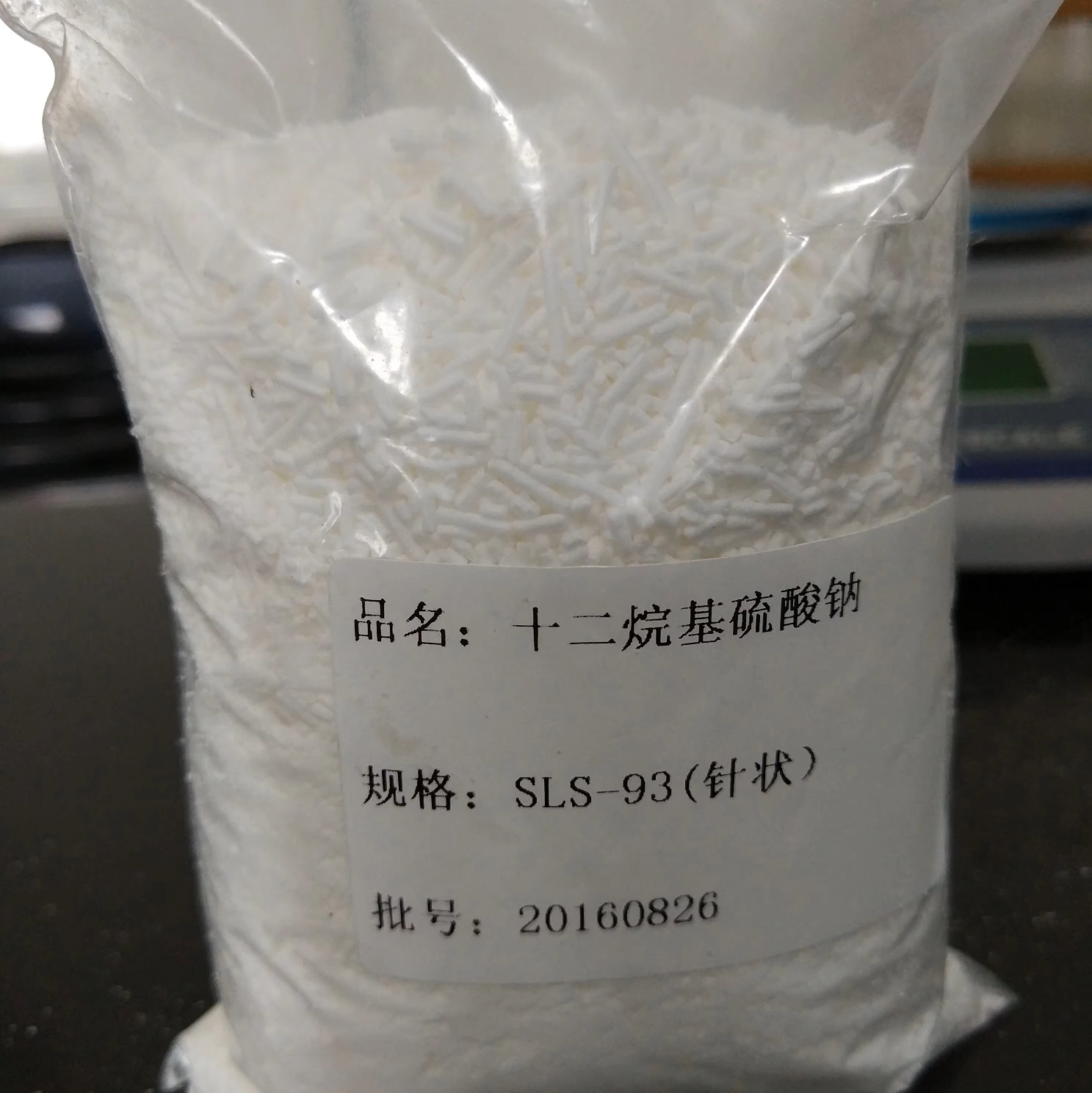
| Physical Appearance | White powder or slightly yellowish crystalline solid |
| Odor | Slight characteristic odor |
| Melting Point | 205.5 °C |
| Density | ~1.6 g/cm³ |
| Solubility (20 °C) | ~15 g / 100 ml water (moderately soluble) |
| pH (1% solution) | Typically 7 – 10 (depending on product specification) |
| Stability | Stable under normal conditions |
| Surface Activity | Effectively reduces surface tension; excellent foaming, wetting and emulsifying ability |
3. TYPICAL APPLICATIONS
-
Personal Care & Cosmetics: Primary surfactant in products such as shampoos, toothpastes and shaving foams.
-
Detergents & Cleaning Products: Acts as an emulsifying, wetting and foaming agent; used to reduce surface tension in formulations containing LABSA.
-
Leather Industry: Leather softening agent.
-
Paper Industry: Penetrating (wetting) agent.
-
Textile Industry: Wetting agent.
-
Metal & Mining: Flotation chemical in metal extraction and refining; additive in nickel and zinc electroplating baths.
-
Paints & Varnishes: Used in the manufacture of paint and varnish strippers.
-
Laboratory Applications: Electrophoretic separation (especially important in lipid analysis).
4. PACKAGING AND STORAGE
-
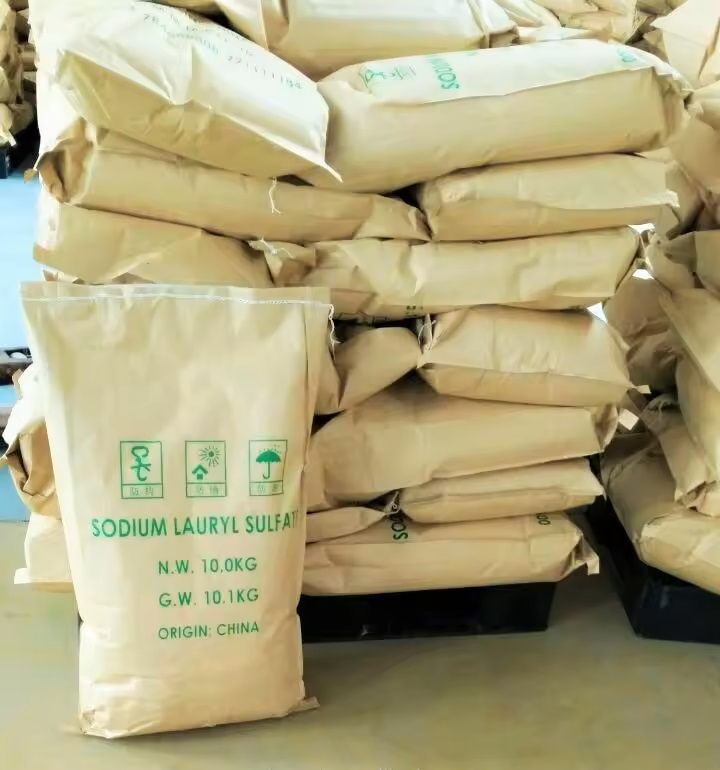
Packaging: 25 kg kraft bags with PE liner, or big bags according to customer request.
-
Storage Conditions: Store in a cool, dry, well-ventilated area away from direct sunlight and moisture. Keep container tightly closed in the original packaging.
-
Shelf Life: At least 24 months from the date of production under proper storage conditions.
5. SAFETY AND HANDLING PRECAUTIONS
-
When handling the powder form, use adequate ventilation and a dust mask to avoid inhalation of dust.
-
Avoid contact with skin and eyes; wear protective gloves and safety goggles.
-
For detailed information, refer to the Safety Data Sheet (SDS).
6. REFERENCE COMMERCIAL PRODUCTS (BASF)
Below are some commercial BASF products with similar alcohol sulfate chemistry, provided for information. The closest match for SLS powder is Agnique® SLS 90 P.
| Trade Name | Chemical Description | Form | Active Content (approx.) |
|---|---|---|---|
| Agnique® SLS 90 P | Sodium dodecyl sulfate (C12) | Powder | ~100% |
| Disponil® SDS 15 EVO | Sodium lauryl sulfate (C12) | Liquid | ~15% |
| Disponil® SDS 30 EVO | Sodium lauryl sulfate (C12) | Liquid | ~30% |
| Disponil® SDS G | Sodium lauryl sulfate (C12) | Solid (granules) | ~97% |
| Disponil® SLS 101 Spec EVO | Sodium C12-C16 alkyl sulfate | Liquid | ~30% |
Disclaimer: This technical data sheet has been prepared for general information purposes based on available knowledge and data. For exact specifications and confirmation of suitability, the manufacturer's original documentation should be consulted.
SODIUM DODECYL SULFATE (SLS) POWDER
APPLICATION RECIPES, FREQUENTLY ASKED QUESTIONS, ALTERNATIVES, OTHER NAMES, SECTORAL APPLICATION TABLE AND COMPARISONS
1. APPLICATION RECIPES
These recipes are typical starting-point formulations. Usage rates can be optimized based on final product performance targets. All percentages are by weight (% w/w).
A. Liquid Shampoo (Clear, Sulfate-Based)
| Ingredient | Function | Rate (%) |
|---|---|---|
| Water (Deionized) | Solvent | q.s. (approx. 50-55%) |
| SLS Powder (e.g., Agnique® SLS 90 P) | Primary surfactant, foaming, cleansing | 8 – 12 |
| Cocamidopropyl Betaine (CAPB) | Co-surfactant, foam booster, mildness | 3 – 5 |
| Coconut Fatty Acid Diethanolamide (CDEA) | Thickener, foam stabilizer | 1 – 2 |
| Sodium Chloride (Salt) | Viscosity modifier | 0.5 – 1.5 |
| Preservative (e.g., Sodium Benzoate) | Preservation | 0.5 |
| Citric Acid | pH adjuster (pH 5.5 – 6.5) | q.s. |
| Fragrance & Dye | Aesthetics | q.s. |
*Note: SLS powder is added slowly to the water phase and stirred until completely dissolved. A warm process (40-50°C) accelerates dissolution.*
B. Toothpaste (Opaque, Fluoride)
| Ingredient | Function | Rate (%) |
|---|---|---|
| Sorbitol (70% solution) | Humectant, sweetener | 25 – 35 |
| Water (Deionized) | Solvent | 15 – 20 |
| Hydrated Silica | Abrasive, thickener | 18 – 22 |
| SLS Powder | Foaming agent, surfactant | 1.5 – 2.0 |
| Xanthan Gum / Carbomer | Binder, stabilizer | 0.5 – 1.2 |
| Sodium Saccharin | Sweetener | 0.2 – 0.3 |
| Sodium Fluoride | Active (anti-cavity) | 0.32 |
| Titanium Dioxide | Opacifier | 0.5 – 1.0 |
| Flavoring | Mint etc. | 1 – 1.5 |
| Sodium Benzoate | Preservative | 0.2 |
Note: SLS is critical for foaming performance, but for those with oral mucosa sensitivity, alternative sulfate-free formulations (e.g., sodium cocoyl glutamate) may be considered.
C. Powder Laundry Detergent
| Ingredient | Function | Rate (%) |
|---|---|---|
| Soda Ash (Sodium Carbonate) | Builder, water softener | 30 – 40 |
| Sodium Percarbonate / Perborate | Bleaching agent | 10 – 15 |
| LABSA (Linear Alkyl Benzene Sulfonic Acid) – neutralized with soda ash | Primary anionic surfactant | 10 – 15 |
| SLS Powder | Co-surfactant, quick foam, wetting | 3 – 7 |
| Sodium Silicate | Corrosion inhibitor, powder structurant | 5 – 8 |
| Filler (Sodium Sulfate) | Filler | q.s. to 100% |
| Carboxymethyl Cellulose (CMC) | Anti-redeposition agent | 1 – 2 |
| Optical Brightener, Enzyme, Fragrance | Performance/Aesthetics | q.s. |
Note: In LABSA-based powder detergents, SLS reduces surface tension, especially boosting wetting and foaming speed in cold water.
D. Liquid Hand Soap
| Ingredient | Function | Rate (%) |
|---|---|---|
| Water | Solvent | q.s. (~70%) |
| SLS Powder | Primary cleanser, foaming | 5 – 8 |
| Cocamidopropyl Betaine | Mildness, foam | 3 – 5 |
| Glycerin | Humectant | 1 – 2 |
| Salt | Viscosity | 0.5 – 2 |
| Preservative, Fragrance, pH adjuster | q.s. |
2. FREQUENTLY ASKED QUESTIONS (FAQ)
Q1: Is SLS an organic product?
No, it is a chemical compound. However, its raw material is of natural origin. SLS is produced by sulfation of lauryl alcohol derived from coconut kernel or palm kernel oil. Therefore, it is classified as a plant-based or naturally derived surfactant.
Q2: What is the difference between SLS and Sodium Lauryl Ether Sulfate (SLES)?
SLS is a non-ethoxylated alcohol sulfate (1 mol fatty alcohol : 1 mol sulfate). SLES is produced by reacting the alcohol with ethylene oxide (ethoxylation) prior to sulfation.
-
SLS: Stronger cleaning, more foam, can be slightly harsher on skin. Stable at low pH.
-
SLES: Better performance in hard water, less skin irritation, milder feel. Stable at high pH.
Q3: Does SLS cause irritation?
Like all anionic surfactants, at high concentrations and prolonged contact there is potential for skin and eye irritation. However, when combined with co-surfactants (e.g., coco betaine) in a formulation, the irritation potential is significantly reduced. In toothpaste, it is used at safe, accepted levels of around 2%.
Q4: Can SLS powder be dissolved in water without heating?
The dissolution rate is slow. At 20°C it has a solubility of 15 g/100 mL. In cold water it may form lumps (fish eyes). Therefore it should be sprinkled slowly into the water phase with rapid agitation, and gentle heating to 40-50°C is the best practice to prevent lumping.
Q5: What is the role of salt in SLS-containing formulations and how much should be used?
Sodium chloride (table salt) increases ionic strength, changes the shape of SLS micelles, and substantially increases the viscosity of the liquid. Typical usage is 0.5% - 2%. Too much salt lowers the viscosity. The optimum point should be found by adding gradually for each batch.
3. OTHER NAMES AND SYNONYMS
SLS powder may be referred to by the following names in different industries and languages. (Note: All refer chemically to the same compound.)
| Name | Context of Use |
|---|---|
| Sodium Lauryl Sulfate | Most common international name |
| SLS | General abbreviation |
| Sodium Dodecyl Sulfate | Systematic chemical name |
| Lauryl Sulfate Sodium Salt | Name emphasizing the salt form |
| Dodecyl Sulfate Sodium Salt | Alternative systematic name |
| Lauryl Sulfuric Acid Sodium Salt | Indicates it is the salt of the acid form |
| Monododecyl Sodium Sulfate | Specifies the mono-alkyl chain |
| Agnique® SLS 90 P | BASF trade name (Powder, ~100% active) |
| Disponil® SDS G | BASF trade name (Granules, ~97% active) |
| Texapon® K 12 P | Another common trade name (BASF/previous nomenclature) |
4. SECTORAL APPLICATION TABLE
The table below summarizes the functional uses of SLS powder by industry, along with typical dosage ranges.
| Industry | Main Function | Specific Application Example | Typical Dosage (% w/w) |
|---|---|---|---|
| Personal Care & Cosmetics | Surfactant, Foaming, Cleansing | Shampoo, liquid soap, toothpaste, shaving cream, bubble bath | 1 – 15 |
| Household & Industrial Cleaning | Wetting, Emulsifying, Foam stabilizer | Powder detergent, liquid dish soap, all-purpose cleaner, surface tension reducer in LABSA formulations | 1 – 15 |
| Textile | Wetting agent, Penetrant, Post-wash softening | Desizing of raw fabric, pre-dye wetting, wool washing, finishing | 0.5 – 3 (depending on bath) |
| Leather | Softener, Rewetting aid | Soft leather processing baths, post-pickling wetting | 0.5 – 2 |
| Paper | Penetrating agent | Added to pulp to increase absorbency | 0.2 – 1 |
| Metallurgy & Mining | Flotation chemical, Brightener | Separation of precious metal ores (flotation); surface tension reducer and brightener in nickel and zinc electroplating baths | 0.1 – 2 |
| Paint & Varnish | Paint stripper surfactant, Wetting | Enhancing penetration in varnish and paint remover formulations | 1 – 5 |
| Laboratory & Biotechnology | Protein denaturation, Lysing agent | SDS-PAGE electrophoresis, lipid separation and cell lysis buffers | 0.1 – 10 (buffer dependent) |
5. ALTERNATIVES AND COMPARISON
This section serves as a guide for formulators wanting to switch to a milder or different surfactant profile.
| Comparison Criterion | SLS (Sodium Lauryl Sulfate) | SLES (Sodium Lauryl Ether Sulfate) | Sodium Cocoyl Isethionate (SCI) | Sodium Cocoyl Glutamate (SCG) |
|---|---|---|---|---|
| Origin | Coconut/palm (sulfated) | Coconut/palm (ethoxylated + sulfated) | Coconut oil + isethionic acid | Coconut oil + glutamic acid |
| Chemical Family | Alkyl Sulfate | Alkyl Ether Sulfate | Alkyl Sulfonate / Acyl Isethionate | Acyl Amino Acid Salt |
| Form | Powder, granule, needle | Usually liquid (28-70% active), paste | Powder, flake, noodle | Usually liquid (25-30%) |
| Sensitivity to Hardness | Sensitive to hard water (calcium salt precipitates) | Hard-water tolerant | Hard-water tolerant | Hard-water tolerant |
| Skin Mildness | Moderate-High (alone) | Low-Moderate | Very Low | Very Low |
| Foam Profile | Abundant, rapid, large bubbles | Rich, creamy, dense | Dense, creamy, silky | Creamy, fine, stable |
| Irritation Potential | Relatively high | Low | Very low | Very low |
| pH Tolerance | Broad, stable at acidic pH (sulfate-free types may hydrolyze at acidic pH) | Broad, stable at alkaline pH | Best at slightly acidic-neutral (pH 5-7) | Best at slightly acidic-neutral (pH 5-7) |
| Price Index (Relative) | 1.0 (Reference) | 1.2 – 1.5 | 3.0 – 4.0 | 5.0 – 7.0 |
| Main Application Area | Economy shampoo, toothpaste, industrial cleaning, detergent | Liquid soap, shower gel, baby shampoo (market standard) | "Sulfate-free" solid shampoos, facial cleansers, luxury/green cosmetics | Premium sulfate-free liquid products, baby, sensitive skin formulations |
6. COMPARISON TABLE: DIFFERENT SLS GRADES (BASF EXAMPLE)
SLS is offered in different physical forms and active matter concentrations. The table below helps the formulator choose the correct physical form.
| Property | Agnique® SLS 90 P | Disponil® SDS 15 EVO | Disponil® SDS 30 EVO | Disponil® SDS G | Disponil® SLS 101 Spec EVO |
|---|---|---|---|---|---|
| Physical Form (20°C) | Powder | Liquid (free-flowing) | Liquid (viscous) | Solid (Granules/Needles) | Liquid (medium viscosity) |
| Active Content (%) | ~100 | ~15 | ~30 | ~97 | ~30 |
| Alkyl Chain Distribution | Mainly C12 (Lauryl) | C12 | C12 | C12 | C12-C16 blend |
| Ease of Use in Production | Moderate (requires powder dissolution, energy cost) | Very Easy (cold process) | Easy (pumpable, cold process) | Moderate-Easy (easily dissolved with low energy) | Easy |
| Storage / Transport | Cheap, non-perishable | Expensive (water shipped), freezing risk | More economical | Cheap, compact | More economical |
| Formulation Suitability | Powder shampoo, toothpaste, dry detergent, electrophoresis | Ready-to-use liquid soap, clear products, ambient temperature processing | Liquid shampoo, bubble bath, concentrated cleaners | Compact detergent, solid cosmetics, automated processes | Low-cost liquid cleaning, industrial detergents |
Disclaimer: The information provided is based on our current knowledge and does not constitute a binding guarantee of product properties. Buyers should determine the suitability of the product for their specific intended use through their own testing. For regulatory compliance and safety precautions, please refer to the product's current Safety Data Sheet (SDS) and official manufacturer documentation.