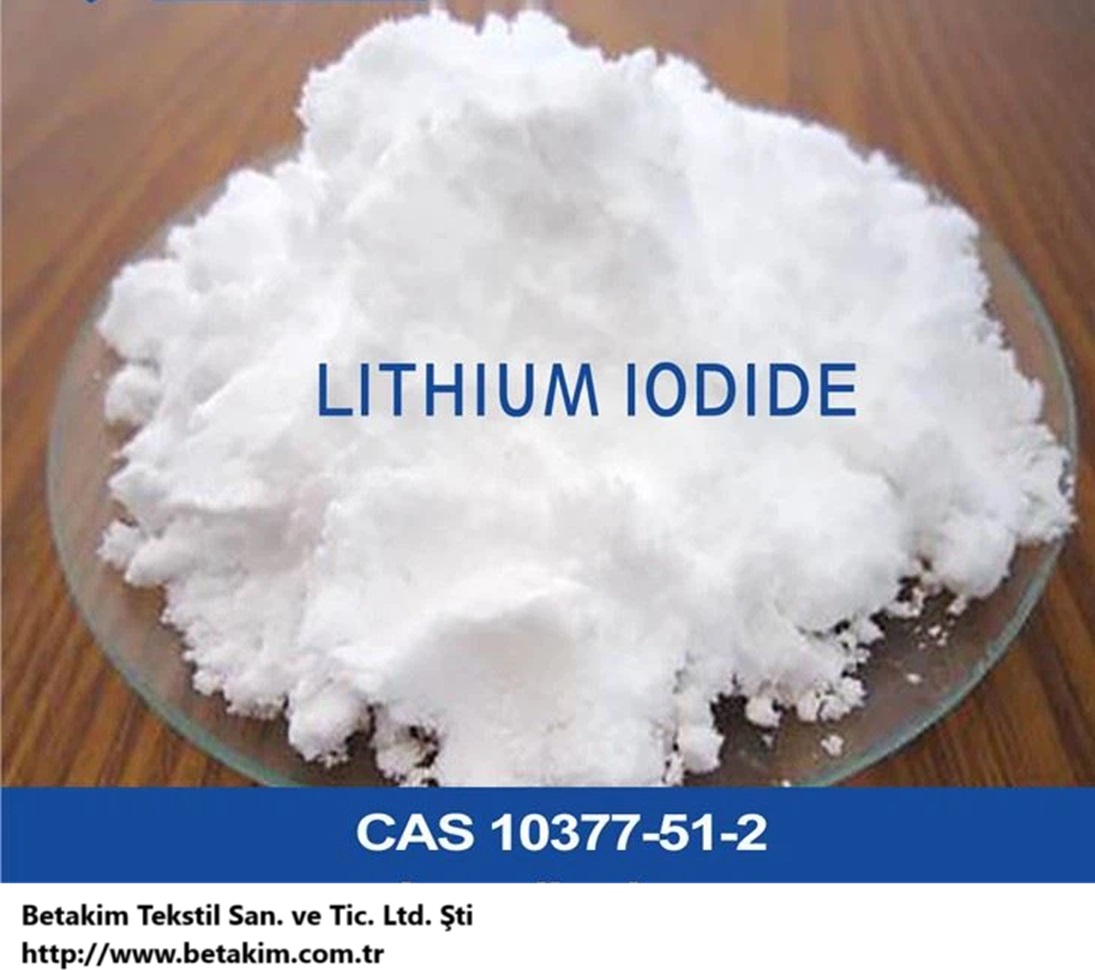
Lithium Iodide, Lithium Monoiodide, Lithium Iodide Anhydrous, 10377-51-2
LITHIUM IODIDE – LİTHIUM IODIDE
1. CHEMICAL IDENTITY AND DEFINITION
| Parameter |
Information |
| Chemical Name (IUPAC) |
Lithium iodide |
| Other Names |
Lithium Monoiodide, Lithium Iodide Anhydrous, Lithium (I) Iodide |
| Chemical Formula |
LiI |
| Molecular Weight |
133.85 g/mol |
| CAS Number |
10377-51-2 |
| EC Number (EINECS) |
233-822-5 |
| Chemical Class |
Inorganic salt (metal halide) |
| Appearance |
White crystalline solid |
| Odor |
Odorless |
| Physical State (20°C) |
Solid (crystalline) |
2. PHYSICAL PROPERTIES
| Property |
Value |
| Appearance |
White crystalline solid |
| Chemical Formula |
LiI |
| Molecular Weight |
133.85 g/mol |
| Density (Anhydrous) |
4.076 g/cm³ |
| Density (Trihydrate) |
3.494 g/cm³ |
| Melting Point |
469 °C |
| Boiling Point |
1,171 °C |
| Solubility in Water |
Very high (freely soluble) |
| Solubility in Ethanol |
High |
| Solubility in Propanol |
High |
| Solubility in Ethanediol |
High |
| Solubility in Ammonia |
High |
| Refractive Index |
~1.955 |
| Crystal Structure |
Cubic (NaCl type) |
3. CHEMICAL PROPERTIES
| Property |
Information |
| Chemical Formula |
LiI |
| Molecular Weight |
133.85 g/mol |
| CAS Number |
10377-51-2 |
| EC Number |
233-822-5 |
| Chemical Class |
Inorganic salt (metal halide) |
| Melting Point |
469 °C |
| Boiling Point |
1,171 °C |
| Solubility in Water |
Very high (~1,500 g/L at 20°C) |
| Solubility in Organic Solvents |
High (ethanol, propanol, glycol, ammonia) |
| Stability |
Hygroscopic; decomposes in light/air |
| Hygroscopicity |
Very high (deliquescent) |
| Oxidation State |
+1 (lithium), -1 (iodide) |
4. CRYSTALLINE FORMS
| Form |
Formula |
Density |
Description |
| Anhydrous |
LiI |
4.076 g/cm³ |
White crystalline solid |
| Monohydrate |
LiI·H₂O |
- |
Hydrated form |
| Trihydrate |
LiI·3H₂O |
3.494 g/cm³ |
Common commercial form |
5. CHEMICAL STRUCTURE
    Li⁺  I⁻

    Ionic crystal structure:
    - Cubic (NaCl-type) crystal lattice
    - Each Li⁺ ion surrounded by 6 I⁻ ions
    - Each I⁻ ion surrounded by 6 Li⁺ ions
Crystal Structure:
        I⁻
       /  \
      /    \
    Li⁺    Li⁺
      \    /
       \  /
        I⁻

    (Simple ionic representation - NaCl-type cubic structure)
6. HYDRATION STATES
| Parameter |
Information |
| Anhydrous |
LiI (no water molecules) |
| Monohydrate |
LiI·H₂O (one water molecule) |
| Trihydrate |
LiI·3H₂O (three water molecules) |
| Deliquescence |
Absorbs moisture from air, forms hydrate |
7. PRODUCTION METHODS
7.1. Neutralization Method (Most Common)
| Method |
Description |
| Reaction with LiOH |
LiOH + HI → LiI + H₂O |
| Reaction with Li₂CO₃ |
Li₂CO₃ + 2HI → 2LiI + H₂O + CO₂ |
| Advantages |
Simple, low cost |
| Disadvantages |
HI is chemically unstable, produces toxic iodine vapors |
7.2. Alternative Methods
| Method |
Description |
| Electrodialysis Metathesis |
More environmentally friendly method |
| Ion Exchange |
Alternative purification method |
| Direct Synthesis |
2Li + I₂ → 2LiI |
8. MECHANISM OF ACTION (BATTERY ELECTROLYTE)
| Step |
Description |
| 1 |
Lithium iodide dissociates into Li⁺ and I⁻ ions |
| 2 |
Ions move through solid electrolyte |
| 3 |
Li⁺ ions conduct electrical charge |
| 4 |
High ionic conductivity due to defect structure |
| 5 |
Stable at high temperatures |
| 6 |
Enables solid-state battery operation |
9. APPLICATIONS
9.1. Batteries and Electronics
| Application |
Description |
| High-Temperature Batteries |
Solid-state electrolyte for high-temperature batteries |
| Artificial Pacemakers |
Solid electrolyte in cardiac pacemaker batteries |
| Solid-State Electrolytes |
Ionic conductor in solid-state lithium batteries |
| Lithium-Ion Batteries |
Additive for electrolyte formulations |
9.2. Neutron Detection
| Application |
Description |
| Neutron Scintillation |
Used as phosphor for neutron detection |
| Radiation Detection |
Scintillation crystals for neutron spectroscopy |
| Medical Imaging |
Neutron detection in medical applications |
9.3. Organic Synthesis
| Application |
Description |
| C-O Bond Cleavage |
Conversion of methyl esters to carboxylic acids |
| Demethylation |
Used for selective demethylation of aromatic methyl ethers |
| Nucleophilic Reactions |
Iodide source for various organic transformations |
| Catalysis |
Catalyst in certain organic reactions |
9.4. Dye-Sensitized Solar Cells (DSSC)
| Application |
Description |
| Electrolyte Component |
Redox electrolyte in dye-sensitized solar cells |
| Iodide/Triiodide Redox |
I⁻/I₃⁻ redox couple for charge transport |
| Photovoltaic Applications |
Enhances solar cell efficiency |
9.5. Medical Applications
| Application |
Description |
| Radiocontrast Agent |
Previously used for CT scans |
| Status |
Discontinued due to nephrotoxicity (kidney toxicity) |
10. OTHER APPLICATIONS
| Application |
Description |
| Catalysis |
Catalyst in organic and inorganic reactions |
| Battery Research |
Research electrolyte materials |
| Chemical Synthesis |
Iodide source in chemical manufacturing |
| Photography |
Used in some photographic emulsions |
| Lithium Extraction |
Used in lithium refining processes |
11. SOLUBILITY TABLE
| Solvent |
Solubility (20°C) |
Rating |
| Water |
~1,500 g/L |
Very high |
| Ethanol |
~400 g/L |
High |
| Propanol |
High |
High |
| Ethanediol |
High |
High |
| Ammonia |
High |
High |
| Acetone |
Moderate |
Moderate |
| Ether |
Low |
Low |
12. SAFETY AND TOXICOLOGY
| Parameter |
Value |
| Oral LD50 (Rat) |
~1,000 - 2,000 mg/kg (estimated) |
| Skin Irritation |
May cause irritation |
| Eye Irritation |
May cause severe irritation |
| Inhalation |
May cause respiratory tract irritation |
| Carcinogenicity |
Not classified as carcinogenic |
| Mutagenicity |
Not classified as mutagenic |
| Reproductive Toxicity |
No evidence of adverse effects |
| Nephrotoxicity |
Kidney toxicity (radiocontrast use discontinued) |
13. SIDE EFFECTS AND PRECAUTIONS
| Condition |
Description |
| Kidney Toxicity |
High doses may cause nephrotoxicity |
| Skin Contact |
May cause irritation; use protective gloves |
| Eye Contact |
May cause severe irritation; use safety goggles |
| Inhalation |
May cause respiratory irritation; use dust mask |
| Ingestion |
May be toxic; seek medical attention |
| Light Sensitivity |
Decomposes in light; store in dark |
14. HANDLING AND STORAGE
| Parameter |
Information |
| Storage Temperature |
15-25°C (cool, ambient temperature) |
| Storage Conditions |
Cool, dry, well-ventilated area |
| Container Requirements |
Tightly closed, light-protected, original packaging |
| Protect From |
Moisture, light, strong acids, strong oxidizing agents |
| Shelf Life |
12-24 months (in unopened original packaging) |
| Hygroscopicity |
Very high (deliquescent); must be stored in airtight containers |
| Handling Precautions |
Use in inert atmosphere; avoid moisture exposure |
15. DECOMPOSITION AND BYPRODUCTS
| Condition |
Decomposition Products |
| Light Exposure |
Iodine (I₂) - forms brown discoloration |
| Moisture Exposure |
Dissolves (deliquesces) to form LiI solution |
| High Temperature |
LiI → Li + I₂ (thermal decomposition) |
| Air Exposure |
May oxidize to form iodine |
16. PACKAGING OPTIONS
| Packaging Type |
Quantity |
Material |
| Aluminum Foil Bag |
1-5 kg |
Laminated aluminum |
| Plastic Bottle |
100-500 g |
HDPE with desiccant |
| Plastic Bucket |
5-25 kg |
HDPE |
| Steel Drum |
50-100 kg |
Steel with liner |
| Plastic Bag |
1-5 kg |
PE/LDPE |
17. TRANSPORT INFORMATION
| Parameter |
Information |
| UN Number |
Not regulated (depending on quantity) |
| Hazard Class |
Not applicable |
| Packing Group |
Not applicable |
| ADR/RID |
Not regulated |
| IMDG Code |
Not regulated |
| IATA (Air) |
Not regulated |
| Marine Pollutant |
No |
18. REGULATORY STATUS
| Region / Authority |
Status |
| European Union (REACH) |
Registered substance |
| USA (EPA TSCA) |
Listed on TSCA inventory |
| China |
Listed on inventory |
| Japan (CSCL) |
Listed on CSCL inventory |
19. OTHER NAMES AND SYNONYMS
| Type |
Name |
| Turkish Names |
Lityum İyodür, Lityum Monoiyodür, Lityum İyodür Anhidrat |
| English Names |
Lithium Iodide, Lithium Monoiodide, Lithium Iodide Anhydrous |
| Chemical Names |
Lithium (I) Iodide |
| CAS Number |
10377-51-2 |
| EC Number |
233-822-5 |
20. SUMMARY AND CRITICAL WARNINGS
Product Summary
| Parameter |
Value |
| Product |
Lithium Iodide (Anhydrous) |
| CAS Number |
10377-51-2 |
| Formula |
LiI |
| Molecular Weight |
133.85 g/mol |
| Appearance |
White crystalline solid |
| Density |
4.076 g/cm³ |
| Melting Point |
469 °C |
| Boiling Point |
1,171 °C |
| Primary Function |
Battery electrolyte, neutron detection, organic synthesis |
CRITICAL WARNINGS
1. High Hygroscopicity: Lithium iodide is very hygroscopic (deliquescent). It absorbs moisture from the air and dissolves. Must be stored in airtight, moisture-proof containers.
2. Light Sensitivity: Decomposes upon light exposure, forming iodine (brown discoloration). Store in light-protected containers.
3. Solubility: Very high solubility in water and many organic solvents (ethanol, propanol, glycol, ammonia).
4. Battery Applications: Used as solid-state electrolyte in high-temperature batteries and artificial pacemakers.
5. Neutron Detection: Used as phosphor for neutron scintillation detection.
6. Medical Use: Previously used as radiocontrast agent for CT scans, but discontinued due to nephrotoxicity (kidney toxicity).
7. Organic Synthesis: Used for C-O bond cleavage and selective demethylation of aromatic ethers.
8. Solar Cells: Used as redox electrolyte component in dye-sensitized solar cells.
9. Safety: May cause skin, eye, and respiratory irritation. Handle with protective equipment.
10. Storage: Store in cool, dry, dark place in airtight containers. Protect from moisture and light.
IMPORTANT DISCLAIMER: This Technical Data Sheet (TDS) is for informational purposes only and is prepared based on available technical data. The user is responsible for determining the suitability of the product for their specific application and for complying with all local, national, and international regulations. For complete safety, storage, use, handling, disposal, and regulatory compliance information, refer to the official Safety Data Sheet (SDS/MSDS) provided by the manufacturer/supplier. This document is not a substitute for professional or medical advice.