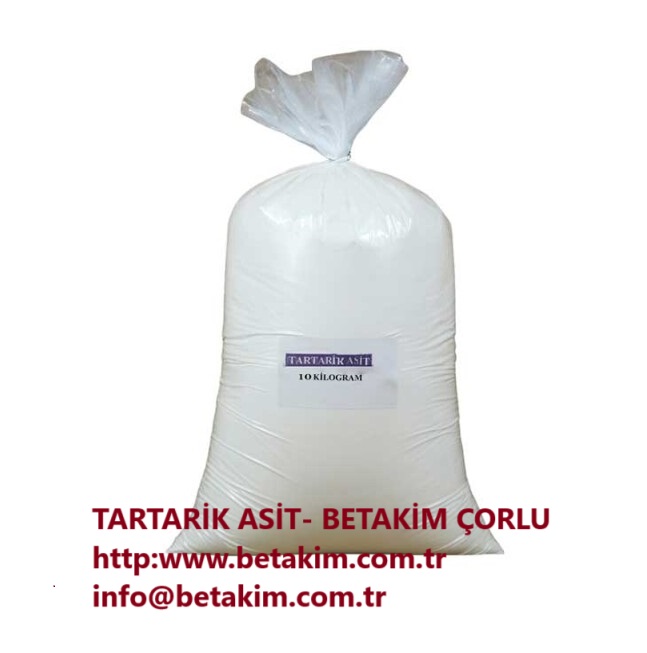
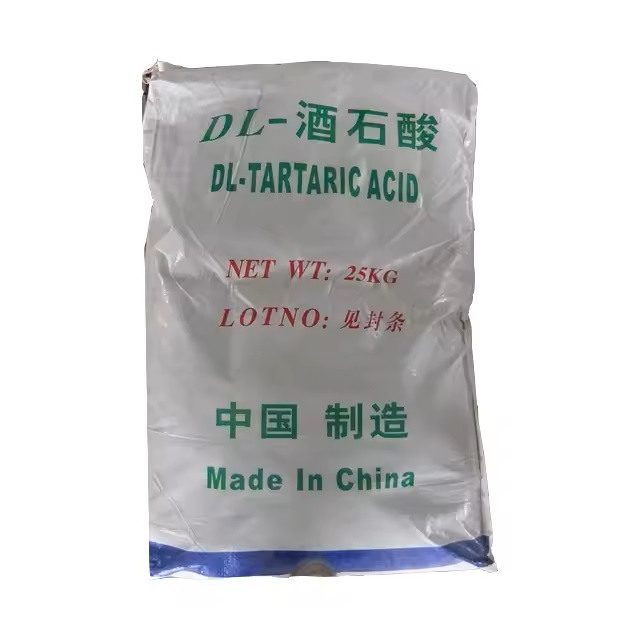
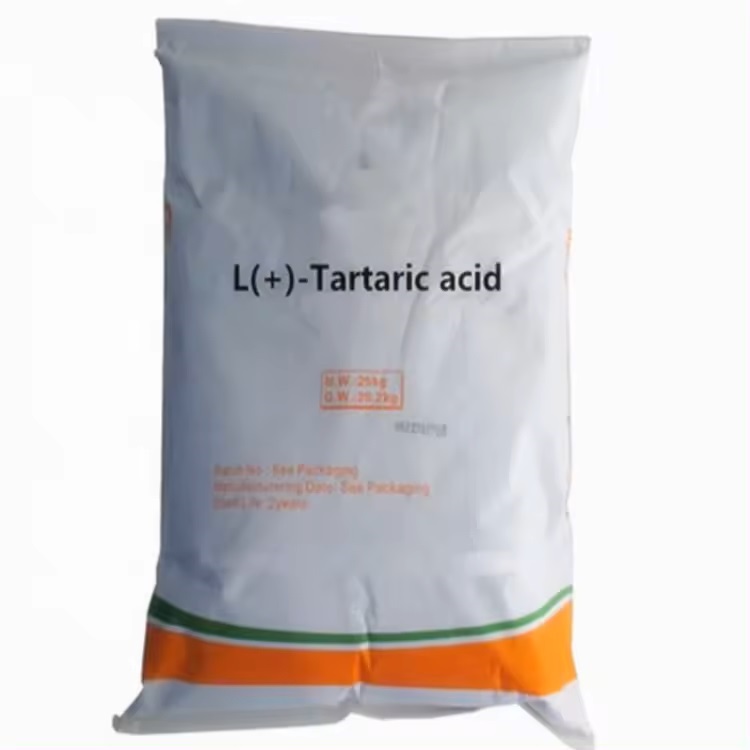
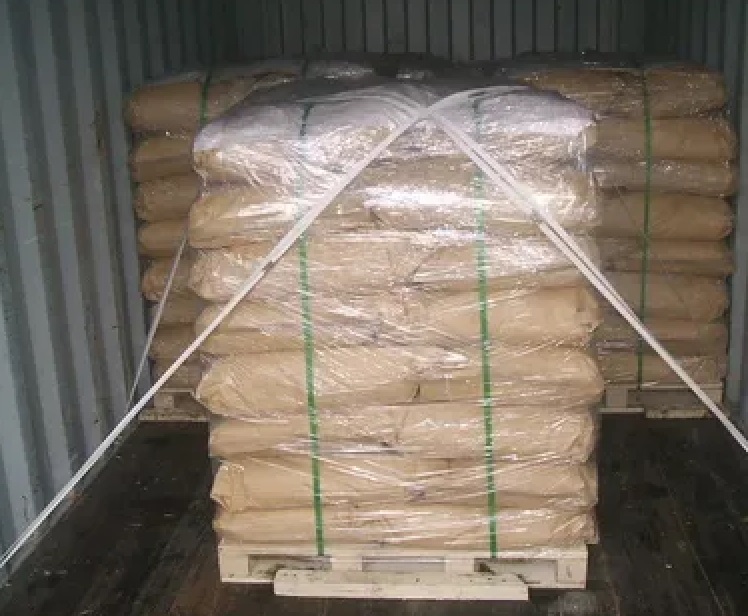
We unleash your business potential by maximize the business innovation.
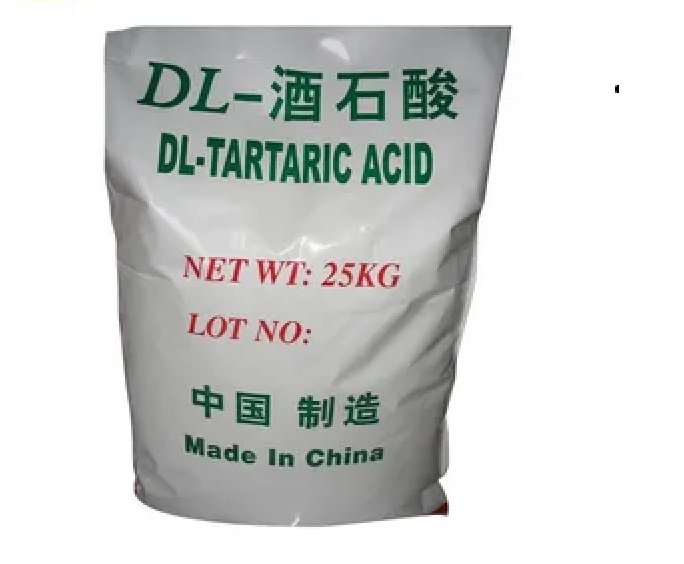
Send EmailTartaric Acid, L(+)-Tartaric Acid, Racemic Acid, Paratartaric Acid, Uvic Acid, DL-Tartrate, Dihydroxy Butanedioic Acid, E334, 87-69-4
TARTARIC ACID (L(+)-TARTARIC ACID, E334)
1. Chemical Identity and Material Classification
-
Chemical Name: L(+)-Tartaric Acid, 2,3-Dihydroxybutanedioic Acid, 2,3-Dihydroxysuccinic Acid
-
Synonyms: L-Natural Tartaric Acid, Racemic Acid, Paratartaric Acid, Uvic Acid, DL-Tartrate, Tartrate, E334
-
CAS Number: 87-69-4 (L(+)-natural); 133-37-9 (DL-racemic)
-
EC Number (EINECS): 201-766-0
-
Molecular Formula: C₄H₆O₆ (HOOC–CH(OH)–CH(OH)–COOH)
-
Molecular Weight: 150.09 g/mol
-
E Number: E334 (food additive)
-
Chemical Class: Organic dicarboxylic acid (dihydroxy)
-
HS Code: 2918.12
-
UN Number: Not regulated (non-hazardous for transport)
2. Physical Properties
2.1 General Physical Properties
| Property | L(+)-Tartaric Acid | DL-Racemic Tartaric Acid |
|---|---|---|
| Appearance | White to off-white crystalline powder or colorless crystals | |
| Physical state (20°C) | Solid (crystalline) | |
| Odor | Odorless | |
| Taste | Strongly acidic, tart (sour) | |
| Density (20°C) | 1.984 g/cm³ | |
| Bulk density | 0.8–1.0 g/cm³ | |
| Melting point | 168–170°C (decomposes) | 206°C (decomposes) |
| Optical rotation [α]D20 | +12° to +13° (20% w/v in water) | 0° (racemic mixture) |
| Specific rotation | +12.0° to +13.0° | – |
| Flash point | Non-flammable | Non-flammable |
| Autoignition temperature | >400°C | >400°C |
| pKa₁ (25°C) | 3.04 | 3.04 |
| pKa₂ (25°C) | 4.37 | 4.37 |
2.2 Solubility in Water
| Temperature (°C) | Solubility (g/100 mL water) |
|---|---|
| 0°C | 60.0 |
| 10°C | 70.0 |
| 20°C | 133.0 |
| 25°C | 139.0 |
| 30°C | 150.0 |
| 40°C | 170.0 |
| 50°C | 195.0 |
| 60°C | 220.0 |
| 80°C | 280.0 |
| 100°C | 350.0 |
2.3 Solubility in Other Solvents
| Solvent | Solubility |
|---|---|
| Water | Very soluble (133 g/100 mL at 20°C) |
| Ethanol (absolute) | Soluble (approx. 20–30 g/100 mL) |
| Methanol | Soluble |
| Acetone | Slightly soluble |
| Glycerol | Soluble |
| Diethyl ether | Insoluble |
| Chloroform | Insoluble |
2.4 Aqueous Solution Properties
| Parameter | Value |
|---|---|
| pH (1% solution, 20°C) | 2.0–2.5 |
| pH (10% solution, 20°C) | 1.8–2.0 |
| Heat of solution | Endothermic (cools water) |
| Buffering capacity | Moderate (effective pH range 2.5–4.5) |
3. Chemical Properties
3.1 Molecular Structure
Structure: HOOC–CH(OH)–CH(OH)–COOH
-
Dicarboxylic acid (two carboxyl groups)
-
Dihydroxy (two hydroxyl groups – one on each chiral carbon)
-
Two chiral centers → optically active
-
Forms three stereoisomers: L(+)-tartaric, D(-)-tartaric, meso-tartaric, and DL-racemic mixture
3.2 Stereoisomers of Tartaric Acid
| Isomer | CAS | Optical Rotation | Melting Point | Occurrence |
|---|---|---|---|---|
| L(+)-Tartaric (natural) | 87-69-4 | +12° to +13° | 168–170°C | Grapes, tamarind, wine |
| D(-)-Tartaric | 147-71-7 | -12° to -13° | 168–170°C | Synthetic/rare |
| DL-Racemic (Paratartaric) | 133-37-9 | 0° | 206°C | Synthetic mixture |
| Meso-Tartaric | 147-73-9 | 0° | 140°C | Synthetic |
3.3 Acid Dissociation Constants (pKa, 25°C)
| Dissociation Step | pKa | Equation |
|---|---|---|
| First dissociation | 3.04 | H₂C₄H₄O₆ ⇌ HC₄H₄O₆⁻ + H⁺ |
| Second dissociation | 4.37 | HC₄H₄O₆⁻ ⇌ C₄H₄O₆²⁻ + H⁺ |
3.4 Chemical Reactivity
| Reaction | Description |
|---|---|
| With bases (neutralization) | Forms tartrate salts (potassium bitartrate – cream of tartar, sodium tartrate, calcium tartrate) |
| Esterification | With alcohols → tartrate esters (diethyl tartrate, dibutyl tartrate) |
| With sodium bicarbonate | NaHCO₃ + tartaric acid → effervescence (CO₂) – used in baking powder |
| Complexation with metal ions | Forms complexes with Cu²⁺, Fe³⁺, Al³⁺, Ca²⁺ |
| Dehydration (heating) | Decomposes to form pyrotartaric acid, then further to CO₂ + H₂O |
| Reduction | To succinic acid or glyceric acid |
3.5 Thermal Stability
| Temperature | Behavior |
|---|---|
| <150°C | Stable |
| 150–170°C | Melts (168–170°C) |
| >170°C | Decomposes (charring, CO₂, H₂O) |
| >200°C | Complete decomposition |
3.6 Stability
| Parameter | Behavior |
|---|---|
| Stability in dry air | Stable indefinitely |
| Stability in moist air | Slightly hygroscopic |
| Light sensitivity | Stable |
| Thermal stability | Decomposes above 170°C |
3.7 Incompatibilities
| Substance | Hazard |
|---|---|
| Strong oxidizing agents (permanganates, chromates, peroxides, nitrates) | Oxidation, fire/explosion risk |
| Strong bases (NaOH, KOH) | Neutralization (exothermic) |
| Metal salts (iron, copper, aluminum) | Complexation, corrosion |
| Sodium bicarbonate (in presence of moisture) | CO₂ evolution (effervescence) |
4. Quality Specifications (Food/Pharmaceutical Grade – L(+)-Natural)
| Parameter | Specification | Test Method |
|---|---|---|
| Assay (C₄H₆O₆, dried basis) | 99.5–101.0% | Titration |
| Loss on drying (105°C, 2 hours) | ≤ 0.5% | Gravimetric |
| Residue on ignition (sulfated ash) | ≤ 0.1% | Ignition (800°C) |
| Chlorides (Cl) | ≤ 0.01% | Turbidimetric |
| Sulfates (SO₄) | ≤ 0.02% | Turbidimetric |
| Heavy metals (as Pb) | ≤ 10 ppm | Colorimetric |
| Lead (Pb) | ≤ 2 mg/kg | Atomic absorption |
| Arsenic (As) | ≤ 3 ppm | Atomic absorption |
| Iron (Fe) | ≤ 20 ppm | Colorimetric |
| Calcium (Ca) | ≤ 0.02% | Atomic absorption |
| Oxalates (C₂O₄) | ≤ 0.01% | Colorimetric |
| Specific optical rotation [α]D20 | +12.0° to +13.0° | Polarimetry |
| Melting point | 168–170°C | Capillary |
| pH (1% solution) | 2.0–2.5 | pH meter |
| Appearance | White to off-white crystalline powder | Visual |
5. Production Methods
5.1 Natural L(+)-Tartaric Acid from Wine Industry By-products (Most Common)
Source: Potassium bitartrate (cream of tartar) precipitated during wine fermentation
Process:
-
Wine lees (sediment) and tartrates are collected from wine barrels and tanks
-
Crude potassium bitartrate is purified by recrystallization
-
Calcium chloride is added to convert to calcium tartrate
-
Calcium tartrate is treated with sulfuric acid → L(+)-tartaric acid + calcium sulfate (gypsum)
-
Purification by crystallization
Purity: 99.5–100.5% (food/pharmaceutical grade)
5.2 Synthetic DL-Tartaric Acid (Racemic)
Process: From maleic acid or fumaric acid via oxidation with hydrogen peroxide or potassium permanganate
Purity: 99.0–99.5% (technical grade)
5.3 Natural Occurrence
-
Grapes and wine (0.3–1.0%)
-
Tamarind (8–18% – very high concentration)
-
Bananas, citrus fruits
6. Industrial Applications
6.1 Food and Beverage Industry (E334 – Largest Application)
| Application | Function | Typical Concentration |
|---|---|---|
| Soft drinks (carbonated) | Acidulant, flavor enhancer | 0.1–0.5% |
| Fruit juices | Acidity regulator, flavor enhancer | 0.1–0.3% |
| Jams, jellies, marmalades | Acidity regulator (pectin setting) | 0.1–0.5% |
| Candies and confectionery | Acidulant, tartness, flavor enhancer | 0.5–2.0% |
| Baking powder | Acid component (reacts with bicarbonate → CO₂) | 10–30% of baking powder |
| Wine production | Acidity adjustment, pH control, stabilizes color | 1–5 g/L |
| Canned vegetables | pH control, preservative | 0.1–0.3% |
| Chewing gum | Acidulant, flavor enhancer | 0.1–0.5% |
| Effervescent tablets | Acid component (with bicarbonate) | 10–40% |
| Dried fruits (apricots, raisins) | Antioxidant, flavor enhancer, color stabilizer | 0.1–0.5% |
Food additive code: E334 – permitted worldwide (EU, USA, Codex)
6.2 Baking Powder (Synergistic with Sodium Bicarbonate)
| Component | Function | Typical Ratio |
|---|---|---|
| Sodium bicarbonate (NaHCO₃) | Base (CO₂ source) | 30–35% |
| Tartaric acid | Acid (reacts with bicarbonate) | 20–30% |
| Corn starch | Filler, moisture absorber | 30–40% |
Reaction: H₂C₄H₄O₆ + 2NaHCO₃ → Na₂C₄H₄O₆ + 2H₂O + 2CO₂↑
6.3 Pharmaceutical Applications
| Application | Function | Typical Dosage |
|---|---|---|
| Effervescent tablets (vitamins, analgesics, antacids) | Acid component (CO₂ source) | 10–40% of tablet |
| Laxatives | Active ingredient (as potassium bitartrate) | 1–5 g |
| Antacids | pH adjuster, acidulant | 5–15% |
| Cough syrups | pH adjuster, flavor enhancer | 0.1–1% |
| L-Carnitine tartrate | Salt form (improves bioavailability) | 50–80% L-carnitine tartrate |
| Oral rehydration salts | pH buffer | 0.5–2% |
6.4 Wine and Beverage Industry (Critical Application)
| Parameter | Value |
|---|---|
| Natural occurrence in grapes | 0.3–1.0% |
| Role in wine | Primary acid in wine (30–50% of total acidity) |
| pH control | Lowers pH (prevents bacterial growth, stabilizes color) |
| Tartrate stabilization | Prevents precipitation of potassium bitartrate (wine diamonds) |
| Cold stabilization addition | 50–200 mg/L (to prevent tartrate crystals) |
| Acid adjustment (high pH wines) | 1–5 g/L |
6.5 Industrial and Technical Applications
| Application | Function |
|---|---|
| Electroplating (gold, silver, copper) | Complexing agent, bath stabilizer |
| Metal cleaning and polishing | Removes oxide layers, tarnish |
| Leather tanning | Masking agent for chromium tanning |
| Textile dyeing | Mordant, complexing agent |
| Photography | Developing solution component |
| Concrete admixture (retarder) | Delays setting time (gypsum/plaster) |
| Mirror silvering (Tollens' test) | Complexes silver ions in silvering solutions |
| Blue ink manufacturing | Component in iron-gall inks |
| Water-soluble plastics | Organic acid source for biodegradable polymers |
| Gypsum/plaster retarder | Extends workability, delays setting |
6.6 Cosmetics and Personal Care
| Application | Function | Typical Concentration |
|---|---|---|
| Skin care (exfoliants) | Mild exfoliant, pH adjuster | 0.5–5% |
| Sunscreens | pH adjuster, antioxidant | 0.1–1% |
| Hair care products | pH adjuster, shine enhancer | 0.1–1% |
| Facial toners | pH adjuster, mild astringent | 0.1–1% |
6.7 Construction (Plaster and Gypsum Retarder)
| Application | Function | Typical Concentration |
|---|---|---|
| Gypsum plaster retarder | Extends setting time, improves workability | 0.05–0.2% by weight of plaster |
| Wall plastering | Prevents premature hardening | 0.1–0.3% |
7. Tartaric Acid vs. Citric Acid – Comparison
| Property | Tartaric Acid | Citric Acid |
|---|---|---|
| Formula | C₄H₆O₆ | C₆H₈O₇ |
| Molecular weight | 150.09 | 192.12 |
| pKa₁ | 3.04 | 3.13 |
| pKa₂ | 4.37 | 4.76 |
| Acid strength | Slightly stronger | Slightly weaker |
| Solubility (20°C) | 133 g/100 mL | 70 g/100 mL |
| Taste | Very tart, sharp | Mild, pleasant |
| Natural source | Grapes, tamarind | Citrus fruits |
| Calcium binding | High (forms calcium tartrate) | Moderate (calcium citrate) |
| Effervescent tablet compatibility | Excellent | Excellent |
| Baking powder use | Common (fast-acting) | Common (delayed action) |
| Wine use | Primary acid (natural) | Rare (added for adjustment) |
| E number | E334 | E330 |
8. Derivatives – Tartrate Salts
| Salt | Formula | CAS | Applications |
|---|---|---|---|
| Potassium bitartrate (Cream of tartar) | KHC₄H₄O₆ | 868-14-4 | Baking powder, stabilizer, reducing agent |
| Sodium tartrate | Na₂C₄H₄O₆·2H₂O | 6106-24-7 | Buffer, sequestrant, food additive |
| Potassium sodium tartrate (Rochelle salt) | KNaC₄H₄O₆·4H₂O | 304-59-6 | Buffer, piezoelectric crystals |
| Calcium tartrate | CaC₄H₄O₆·4H₂O | 3164-34-9 | Effervescent tablets, antacid |
| Diethyl tartrate | C₄H₄O₆(C₂H₅)₂ | 87-91-2 | Plasticizer, chiral auxiliary |
| Dibutyl tartrate | C₄H₄O₆(C₄H₉)₂ | 2050-27-3 | Plasticizer |
9. Toxicology and Safety
9.1 Acute Toxicity
| Parameter | Value | Classification |
|---|---|---|
| Oral LD₅₀ (rat) | 5,000–7,500 mg/kg (low toxicity) | Not classified |
| Dermal LD₅₀ (rabbit) | >2,000 mg/kg | Not classified |
| Inhalation LC₅₀ | Not determined (dust may irritate) | Not classified |
| Skin irritation | Mild irritant (dust) | Not classified |
| Eye irritation | Moderate to severe irritant | Eye Dam. 1 |
| Skin sensitization | Non-sensitizer | Not classified |
9.2 GHS Classification
| Classification | Category |
|---|---|
| Signal word | Warning |
| Hazard statements | H319 – Causes serious eye irritation |
| Precautionary statements | P264, P280, P305+P351+P338, P337+P313 |
9.3 NFPA Rating
| Health | Flammability | Reactivity |
|---|---|---|
| 1 | 0 | 0 |
10. Safety Precautions and Personal Protective Equipment (PPE)
-
Hazards:
-
Low acute toxicity
-
Dust may cause eye irritation (H319)
-
Mild skin irritant (dust)
-
Non-flammable
-
Slightly hygroscopic
-
-
PPE (recommended – industrial handling):
-
Safety glasses (EN 166) – mandatory (eye irritation risk)
-
Dust mask (FFP1/FFP2) – for dusty operations
-
Chemical-resistant gloves (nitrile – optional)
-
Protective clothing (dust protection)
-
-
Engineering controls:
-
Local exhaust ventilation (LEV) for dust control
-
Eyewash stations
-
-
Storage conditions:
-
Keep tightly closed in original container (HDPE, PP, paper bags with liner)
-
Store in cool, dry, well-ventilated area (5–30°C)
-
Protect from moisture (slightly hygroscopic)
-
Store away from strong oxidizing agents and strong bases
-
-
First aid:
-
Inhalation: Move to fresh air
-
Eye contact: Rinse with water for 15 minutes; remove contact lenses; seek medical attention if irritation persists
-
Skin contact: Wash with soap and water
-
Ingestion: Rinse mouth; drink water (low toxicity)
-
11. Environmental Fate
| Parameter | Value |
|---|---|
| Biodegradability | Readily biodegradable (OECD 301) |
| Aquatic toxicity (fish, LC₅₀, 96 hours) | 100–500 mg/L (low to moderate toxicity) |
| Daphnia magna (EC₅₀, 48 hours) | 50–200 mg/L |
| Algal toxicity (EC₅₀, 72 hours) | 10–100 mg/L |
| Bioaccumulation | Low (log P < 1) |
| Soil mobility | High (high water solubility) |
| WGK Germany | 1 (low hazard to water) |
| Disposal method | Landfill or incineration (non-hazardous waste) |
12. Storage and Shelf Life
12.1 Storage Conditions
| Parameter | Requirement |
|---|---|
| Storage temperature | 5–30°C (room temperature) |
| Container | Keep tightly closed (HDPE, PP, paper bags with liner) |
| Protect from | Moisture (slightly hygroscopic), strong oxidizing agents, strong bases |
| Environment | Cool, dry, well-ventilated area |
12.2 Shelf Life
| Parameter | Value |
|---|---|
| Shelf life (sealed, dry) | 24–36 months |
| Degradation indicators | Caking (moisture absorption), discoloration (yellowing) |
13. Transport Information
| Regulation | Classification |
|---|---|
| UN Number | Not regulated (non-hazardous) |
| ADR/RID | Not classified as dangerous goods |
| IMDG | Not regulated |
| IATA | Not regulated |
| Proper shipping name | Tartaric acid (non-hazardous) |
14. Synonyms and Common Names
-
English: Tartaric Acid, L(+)-Tartaric Acid, Natural Tartaric Acid, 2,3-Dihydroxybutanedioic acid, 2,3-Dihydroxysuccinic acid, Racemic Acid, Paratartaric Acid, Uvic Acid, DL-Tartrate
-
Trade names: L-Natural Tartaric Acid, Cream of tartar (potassium bitartrate)
-
French: Acide tartrique
-
German: Weinsäure
-
Spanish: Ácido tartárico
-
Turkish: Tartarik Asit, L(+)-Doğal Tartarik Asit
15. Regulatory Status
| Regulation | Status |
|---|---|
| REACH (EU) | Registered |
| TSCA (US) | Listed |
| FDA | GRAS – food additive (E334) – 21 CFR § 184.1099 |
| EFSA | Permitted as food additive (E334) |
| USP / Ph. Eur. | Monographed for pharmaceutical use |
16. Why Choose Tartaric Acid?
| Advantage | Description |
|---|---|
| Natural origin (L(+)-form) | Derived from wine industry by-products (renewable, sustainable) |
| Very high water solubility | 133 g/100 mL at 20°C – easy to incorporate |
| Strong acidity (pKa₁ 3.04) | Effective acidulant even at low concentrations |
| Distinct sharp, tart taste | Preferred for certain applications (wine, candies) |
| Excellent leavening agent | Fast reaction with bicarbonate (ideal for baking powder) |
| Natural wine acid | Primary acid in grapes – authentic for wine making |
| Pharmaceutical uses | Effervescent tablets, L-carnitine tartrate |
| Chelating properties | Binds metal ions (Cu²⁺, Fe³⁺, Ca²⁺) |
| Plaster/gypsum retarder | Extends workability in construction |
| GRAS status | FDA-approved food additive (E334) |
| Long shelf life | 24–36 months when stored properly |
Limitations:
-
Slightly hygroscopic – Absorbs moisture; requires airtight storage
-
May cause eye irritation – Dust requires PPE (goggles)
-
Not suitable for low-sodium applications (sodium salts may form)
-
High cost compared to citric acid in some regions
-
Limited solubility in organic solvents – Primarily aqueous applications
17. Comparison of Tartaric Acid Isomers
| Property | L(+)-Tartaric | D(-)-Tartaric | DL-Racemic | Meso-Tartaric |
|---|---|---|---|---|
| CAS Number | 87-69-4 | 147-71-7 | 133-37-9 | 147-73-9 |
| Optical rotation | +12° to +13° | -12° to -13° | 0° | 0° |
| Melting point | 168–170°C | 168–170°C | 206°C | 140°C |
| Solubility (g/100 mL) | 133 | 133 | 20–25 | 125 |
| Natural occurrence | Grapes, tamarind | Rare (synthetic) | Synthetic | Synthetic |
| Food additive status | E334 (approved) | Not approved | Not approved | Not approved |
| Applications | Food, pharma, industrial | Research only | Industrial (limited) | Research only |
18. Frequently Asked Questions (FAQs)
Q1: What is the difference between tartaric acid and cream of tartar?
A1: Cream of tartar is potassium bitartrate (KHC₄H₄O₆), which is the monopotassium salt of tartaric acid. It is less acidic (pH ~3.5–4.0) than tartaric acid (pH ~2.0–2.5). Cream of tartar is used in baking powder (as the acid component) and as a stabilizer.
Q2: Is tartaric acid safe to eat?
A2: Yes, food-grade L(+)-tartaric acid (E334) is GRAS (Generally Recognized as Safe) by FDA and EFSA. It occurs naturally in grapes and wine and is used as a food additive in many products.
Q3: Why is tartaric acid used in wine making?
A3: Tartaric acid is the primary acid in grapes. It is used to adjust wine acidity (lower pH), stabilize color, inhibit bacterial growth, and prevent tartrate crystallization (wine diamonds). It is also used in cold stabilization to remove excess potassium bitartrate.
Q4: Is tartaric acid the same as citric acid?
A4: No. Tartaric acid (C₄H₆O₆) and citric acid (C₆H₈O₇) are different compounds. Tartaric acid has a sharper, more astringent taste and is the primary acid in grapes. Citric acid is milder and is the primary acid in citrus fruits. They are used interchangeably in some applications but have different properties.
Q5: Can tartaric acid be used in baking?
A5: Yes, tartaric acid is used in baking powder as the fast-acting acid component. It reacts with sodium bicarbonate to produce carbon dioxide gas, which leavens baked goods. Cream of tartar (potassium bitartrate) is also used in baking.
Q6: Is tartaric acid gluten-free?
A6: Yes, tartaric acid is gluten-free. It is a simple organic acid derived from grapes or synthetically produced; it contains no gluten.
19. Applications Summary Table
| Sector | Application | Typical Concentration | Function |
|---|---|---|---|
| Food & Beverage | Soft drinks, juices, candies | 0.1–2% | Acidulant, flavor enhancer |
| Baking | Baking powder | 20–30% of baking powder | Leavening agent (CO₂ source) |
| Wine making | Acidity adjustment | 1–5 g/L | pH control, stabilization |
| Pharmaceutical | Effervescent tablets | 10–40% | Acid component (CO₂ source) |
| Pharmaceutical | L-Carnitine tartrate | 50–80% | Salt form (improved bioavailability) |
| Cosmetics | Skin care (exfoliants) | 0.5–5% | Mild exfoliant, pH adjuster |
| Construction | Plaster/gypsum retarder | 0.05–0.2% | Extends setting time |
| Industrial | Electroplating (gold, silver) | 1–10% | Complexing agent |
| Industrial | Metal cleaning/polishing | 1–5% | Removes oxides, tarnish |
| Textile | Dyeing auxiliary | 0.5–2% | Mordant, complexing agent |
20. Summary Table – Key Specifications at a Glance
| Parameter | Value |
|---|---|
| Product Name | L(+)-Tartaric Acid (E334) |
| CAS Number | 87-69-4 |
| Molecular Formula | C₄H₆O₆ |
| Molecular Weight | 150.09 g/mol |
| Appearance | White to off-white crystalline powder |
| Density | 1.984 g/cm³ |
| Melting Point | 168–170°C |
| pH (1% solution) | 2.0–2.5 |
| Water Solubility (20°C) | 133 g/100 mL |
| Optical Rotation [α]D20 | +12.0° to +13.0° |
| pKa₁ / pKa₂ | 3.04 / 4.37 |
| Assay (food/pharma grade) | 99.5–101.0% |
| E Number | E334 |
| Primary Applications | Food additive (acidulant, leavening agent), wine making, pharmaceuticals (effervescent tablets), cosmetics, construction (plaster retarder), electroplating |
| GHS Signal Word | Warning |
| Hazard Statements | H319 (Causes serious eye irritation) |
| Oral LD₅₀ (rat) | 5,000–7,500 mg/kg |
| Biodegradability | Readily biodegradable |
| Shelf Life | 24–36 months |
This TDS is prepared in compliance with ISO 11014-1 format and is intended for food technologists, winemakers, pharmaceutical scientists, bakers, cosmetic chemists, construction material formulators, and procurement professionals. Certificates of Analysis (CoA), Safety Data Sheets (SDS), and sample validation reports are available upon request.