We unleash your business potential by maximize the business innovation.
Send EmailParaformaldehyde, Polyoxymethylene, Polyoxymethylene, Formaldehyde Polymer, Trioxane, PFA, POM, %91,%96, 30525-89-4
PARAFORMALDEHYDE (PFA)
1. PRODUCT DEFINITION AND CHEMICAL IDENTITY
| Parameter | Description |
|---|---|
| Chemical Name | Paraformaldehyde (Formaldehyde polymer; Polyoxymethylene precursor) |
| Molecular Formula | (CH₂O)ₙ where n = 8–100 |
| CAS Number | 30525-89-4 |
| UN Number & Class | UN 2213, Class 4.1 (Flammable solid) |
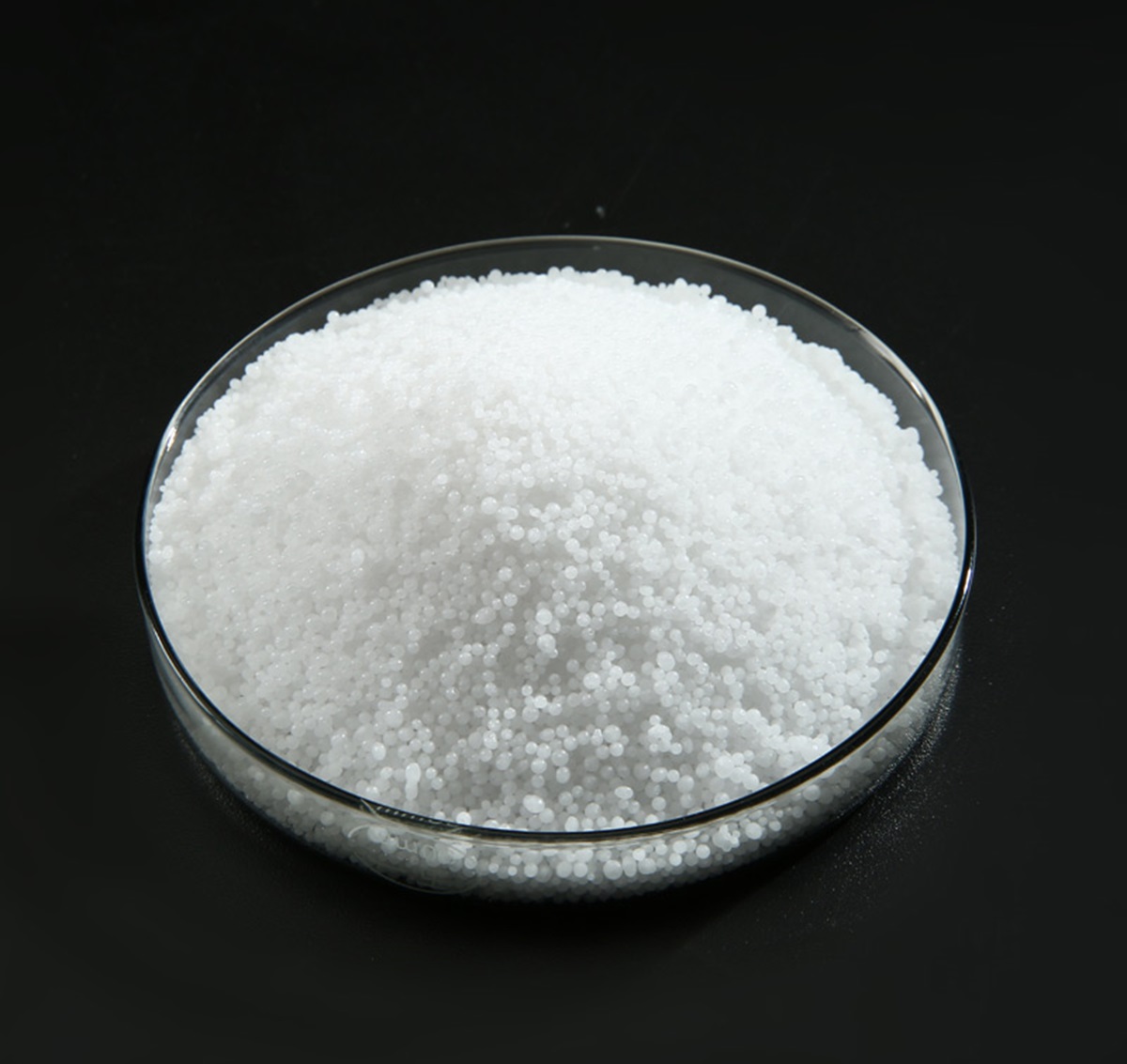
| Appearance | White crystalline powder, granules, or prills with a pungent formaldehyde odour |
| Synonyms | Formaldehyde polymer, Paraform, Trioxane (historical), Polyoxymethylene precursor |
Note: Paraformaldehyde is the solid, polymerized form of formaldehyde. Unlike formalin (aqueous formaldehyde solution), it is a convenient, stable solid source of formaldehyde gas or solution upon controlled heating or depolymerization.
2. PHYSICAL AND CHEMICAL PROPERTIES
| Property | Value / Description |
|---|---|
| Physical form | White crystalline solid; available as fine powder, granules, or prills |
| Odour | Pungent, characteristic formaldehyde odour (intensifies with free formaldehyde content) |
| Melting / Softening Range | 120–170 °C (softens); >150–180 °C (marked depolymerization, releasing formaldehyde gas) |
| Solubility in Water | Not directly soluble; undergoes hydrolysis/depolymerization to form a formaldehyde solution, accelerated by heat and pH |
| Reactivity | High; active in condensation and polymerization reactions due to terminal aldehyde functionality |
| Flammability | Flammable solid; dust cloud can form an explosive atmosphere with air; thermal decomposition releases toxic gases (formaldehyde, CO, CO₂) |
3. TYPICAL QUALITY PARAMETERS (QC Framework)
| Parameter | Typical Specification |
|---|---|
| Assay (Polymerized Formaldehyde) | ≥ 95–97% (dry basis) |
| Free Formaldehyde | 0.1–1.0% (low FO preferred depending on application) |
| Moisture (Karl Fischer) | ≤ 0.5–1.0% |
| Acidity (as Formic Acid) | ≤ 0.05–0.1% |
| Colour | White; yellowing is an indicator of oxidation and ageing |
| Particle Size | Granules/Prills: 1–4 mm; Powder: <500 µm |
| Odour Intensity | Increases with free formaldehyde content and product age |
Grade Selection Guidance:
IHC/ICC Grade: Low free formaldehyde, low trace metals, high purity, fine powder for faster dissolution.
Resin/Adhesive Grade: Granule/prill form with controlled particle size for optimal flow, feeding, and dissolution; moisture ≤0.5–1%.
4. SECTORAL APPLICATIONS, USAGE RATES, AND PREPARATION NOTES
| Sector | Application | Typical Usage / Notes |
|---|---|---|
| Laboratory & Biotechnology | Tissue/cell fixation for IHC, ICC, microscopy | Freshly prepared 4% w/v formaldehyde solution derived from PFA in PBS, pH 7.2–7.4. Gentle heating (50–60 °C) and stirring required. |
| Resin & Adhesive Production | Feedstock for PF, UF, MF resins; PRF adhesive hardener | Preferred for low water content and controlled reaction kinetics. Granule/prill format is ideal. |
| Agriculture & Livestock | Disinfection/fumigation of barns, equipment, soil sterilization | Broad-spectrum microbial control. Adherence to local regulations on residue and ventilation times is critical. |
| Cosmetics & Pharmaceuticals | Slow-release formaldehyde source in antimicrobial formulations | Subject to strict labeling and regulatory restrictions for formaldehyde-releasing systems. |
| Polymer & Plastics | Intermediate for Polyoxymethylene (POM, Acetal) production | Industrial grade; high purity required for consistent polymerization. |
| Paper & Textile | Finishing agent for strength, wrinkle resistance, and dimensional stability | Formaldehyde release provides the finishing effect; occupational emission limits must be observed. |
5. PREPARATION OF 4% FORMALDEHYDE SOLUTION (for Laboratory Use)
-
Weigh: 4 g of paraformaldehyde (IHC grade) per 100 mL of solution.
-
Solvent: Add to 100 mL of PBS (phosphate-buffered saline), pH 7.2–7.4.
-
Heat & Stir: Gently heat to 50–60 °C while stirring continuously. Add a few drops of 1N NaOH if needed to catalyze depolymerization. Continue until the solution becomes completely clear.
-
Cool & Filter: Cool the solution to room temperature. Filter through a 0.22–0.45 µm membrane to remove any undissolved particles or by-products.
-
Use: Use freshly prepared. Methanol-free protocols are preferred for IHC specificity.
6. SAFETY, REGULATORY COMPLIANCE, AND STORAGE (GHS/CLP Framework)
-
GHS Classification: Refer to the supplier's SDS for specific hazard statements, which are primarily driven by the release of formaldehyde gas. Formaldehyde is classified as a carcinogen (Cat. 1B) and skin sensitizer (Cat. 1).
-
Personal Protective Equipment (PPE): Safety goggles, nitrile/PVC gloves, lab coat/chemical apron, and a suitable respirator for formaldehyde vapour and dust (e.g., Type A/P3 combination filter).
-
Exposure: Irritant to eyes, skin, and respiratory system. Formaldehyde is a known dermal sensitizer and carcinogen.
-
Storage: Store in a cool, dry, and well-ventilated area, away from heat, sparks, and open flames. Minimize moisture ingress to prevent premature hydrolysis. FIFO (First In, First Out) inventory management is recommended.
-
Incompatibilities: Strong oxidizers, strong acids, and alkalis can cause uncontrolled reactions.
-
Spill Management: Collect dry spills, avoiding dust generation, and place in a sealable container. Avoid wetting large spills, as this can accelerate formaldehyde release.
-
Transport: UN 2213, Class 4.1 (Flammable solid). Must be packaged and labelled according to ADR/IMDG regulations.
7. PACKAGING AND SUPPLY CHAIN DETAILS
-
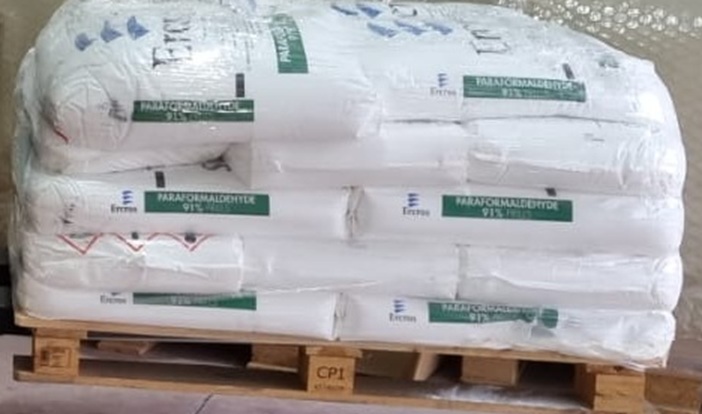
Standard Packaging: 25 kg kraft paper bag with PE inner liner; 500–1000 kg big-bag with liner.
-
Special Formats: Low-dust prill/granule formats are available from specific manufacturers.
-
Required Documentation: Up-to-date SDS (16-section), TDS/QC certificate, batch-specific COA. For laboratory use, request a report on trace metals and impurities.
-
Shelf Life: Typically 12–36 months, depending on storage temperature and humidity. Increased odour and yellowish discolouration are key signs of ageing.
8. QUICK REFERENCE TABLE
| Property | Value / Description |
|---|---|
| Product Name | Paraformaldehyde |
| CAS | 30525-89-4 |
| Formula | (CH₂O)ₙ |
| Physical Form | White crystalline solid (powder, granules, prills) |
| Assay | ≥ 95–97% (dry basis) |
| Free Formaldehyde | 0.1–1.0% |
| Moisture | ≤ 0.5–1.0% |
| UN & Class | UN 2213, Class 4.1 (Flammable solid) |
| Key Applications | Resins (PF/UF/MF), IHC fixation, POM precursor, disinfection |
| Key Note | Insoluble in water until chemically depolymerized by heat and/or pH |