We unleash your business potential by maximize the business innovation.
Send EmailPolyethylene, Polythene, Ethene Homopolymer, PE, 9002-88-4
POLYETHYLENE (PE)
CAS Number: 9002-88-4
EC Number (EINECS): 618-339-0
Molecular Formula: (C₂H₄)ₙ
Molecular Weight: Variable (typically 10,000–1,000,000 g/mol)
Chemical Class: Thermoplastic (semi-crystalline)
SECTION 1: CHEMICAL IDENTITY AND MATERIAL CLASSIFICATION
| Parameter | Description |
|---|---|
| Chemical Name (IUPAC) | Poly(ethylene) |
| Other Names | PE, Ethene Homopolymer, Polythene |
| CAS Number | 9002-88-4 |
| EC Number (EINECS) | 618-339-0 |
| Molecular Formula | (C₂H₄)ₙ |
| Molecular Weight | Variable (typically 10,000–1,000,000 g/mol) |
| Chemical Class | Thermoplastic (semi-crystalline) |
| Structure | –(CH₂–CH₂)ₙ– |
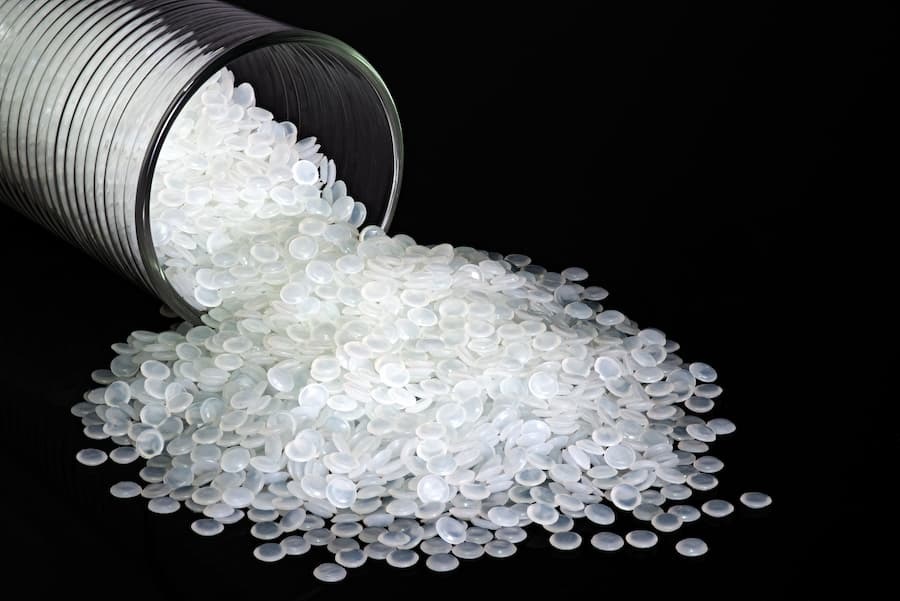
| Appearance | White to translucent pellets, granules, or powder |
| Odor | Odorless |
SECTION 2: TYPES OF POLYETHYLENE
| Property | LDPE | LLDPE | HDPE | UHMWPE |
|---|---|---|---|---|
| Density (g/cm³) | 0.910–0.925 | 0.915–0.940 | 0.940–0.965 | 0.930–0.945 |
| Crystallinity | Low (40–50%) | Medium (50–60%) | High (60–80%) | Very High (80–85%) |
| Tensile Strength (MPa) | 8–20 | 15–30 | 20–40 | 40–60 |
| Elongation at Break | 100–600% | 200–800% | 100–500% | 300–500% |
| Vicat Softening Point (°C) | 80–95 | 90–110 | 110–130 | 120–135 |
| Hardness (Shore D) | 40–50 | 50–60 | 60–70 | 60–70 |
| Chemical Resistance | Good | Excellent | Excellent | Excellent |
| Impact Resistance | Moderate | High | High | Very High |
| Common Applications | Film, bags, bottles | Film, stretch, packaging | Pipes, containers, drums | Wear parts, armor |
| Processing Method | Extrusion, film | Extrusion, film | Injection, extrusion | Compression molding |
SECTION 3: DETAILED PROPERTIES BY TYPE
3.1. Low-Density Polyethylene (LDPE)
| Property | Value / Range |
|---|---|
| Density | 0.910–0.925 g/cm³ |
| Melting Point | 105–115°C |
| Crystallinity | 40–50% |
| Tensile Strength | 8–20 MPa |
| Elongation at Break | 100–600% |
| Hardness (Shore D) | 40–50 |
| Vicat Softening | 80–95°C |
| Flexibility | High |
| Transparency | Translucent |
| Processability | Excellent |
| Advantages | Flexible, cheap, easy to process |
| Disadvantages | Low strength, low heat resistance |
3.2. Linear Low-Density Polyethylene (LLDPE)
| Property | Value / Range |
|---|---|
| Density | 0.915–0.940 g/cm³ |
| Melting Point | 120–130°C |
| Crystallinity | 50–60% |
| Tensile Strength | 15–30 MPa |
| Elongation at Break | 200–800% |
| Hardness (Shore D) | 50–60 |
| Vicat Softening | 90–110°C |
| Advantages | Higher strength than LDPE, tear resistance |
| Disadvantages | Less transparent, harder to process |
3.3. High-Density Polyethylene (HDPE)
| Property | Value / Range |
|---|---|
| Density | 0.940–0.965 g/cm³ |
| Melting Point | 125–135°C |
| Crystallinity | 60–80% |
| Tensile Strength | 20–40 MPa |
| Elongation at Break | 100–500% |
| Hardness (Shore D) | 60–70 |
| Vicat Softening | 110–130°C |
| Advantages | High strength, good chemical resistance, stiffness |
| Disadvantages | Less flexible, less transparent |
3.4. Ultra-High Molecular Weight Polyethylene (UHMWPE)
| Property | Value / Range |
|---|---|
| Molecular Weight | 3,000,000–6,000,000 g/mol |
| Density | 0.930–0.945 g/cm³ |
| Melting Point | 130–140°C |
| Crystallinity | 80–85% |
| Tensile Strength | 40–60 MPa |
| Elongation at Break | 300–500% |
| Hardness (Shore D) | 60–70 |
| Vicat Softening | 120–135°C |
| Abrasion Resistance | Excellent |
| Advantages | Excellent wear resistance, low friction, high impact resistance |
| Disadvantages | Very difficult to process, high cost |
SECTION 4: POLYETHYLENE COMPARISON TABLE
| Property | LDPE | LLDPE | HDPE | UHMWPE |
|---|---|---|---|---|
| Density (g/cm³) | 0.910–0.925 | 0.915–0.940 | 0.940–0.965 | 0.930–0.945 |
| Crystallinity (%) | 40–50 | 50–60 | 60–80 | 80–85 |
| Melting Point (°C) | 105–115 | 120–130 | 125–135 | 130–140 |
| Tensile Strength (MPa) | 8–20 | 15–30 | 20–40 | 40–60 |
| Elongation at Break (%) | 100–600 | 200–800 | 100–500 | 300–500 |
| Hardness (Shore D) | 40–50 | 50–60 | 60–70 | 60–70 |
| Vicat (°C) | 80–95 | 90–110 | 110–130 | 120–135 |
| Flexibility | High | High | Low | Low |
| Transparency | Translucent | Translucent | Opaque | Opaque |
| Chemical Resistance | Good | Excellent | Excellent | Excellent |
| Impact Resistance | Moderate | High | High | Very High |
| Abrasion Resistance | Moderate | Moderate | High | Excellent |
| Cost | Low | Medium | Low | High |
| Processability | Excellent | Good | Good | Difficult |
| Main Application | Film, bags | Film, stretch | Pipes, containers | Wear parts |
SECTION 5: PHYSICAL AND CHEMICAL PROPERTIES
| Property | LDPE | HDPE |
|---|---|---|
| Solubility in Water | Insoluble | Insoluble |
| Solubility in Organic Solvents | Toluene, xylene, naphtha at 80°C | Toluene, xylene, naphtha at 80°C |
| Water Absorption (24h) | <0.01% | <0.01% |
| Thermal Conductivity | 0.33 W/(m·K) | 0.45–0.52 W/(m·K) |
| Specific Heat | 2.3 kJ/(kg·K) | 2.3 kJ/(kg·K) |
| Thermal Expansion | 200–400×10⁻⁶ /K | 100–200×10⁻⁶ /K |
| Dielectric Constant | 2.3 | 2.3 |
| Dielectric Strength | 18–20 kV/mm | 18–20 kV/mm |
| Volume Resistivity | >10¹⁵ Ω·cm | >10¹⁵ Ω·cm |
| Decomposition Temperature | >300°C | >300°C |
| Service Temperature | -40°C to +80°C | -60°C to +100°C |
5.1. Chemical Resistance
| Chemical | LDPE | HDPE |
|---|---|---|
| Acids (Dilute) | Excellent | Excellent |
| Acids (Concentrated) | Good | Good |
| Alkalies | Excellent | Excellent |
| Alcohols | Good | Good |
| Oils and Greases | Good | Good |
| Aromatic Hydrocarbons | Poor | Poor |
| Chlorinated Solvents | Poor | Poor |
| Oxidizing Agents | Moderate | Moderate |
| Water | Excellent | Excellent |
| Gasoline | Moderate | Moderate |
SECTION 6: MAJOR APPLICATIONS AND END-USES
6.1. Packaging Industry (~60%) - Largest Application
| Application | PE Type | Advantages |
|---|---|---|
| Stretch Film | LLDPE | Flexibility, cling |
| Shrink Film | LDPE | Clarity, shrinkage |
| Plastic Bags | LDPE / HDPE | Low cost, durability |
| Carrier Bags | LDPE / HDPE | Lightweight, cheap, portable |
| Greenhouse Film | LDPE / LLDPE | UV stability, light transmission |
| Lamination Films | LDPE | Adhesion, barrier |
| Drip Irrigation Pipes | LLDPE / HDPE | Flexibility, durability |
| Food Packaging | LDPE / LLDPE | Food contact, barrier |
6.2. Pipes and Profiles (~15%)
| Application | PE Type | Advantages |
|---|---|---|
| Water Pipes | HDPE | Corrosion resistance, flexibility |
| Gas Pipes | HDPE | Pressure resistance, weldability |
| Sewage Pipes | HDPE | Chemical resistance, long life |
| Electrical Conduits | HDPE / LDPE | Insulation, lightweight |
6.3. Automotive (~8%)
| Application | PE Type | Advantages |
|---|---|---|
| Fuel Tanks | HDPE | Impact resistance, chemical resistance |
| Interior Trim | LDPE / HDPE | Flexibility, low cost |
| Coatings | LDPE | Water resistance, durability |
| Pipes | HDPE | Flexibility, chemical resistance |
6.4. Consumer Goods (~10%)
| Application | PE Type | Advantages |
|---|---|---|
| Containers and Drums | HDPE | Durability, chemical resistance |
| Toys | LDPE / HDPE | Non-toxic, impact resistance |
| Caps and Closures | HDPE / LDPE | Sealing, low cost |
| Household Items | HDPE / LDPE | Durability, cleanability |
6.5. Electrical and Electronics (~4%)
| Application | PE Type | Advantages |
|---|---|---|
| Cable Insulation | LDPE / HDPE | Electrical insulation, flexibility |
| Cable Sheaths | HDPE | Abrasion resistance, durability |
| Connectors | HDPE | Insulation, durability |
6.6. Other Applications (~3%)
| Application | PE Type | Advantages |
|---|---|---|
| Textiles | HDPE | Durability, fiber |
| Medical | HDPE / UHMWPE | Biocompatibility, sterilization |
| Agriculture | LDPE / LLDPE | UV stability, flexibility |
| Construction | HDPE | Impermeability, durability |
SECTION 7: ADVANTAGES AND DISADVANTAGES
7.1. Advantages
| Advantage | Description |
|---|---|
| Low Cost | One of the cheapest engineering thermoplastics |
| Lightweight | Low density (0.91–0.97 g/cm³) |
| Chemical Resistance | Excellent resistance to acids, alkalis, and salts |
| Water Resistance | Very low water absorption (<0.01%) |
| Flexibility | LDPE and LLDPE offer high flexibility |
| Food Contact | FDA approved (food contact) |
| Recyclability | Fully recyclable |
| Processability | Processable by all thermoplastic methods |
| Temperature Resistance | -40°C to +130°C (depending on type) |
| Durability | Long service life |
7.2. Disadvantages
| Disadvantage | Description |
|---|---|
| Low Heat Resistance | Softens at high temperatures (80–130°C) |
| Low Strength | Lower than polypropylene and ABS |
| Flammability | Flammable, not flame retardant |
| UV Resistance | Degrades outdoors without UV stabilization |
| Oxidation | Susceptible to oxidative degradation |
| Solvent Sensitivity | Soluble in some organic solvents |
SECTION 8: PROCESSING METHODS
| Method | Temperature Range | PE Types | Applications |
|---|---|---|---|
| Injection Molding | 180–240°C | LDPE, HDPE, LLDPE | Caps, containers, parts |
| Extrusion | 180–230°C | LDPE, HDPE, LLDPE | Pipes, profiles, films |
| Blow Molding | 180–220°C | HDPE, LDPE | Bottles, containers |
| Film Blowing | 180–210°C | LDPE, LLDPE | Bags, packaging films |
| Rotational Molding | 250–350°C | LLDPE, HDPE | Large parts, tanks |
| Thermoforming | 130–180°C | HDPE, LDPE | Packaging, trays |
SECTION 9: TOXICOLOGY AND SAFETY
| Parameter | Value / Description |
|---|---|
| GHS Classification | Not classified |
| Oral LD₅₀ (Rat) | >5,000 mg/kg (very low toxicity) |
| Skin Irritation | Not irritating |
| Eye Irritation | Mild irritant (dust) |
| Inhalation (Dust) | May cause mechanical irritation |
| Thermal Decomposition | >300°C releases hydrocarbon vapors |
| Combustion Products | CO₂, CO, water vapor |
| Recycling Code | #2 (HDPE), #4 (LDPE) |
SECTION 10: ENVIRONMENTAL ASPECTS
| Parameter | Value |
|---|---|
| Biodegradability | Not biodegradable |
| Recyclability | Yes (mechanical recycling) |
| Combustion Products | CO₂, CO, water vapor |
| Microplastics | A concern |
| Recycling Code | #2 (HDPE), #4 (LDPE) |
| Marine Environment | Contributes to microplastic pollution |
SECTION 11: STORAGE AND SHELF LIFE
Storage Conditions:
-
Cool, dry, well-ventilated area
-
Protect from direct sunlight (UV degradation)
-
Keep away from heat sources and flames
-
Protect from moisture (not hygroscopic)
Shelf Life:
| Product Type | Shelf Life |
|---|---|
| PE Pellets | 12–24 months (in cool, dry storage) |
| PE Film | 6–12 months (depends on UV stabilization) |
Degradation Indicators:
-
Color change (yellowing)
-
Brittleness
-
Surface cracks
-
Oxidation odor
SECTION 12: TRANSPORT INFORMATION
| Parameter | Information |
|---|---|
| UN Number | Not regulated |
| Hazard Class | Not classified as dangerous goods |
| Proper Shipping Name | Polyethylene (non-hazardous) |
| ADR/RID | Not regulated |
| IMDG | Not regulated |
| IATA | Not regulated |
| Dust Explosion Hazard | Fine dust suspended in air can be explosive |
SECTION 13: SYNONYMS AND COMMON NAMES
| Type | Names |
|---|---|
| Turkish | Polietilen, Poli Etilen, PE |
| English | Polyethylene, PE, Ethene Homopolymer, Polythene |
| Trade Names | Alathon, Lupolen, Sclair, Hostalen, Petrothene, Marlex, Dowlex, Borstar |
| Recycling Codes | #2 HDPE, #4 LDPE |
SECTION 14: REGULATORY STATUS
| Regulation | Status |
|---|---|
| REACH (EU) | Registered |
| TSCA (USA) | Listed |
| FDA (USA) | Food contact approved (21 CFR 177.1520) |
| EU Food Contact (10/2011) | Permitted |
| RoHS | Compliant |
| California Prop 65 | Not listed |
| Conflict Minerals | Not applicable |
SECTION 15: SUMMARY AND CRITICAL WARNINGS
Product Summary
| Parameter | Value |
|---|---|
| Product | Polyethylene (PE) |
| CAS | 9002-88-4 |
| Appearance | White to translucent pellets |
| Density | 0.910–0.965 g/cm³ (depending on type) |
| Key Properties | Low cost, chemical resistance, lightweight |
| Key Industry | Packaging (~60%) |
CRITICAL WARNINGS
-
Most Widely Used Plastic: Polyethylene is the most widely used plastic raw material in the world. Its low cost and versatility make it the leader in the packaging industry.
-
Type Selection: Choose the appropriate PE type for your application: LDPE/LLDPE for films, HDPE for pipes, UHMWPE for wear parts.
-
Food Contact: Approved for food contact under FDA 21 CFR 177.1520. Safe for use in food packaging.
-
Temperature Resistance: Service temperature range -40°C to +130°C (depending on type).
-
Chemical Resistance: Excellent resistance to acids, alkalis, alcohols, and salts. Avoid aromatic and chlorinated solvents.
-
UV Resistance: Degrades outdoors without UV stabilization. UV stabilizers required for outdoor applications.
-
Recyclable: Fully recyclable. Recycling codes: #2 (HDPE), #4 (LDPE).
-
Processability: Processable by injection, extrusion, blow molding, film blowing, and rotational molding.
-
Storage: Store in cool, dry, UV-protected areas.
-
Regulatory Status: REACH, TSCA, and FDA compliant.
IMPORTANT DISCLAIMER: This Technical Data Sheet (TDS) is for informational purposes only and is based on available technical data. The user is solely responsible for determining the product's suitability for their specific application and for complying with all applicable local, national, and international regulations. For complete safety, storage, handling, transportation, disposal, and regulatory compliance information, always refer to the official Safety Data Sheet (SDS/MSDS) provided by the manufacturer/supplier. Users are responsible for testing the product in their own processes and applications. All local, national, and international regulations must be followed when working with Polyethylene.