We unleash your business potential by maximize the business innovation.
Send EmailLysine, L-Lysine, L-Lysine Hydrochloride, L-Lysine Monohydrochloride, L-Lysine HCl, 56-87-1, 657-27-2
L-LYSINE and L-LYSINE HCl
PART 1: L-LYSINE (FREE BASE)
1. CHEMICAL IDENTITY AND DEFINITION
| Parameter | Information |
|---|---|
| Chemical Name (IUPAC) | L-2,6-Diaminohexanoic acid |
| Other Names | L-Lysine, Lysine, (S)-2,6-Diaminohexanoic acid |
| CAS Number | 56-87-1 |
| EC Number (EINECS) | 200-294-2 |
| Molecular Formula | C₆H₁₄N₂O₂ |
| Molecular Weight | 146.19 g/mol |
| Chemical Class | Essential amino acid (proteinogenic) |
| Appearance | White to slightly yellowish crystalline powder |
| Odor | Odorless |
| Taste | Slightly bitter |
| Physical State (20°C) | Solid |
| Chirality | L-configuration (biologically active form) |
2. CHEMICAL STRUCTURE
Chemical Structure:
         NH₂
         |
    H₂N — CH₂ — CH₂ — CH₂ — CH₂ — CH — COOH
                                  |
                                 NH₂
Structural Features:
-
Six-carbon aliphatic amino acid
-
Amino group at α-carbon (α-amino)
-
Second amino group at terminal position (ε-amino)
-
L-isomer (biologically active form)
-
Essential amino acid (cannot be synthesized by the body)
-
Basic amino acid (two amino groups)
SMILES: NCCCCC(N)C(=O)O
InChI: InChI=1S/C6H14N2O2/c7-4-2-1-3-5(8)6(9)10/h5H,1-4,7-8H2,(H,9,10)/t5-/m0/s1
InChIKey: KDXKERNSBIXSRK-YFKPBYRVSA-N
3. PHYSICAL PROPERTIES
| Property | Value |
|---|---|
| Appearance | White to slightly yellowish crystalline powder |
| Molecular Weight | 146.19 g/mol |
| Melting Point | ~224 °C (decomposes) |
| Density | ~1.2 g/cm³ |
| pH (1% solution) | ~5.0 – 6.0 |
| Water Solubility (20°C) | ~78 g/L (free base) |
| Solubility in Ethanol | Slightly soluble |
| Solubility in Ether | Insoluble |
| Specific Optical Rotation [α]²⁰D | +14.5° (c=2, 6N HCl) |
| Isoelectric Point (pI) | 9.74 |
| Hygroscopicity | Low |
| Nitrogen Content | ~19.2% (by weight) |
4. CHEMICAL PROPERTIES
| Parameter | Information |
|---|---|
| Chemical Character | Basic amino acid (two amino groups) |
| pKa (α-Carboxyl) | 2.18 |
| pKa (α-Amino) | 8.95 |
| pKa (ε-Amino) | 10.53 |
| Isoelectric Point | 9.74 |
| Stability | Stable under normal conditions |
| Decomposition Products (Heating) | CO₂, NH₃, organic volatiles |
| Incompatible Materials | Strong oxidizing agents, aldehydes |
| Absorption Maximum | 220 nm (peptide bond) |
| Lysine Activity | 100% |
5. APPLICATIONS
| Application | Description |
|---|---|
| Biological Research | Cell culture and molecular biology studies |
| Protein Synthesis | Essential building block |
| Immune System | Supports antibody production |
| Collagen Production | Skin, bone, connective tissue health |
| Antiviral Effect | Supportive against herpes simplex virus |
| Calcium Absorption | Supports bone health |
| Wound Healing | Supports tissue repair |
| Research Chemistry | Peptide synthesis and derivative production |
6. ADVANTAGES AND DISADVANTAGES
| Advantages | Disadvantages |
|---|---|
| Higher lysine content (100%) | Lower water solubility (~78 g/L) |
| Purer amino acid form | Lower stability |
| Contains no chloride ions | Shorter shelf life (24 months) |
| Ideal for biological research | Less flowable in powder form |
| Higher amino acid activity | More difficult to formulate |
| Contains less salt | Not suitable for liquid formulations |
| Higher purity potential | Generally more expensive |
PART 2: L-LYSINE HCl
7. CHEMICAL IDENTITY AND DEFINITION
| Parameter | Information |
|---|---|
| Chemical Name (IUPAC) | (2S)-2,6-Diaminohexanoic acid hydrochloride |
| Other Names | L-Lysine Hydrochloride, L-Lysine Monohydrochloride, L-Lysine HCl |
| CAS Number | 657-27-2 |
| EC Number (EINECS) | 211-519-9 |
| Molecular Formula | C₆H₁₄N₂O₂ · HCl |
| Molecular Weight | 182.65 g/mol (Free base: 146.19 g/mol) |
| Chemical Class | Amino acid (essential amino acid, hydrochloride salt form) |
| Appearance | White to off-white crystalline powder or granules |
| Odor | Odorless or slight characteristic odor |
| Taste | Slightly bitter, salty |
| Physical State (20°C) | Solid |
| Chirality | L-configuration (biologically active form) |
8. CHEMICAL STRUCTURE
Chemical Structure:
         NH₂
         |
    H₂N — CH₂ — CH₂ — CH₂ — CH₂ — CH — COOH
                                  |
                                 NH₂  · HCl
HCl Salt Features:
-
Formed by adding HCl to L-Lysine molecule
-
Salt form is more stable and more water-soluble
-
Lower pH compared to free base form
-
Longer shelf life
-
Better powder flowability
SMILES: NCCCCC(N)C(=O)O.Cl
InChI: InChI=1S/C6H14N2O2.ClH/c7-4-2-1-3-5(8)6(9)10;/h5H,1-4,7-8H2,(H,9,10);1H/t5-/m0./s1
InChIKey: BVHLGVCQOALMSV-JEDNCBNOSA-N
9. PHYSICAL PROPERTIES (L-Lysine HCl)
| Property | Value |
|---|---|
| Appearance | White to off-white crystalline powder or granules |
| Molecular Weight | 182.65 g/mol |
| Density (20°C) | ~1.28 g/cm³ |
| Bulk Density | 0.4-0.6 g/cm³ (depending on particle size) |
| Melting Point | ~263-264°C (decomposes) |
| Water Solubility (20°C) | ~700 g/L (very high solubility) |
| Solubility in Alcohol | Slightly soluble in ethanol; insoluble in ether |
| pH (1% solution) | ~5.5-6.0 |
| Specific Optical Rotation [α]²⁰D | +22.0 to +23.5° (in 5N HCl) |
| Nitrogen Content | ~15.3% (by weight) |
| Chloride Content | ~19.4% (by weight) |
| L-Lysine Content | ~80% (by weight) |
| Hygroscopicity | Hygroscopic (absorbs moisture) |
10. CHEMICAL PROPERTIES (L-Lysine HCl)
| Parameter | Information |
|---|---|
| Chemical Character | Basic amino acid HCl salt |
| pKa (α-Carboxyl) | 2.18 |
| pKa (α-Amino) | 8.95 |
| pKa (ε-Amino) | 10.53 |
| Isoelectric Point | 9.74 |
| Stability | Very stable under normal conditions |
| pH (1% solution) | 5.0 – 6.0 |
| Incompatible Materials | Strong oxidizing agents, aldehydes, strong acids, strong bases |
| Absorption Maximum | 220 nm (peptide bond) |
Acid-Base Properties:
L-Lysine HCl dissociates in aqueous solution:
C₆H₁₄N₂O₂·HCl → C₆H₁₄N₂O₂ + H⁺ + Cl⁻
Free base ionization equilibria:
-
pKa₁ (COOH): 2.18 (carboxyl group deprotonation)
-
pKa₂ (α-NH₂): 8.95 (α-amino group deprotonation)
-
pKa₃ (ε-NH₂): 10.53 (ε-amino group deprotonation)
11. APPLICATIONS
| Application | Description |
|---|---|
| Dietary Supplements | Protein synthesis, immunity, collagen production |
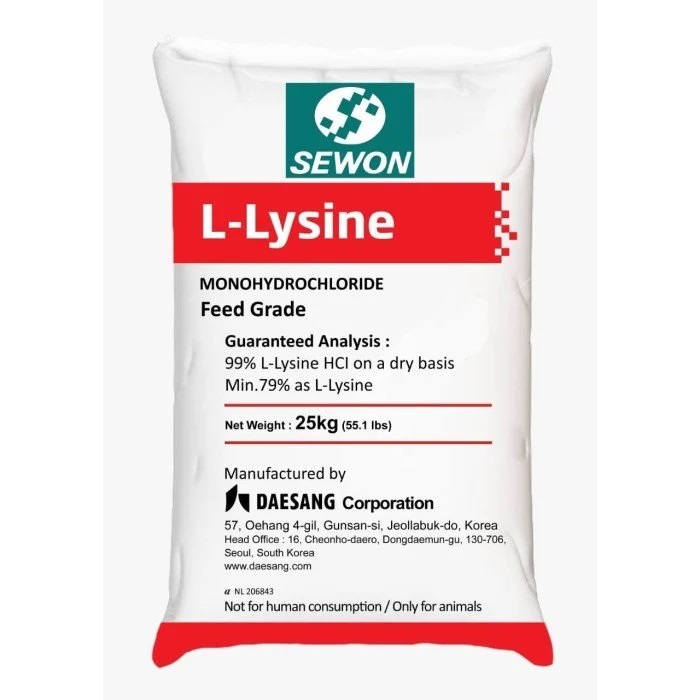
| Animal Feed | Livestock, poultry, aquaculture |
| Pharmaceutical | Intermediates, drug formulations |
| Food Industry | Fortification, sports nutrition |
| Cosmetics | Skin care, hair care, anti-aging |
| Infant Formula | Growth support |
Detailed Application Areas:
| Sector | Application | Typical Dosage |
|---|---|---|
| Human Nutrition | Dietary supplement | 500-3,000 mg/day |
| Animal Nutrition | Feed additive | Variable (based on feed formulation) |
| Pharmaceutical | Intermediate, formulation | Based on clinical protocol |
| Cosmetics | Skin/hair care | 0.5-2.0% (in formulation) |
| Food | Fortification | Varies by product |
12. ADVANTAGES AND DISADVANTAGES
| Advantages | Disadvantages |
|---|---|
| Very high water solubility (~700 g/L) | Lower lysine content (~80%) |
| High stability | Contains chloride ions |
| Long shelf life (36 months) | Extra weight due to salt addition |
| Good powder flowability | Lower amino acid activity |
| Easy to formulate | Higher ionic strength |
| Suitable for liquid formulations | pH buffering effect |
| Low production cost | Higher chloride load |
| Widespread use | Less "pure" than free base |
13. HEALTH BENEFITS
| Benefit | Description |
|---|---|
| Protein Synthesis | Critical for muscle growth, repair, and maintenance |
| Immune System Support | Promotes antibody production |
| Collagen Production | Supports skin, bone, tendon health |
| Wound Healing | Supports tissue repair |
| Calcium Absorption | Supports bone health |
| Cold Sore Management | May help manage HSV outbreaks |
| Athletic Performance | Promotes muscle protein synthesis |
| Anxiety Reduction | May help reduce anxiety and stress |
| Growth and Development | Essential for children and adolescents |
PART 3: COMPARISON
14. KEY DIFFERENCES TABLE
| Feature | L-Lysine (56-87-1) | L-Lysine HCl (657-27-2) |
|---|---|---|
| Chemical Form | Free base | Hydrochloride salt |
| CAS Number | 56-87-1 | 657-27-2 |
| EC Number | 200-294-2 | 211-519-9 |
| Molecular Formula | C₆H₁₄N₂O₂ | C₆H₁₄N₂O₂·HCl |
| Molecular Weight | 146.19 g/mol | 182.65 g/mol |
| Lysine Content | 100% | ~80% |
| Chloride Content | 0% | ~19.4% |
| Nitrogen Content | ~19.2% | ~15.3% |
| Water Solubility (20°C) | ~78 g/L | ~700 g/L |
| pH (1% solution) | 5.0-6.0 | 5.5-6.0 |
| Melting Point | ~224 °C | ~263-264 °C |
| Optical Rotation [α]²⁰D | +14.5° | +22.0° to +23.5° |
| Hygroscopicity | Low | Hygroscopic |
| Stability | Moderate | High |
| Shelf Life | 24 months | 36 months |
| Powder Flowability | Moderate | Good |
| Formulation Suitability | Moderate | High |
| Liquid Formulations | Limited | Ideal |
| Research Use | Preferred | Used |
| Commercial Use | Less | Widespread |
| Cost | Higher | Lower |
15. PHYSICOCHEMICAL COMPARISON
| Parameter | L-Lysine | L-Lysine HCl |
|---|---|---|
| Isoelectric Point | 9.74 | 9.74 |
| pKa (α-Carboxyl) | 2.18 | 2.18 |
| pKa (α-Amino) | 8.95 | 8.95 |
| pKa (ε-Amino) | 10.53 | 10.53 |
| Electrical Charge (pH 7) | +1 | +1 |
| Buffering Capacity | Lower | Higher |
| Ionic Strength | Low | Moderate-High |
| Compressibility | Moderate | High |
| Flowability | Good | Very good |
16. SOLUBILITY COMPARISON
| Solvent | L-Lysine (56-87-1) | L-Lysine HCl (657-27-2) |
|---|---|---|
| Water (20°C) | ~78 g/L | ~700 g/L |
| Water (50°C) | ~150 g/L | >200 g/L |
| Ethanol (95%) | Slightly soluble | Slightly soluble |
| Methanol | Slightly soluble | Slightly soluble |
| Acetone | Insoluble | Insoluble |
| Ether | Insoluble | Insoluble |
| pH 1.0 (0.1M HCl) | High | High |
| pH 7.0 (Water) | Moderate | High |
| pH 12.0 (0.1M NaOH) | High | High |
Solubility Advantage:
L-Lysine HCl has approximately 9 times higher water solubility (~700 g/L) than L-Lysine free base (~78 g/L). This makes it ideal for liquid formulations, effervescent tablets, and clear beverages.
17. APPLICATION AREA COMPARISON
| Application | L-Lysine (56-87-1) | L-Lysine HCl (657-27-2) |
|---|---|---|
| Dietary Supplements | Used (less common) | Most commonly used |
| Tablet/Capsule Formulations | Limited | Ideal |
| Liquid Formulations | Low solubility | High solubility |
| Powder Blends | Used | Widespread |
| Effervescent Tablets | Not suitable | Suitable |
| Pharmaceutical Production | Limited | Widespread |
| Biological Research | Preferred | Used |
| Animal Feed | Used | More common |
| Cosmetic Formulations | Used | More common |
| Clinical Nutrition | Used | More common |
| Infant Formula | Rare | Common |
| Sports Nutrition | Limited | Common |
18. BIOLOGICAL ACTIVITY COMPARISON
| Parameter | L-Lysine | L-Lysine HCl |
|---|---|---|
| Lysine Activity | 100% | ~80% (by weight) |
| Absorption | Good | Good |
| Bioavailability | High | High |
| Metabolic Pathway | Lysine → Protein synthesis | Lysine → Protein synthesis |
| Body pH Effect | Minimal | Minimal (HCl buffered) |
| Urine pH Effect | Minimal | Slightly acidic (due to chloride) |
| Cellular Uptake | Good | Good |
19. SELECTION GUIDE
| If you need... | Choose... |
|---|---|
| High water solubility | L-Lysine HCl |
| Long shelf life | L-Lysine HCl |
| Liquid formulations | L-Lysine HCl |
| Effervescent tablets | L-Lysine HCl |
| High lysine purity | L-Lysine |
| Higher lysine activity | L-Lysine |
| Chloride-free formulation | L-Lysine |
| Low cost | L-Lysine HCl |
| Biological research | L-Lysine |
| Pharmaceutical production | L-Lysine HCl |
| Animal feed production | L-Lysine HCl |
| Powder blends | L-Lysine HCl (better flowability) |
20. STORAGE COMPARISON
| Parameter | L-Lysine | L-Lysine HCl |
|---|---|---|
| Storage Temperature | 15-25°C | 15-25°C |
| Moisture Sensitivity | Low | High (hygroscopic) |
| Light Sensitivity | Low | Low |
| Shelf Life | 24 months | 36 months |
| Container Requirement | Tightly closed | Tightly closed, moisture-proof |
21. SUMMARY TABLE
| Feature | L-Lysine (56-87-1) | L-Lysine HCl (657-27-2) |
|---|---|---|
| Form | Free base | HCl salt |
| CAS Number | 56-87-1 | 657-27-2 |
| Molecular Formula | C₆H₁₄N₂O₂ | C₆H₁₄N₂O₂·HCl |
| Molecular Weight | 146.19 g/mol | 182.65 g/mol |
| Lysine Content | 100% | ~80% |
| Water Solubility | 78 g/L | 700 g/L |
| Stability | Moderate | High |
| Shelf Life | 24 months | 36 months |
| Hygroscopicity | Low | High |
| Application | Research, basic amino acid | Supplements, pharmaceutical |
| Formulation Suitability | Moderate | High |
| Cost | Higher | Lower |
| Market Share | Low | High (standard) |
| Preferred For | Biological research | Commercial production |
22. CRITICAL INFORMATION
1. L-LYSINE (56-87-1):
-
Free base form is ideal for research and high-purity applications
-
Higher lysine content (100%) and purer amino acid form
-
Limited water solubility (~78 g/L), therefore not suitable for liquid formulations
-
Shorter shelf life (24 months)
-
Preferred for biological research and cell culture studies
2. L-LYSINE HCl (657-27-2):
-
HCl salt form is the standard for commercial production and formulations
-
Very high water solubility (~700 g/L) → ideal for liquid formulations
-
More stable with longer shelf life (36 months)
-
L-lysine content is ~80% (contains chloride ion)
-
Better powder flowability, easier to process in tablet and capsule production
-
Ideal for effervescent tablets, liquid formulations, and beverages
3. SELECTION CRITERIA:
-
Research/Biological Studies: Choose L-Lysine (56-87-1)
-
Commercial Production/Supplements: Choose L-Lysine HCl (657-27-2)
-
Liquid Formulations: Choose L-Lysine HCl (657-27-2)
-
High Purity Required: Choose L-Lysine (56-87-1)
-
Low Cost Required: Choose L-Lysine HCl (657-27-2)
-
Chloride-Free Formulation: Choose L-Lysine (56-87-1)
4. BIOLOGICALLY:
Both forms are metabolized identically in the body. The HCl salt form converts to free lysine in stomach acid. Biologically, both forms are equivalent in activity.
IMPORTANT DISCLAIMER: This Technical Data Sheet (TDS) is for informational purposes only. For complete safety, storage, use, and regulatory compliance information, refer to the official documentation provided by the manufacturer/supplier. This document is not a substitute for medical advice.