We unleash your business potential by maximize the business innovation.
Send EmailEthylenediaminetetraacetic Acid, Ethylene Diamine Tetra Acetic Acid, Edetic Acid, Chelating Agent, EDTA, 60-00-4
ETHYLENEDIAMINETETRAACETIC ACID (EDTA)
1. Chemical Identity and Material Classification
-
Chemical Name: Ethylenediaminetetraacetic Acid, Edetic Acid, (Ethylenedinitrilo)tetraacetic acid
-
Synonyms: EDTA, Edetic Acid, Versene, Sequestrene, Nullapon, Chelaton, Trilon BS, Chelaplex, Complexon
-
CAS Number: 60-00-4
-
EC Number (EINECS): 200-449-4
-
Molecular Formula: C₁₀H₁₆N₂O₈
-
Molecular Weight: 292.24 g/mol
-
Chemical Class: Aminopolycarboxylic acid (chelating agent)
-
HS Code: 2922.49
-
UN Number: Not regulated (non-hazardous for transport)
2. Physical Properties
2.1 General Physical Properties
| Property | Value |
|---|---|
| Appearance | White to off-white crystalline powder |
| Physical state (20°C) | Solid (crystalline) |
| Odor | Odorless |
| Taste | Slightly acidic |
| Density | 0.86 g/cm³ (1.0–1.2 g/cm³ bulk density) |
| Melting point | 237–245°C (decomposes) |
| Boiling point | Decomposes before boiling |
| Flash point | Non-flammable |
| Vapor pressure | Negligible |
| Refractive index (nD20) | 1.485 |
2.2 Solubility in Water
| Temperature (°C) | Solubility (g/100 mL water) | pH |
|---|---|---|
| 20°C | 0.5 (very low) | 2.5–3.0 |
| 22°C | 0.5 | – |
| 40°C | 1.0 | – |
| 60°C | 2.5 | – |
| 80°C | 5.0 | – |
| 100°C | 8.0 | – |
Note: EDTA free acid has low water solubility (0.5 g/L). For most applications, EDTA is used as its more soluble salt forms (disodium, tetrasodium).
2.3 Solubility in Other Solvents
| Solvent | Solubility |
|---|---|
| Water | 0.5 g/L (low) – limited |
| Ethanol | Slightly soluble |
| Methanol | Slightly soluble |
| Acetone | Slightly soluble |
| Dichloromethane | Insoluble |
| Chloroform | Insoluble |
2.4 Aqueous Solution Properties
| Parameter | Value |
|---|---|
| pH (saturated solution, 20°C) | 2.5–3.0 (acidic) |
| pH (1% solution of free acid) | 4.0–5.0 |
3. EDTA Salts – Comparison and Specifications
| Salt | Formula | CAS | Molecular Weight | Solubility (20°C) | pH (1% solution) | Primary Applications |
|---|---|---|---|---|---|---|
| EDTA (free acid) | C₁₀H₁₆N₂O₈ | 60-00-4 | 292.24 | ~0.5 g/L | 4.0–5.0 | Analytical chemistry, buffer solutions, salt preparation |
| Disodium EDTA (Na₂EDTA) | C₁₀H₁₄N₂Na₂O₈·2H₂O | 139-33-3 | 372.24 | ~10 g/100 mL | 4.5–5.0 | Cosmetics, food preservative, pharmaceuticals, anticoagulant |
| Tetrasodium EDTA (Na₄EDTA) | C₁₀H₁₂N₂Na₄O₈·4H₂O | 64-02-8 | 452.19 | ~60 g/100 mL | 11.5–12.0 | Detergents, cleaning products, water treatment |
| Calcium Disodium EDTA (CaNa₂EDTA) | C₁₀H₁₂CaN₂Na₂O₈·2H₂O | 62-33-9 | 410.31 | ~30 g/100 mL | 6.5–7.5 | Chelation therapy (heavy metal poisoning – lead) |
4. Quality Specifications (Free Acid)
4.1 EDTA Free Acid – Technical / Analytical Grade
| Parameter | Specification | Test Method |
|---|---|---|
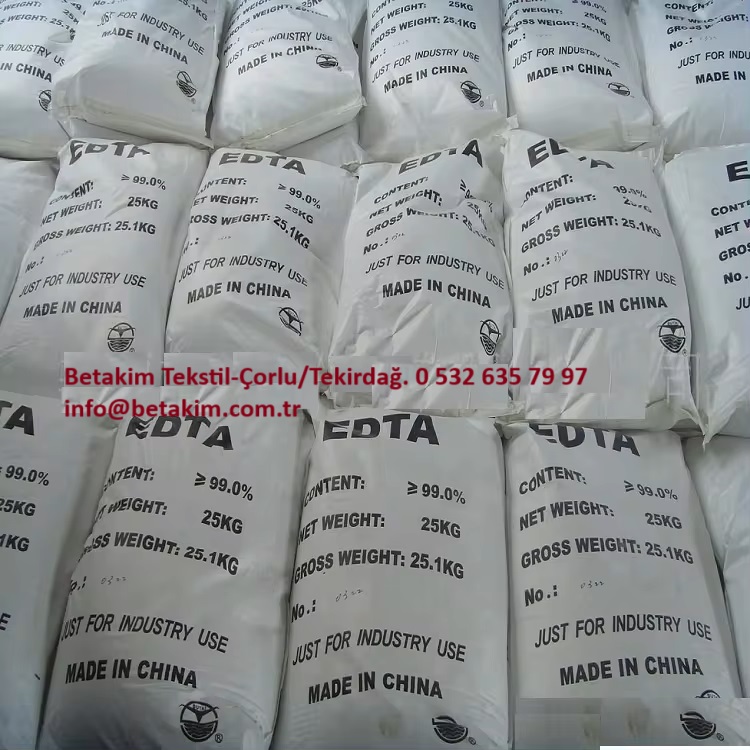
| Assay (C₁₀H₁₆N₂O₈, dry basis) | ≥ 99.0% | Titration |
| Water content (K. Fischer) | ≤ 0.5% | Karl Fischer |
| Chlorides (Cl) | ≤ 0.05% | Turbidimetric |
| Sulfates (SO₄) | ≤ 0.05% | Turbidimetric |
| Heavy metals (as Pb) | ≤ 20 ppm | Colorimetric |
| Iron (Fe) | ≤ 20 ppm | Colorimetric |
| Chelation value (mg CaCO₃/g) | ≥ 339 mg CaCO₃/g | Titration |
| pH (10% solution of Na salt) | 4.0–5.0 | pH meter |
| Residue on ignition | ≤ 0.2% | Ignition (800°C) |
| Appearance | White crystalline powder | Visual |
4.2 EDTA Free Acid – USP Grade
| Parameter | Specification |
|---|---|
| Assay (C₁₀H₁₆N₂O₈, dry basis) | 99.0–101.0% |
| Water content | ≤ 0.5% |
| Heavy metals (as Pb) | ≤ 20 ppm |
| Iron (Fe) | ≤ 10 ppm |
| Chlorides (Cl) | ≤ 0.05% |
| Sulfates (SO₄) | ≤ 0.05% |
| Nitrilotriacetic acid (NTA) | ≤ 0.2% |
| pH (1% solution) | 4.0–5.0 |
5. Chemical Properties
5.1 Molecular Structure
Structure: (HOOC–CH₂)₂N–CH₂–CH₂–N(CH₂–COOH)₂
-
Hexadentate ligand (six donor atoms: two N, four O from carboxyl groups)
-
Forms extremely stable 1:1 complexes with metal ions (chelate effect)
-
Multiple dissociable protons (tetraprotic acid)
5.2 Dissociation Constants (pKa, 25°C)
| Dissociation Step | pKa | Group |
|---|---|---|
| First dissociation | 1.99 | –N⁺H– (protonated amine) |
| Second dissociation | 2.67 | –N⁺H– (protonated amine) |
| Third dissociation | 6.16 | –COOH |
| Fourth dissociation | 10.26 | –COOH |
| Fifth dissociation | 12.67 | –COOH (minor) |
| Sixth dissociation | 13.26 | –COOH (minor) |
Note: EDTA is tetraprotic (four dissociable carboxylic acid protons) plus two protonated nitrogens in acid form.
5.3 Chelation – Stability Constants (log K, 25°C)
| Metal Ion | Stability Constant (log K) | Application |
|---|---|---|
| Fe³⁺ (iron) | 25.1 | Iron chelation, rust removal |
| Cu²⁺ (copper) | 18.8 | Copper complexation |
| Ni²⁺ (nickel) | 18.6 | Nickel complexation |
| Zn²⁺ (zinc) | 16.5 | Zinc complexation |
| Co²⁺ (cobalt) | 16.3 | Cobalt complexation |
| Pb²⁺ (lead) | 15.5 | Lead chelation (therapy) |
| Ca²⁺ (calcium) | 10.7 | Water softening, anticoagulant |
| Mg²⁺ (magnesium) | 8.7 | Water softening |
5.4 Metal-EDTA Complex Formation (1:1 Stoichiometry)
Mⁿ⁺ + EDTA⁴⁻ → [M(EDTA)]ⁿ⁻⁴
-
Forms extremely stable, water-soluble complexes with most divalent and trivalent metal ions
-
Selectivity: Fe³⁺ > Cu²⁺ > Ni²⁺ > Zn²⁺ > Co²⁺ > Pb²⁺ > Ca²⁺ > Mg²⁺
5.5 Chemical Stability
| Parameter | Behavior |
|---|---|
| Stability in dry air | Stable |
| Stability in solution | Stable at pH 4–11 |
| Light sensitivity | Stable |
| Thermal stability | Decomposes >200°C (evolves CO, CO₂, H₂O, N₂) |
| Hydrolytic stability | Stable (resistant to hydrolysis) |
5.6 Incompatibilities
| Substance | Hazard |
|---|---|
| Strong oxidizing agents (HNO₃, H₂O₂, permanganates, chromates) | Oxidation |
| Strong bases (NaOH, KOH) | Neutralization (forms EDTA salts) |
| Heavy metal ions | Chelation (intended – not a hazard) |
| Copper, iron, and other metals | Corrosion (chelates metal ions from surfaces) |
6. Production Methods
6.1 From Ethylenediamine, Formaldehyde, and Sodium Cyanide (Industrial Standard)
Reaction: H₂N–CH₂–CH₂–NH₂ + 4CH₂O + 4NaCN → EDTA (via tetrasodium salt)
Process:
-
Ethylenediamine is reacted with formaldehyde and sodium cyanide (cyanomethylation)
-
Forms tetrasodium EDTA (Na₄EDTA)
-
Acidification yields EDTA free acid
Typical yield: 85–90%
6.2 Alternative Method (Chloroacetic Acid Route)
Reaction: C₂H₄(NH₂)₂ + 4ClCH₂COOH + 4NaOH → C₂H₄(N(CH₂COONa)₂)₂ + 4NaCl + 4H₂O
Process:
-
Ethylenediamine is reacted with chloroacetic acid
-
Tetrasodium EDTA is formed
-
Acidification yields EDTA free acid
7. Mechanism of Action – Chelation
7.1 Chelation Mechanism
| Step | Description |
|---|---|
| 1 | EDTA dissociates in water to form EDTA⁴⁻ anions (at pH > 10) or HEDTA³⁻, H₂EDTA²⁻ (at lower pH) |
| 2 | EDTA⁴⁻ donates six electron pairs (lone pairs) to empty orbitals of metal ion |
| 3 | Forms extremely stable, water-soluble octahedral complexes |
| 4 | Metal ions are effectively "sequestered" – unavailable for precipitation, catalysis, or biological activity |
7.2 Water Softening
Reaction: Ca²⁺ (aq) + EDTA⁴⁻ (aq) → [Ca(EDTA)]²⁻ (aq)
-
Ca²⁺ and Mg²⁺ are chelated, preventing precipitation as CaCO₃ or CaSO₄ (scale)
-
Chelated calcium remains soluble and non-reactive
7.3 Anticoagulant Mechanism
-
Chelates Ca²⁺ ions from blood plasma
-
Calcium is essential for the coagulation cascade
-
Removal of Ca²⁺ prevents clot formation
8. Industrial Applications
8.1 Water Treatment (Scale Prevention)
| Parameter | Value |
|---|---|
| Application | Sequesters Ca²⁺ and Mg²⁺ → prevents scale (CaCO₃, CaSO₄) |
| Typical dosage | 1–50 mg/L |
| Forms used | Tetrasodium EDTA (Na₄EDTA) or free acid (with pH adjustment) |
| Industries | Boiler water, cooling water, industrial process water |
8.2 Detergents and Cleaning Products
| Application | Function | Typical Concentration |
|---|---|---|
| Laundry detergents | Builder, water softener (sequesters Ca²⁺/Mg²⁺) | 0.5–5% |
| Automatic dishwashing | Prevents scale on glassware and dishes | 0.5–3% |
| Industrial cleaners | Metal ion sequestration, prevents precipitation | 1–10% |
| Bottle washing | Prevents scale on bottles | 0.1–1% |
Preferred salt: Tetrasodium EDTA (Na₄EDTA) – high solubility, alkaline pH
8.3 Cosmetics and Personal Care (INCI: Disodium EDTA or Tetrasodium EDTA)
| Application | Function | Typical Concentration |
|---|---|---|
| Shampoos and conditioners | Stabilizer, prevents oxidation (chelates metal ions that catalyze degradation) | 0.1–0.5% |
| Creams and lotions | Preservative booster, stabilizer | 0.05–0.2% |
| Soaps | Prevents rancidity (chelates metal catalysts) | 0.1–0.5% |
| Makeup | Stabilizer, antioxidant synergist | 0.05–0.2% |
| Toothpaste | Prevents discoloration (chelates iron) | 0.1–0.5% |
Benefits:
-
Prevents metal-catalyzed oxidation (rancidity, discoloration)
-
Stabilizes formulations
-
Enhances preservative efficacy (preservative booster)
-
Improves foaming in hard water
8.4 Food Industry (E385 – Calcium Disodium EDTA)
| Application | Function | Typical Concentration |
|---|---|---|
| Preservative (canned foods) | Chelates metal ions (Fe, Cu) that catalyze oxidation | 50–200 mg/kg |
| Color stabilizer | Prevents discoloration (iron-induced browning) | 50–150 mg/kg |
| Flavor stabilizer | Prevents metal-catalyzed flavor degradation | 50–100 mg/kg |
| Mayonnaise and dressings | Preservative (prevents oxidation) | 75 mg/kg (max) |
| Soft drinks | Stabilizer (preserves flavor, color) | 50–100 mg/L |
| Pickles and relishes | Preservative, color stabilizer | 100–200 mg/kg |
Food additive code: E385 (Calcium disodium EDTA) – permitted in EU, US, Japan
8.5 Pharmaceutical and Medical Applications
| Application | Function |
|---|---|
| Blood collection tubes (anticoagulant) | Chelates Ca²⁺ → prevents clotting (lavender-top tubes) |
| Chelation therapy (heavy metal poisoning) | CaNa₂EDTA for lead (Pb²⁺) poisoning |
| Ophthalmic preparations | Stabilizer (prevents metal-catalyzed degradation) |
| Topical creams | Preservative booster |
| Kidney stone treatment | Chelates calcium oxalate (limited) |
8.6 Agriculture
| Application | Function | Typical Concentration |
|---|---|---|
| Micronutrient chelates (Fe-EDTA, Zn-EDTA, Mn-EDTA, Cu-EDTA) | Keeps micronutrients soluble and available for plant uptake | 1–10% in chelate products |
| Soil remediation | Chelates heavy metals (Pb, Cd) | Variable |
| Fertilizer additives | Prevents precipitation of metal phosphates | 0.1–1% |
8.7 Textile and Paper Industry
| Application | Function |
|---|---|
| Bleaching (peroxide stabilizer) | Chelates Fe, Cu, Mn that catalyze peroxide decomposition |
| Dyeing auxiliaries | Prevents metal ion interference (Ca²⁺, Mg²⁺, Fe³⁺, Cu²⁺) |
| Brightness enhancement | Removes metal ions that cause discoloration |
8.8 Metal Plating and Electronics
| Application | Function |
|---|---|
| Electroless copper plating | Chelates Cu²⁺ – prevents precipitation |
| PCB manufacturing | Copper deposition, etching solutions |
| Metal cleaning | Removes oxide scales (rust) |
| Photographic processing | Prevents metal ion contamination |
8.9 Oil and Gas Industry
| Application | Function |
|---|---|
| Scale inhibition (oil wells, pipelines) | Chelates Ca²⁺, Ba²⁺ (prevents sulfate scale) |
| Well stimulation | Iron chelation (prevents precipitation) |
8.10 Laboratory and Analytical Chemistry
| Application | Function |
|---|---|
| Complexometric titrations | Determination of Ca²⁺, Mg²⁺, Zn²⁺, etc. |
| Masking agent | Prevents metal ion interference in analytical procedures |
| Buffer solutions | Component of pH buffers (e.g., Tris-EDTA buffer) |
| Biochemical research | Removes metal ions (e.g., DNase/RNase inhibition) |
| Cell culture | EDTA-trypsin solution for cell detachment |
8.11 Power Generation
| Application | Function |
|---|---|
| Boiler cleaning | Removes scale (CaCO₃, iron oxides) |
| Cooling tower treatment | Scale prevention |
| Flue gas desulfurization | Chelates trace metals |
9. BASF Equivalent Products (Trilon® Series)
| BASF Product | Description | Form | Assay (%) | pH (1%) | Density (g/cm³) |
|---|---|---|---|---|---|
| Trilon® BS | EDTA (free acid) | Powder | ~99 | ~2.8 | ~820 kg/m³ |
| Trilon® BS Powder | EDTA (free acid) | Powder | ~99 | ~2.5 | – |
| Trilon® BD | Na₂EDTA·2H₂O (disodium salt) | Powder | ≥ 89 | ~4.5 | ~950 kg/m³ |
| Trilon® B Liquid | Na₄EDTA (tetrasodium salt) | Liquid | ~40 | ~11.5 | ~1.31 |
| Trilon® B Powder | Na₄EDTA·4H₂O (tetrasodium salt) | Powder | ~87 | ~11.5 | ~700 kg/m³ |
| Trilon® BX Liquid | Na₄EDTA (pure form) | Liquid | ~40 | ~11.5 | ~1.28 |
| Trilon® BX Powder | Na₄EDTA (pure form) | Powder | ~84 | ~11.2 | ~845 kg/m³ |
| Trilon® D Liquid | HEDTA trisodium salt | Liquid | ~40 | ~11.5 | ~1.26 |
| Trilon® M Liquid | MGDA trisodium salt | Liquid | ~40 | ~11.0 | ~1.30 |
| Trilon® M Max | MGDA (granular) | Granular | ~81 | ~11.4 | ~790 kg/m³ |
10. Toxicology and Safety
10.1 Acute Toxicity
| Parameter | Value | Classification |
|---|---|---|
| Oral LD₅₀ (rat) | 2,000–4,000 mg/kg (low toxicity) | Not classified |
| Dermal LD₅₀ (rabbit) | >2,000 mg/kg | Not classified |
| Inhalation LC₅₀ | Not determined (dust may irritate) | Not classified |
| Skin irritation | Non-irritant | Not classified |
| Eye irritation | Mild irritant (dust) | Not classified |
| Skin sensitization | Non-sensitizer | Not classified |
10.2 Chronic Toxicity
| Endpoint | Classification |
|---|---|
| Carcinogenicity | Not classified (non-carcinogenic) |
| Mutagenicity | Negative (some in vitro positive at high concentrations) |
| Reproductive toxicity | Not classified |
| Target organ toxicity | Not classified |
10.3 Environmental Fate
| Parameter | Value |
|---|---|
| Biodegradability | Slow to moderate (10–30% in 28 days) – not readily biodegradable |
| Aquatic toxicity (fish, LC₅₀, 96 hours) | 100–500 mg/L (low to moderate toxicity) |
| Daphnia magna (EC₅₀, 48 hours) | 50–200 mg/L |
| Algal toxicity (EC₅₀, 72 hours) | 10–100 mg/L |
| Metal mobilization (soil/water) | May mobilize heavy metals from sediments (environmental concern) |
| Bioaccumulation | Low potential (log P < 1) |
| WGK Germany | 2 (hazard to water) |
10.4 GHS Classification (Typical)
| Classification | Category |
|---|---|
| Signal word | None (not classified as hazardous) |
| Hazard statements | None (under normal conditions) |
| Precautionary statements | P264, P280 (for dust – eye protection) |
10.5 NFPA Rating
| Health | Flammability | Reactivity |
|---|---|---|
| 0–1 | 0 | 0 |
11. Safety Precautions and Personal Protective Equipment (PPE)
-
Hazards:
-
Low acute toxicity
-
Dust may cause mild eye and respiratory tract irritation
-
Non-flammable
-
Low bioavailability (poorly absorbed)
-
-
PPE (recommended – industrial handling):
-
Safety glasses (EN 166) – optional (low hazard)
-
Dust mask (FFP1/FFP2) – for dusty operations
-
Chemical-resistant gloves (nitrile – optional)
-
Protective clothing (dust protection)
-
-
Engineering controls:
-
Local exhaust ventilation (LEV) for dust control
-
Eyewash stations
-
-
Storage conditions:
-
Keep tightly closed in original container (HDPE, PP, paper bags with liner)
-
Store in cool, dry, well-ventilated area
-
Protect from moisture (hygroscopic – absorbs moisture)
-
-
First aid:
-
Inhalation: Move to fresh air
-
Eye contact: Rinse with water for 15 minutes; remove contact lenses; seek medical attention if irritation persists
-
Skin contact: Wash with soap and water
-
Ingestion: Rinse mouth; drink water; seek medical attention if large amount swallowed
-
12. Storage and Shelf Life
12.1 Storage Conditions
| Parameter | Requirement |
|---|---|
| Storage temperature | 5–30°C (room temperature) |
| Container | Keep tightly closed (HDPE, PP, paper bags with liner) |
| Protect from | Moisture (hygroscopic – absorbs water, may cake) |
| Environment | Cool, dry, well-ventilated area |
12.2 Shelf Life
| Parameter | EDTA Free Acid | EDTA Salts |
|---|---|---|
| Shelf life (sealed, dry) | 24–36 months | 24–36 months |
| Degradation indicators | Caking (moisture absorption), discoloration | Caking, efflorescence (loss of water of crystallization) |
13. Transport Information
| Regulation | Classification |
|---|---|
| UN Number | Not regulated (non-hazardous) |
| ADR/RID | Not classified as dangerous goods |
| IMDG | Not regulated |
| IATA | Not regulated |
| Proper shipping name | Ethylenediaminetetraacetic acid (non-hazardous) |
14. Synonyms and Common Names
-
English: Ethylenediaminetetraacetic Acid, EDTA, Edetic Acid, Versene, Sequestrene, Nullapon, Chelaton, Trilon BS, Chelaplex, Complexon
-
French: Acide éthylènediaminetétraacétique
-
German: Ethylendiamintetraessigsäure, EDTA
-
Spanish: Ácido etilendiaminotetraacético
-
Turkish: Etilen Diamin Tetra Asetik Asit, EDTA
15. Regulatory Status
| Regulation | Status |
|---|---|
| REACH (EU) | Registered (EC 200-449-4) |
| TSCA (US) | Listed |
| FDA | GRAS for certain uses (E385 – calcium disodium EDTA) |
| EFSA | Permitted as food additive (E385) |
| EPA | Not restricted |
| USP / Ph. Eur. | Monographed for pharmaceutical use |
16. Why Choose EDTA?
| Advantage | Description |
|---|---|
| Powerful chelating agent | Forms extremely stable 1:1 complexes with most metal ions |
| Selective chelation | Stability: Fe³⁺ > Cu²⁺ > Ni²⁺ > Zn²⁺ > Co²⁺ > Pb²⁺ > Ca²⁺ > Mg²⁺ |
| Water softening | Effectively sequesters Ca²⁺ and Mg²⁺ – prevents scale |
| Antioxidant synergist | Chelates metal catalysts (Fe, Cu) that promote oxidation |
| Preservative booster | Enhances efficacy of preservatives by chelating metal ions |
| GRAS for food use | E385 – calcium disodium EDTA permitted as food additive |
| Pharmaceutical applications | Anticoagulant (blood collection), chelation therapy (lead poisoning) |
| Biodegradable salts | EDTA salts are degradable (slow) |
| Multiple salt forms | Free acid, disodium, tetrasodium, calcium disodium – tailored solubility |
| Long shelf life | 24–36 months when stored properly |
Limitations:
-
Low solubility (free acid) – 0.5 g/L at 20°C; use salt forms for aqueous applications
-
Slow biodegradability – 10–30% in 28 days; environmental persistence concern
-
Metal mobilization – May mobilize heavy metals from sediments (environmental impact)
-
Not effective at very low pH – Chelation ability decreases below pH 4 (protonation)
-
Selectivity limitations – Chelates both desired and undesired metal ions (non-specific)
17. EDTA Salts Comparison – Selection Guide
| Application | Recommended EDTA Salt | Reason |
|---|---|---|
| Water softening | Tetrasodium EDTA (Na₄EDTA) | High solubility, alkaline pH, effective Ca²⁺/Mg²⁺ chelation |
| Detergents & cleaners | Tetrasodium EDTA (Na₄EDTA) | High solubility, alkaline compatibility |
| Cosmetics | Disodium EDTA (Na₂EDTA) | Mild, compatible with skin pH (5.5–7.0) |
| Food preservation | Calcium disodium EDTA (CaNa₂EDTA) | GRAS permitted (E385), food grade |
| Anticoagulant (blood) | Na₂EDTA or K₂EDTA | Chelates Ca²⁺, prevents clotting |
| Chelation therapy | Calcium disodium EDTA (CaNa₂EDTA) | Removes lead without depleting essential Ca²⁺ |
| Laboratory analysis | Disodium EDTA (Na₂EDTA) | Standard titrant for complexometry |
| Agriculture (micronutrients) | Free acid or Na salts (converted to Fe-EDTA, Zn-EDTA, etc.) | Forms metal chelates |
18. EDTA vs. DTPA vs. NTA – Comparison
| Property | EDTA | DTPA (diethylene triamine pentaacetic acid) | NTA (nitrilotriacetic acid) |
|---|---|---|---|
| Donor atoms | 6 (2N, 4O) | 8 (3N, 5O) | 4 (1N, 3O) |
| log K (Ca²⁺) | 10.7 | 10.9 | 6.4 |
| log K (Fe³⁺) | 25.1 | 28.6 | 15.9 |
| Biodegradability | Slow (10–30%/28 days) | Very slow | Moderate (30–50%/28 days) |
| Cost | Low | Higher | Lower |
| Primary use | General chelation | Stronger chelation, nuclear medicine | Detergent builder (restricted) |
19. Frequently Asked Questions (FAQs)
Q1: What is the difference between EDTA and its salts (Na₂EDTA, Na₄EDTA)?
A1: EDTA free acid has low water solubility (0.5 g/L). Salts are much more soluble: Na₂EDTA (~10 g/100 mL), Na₄EDTA (~60 g/100 mL). Na₄EDTA is more alkaline (pH 11.5). Use salt forms for aqueous applications.
Q2: Is EDTA safe to eat?
A2: Calcium disodium EDTA (E385) is permitted as a food additive in limited quantities (50–200 mg/kg). It is GRAS (Generally Recognized as Safe) by FDA. EDTA free acid is not used directly in food.
Q3: How does EDTA work as an anticoagulant?
A3: EDTA chelates calcium ions (Ca²⁺) from blood plasma. Calcium is essential for the coagulation cascade; removing it prevents clot formation. Used in lavender-top blood collection tubes.
Q4: Is EDTA biodegradable?
A4: EDTA is slowly biodegradable (10–30% in 28 days). It is not considered readily biodegradable, and there is environmental concern about metal mobilization from sediments. Newer chelating agents (MGDA, GLDA) are more biodegradable.
Q5: Can EDTA remove rust?
A5: Yes, EDTA chelates Fe³⁺ (iron) forming soluble iron-EDTA complexes. It can remove rust from metal surfaces, but it is slower than strong acids (HCl, H₂SO₄). Effective for rust stain removal.
Q6: Why is EDTA used in shampoos?
A6: EDTA chelates metal ions (Ca²⁺, Mg²⁺, Fe³⁺, Cu²⁺) that interfere with surfactants, cause oxidation (rancidity), and degrade preservatives. It stabilizes formulations, improves foaming in hard water, and acts as a preservative booster.
20. Summary Table – Key Specifications at a Glance
| Parameter | EDTA (Free Acid) | Na₂EDTA·2H₂O | Na₄EDTA·4H₂O | CaNa₂EDTA·2H₂O |
|---|---|---|---|---|
| CAS Number | 60-00-4 | 139-33-3 | 64-02-8 | 62-33-9 |
| Molecular Weight | 292.24 | 372.24 | 452.19 | 410.31 |
| Appearance | White crystalline powder | White powder | White powder | White powder |
| Water Solubility (20°C) | ~0.5 g/L | ~10 g/100 mL | ~60 g/100 mL | ~30 g/100 mL |
| pH (1% solution) | 4.0–5.0 | 4.5–5.0 | 11.5–12.0 | 6.5–7.5 |
| Assay | ≥ 99.0% | ≥ 89.0% | ≥ 87.0% | ≥ 97.0% |
| Primary Applications | Analytical, salt preparation | Cosmetics, pharma, anticoagulant | Detergents, water treatment | Food preservative (E385), chelation therapy |
| GHS Signal Word | None | None | Danger (corrosive) | None |
| Hazard Statements | None | None | H318 (eye damage) | None |
| Shelf Life | 24–36 months | 24–36 months | 24–36 months | 24–36 months |
This TDS is prepared in compliance with ISO 11014-1 format and is intended for water treatment specialists, detergent formulators, cosmetic chemists, food technologists, pharmaceutical scientists, analytical chemists, and procurement professionals. Certificates of Analysis (CoA), Safety Data Sheets (SDS), and sample validation reports are available upon request.