We unleash your business potential by maximize the business innovation.
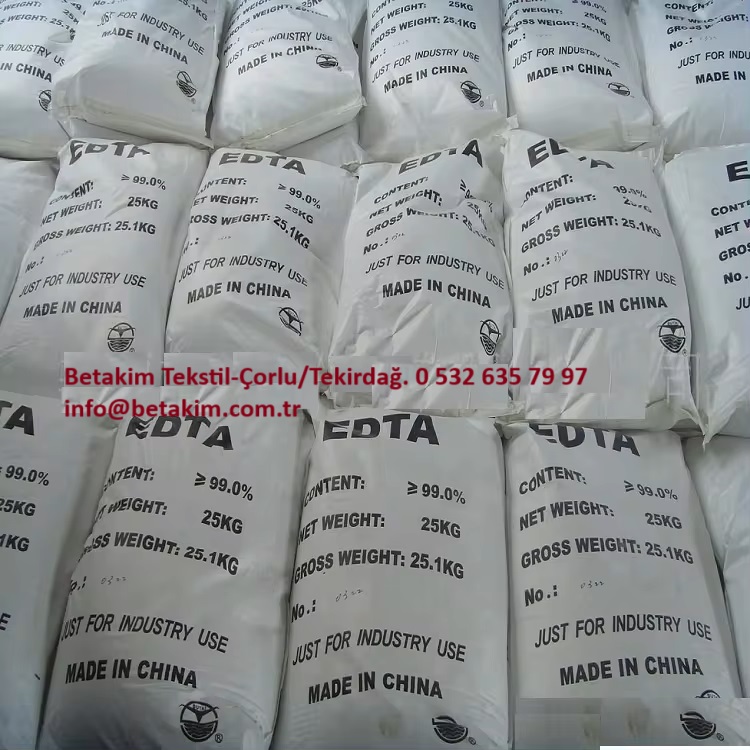
Send EmailEthylene Diamine Tetra Acetic Acid, Edetic Acid, Versene, Chelating Agent, EDTA, 60-00-4
Basic Properties
-
Chemical Formula: C10H16N2O8
-
CAS Number: 60-00-4
-
Molecular Weight: 292.24 g/mol
-
Appearance: White crystalline powder
-
Solubility: Slightly soluble in water (about 0.5 g/L at 25 °C)
-
pH (1% solution): 4.0–5.0
-
Melting Point: 237 °C
-
Density: 0.86 g/cm³
-
Storage Conditions: 2–8 °C
Structural Characteristics
-
Belongs to the polyamino carboxylic acid group.
-
Contains multiple -COOH and -NH2 groups.
-
Strong ability to bind metal ions, forming stable complexes.
Applications
-
Water Treatment: Prevents scale formation by binding calcium and magnesium ions.
-
Detergents and Cleaning Agents: Improves cleaning efficiency by sequestering metal ions.
-
Cosmetics: Stabilizes formulations and prevents oxidation.
-
Food Industry: Preserves color, taste, and texture; extends shelf life.
-
Pharmaceuticals: Used as an anticoagulant in blood samples.
-
Agriculture: Enhances plant access to essential nutrients.
-
Textiles and Paper: Supports bleaching processes and prevents catalytic damage.
-
Electronics and Metal Plating: Assists in copper deposition for printed circuit boards.
-
Industrial Use: Applied in coal plants, oil platforms, and polymer production as a cleaning or stabilizing agent.
Other Names
-
Ethylenediaminetetraacetic Acid
-
Edetic Acid
-
Versene
-
Chelating Agent / Sequestering Agent
Major Types of EDTA and Their Uses
| Type | Chemical Form | CAS Number | Key Applications |
|---|---|---|---|
| EDTA (Free Acid) | Ethylenediaminetetraacetic acid | 60-00-4 | Used in analytical chemistry, laboratory buffers, and as a base compound for preparing salts. |
| Disodium EDTA (Na2EDTA) | Disodium dihydrogen ethylenediaminetetraacetate | 139-33-3 | Common in cosmetics, food preservation, and pharmaceuticals; stabilizes formulations and prevents oxidation. |
| Tetrasodium EDTA (Na4EDTA) | Tetrasodium ethylenediaminetetraacetate | 64-02-8 | Widely used in detergents, cleaning agents, and water treatment due to higher solubility and alkaline nature. |
| Calcium Disodium EDTA (CaNa2EDTA) | Calcium disodium ethylenediaminetetraacetate | 62-33-9 | Medical use in chelation therapy for heavy metal poisoning (e.g., lead). |
| DTPA (Diethylenetriaminepentaacetic Acid) | Extended chelating agent related to EDTA | 67-43-6 | Used in nuclear medicine imaging and industrial cleaning where stronger chelation is required. |
| HEDTA (Hydroxyethyl-EDTA) | Hydroxyethyl ethylenediaminetriacetic acid | 140-01-2 | Applied in agriculture and textile processing, especially for micronutrient delivery. |
Key Application Areas
-
Water Treatment: Na4EDTA is preferred for preventing scale and binding Ca²⁺/Mg²⁺ ions.
-
Cosmetics & Personal Care: Na2EDTA stabilizes creams, shampoos, and lotions by preventing metal-catalyzed degradation.
-
Food Industry: Na2EDTA acts as a preservative, maintaining color and flavor stability.
-
Pharmaceuticals: CaNa2EDTA is used in chelation therapy for lead poisoning; Na2EDTA serves as an anticoagulant in blood samples.
-
Agriculture: HEDTA and EDTA salts improve micronutrient availability to plants.
-
Industrial Cleaning & Detergents: Na4EDTA enhances cleaning efficiency by sequestering metal ions.
-
Textiles & Paper: EDTA salts prevent catalytic damage during bleaching and improve brightness.
Risks and Considerations
-
Safety: EDTA salts are generally safe at regulated concentrations but can cause toxicity if misused, especially in medical applications.
-
Environmental Impact: EDTA is persistent in the environment; wastewater treatment plants must manage its disposal carefully.
-
Regulatory Limits: Food and pharmaceutical use is strictly controlled, with maximum allowable concentrations set by agencies like FDA and EFSA.
BASF PRODUCTS:
Chelating Agents
- Trilon® BS Ethylenediaminetetra acetic acid (EDTA) Powder approx. 99 approx. 2.8 approx. 820
- Trilon® BS Powder Powder approx. 99 approx. 2.5––
- Trilon® BD Disodium salt of EDTA, dihydrate Powder ≥ 89 approx. 4.5 approx. 950
- Trilon® B Liquid Tetrasodium salt of EDTA Liquid approx. 40 approx. 11.5–approx. 1.31
- Trilon® B Powder Tetrasodium salt of EDTA, tetrahydrate Powder approx. 87 approx. 11.5 approx. 700
- Trilon® BX Liquid Tetrasodium salt of EDTA, pure form Liquid approx. 40 approx. 11.5–approx. 1.28
- Trilon® BX Powder Powder approx. 84 approx. 11.2 approx. 845
- Trilon® D Liquid Trisodium salt of Hydroxyethyl ethylenediaminetriacetic acid (HEDTA) Liquid approx. 40 approx. 11.5–approx. 1.26
- Trilon® M Liquid Trisodium salt of Methylglycine diacetic acid (MGDA) Liquid approx. 40 approx. 11.0–approx. 1.30
- Trilon® M EcoBalanced Liquid approx. 40 approx. 11.0–approx. 1.30
- Trilon® M Max EcoBalanced Gran Solid approx. 81 approx. 11.4 approx. 790