We unleash your business potential by maximize the business innovation.
Send EmailLinalool, Linalyl Alcohol, Linaloyl Oxide, 78-70-6
LINALOOL – LINALOOL
CAS Number: 78-70-6
EC Number (EINECS): 201-134-4
Molecular Formula: C₁₀H₁₈O
Molecular Weight: 154.25 g/mol
Chemical Class: Terpene alcohol (monoterpenoid)
SECTION 1: CHEMICAL IDENTITY AND DEFINITION
| Parameter | Information |
|---|---|
| Chemical Name (IUPAC) | 3,7-Dimethyl-1,6-octadien-3-ol |
| Other Names | Linalyl Alcohol, β-Linalool, Licareol, Koriandrol, Linaloyl Oxide, Allo-ocimenol |
| Chemical Formula | C₁₀H₁₈O |
| Molecular Weight | 154.25 g/mol |
| CAS Number | 78-70-6 |
| EC Number (EINECS) | 201-134-4 |
| Chemical Class | Terpene alcohol (monoterpenoid) |
| Appearance | Colorless to pale yellow, oily liquid |
| Odor | Floral, slightly spicy, lavender-like |
| Taste | Slightly spicy, floral |
| Physical State (20°C) | Liquid |
| Optical Activity | (R)-(-)-Linalool and (S)-(+)-Linalool enantiomers available |
| Source | Lavender, coriander, basil, orange, bay leaf |
| E Number | Not assigned |
SECTION 2: PHYSICAL PROPERTIES
| Property | Value |
|---|---|
| Appearance | Colorless to pale yellow, oily liquid |
| Odor | Floral, slightly spicy, lavender-like |
| Molecular Weight | 154.25 g/mol |
| Melting Point | < -20 °C |
| Boiling Point | 198 – 199 °C |
| Density (20°C) | 0.858 – 0.868 g/cm³ |
| Refractive Index (nD²⁰) | 1.460 – 1.464 |
| Specific Rotation [α]D²⁰ | -12° to -17° (R-form), +12° to +17° (S-form) |
| Solubility in Water | Slightly soluble (~1.5 g/L) |
| Solubility in Ethanol | Miscible |
| Solubility in Oils | Miscible |
| Solubility in Organic Solvents | Miscible (ether, chloroform, hexane) |
| Flash Point | 76 °C (closed cup) |
| Vapor Pressure (20°C) | ~0.16 mmHg |
| Log P (octanol/water) | 2.97 |
SECTION 3: CHEMICAL PROPERTIES
| Property | Information |
|---|---|
| Chemical Formula | C₁₀H₁₈O |
| Molecular Weight | 154.25 g/mol |
| Chemical Class | Terpene alcohol (monoterpenoid) |
| Functional Groups | Alcohol (-OH), two double bonds (C=C) |
| Structure | Acyclic monoterpene alcohol |
| SMILES | CC(=CCCC(C)(C=C)O)C |
| InChI Key | CDOSHBSSFJOMGT-UHFFFAOYSA-N |
| Optical Isomers | (R)-(-)-Linalool (natural, lavender), (S)-(+)-Linalool (natural, coriander) |
| Stability | Stable under normal storage conditions |
| Oxidation | Slowly oxidizes in air |
| Incompatible Materials | Strong oxidizing agents, strong acids, strong bases |
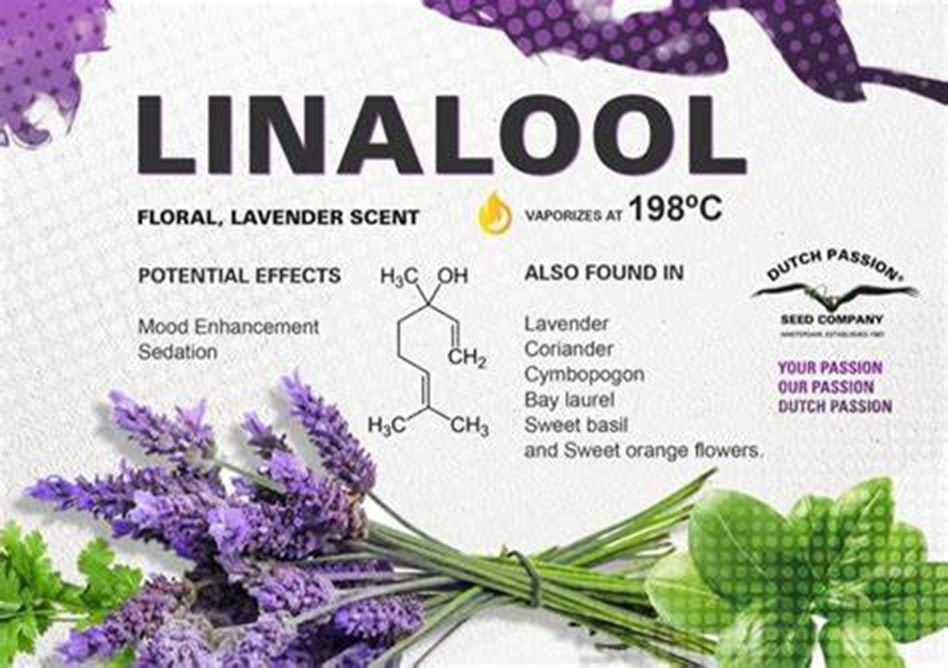
Chemical Structure:
    CH₃
     |
CH₃-C-CH₂-CH₂-CH=C(CH₃)₂
     |
     OH

3,7-Dimethyl-1,6-octadien-3-ol
(Linalool)
SECTION 4: ENANTIOMERS
| Isomer | CAS Number | Source | Odor Profile |
|---|---|---|---|
| (R)-(-)-Linalool | 126-91-0 | Lavender, bay leaf, basil | Sweet, floral, lavender-like |
| (S)-(+)-Linalool | 126-90-9 | Coriander, sweet orange, bergamot | Spicy, woody, coriander-like |
| Racemic (R/S) | 78-70-6 | Synthetic mixture | Mixed profile |
SECTION 5: NATURAL SOURCES
| Source | Content (%) | Enantiomer |
|---|---|---|
| Lavender (Lavandula officinalis) | 30-50% | R-(-) |
| Coriander (Coriandrum sativum) | 60-80% | S-(+) |
| Sweet Basil (Ocimum basilicum) | 30-70% | R-(-) |
| Sweet Orange (Citrus sinensis) | 10-30% | S-(+) |
| Bay Leaf (Laurus nobilis) | 30-50% | R-(-) |
| Bergamot (Citrus bergamia) | 10-20% | S-(+) |
| Rosemary (Rosmarinus officinalis) | 10-30% | R-(-) |
| Thyme (Thymus vulgaris) | 10-20% | R-(-) |
SECTION 6: APPLICATION AREAS
6.1. Perfume and Cosmetic Industry
| Application | Function |
|---|---|
| Perfumes | Fragrance component; floral, lavender note |
| Cosmetic Products | Fragrance component |
| Soaps | Fragrance component |
| Lotions and Creams | Fragrance component |
| Shampoos | Fragrance component |
| Detergents | Fragrance component |
| Room Sprays | Fragrance component |
6.2. Food Industry
| Application | Function |
|---|---|
| Flavoring Agent | Natural flavor component (FEMA 2635) |
| Flavor Enhancer | Flavoring in foods and beverages |
| Spice Blends | Flavor component |
| Alcoholic Beverages | Flavor and taste component |
6.3. Agriculture
| Application | Function |
|---|---|
| Insect Repellent | Natural insect repellent |
| Insecticide | Natural pesticide |
6.4. Household Products
| Application | Function |
|---|---|
| Cleaning Products | Fragrance component |
| Fabric Softeners | Fragrance component |
SECTION 7: BIOLOGICAL ACTIVITIES
| Activity | Description |
|---|---|
| Anti-inflammatory | Reduces inflammation |
| Antimicrobial | Effective against bacteria and fungi |
| Antioxidant | Scavenges free radicals |
| Anxiolytic | Calming, anxiety-reducing effects |
| Sedative | Sleep-promoting effects |
| Analgesic | Pain-relieving effects |
| Insect Repellent | Effective against mosquitoes and other insects |
SECTION 8: SAFETY AND HEALTH INFORMATION
GHS Classification
| Hazard Class | Category |
|---|---|
| Skin Irritation | Category 2 (H315) |
| Eye Irritation | Category 2A (H319) |
| Skin Sensitization | Category 1 (H317) |
| Aquatic Toxicity (Chronic) | Category 2 (H411) |
| Signal Word | Warning |
Hazard Statements (H-Codes)
| Code | Statement |
|---|---|
| H315 | Causes skin irritation |
| H317 | May cause an allergic skin reaction |
| H319 | Causes serious eye irritation |
| H411 | Toxic to aquatic life with long lasting effects |
Precautionary Statements (P-Codes)
| Code | Statement |
|---|---|
| P261 | Avoid breathing vapors |
| P280 | Wear protective gloves/eye protection |
| P302+P352 | IF ON SKIN: Wash with plenty of soap and water |
| P305+P351+P338 | IF IN EYES: Rinse cautiously with water for several minutes; remove contact lenses if present and easy to do; continue rinsing |
SECTION 9: TOXICOLOGICAL INFORMATION
| Parameter | Value |
|---|---|
| Oral LD50 (Rat) | 2,790 mg/kg |
| Dermal LD50 (Rabbit) | > 5,000 mg/kg |
| Skin Irritation | Mild irritant |
| Eye Irritation | Mild irritant |
| Skin Sensitization | May be sensitizing |
| Carcinogenicity | Not classified |
| Mutagenicity | Negative in standard tests |
| Target Organs | Skin, eyes |
SECTION 10: FIRST AID MEASURES
| Exposure Route | Action |
|---|---|
| Inhalation | Move to fresh air. If respiratory irritation persists, seek medical attention. |
| Skin Contact | Wash with plenty of soap and water. Remove contaminated clothing. |
| Eye Contact | Rinse immediately with plenty of water for at least 15 minutes. Seek medical attention. |
| Ingestion | Rinse mouth. Do not induce vomiting. Seek medical attention. |
SECTION 11: STORAGE AND SHELF LIFE
| Parameter | Information |
|---|---|
| Storage Conditions | Cool (15-25°C), dry, well-ventilated area |
| Container Requirements | Tightly closed, light-resistant containers |
| Protect From | Light, air (oxidation), heat, strong oxidizing agents |
| Shelf Life | 24-48 months (unopened original packaging) |
| Stability Note | Slowly oxidizes in air; color may darken |
SECTION 12: PACKAGING OPTIONS
| Packaging Type | Quantity | Material |
|---|---|---|
| Glass bottle | 1-5 L | Amber glass |
| Plastic drum | 200-250 kg | HDPE |
| Plastic pail | 20-25 kg | HDPE |
| Aluminum foil bag | 1-5 kg | Laminated aluminum |
SECTION 13: TRANSPORT INFORMATION
| Parameter | Information |
|---|---|
| UN Number | Not regulated (not dangerous goods) |
| Hazard Class | Not applicable |
| Packing Group | Not applicable |
| ADR/RID | Not regulated |
| IMDG Code | Not regulated |
| IATA (Air) | Not regulated |
| Marine Pollutant | Yes (H411) |
SECTION 14: FIRE-FIGHTING MEASURES
| Parameter | Information |
|---|---|
| Fire Hazard | Combustible liquid |
| Flash Point | 76 °C |
| Suitable Extinguishing Media | CO₂, dry chemical powder, alcohol-resistant foam, water spray |
| Specific Hazards | When heated, emits CO, CO₂ |
| Decomposition Products | CO, CO₂ |
| Protective Equipment | Self-contained breathing apparatus (SCBA), full protective clothing |
SECTION 15: ACCIDENTAL SPILLAGE AND CLEANUP
| Parameter | Information |
|---|---|
| Personal Protection | Nitrile gloves, protective goggles, chemical-resistant clothing |
| Cleaning Methods | Absorb with inert material (sand, vermiculite); dispose in sealed containers |
| Environmental Precautions | Prevent entry into drains, soil, and surface waters |
| Waste Disposal | According to local regulations; incineration at licensed facilities |
SECTION 16: OTHER NAMES AND SYNONYMS
| Type | Name |
|---|---|
| Turkish Names | Linalol, Linalil Alkol |
| English Names | Linalool, Linalyl Alcohol, Licareol, Koriandrol, Linaloyl Oxide |
| Chemical Names | 3,7-Dimethyl-1,6-octadien-3-ol, β-Linalool, Allo-ocimenol |
| CAS Number | 78-70-6 |
| EC Number | 201-134-4 |
| FEMA Number | 2635 |
| PubChem CID | 6549 |
SECTION 17: SUMMARY AND CRITICAL NOTES
Product Summary
| Parameter | Value |
|---|---|
| Product | Linalool |
| CAS Number | 78-70-6 |
| Appearance | Colorless to pale yellow, oily liquid |
| Odor | Floral, lavender-like |
| Boiling Point | 198-199 °C |
| Primary Function | Fragrance component, flavoring agent |
Critical Notes
-
Natural Source: Linalool is naturally found in lavender, coriander, basil, orange, and many other plants.
-
Enantiomers: Two optical isomers exist: (R)-(-)-Linalool (lavender odor) and (S)-(+)-Linalool (coriander odor).
-
Fragrance Component: Widely used in perfumes, cosmetics, soaps, and detergents.
-
Flavoring Agent: Used as a natural flavoring agent in the food industry (FEMA 2635).
-
Bioactivity: Exhibits anti-inflammatory, antimicrobial, antioxidant, and sedative properties.
-
Insect Repellent: Effective as a natural insect repellent.
-
Sensitization: May cause skin sensitization in some individuals.
-
Oxidation: Slowly oxidizes in air; oxidation products may increase allergenic potential.
-
Environmental Impact: Toxic to aquatic life (H411); avoid release into the environment.
-
Regulatory Status: Widely approved in cosmetic, food, and fragrance industries; no E number assigned.
IMPORTANT DECLARATION: This Technical Data Sheet (TDS) is for informational purposes only and has been prepared based on available technical data. The user is responsible for determining the product's suitability for their specific application and for complying with all local, national, and international regulations. For complete safety, storage, use, transport, waste, and regulatory compliance information, refer to the official Safety Data Sheet (SDS/MSDS) provided by the manufacturer/supplier.