We unleash your business potential by maximize the business innovation.
Send EmailThymol, Isopropyl Methyl Phenol, Thyme Camphor, 89-83-8
THYMOL – TİMOL
CAS Number: 89-83-8
EC Number (EINECS): 201-944-8
Molecular Formula: C₁₀H₁₄O
Molecular Weight: 150.22 g/mol
Chemical Class: Monoterpenoid phenol
SECTION 1: CHEMICAL IDENTITY AND DEFINITION
| Parameter | Information |
|---|---|
| Chemical Name (IUPAC) | 2-Isopropyl-5-methylphenol |
| Other Names | Thymol, Isopropyl Methyl Phenol, 5-Methyl-2-(1-methylethyl)phenol, Thyme Camphor |
| Chemical Formula | C₁₀H₁₄O |
| Molecular Weight | 150.22 g/mol |
| CAS Number | 89-83-8 |
| EC Number (EINECS) | 201-944-8 |
| Chemical Class | Monoterpenoid phenol |
| Appearance | Colorless to white, crystalline solid |
| Odor | Characteristic, pungent, thyme-like, medicinal |
| Taste | Pungent, spicy, burning |
| Physical State (20°C) | Solid (crystalline) |
| Source | Thyme (Thymus vulgaris), oregano, basil |
| E Number | Not assigned |
SECTION 2: PHYSICAL PROPERTIES
| Property | Value |
|---|---|
| Appearance | Colorless to white, crystalline solid |
| Odor | Characteristic, pungent, thyme-like, medicinal |
| Taste | Pungent, spicy, burning |
| Molecular Weight | 150.22 g/mol |
| Melting Point | 48 – 51 °C |
| Boiling Point | 232 °C |
| Density (20°C) | 0.965 g/cm³ |
| Refractive Index (nD²⁰) | 1.520 – 1.525 |
| Solubility in Water | Slightly soluble (~0.9 g/L) |
| Solubility in Ethanol | Highly soluble |
| Solubility in Oils | Soluble |
| Solubility in Organic Solvents | Highly soluble (ether, chloroform, acetone) |
| Flash Point | 102 °C (closed cup) |
| Vapor Pressure (25°C) | ~0.06 mmHg |
| Log P (octanol/water) | 3.30 |
| pKa | 10.59 (phenolic) |
SECTION 3: CHEMICAL PROPERTIES
| Property | Information |
|---|---|
| Chemical Formula | C₁₀H₁₄O |
| Molecular Weight | 150.22 g/mol |
| Chemical Class | Monoterpenoid phenol |
| Functional Groups | Phenolic hydroxyl (-OH) |
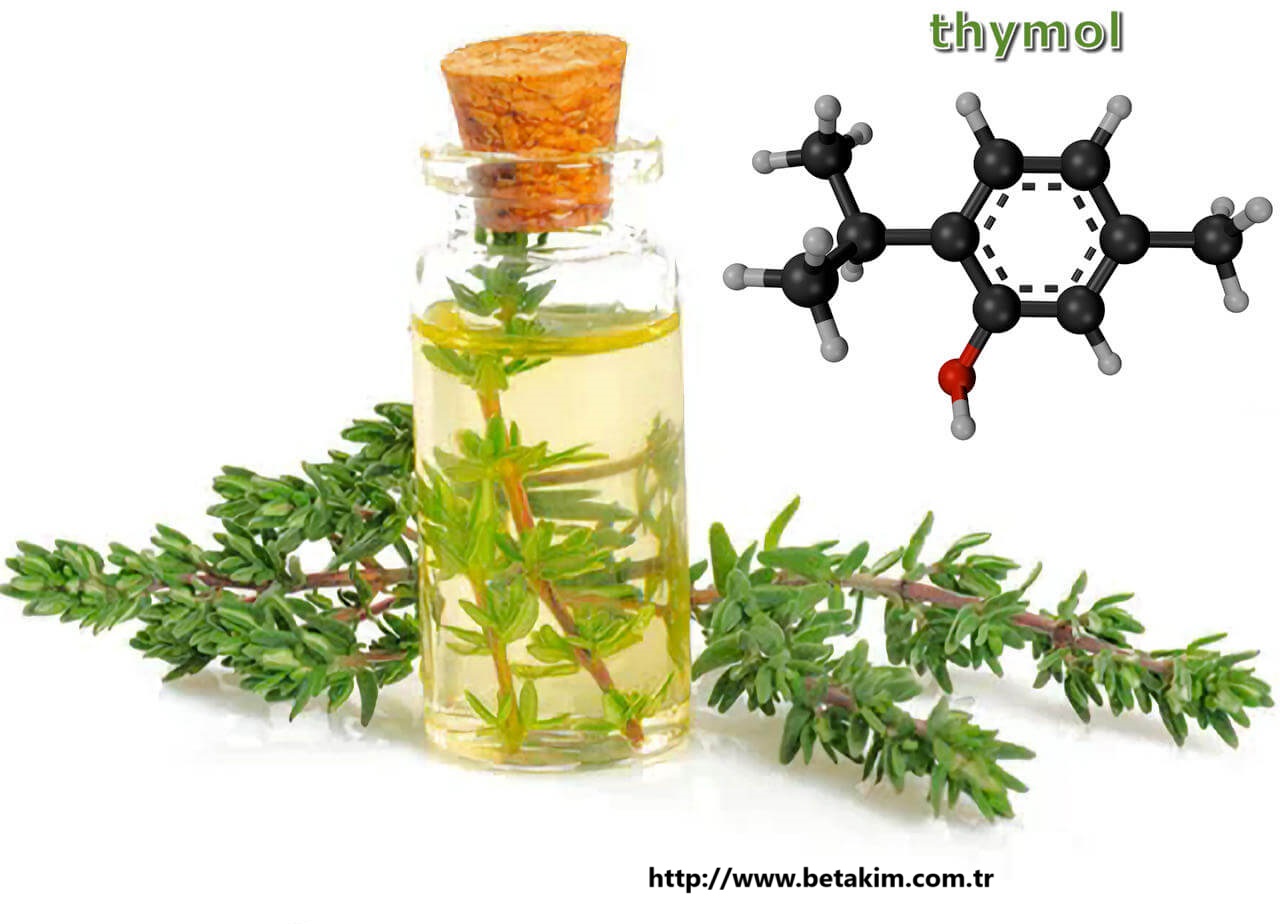
| Structure | Benzene ring with hydroxyl, methyl, and isopropyl substituents |
| SMILES | CC1=CC(=C(C=C1)C(C)C)O |
| InChI Key | MGSRCZKZVOBKFT-UHFFFAOYSA-N |
| Stability | Stable under normal storage conditions |
| Oxidation | Slowly oxidizes in air |
| Incompatible Materials | Strong oxidizing agents, strong bases, strong acids |
Chemical Structure:
    OH
     |
    C₆H₃(CH₃)(CH(CH₃)₂)
     |
2-Isopropyl-5-methylphenol
(Thymol)
SECTION 4: NATURAL SOURCES
| Source | Content (%) | Description |
|---|---|---|
| Thyme (Thymus vulgaris) | 30-70% | Primary commercial source |
| Oregano (Origanum vulgare) | 10-30% | Significant source |
| Wild Thyme (Thymus serpyllum) | 20-50% | Moderate source |
| Basil (Ocimum basilicum) | 5-15% | Moderate source |
| Ajowan (Trachyspermum ammi) | 40-60% | Rich source |
| Satureja (Satureja hortensis) | 20-40% | Moderate source |
SECTION 5: ANTIMICROBIAL ACTIVITY
| Microorganism | Activity | Description |
|---|---|---|
| Bacteria | Strong antibacterial | Effective against Gram-positive and Gram-negative bacteria |
| Fungi | Strong antifungal | Effective against Candida, Aspergillus species |
| Yeast | Moderate activity | Effective against Saccharomyces species |
| Mold | Good activity | Effective against common molds |
| Biofilm | Inhibits biofilm formation | Prevents bacterial biofilm development |
Mechanism of Action:
-
Disrupts cell membrane integrity
-
Denatures proteins and enzymes
-
Increases membrane permeability
-
Causes leakage of cellular contents
SECTION 6: APPLICATION AREAS
6.1. Medical and Pharmaceutical Applications
| Application | Function |
|---|---|
| Antiseptic | Wound disinfection; skin sterilization |
| Mouthwash | Antimicrobial; treats gingivitis |
| Throat Lozenges | Antiseptic; sore throat relief |
| Topical Creams | Antimicrobial; wound healing |
| Vapor Rubs | Decongestant; respiratory relief |
| Teeth Whitening | Antimicrobial component |
| Dental Products | Toothpaste, mouthwash, dental floss |
6.2. Cosmetic and Personal Care
| Application | Function |
|---|---|
| Toothpaste | Antimicrobial, breath freshening |
| Skin Care | Antimicrobial, preservative |
| Deodorants | Antibacterial, odor control |
| Soaps | Antimicrobial, fragrance |
6.3. Food Industry
| Application | Function |
|---|---|
| Food Preservative | Natural antimicrobial agent |
| Flavoring Agent | Spicy, thyme-like flavor (FEMA 3066) |
| Spice Blends | Flavor component |
| Essential Oils | Natural preservative |
6.4. Agricultural Applications
| Application | Function |
|---|---|
| Fungicide | Natural antifungal agent |
| Insect Repellent | Natural insect deterrent |
| Seed Treatment | Antimicrobial seed coating |
SECTION 7: BIOLOGICAL ACTIVITIES
| Activity | Description |
|---|---|
| Antimicrobial | Effective against bacteria, fungi, and yeast |
| Antioxidant | Scavenges free radicals |
| Anti-inflammatory | Reduces inflammation |
| Antispasmodic | Relieves muscle spasms |
| Expectorant | Loosens mucus |
| Anesthetic | Mild local anesthetic effect |
| Antitussive | Cough suppressant |
SECTION 8: COMPARISON WITH CARVACROL
| Property | Thymol | Carvacrol |
|---|---|---|
| Chemical Formula | C₁₀H₁₄O | C₁₀H₁₄O |
| Structure | Isopropyl at ortho, methyl at meta | Isopropyl at ortho, methyl at para |
| Odor | Thyme-like, medicinal | Oregano-like, spicy |
| Melting Point | 48-51 °C | 0-5 °C |
| Antimicrobial Activity | Strong | Very Strong |
| Solubility | Similar | Similar |
| Source | Thyme, oregano | Oregano, thyme |
SECTION 9: QUALITY SPECIFICATIONS
| Parameter | Specification (USP / Ph. Eur.) |
|---|---|
| Appearance | Colorless to white, crystalline solid |
| Identification | Positive (IR, HPLC) |
| Assay (on dried basis) | 99.0 – 101.0% |
| Melting Point | 48 – 51 °C |
| Loss on Drying | ≤ 0.5% |
| Residue on Ignition | ≤ 0.1% |
| Heavy Metals (as Pb) | ≤ 10 ppm |
| Lead (Pb) | ≤ 2 ppm |
| Arsenic (As) | ≤ 3 ppm |
| Mercury (Hg) | ≤ 1 ppm |
| Cadmium (Cd) | ≤ 1 ppm |
| Related Substances | ≤ 1.0% |
SECTION 10: STORAGE AND SHELF LIFE
| Parameter | Information |
|---|---|
| Storage Conditions | Cool (15-25°C), dry, well-ventilated area |
| Container Requirements | Tightly closed, light-resistant containers |
| Protect From | Light, air (oxidation), heat, strong oxidizing agents |
| Shelf Life | 24-48 months (unopened original packaging) |
| Stability Note | Slowly oxidizes in air; color may darken |
SECTION 11: PACKAGING OPTIONS
| Packaging Type | Quantity | Material |
|---|---|---|
| Glass bottle | 1-5 kg | Amber glass |
| Plastic pail | 20-25 kg | HDPE |
| Fiber drum | 25-50 kg | HDPE + PE |
| Aluminum foil bag | 1-5 kg | Laminated aluminum |
SECTION 12: SAFETY AND HEALTH INFORMATION
GHS Classification
| Hazard Class | Category |
|---|---|
| Acute Toxicity (Oral) | Category 4 (H302) |
| Skin Irritation | Category 2 (H315) |
| Eye Irritation | Category 2A (H319) |
| Skin Sensitization | Category 1 (H317) |
| Aquatic Toxicity (Chronic) | Category 3 (H412) |
| Signal Word | Warning |
Hazard Statements (H-Codes)
| Code | Statement |
|---|---|
| H302 | Harmful if swallowed |
| H315 | Causes skin irritation |
| H317 | May cause an allergic skin reaction |
| H319 | Causes serious eye irritation |
| H412 | Harmful to aquatic life with long lasting effects |
Precautionary Statements (P-Codes)
| Code | Statement |
|---|---|
| P261 | Avoid breathing dust |
| P280 | Wear protective gloves/eye protection |
| P301+P312 | IF SWALLOWED: Call a POISON CENTER/doctor if you feel unwell |
| P302+P352 | IF ON SKIN: Wash with plenty of soap and water |
| P305+P351+P338 | IF IN EYES: Rinse cautiously with water for several minutes; remove contact lenses if present and easy to do; continue rinsing |
SECTION 13: TOXICOLOGICAL INFORMATION
| Parameter | Value |
|---|---|
| Oral LD50 (Rat) | 980 mg/kg |
| Dermal LD50 (Rabbit) | > 5,000 mg/kg |
| Skin Irritation | Moderate irritant |
| Eye Irritation | Moderate irritant |
| Skin Sensitization | May be sensitizing |
| Carcinogenicity | Not classified |
| Mutagenicity | Negative in standard tests |
SECTION 14: FIRST AID MEASURES
| Exposure Route | Action |
|---|---|
| Inhalation | Move to fresh air. If respiratory irritation persists, seek medical attention. |
| Skin Contact | Wash with plenty of soap and water. Remove contaminated clothing. |
| Eye Contact | Rinse immediately with plenty of water for at least 15 minutes. Seek medical attention. |
| Ingestion | Rinse mouth. Do not induce vomiting. Seek medical attention. |
SECTION 15: REGULATORY STATUS
| Region / Authority | Status |
|---|---|
| European Union | Approved as food flavoring and cosmetic ingredient |
| USA (FDA) | GRAS (21 CFR 172.515) |
| Turkey | Approved (food and cosmetic) |
| EFSA | Approved as food flavoring |
SECTION 16: TRANSPORT INFORMATION
| Parameter | Information |
|---|---|
| UN Number | Not regulated (not dangerous goods) |
| Hazard Class | Not applicable |
| Packing Group | Not applicable |
| ADR/RID | Not regulated |
| IMDG Code | Not regulated |
| IATA (Air) | Not regulated |
| Marine Pollutant | No |
SECTION 17: FIRE-FIGHTING MEASURES
| Parameter | Information |
|---|---|
| Fire Hazard | Combustible solid |
| Flash Point | 102 °C |
| Suitable Extinguishing Media | Water spray (mist), CO₂, dry chemical powder, alcohol-resistant foam |
| Specific Hazards | When heated, emits CO, CO₂ |
| Decomposition Products | CO, CO₂ |
| Protective Equipment | Self-contained breathing apparatus (SCBA), full protective clothing |
SECTION 18: ACCIDENTAL SPILLAGE AND CLEANUP
| Parameter | Information |
|---|---|
| Personal Protection | Nitrile gloves, protective goggles, dust mask (N95) |
| Cleaning Methods | Collect mechanically (sweep or spatula) |
| Environmental Precautions | Prevent entry into drains, soil, and surface waters |
| Waste Disposal | According to local regulations; incineration at licensed facilities |
SECTION 19: OTHER NAMES AND SYNONYMS
| Type | Name |
|---|---|
| Turkish Names | Timol, Kekik Yağı Bileşiği, İzopropil Metil Fenol |
| English Names | Thymol, 2-Isopropyl-5-methylphenol, Isopropyl Methyl Phenol |
| Chemical Names | 5-Methyl-2-(1-methylethyl)phenol, Thyme Camphor |
| CAS Number | 89-83-8 |
| EC Number | 201-944-8 |
| FEMA Number | 3066 |
| PubChem CID | 6989 |
SECTION 20: SUMMARY AND CRITICAL NOTES
Product Summary
| Parameter | Value |
|---|---|
| Product | Thymol |
| CAS Number | 89-83-8 |
| Appearance | Colorless to white, crystalline solid |
| Odor | Pungent, thyme-like, medicinal |
| Melting Point | 48-51 °C |
| Primary Function | Antimicrobial, antiseptic |
Critical Notes
-
Natural Source: Thymol is naturally found in thyme, oregano, basil, and ajowan.
-
Powerful Antimicrobial: Effective against bacteria, fungi, and yeast; used as a natural preservative.
-
Antiseptic: Widely used in mouthwashes, toothpastes, and wound disinfectants.
-
GRAS Status: Approved as GRAS by FDA (21 CFR 172.515).
-
Medicinal Odor: Characteristic thyme-like, medicinal odor.
-
Flavoring Agent: Used as a flavoring agent in foods (FEMA 3066).
-
Irritant: May cause skin and eye irritation; handle with care.
-
Crystalline Solid: Solid at room temperature (melting point 48-51°C); must be heated for liquid applications.
-
Phenolic Compound: Contains phenolic hydroxyl group; responsible for antimicrobial activity.
-
Regulatory Status: Approved in food, pharmaceutical, and cosmetic industries; no E number assigned.
IMPORTANT DECLARATION: This Technical Data Sheet (TDS) is for informational purposes only and has been prepared based on available technical data. The user is responsible for determining the product's suitability for their specific application and for complying with all local, national, and international regulations. For complete safety, storage, use, transport, waste, and regulatory compliance information, refer to the official Safety Data Sheet (SDS/MSDS) provided by the manufacturer/supplier. This document does not replace medical advice.