We unleash your business potential by maximize the business innovation.
Send EmailLinear Alkyl Benzene Sulfonic Acid, Linear Alkyl Benzene Sulfonate, LABSA, 27176-87-0, 68584-22-5
LINEAR ALKYL BENZENE SULFONIC ACID (LABSA)
1. PRODUCT DEFINITION AND CHEMICAL IDENTITY
| Parameter | Description |
|---|---|
| Chemical Name | Linear Alkyl Benzene Sulfonic Acid |
| Common Abbreviation | LABSA |
| CAS Number | 27176-87-0 (general); 68584-22-5 (C10-13 alkyl derivatives) |
| Molecular Formula | C₁₈H₃₀O₃S (representative; varies with alkyl chain length) |
| Molecular Weight | ~326 g/mol (for a typical commercial mixture); 158.18 g/mol corresponds only to the approximate mass of the benzene ring with the sulfonic acid group, not the entire molecule |
| Chemical Class | Anionic Surfactant |
| Appearance | Yellowish to brown, viscous liquid |
Note: LABSA is a strong organic acid and anionic surfactant obtained by the sulfonation of linear alkyl benzene (LAB). It is one of the highest-volume synthetic surfactants produced globally. It is commercially available with a typical active matter content of 96-97%. It is the primary raw material for the production of anionic surfactants (e.g., Sodium Alkyl Benzene Sulfonate - LAS) through neutralization (typically with sodium hydroxide or triethanolamine). It possesses excellent cleaning, foaming, and emulsifying properties.
2. PHYSICAL AND CHEMICAL PROPERTIES
| Property | Value / Description |
|---|---|
| Physical form | Yellowish to brown, viscous liquid |
| Density (20 °C) | ~1.06 g/cm³ |
| Boiling point | >315 °C (decomposes) |
| Viscosity (25 °C) | 500 – 1500 mPa·s |
| Active Matter Content | ≥ 96% |
| Solubility in water | Soluble; hydrolyzes upon contact with water, releasing heat |
| pH (1% aqueous solution) | < 2 (strongly acidic) |
| Alkyl Chain Length | C10 – C13 (linear) |
| Oxidizing Property | None |
| Stability | Stable under normal conditions; reacts with strong bases and oxidizing agents |
3. FUNCTIONAL PROPERTIES AND MODE OF ACTION
-
Primary Surfactant Precursor: The most important function of LABSA is its conversion into an anionic surfactant (LAS - Linear Alkyl Benzene Sulfonate) through neutralization with an alkali (NaOH, TEA, etc.). This neutralized form is the fundamental cleaning component in detergent formulations.
-
Excellent Cleaning and Soil Removal: The resulting LAS exhibits high surface activity, lifting solid and liquid soils from surfaces, dispersing them in water, and preventing re-deposition.
-
High Foaming Power and Foam Stability: Provides rich, abundant, and stable lather, especially in powder and liquid detergents, soaps, and shampoos.
-
Wetting and Emulsifying Agent: Effectively lowers surface tension, allowing water to rapidly penetrate surfaces, and emulsifies oils and greases.
-
Synergistic Effect: Cleaning performance and foam quality are enhanced when used in combination with other anionic (e.g., SLES), non-ionic, and amphoteric surfactants.
-
Acidic Catalyst and Intermediate: Used in the regeneration of ion-exchange resins, the production of fuel cell polymer materials, and in some organic syntheses due to its acidic nature.
4. ALTERNATIVE NAMES AND SYNONYMS
-
Linear Alkyl Benzene Sulfonic Acid
-
LABSA
-
Sulfonic Acid
-
Dodecyl Benzene Sulfonic Acid (DDBSA) (for the C12 chain)
-
Alkyl Benzene Sulfonic Acid
-
Phenyl Sulfonic Acid
5. NEUTRALIZATION AND FORMULATION INFORMATION
In most formulations, LABSA is used not directly in its acid form but in its neutralized salt form:
| Neutralizing Agent | Resulting Product | Application Area |
|---|---|---|
| Sodium Hydroxide (NaOH) | Sodium Alkyl Benzene Sulfonate (LAS-Na) | Powder detergents, liquid detergents, industrial cleaners |
| Triethanolamine (TEA) | TEA-Alkyl Benzene Sulfonate | Liquid hand soaps, shampoos, mild cleaners |
| Potassium Hydroxide (KOH) | Potassium Alkyl Benzene Sulfonate (LAS-K) | Liquid detergents, agrochemical emulsifiers |
| Monoethanolamine (MEA) | MEA-Alkyl Benzene Sulfonate | Cosmetic cleansers |
Neutralization Warning: The neutralization of LABSA with an alkali is exothermic (releases heat). Always slowly add the acid to the water (or alkaline solution) , never the reverse.
6. SECTORAL APPLICATIONS AND USAGE RATES
| Sector | Application | Typical Usage Rate (as neutralized LAS) |
|---|---|---|
| Household & Industrial Cleaning | Laundry powder, liquid detergent, dishwashing liquid, general purpose cleaners | 5 – 25% (powder); 5 – 15% (liquid) |
| Soap Manufacturing | Emulsifier and wetting agent in toilet soaps | 2 – 10% |
| Textile | Washing units, mercerization processes | 1 – 5% (in process bath) |
| Water Treatment | Catalyst in ion-exchange resins (via its acidity) | Process-specific |
| Energy | Component of polymer material in fuel cells | Process-specific |
| Cosmetics | Cream formulations for removing dead skin cells | 1 – 5% |
| Polymer/Pigment | Production of pigment polymer materials | Process-specific |
7. ADVANTAGES AND DISADVANTAGES
| ✅ Advantages | ❌ Disadvantages |
|---|---|
| High cleaning power and excellent foam performance | Can be more irritating to the skin compared to other surfactants (e.g., SLES) |
| Suitable for a wide range of formulations (powder, liquid, tablet) | Performance decreases in hard water (high Ca/Mg ions); requires builders (water softeners) |
| Cost-effective; ideal for large-scale production | The strong acid form (un-neutralized LABSA) is corrosive; requires special handling and storage |
| Biodegradable (due to its linear alkyl chain) | Can be toxic to aquatic organisms at high concentrations |
| Excellent synergy with other surfactants |
8. SAFETY, STORAGE, AND TRANSPORT
-
GHS Classification (CLP Regulation):
-
Signal Word: Danger
-
Hazard Statements: H314 (Causes severe skin burns and eye damage), H318 (Causes serious eye damage).
-
Precautionary Statements: P260, P264, P280, P301+P330+P331, P303+P361+P353, P304+P340+P310, P305+P351+P338, P310, P405, P501.
-
-
Storage Conditions:
-
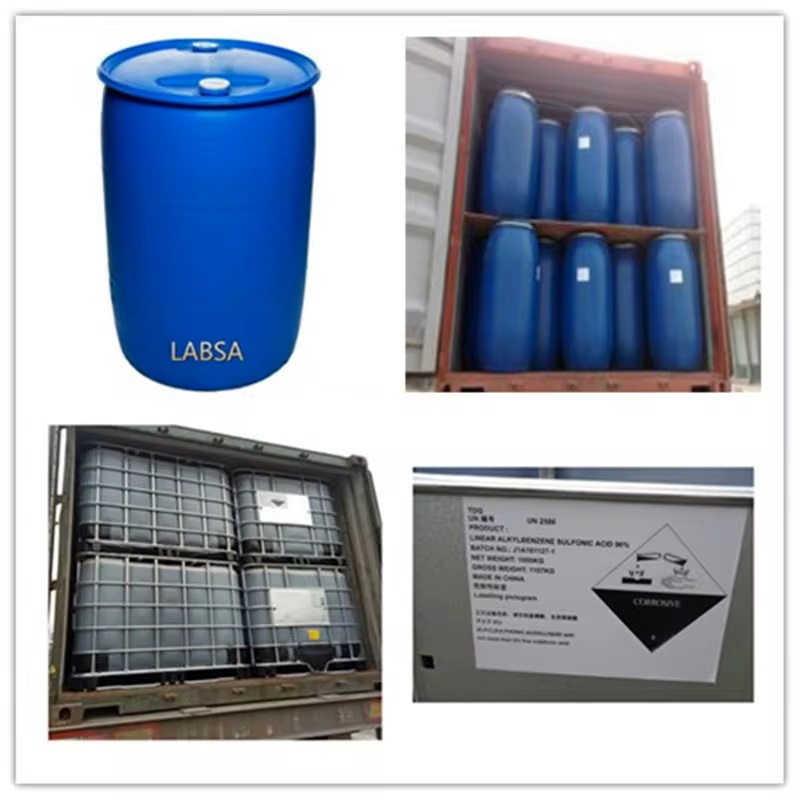
Store in a cool (<30 °C), dry, and well-ventilated area in tightly sealed, acid-resistant containers (HDPE, stainless steel 316L).
-
Keep away from strong bases, oxidizing agents, and moisture.
-
At low temperatures (<10 °C), its viscosity increases, and it may become cloudy; this is a physical change and does not affect product quality. Allow it to reach room temperature before use.
-
-
Personal Protective Equipment (PPE): Use acid-resistant gloves (neoprene, butyl rubber), face shield/safety goggles, and acid-resistant clothing. Avoid breathing vapours.
-
First Aid:
-
Skin contact: Remove contaminated clothing immediately and wash the skin with plenty of water for at least 15 minutes.
-
Eye contact: Rinse immediately with plenty of water for at least 15 minutes and seek medical attention.
-
Ingestion: Rinse mouth with water; do not induce vomiting; seek immediate medical attention.
-
-
Transport: UN 2586, Class 8 (Corrosive Liquid), Packing Group III.
9. FREQUENTLY ASKED QUESTIONS
Q1: What is the difference between LABSA and LAS?
LABSA (Linear Alkyl Benzene Sulfonic Acid) is the acid form. LAS (Linear Alkyl Benzene Sulfonate) is the neutralized salt form of LABSA, typically with NaOH. The active cleaning component used in detergents is LAS. LABSA is the primary raw material for producing LAS.
Q2: Why does LABSA lose its effectiveness in hard water?
LAS (the neutralized salt of LABSA) forms insoluble salts (calcium LAS, magnesium LAS) with calcium (Ca²⁺) and magnesium (Mg²⁺) ions in hard water. As these salts are insoluble, they precipitate and lose their cleaning efficacy. Therefore, builder substances (e.g., sodium carbonate, sodium tripolyphosphate, zeolite) are added to detergent formulations to soften the water.
Q3: Is LABSA biodegradable?
Yes, the linear alkyl chain in commercial LABSA can be broken down by microorganisms. This is a significant environmental advantage over the branched (non-linear) alkyl benzene sulfonates used in the past, which were persistent in the environment.
Q4: Why is it necessary to neutralize LABSA?
LABSA is a very strong acid (pH < 2) and is highly corrosive to the skin. Neutralization converts it into a skin-compatible, mild cleansing salt and allows it to be easily incorporated into formulations.
Q5: What should be done if LABSA freezes?
LABSA does not freeze, but it becomes very viscous and cloudy at low temperatures. This is temporary. Allowing the drum to stand at room temperature (20-25 °C) before use is sufficient for the product to clear and become fluid. Its chemical properties remain unchanged.
10. QUICK REFERENCE TABLE
| Property | Value |
|---|---|
| CAS | 27176-87-0 |
| Abbreviation | LABSA |
| Appearance | Yellowish – brown viscous liquid |
| Active Matter | ≥ 96% |
| Density | ~1.06 g/cm³ |
| pH (1% solution) | < 2 (strongly acidic) |
| Alkyl Chain | C10 – C13 (linear) |
| Main Use | Primary raw material for anionic surfactant (LAS) production |
| Hazard Class | UN 2586, Class 8 (Corrosive Liquid) |