We unleash your business potential by maximize the business innovation.
Send Email2-Ethylhexanol, 2-Ethylhexyl Alcohol, Isooctanol, Octyl Alcohol, 2-EH, 104-76-7
2-ETHYLHEXANOL (2-EH)
1. PRODUCT DEFINITION AND CHEMICAL IDENTITY
| Parameter | Description |
|---|---|
| Chemical Name (IUPAC) | 2-Ethylhexan-1-ol |
| Common Name | 2-Ethylhexanol, 2-EH |
| Other Names | 2-Ethyl-1-hexanol, 2-Ethylhexyl alcohol, Isooctanol (for technical mixtures), Octyl alcohol (generic) |
| CAS Number | 104-76-7 |
| EC Number | 203-234-3 |
| Molecular Formula | C₈H₁₈O (CH₃(CH₂)₃CH(C₂H₅)CH₂OH) |
| Molecular Weight | 130.23 g/mol |
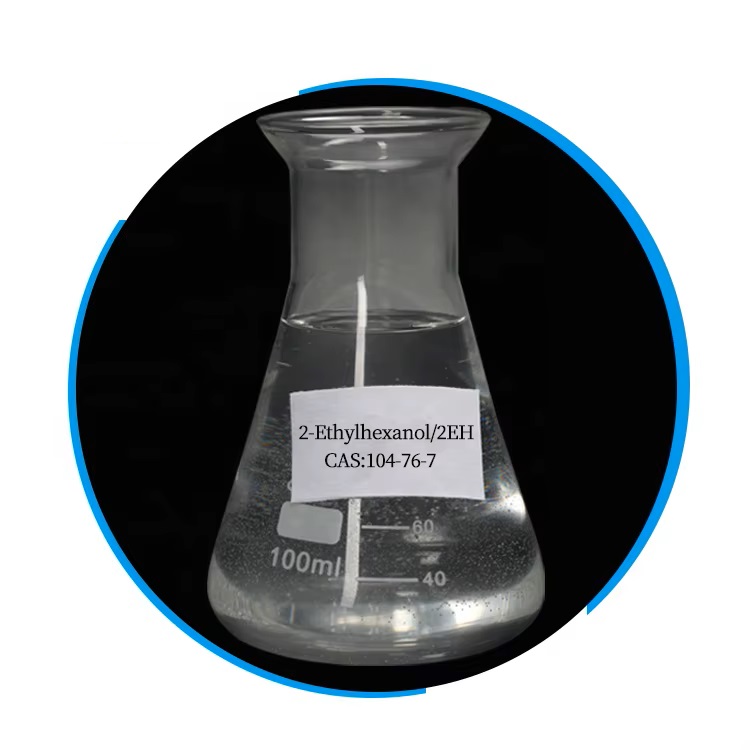
| Appearance | Clear, colourless liquid |
| Odour | Characteristic, slightly oily odour |
Note: 2-Ethylhexanol is a branched primary alcohol. It occurs naturally in trace amounts in plants such as grape (Vitis rotundifolia) and honeysuckle (Lonicera japonica), and is a metabolite detected in yeast (Saccharomyces cerevisiae). Technical product is typically >99% pure.
2. PHYSICAL AND CHEMICAL PROPERTIES
| Property | Value |
|---|---|
| Freezing/melting point | −76 °C (very low) |
| Boiling point | 184–185 °C (at 760 mmHg) |
| Flash point (closed cup) | 73 °C |
| Auto-ignition temperature | ~290 °C |
| Density (20 °C) | ~0.833 g/cm³ |
| Vapour pressure (20 °C) | 0.1 mmHg (13 Pa) |
| Viscosity (20 °C) | ~9–10 mPa·s |
| Solubility in water (20 °C) | 0.07 g/100 mL (practically insoluble) |
| Solubility in organic solvents | Completely miscible with alcohols, ethers, ketones, aromatic hydrocarbons |
| pH | Neutral (no acidic/basic function) |
| Volatility (evaporation rate) | Low (butyl acetate = 1; 2-EH ≈ 0.01) |
| Refractive index (n₂₀/D) | ~1.431 |
| Surface tension (20 °C) | ~30 mN/m |
3. FUNCTIONAL PROPERTIES
-
Plasticizer alcohol: Reacts with dibasic acids (phthalic anhydride, adipic acid, azelaic acid, etc.) to form high-performance plasticizers (DOP, DOA, DOZ, DOTP).
-
High-boiling solvent: Provides long open time in resins, waxes, and coatings due to low evaporation rate.
-
Defoamer / anti-foaming agent: Especially effective in drilling fluids and industrial processes for foam control.
-
Intermediate: Key raw material for the production of 2-ethylhexyl acrylate, sunscreen esters (octocrylene, octyl methoxycinnamate), surfactants, and lubricant additives.
-
Extraction solvent: Used in metal separation and purification processes.
-
Low toxicity & non-HAP: Not listed as a Hazardous Air Pollutant (HAP); suitable for use in confined spaces.
4. ALTERNATIVE NAMES AND SYNONYMS
-
2-Ethylhexanol (2-EH)
-
2-Ethyl-1-hexanol
-
2-Ethylhexyl alcohol
-
Isooctanol (in technical grades, mixture of isomers)
-
Octyl alcohol (generic, but not to be confused with 1-octanol)
-
Octanol (misnomer)
-
Ethylhexanol
5. SECTORAL APPLICATIONS, USAGE RATES, AND EXAMPLE FORMULATIONS
| Sector | Purpose | Typical Usage Rate / Notes |
|---|---|---|
| Plasticizer Production | Raw material alcohol for DOP, DOTP, DOA, DOZ, TOTM synthesis | Stoichiometric: 2 moles of 2-EH per mole of diester |
| PVC & Polymers | Impart flexibility through plasticizers | 30–60 phr depending on plasticizer formulation |
| Drilling & Oilfield | Defoamer; low-volatility solvent | 0.1–1.0% of drilling fluid weight |
| Paints, Varnishes, Coatings | Slow-evaporating solvent; flow and gloss enhancer | 5–15% of total solvent content |
| Printing Inks | Retarder solvent | 2–8% |
| Cleaning Products | Low-volatility solvent, degreaser | 3–10% |
| Sunscreens & Cosmetics | Raw material for octocrylene and other esters; indirect use | Used in ester form |
| Metal Extraction | Organic phase modifier in purification of copper, zinc, etc. | 5–20% |
| Agriculture | Emulsifier and solvent additive | 5–15% |
Example Formulations:
-
Plasticizer DOP (Dioctyl Phthalate) Synthesis:
-
Phthalic anhydride (1 mol) + 2-Ethylhexanol (2.2 mol, slight excess) + catalyst (tetraalkyl titanate) → DOP + water.
-
Reaction at 180–220 °C with continuous removal of water. Excess alcohol is recovered under vacuum.
-
-
Drilling Fluid Defoamer (Concentrate):
-
2-Ethylhexanol: 60% (active ingredient)
-
Hydrophobic fumed silica: 10%
-
Surfactant: 5%
-
Carrier oil (mineral): 25%
-
Dosage in drilling mud: 0.1–0.5 L/m³.
-
-
Slow-Drying Alkyd Varnish:
-
Long oil alkyd resin (70%): 50 kg
-
Mineral spirits: 15 kg
-
2-Ethylhexanol: 10 kg (for flow and gloss)
-
Xylene: 25 kg
2-EH reduces brush marks and enhances surface smoothness.
-
6. ALTERNATIVES AND COMPARISON
| Alternative | Advantage / Disadvantage |
|---|---|
| n-Octanol (1-octanol) | Higher melting point (−16 °C) and less branching; its esters have poorer low-temperature performance than 2-EH |
| Isooctanol (mixture) | Similar properties in technical quality, but plasticizer performance may show slight differences |
| 2-Propylheptanol (2-PH) | Yields higher molecular weight plasticizers (DPHP); much lower volatility, but slightly higher cost |
| Butyl diglycol (BDG) | Slower evaporation, water miscible; but cannot form esters and is not a plasticizer feedstock |
7. REGULATORY STATUS AND SAFETY
-
GHS Classification (CLP Regulation):
-
Signal word: Warning
-
Hazard statements:
-
H315: Causes skin irritation.
-
H319: Causes serious eye irritation.
-
H335: May cause respiratory irritation.
-
-
Precautionary statements: P261, P264, P271, P280, P302+P352, P304+P340, P305+P351+P338, P312, P332+P313, P337+P313, P362, P403+P233, P405, P501.
-
-
Hazardous Air Pollutant (HAP): Not listed, which is a significant advantage.
-
Environment:
-
Readily biodegradable (OECD 301).
-
Low toxicity to aquatic organisms.
-
May spread on water surface; do not discharge into drains or watercourses.
-
-
Storage: Store in stainless steel or HDPE containers, in a cool (<30 °C), dry, well-ventilated area. Keep away from oxidizing agents, strong acids, and bases. Not hygroscopic.
-
Packaging: 200 kg steel drums, 1000 kg IBCs, bulk tankers.
8. FREQUENTLY ASKED QUESTIONS
Q1. Is 2-Ethylhexanol the same as isooctanol?
Isooctanol generally refers to a mixture of branched C8 alcohols. Commercial isooctanol contains 2-ethylhexanol as the major component but may include minor amounts of other isomers. For most applications, technical grades are considered equivalent.
Q2. What should I do if it comes into contact with eyes?
Rinse immediately with plenty of water for at least 15 minutes and seek medical attention. It is severely irritating to the eyes.
Q3. Which plasticizers are produced from 2-EH?
Mainly DOP (DEHP), DOTP, DOA, DOZ, TOTM. These plasticizers are used in PVC products such as cables, films, and flooring.
Q4. Does it mix with water?
Practically immiscible. Its solubility is only 0.07 g/100 mL, and it is less dense than water; it can form a thin film on the water surface.
Q5. Is its odour harmful?
The characteristic odour is not offensive, but high vapour concentrations can cause respiratory irritation. Ensure adequate ventilation.
Q6. What is its shelf life?
Under cool, dry, and closed storage, more than 24 months. Once opened, it is recommended to use within 6 months.
Q7. Why is it preferred as a defoamer in drilling fluids?
Its high boiling point prevents evaporation at the high temperatures encountered in deep wells, and its insolubility in water allows long-lasting spreading action on foam.
Q8. What alternatives can be used?
For plasticizer production, 2-propylheptanol or isononanol; for solvent applications, butyl diglycol or low-odour glycol ethers can be considered. However, each offers different physical properties.
9. QUICK REFERENCE TABLE
| Property | Value |
|---|---|
| CAS | 104-76-7 |
| Formula | C₈H₁₈O |
| Freezing point | −76 °C |
| Boiling point | 185 °C |
| Density | 0.833 g/cm³ |
| Solubility in water | Very low (0.07 g/100 mL) |
| Flash point | 73 °C |
| Chemical family | Branched primary alcohol |
| Main applications | Plasticizers, solvent, defoamer, intermediate |