We unleash your business potential by maximize the business innovation.
Send EmailThiourea Dioxide, Formamidine Sulfinic Acid, Basic Reductant, Aminoimino Methane Sulfinic Acid, TUDO, FAS, TDO, 1758-73-2
THIOUREA DIOXIDE (TDO)
1. PRODUCT DEFINITION AND CHEMICAL IDENTITY
| Parameter | Description |
|---|---|
| Chemical Name | Thiourea Dioxide |
| Synonyms | Formamidine Sulfinic Acid, Aminoiminomethanesulfinic Acid, Methanesulfinic acid, aminomino, TUDO, FAS, TDO |
| CAS Number | 1758-73-2 |
| Molecular Formula | CH₄N₂O₂S |
| Molecular Weight | 108.12 g/mol |
| Appearance | Free-flowing white crystalline powder |
| Odour | Odourless |
2. TECHNICAL SPECIFICATIONS
| Parameter | Specification |
|---|---|
| Appearance | Free-flowing white crystalline powder |
| Active Ingredients (Purity) | 99.0% Min |
| Thiourea Content | 0.10% Max |
| Moisture | 0.05% Max |
| Ash | 0.17% Max |
| Iron (Fe) | 0.001% Max |
3. PHYSICAL AND CHEMICAL PROPERTIES
| Property | Value / Description |
|---|---|
| Physical form | White crystalline powder |
| Odour | Odourless |
| Solubility in water (20 °C) | 26.7 g/L |
| pH (saturated aqueous solution, 20 °C) | ~5.0 (mildly acidic) |
| Stability (dry powder) | Stable; no oxidizing or reducing properties in dry form |
| Stability (aqueous solution, 20–30 °C) | Very stable |
| Reactivity | Decomposes gradually under heat and alkali conditions to form sulfinic acid, a strong reducing agent |
4. FUNCTIONAL PROPERTIES
-
Latent Reducing Agent: Thiourea dioxide is a stable compound in its dry powder form and in cool aqueous solution. It exhibits no oxidizing or reducing properties under these conditions. However, when heated or in the presence of alkali, it decomposes in a controlled manner to generate sulfinic acid, a highly active reducing species. This "latent" or "activatable" reducing power is its most valuable characteristic.
-
High Redox Potential and Efficiency: Once activated, it provides strong and efficient reduction, making it highly effective even at low concentrations.
-
Safe Handling: Unlike many other strong reducing agents, TDO is non-volatile, odourless, and stable during storage and transport, posing fewer immediate hazards. It does not release toxic gases under normal storage conditions.
-
Controlled Reactivity: The reduction process can be precisely controlled by adjusting temperature and pH, allowing its use in sensitive and precise industrial applications.
5. ALTERNATIVE NAMES AND SYNONYMS
-
Thiourea Dioxide (TDO)
-
Formamidine Sulfinic Acid (FAS)
-
Aminoiminomethanesulfinic Acid
-
TUDO
-
Methanesulfinic acid, aminomino
6. SECTORAL APPLICATIONS AND USAGE RATES
| Sector | Purpose | Typical Usage / Notes |
|---|---|---|
| Dyeing Industry / Textile | Discharge printing (colour stripping), reductive washing of polyester fibres, bleaching of cotton, wool, and silk | 1–5 g/L in processing baths; activated by heat and/or alkali |
| Pulp and Paper Industry | Bleaching of mechanical and recycled pulp; de-inking and colour removal | 0.5–2% on pulp weight |
| Synthetic Fiber Industry | Reductive washing of synthetic fibres to remove oxidative residues and improve whiteness | 1–3 g/L |
| Organic Synthesis | Reducing agent for various organic transformations (e.g., reduction of ketones, nitro compounds) | Stoichiometric or slight excess, depending on the reaction |
| Polymer Industry | Additive in polymerization reactions; stabilizer for polyethylene and other polymers | 0.1–0.5% |
| Photography | Sensitizer for photographic emulsions | Trace amounts, highly specific |
| Water Treatment | Removal of excess oxidants (e.g., chlorine, hydrogen peroxide) and colour from wastewater | 5–50 ppm, depending on oxidant load |
| CMC Production | Intermediate for sulfoxylic acid production, used in Carboxymethyl Cellulose (CMC) synthesis | Process-specific |
Example Formulations:
-
Discharge Printing Paste (Textile):
-
Thiourea Dioxide: 5–10% of paste weight
-
Alkali (e.g., sodium carbonate): 2–5% (activator)
-
Printing gum/thickener: balance
Applied to dyed fabric, then steamed. The heat and alkali activate the TDO, which reduces and destroys the dye, creating a white or coloured pattern.
-
-
Polyester Reductive Washing Bath:
-
Thiourea Dioxide: 2 g/L
-
Sodium hydroxide (NaOH): 1 g/L (to activate)
-
Non-ionic detergent: 1 g/L
Treat at 80–90 °C for 20 minutes.
-
7. REGULATORY STATUS AND SAFETY
-
GHS Classification: Generally not classified as hazardous in its dry, stable form. However, decomposition products may be irritants. Always consult the product SDS for the specific classification.
-
Stability: Stable under normal storage conditions. It is a non-oxidizing, non-reducing compound in dry form and cool aqueous solution. Reactivity is triggered only by heat or alkali.
-
Storage: Store in a cool, dry, and well-ventilated place. Avoid dampness, insolation (direct sunlight), and rain. Keep away from heat, sparks, flames, alkalis, and oxidizing agents. Containers should be kept tightly closed.
-
Handling: Avoid creating and breathing dust. Use protective gloves and safety goggles. In case of contact with eyes, rinse immediately with plenty of water.
-
Environmental: Decomposition products are urea and sulfate, which are relatively benign compared to other reducing agents. Avoid large-scale release into waterways.
8. PACKAGING
-
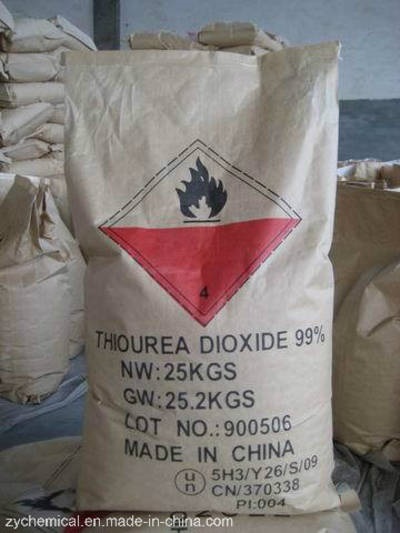
25 kg net kraft paper bag / plastic woven bag
-
80 kg net kraft paper bag / plastic woven bag
-
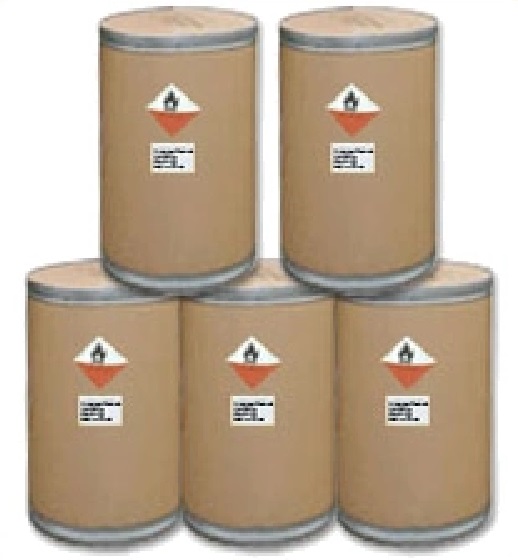
50 kg fibre drum
-
500 kg jumbo bag
9. ALTERNATIVES AND COMPARISON
| Alternative Reducing Agent | Comparison with Thiourea Dioxide |
|---|---|
| Sodium Hydrosulfite (Sodium Dithionite) | Strong reducing agent but highly unstable, flammable when wet, generates sulfur dioxide gas. TDO is safer and more stable. |
| Rongalite (Sodium Formaldehyde Sulfoxylate) | Commonly used in discharge printing. Releases formaldehyde, which is a carcinogen. TDO is formaldehyde-free. |
| Sodium Borohydride | Powerful reducing agent; more expensive, generates hydrogen gas, requires careful handling. TDO is easier to handle and more cost-effective for many applications. |
| Sodium Sulfite / Bisulfite | Milder reducing agents; not strong enough for discharge printing or bleaching. TDO provides higher reduction potential. |
10. FREQUENTLY ASKED QUESTIONS
Q1: How is thiourea dioxide activated for reduction?
TDO is a latent reducing agent. It becomes active when heated in an aqueous solution, especially in the presence of an alkali (e.g., sodium hydroxide or sodium carbonate). The decomposition releases sulfinic acid, which is the actual active reducing species. By controlling temperature and pH, the reduction rate can be precisely managed.
Q2: Is thiourea dioxide the same as thiourea?
No. They are chemically distinct. Thiourea dioxide (CH₄N₂O₂S) is an oxidized derivative of thiourea (CH₄N₂S) with different properties. Thiourea is primarily an intermediate and vulcanization accelerator, while thiourea dioxide is a reducing agent. High-purity TDO, as specified here, contains only trace amounts of residual thiourea (0.1% Max).
Q3: Why is TDO considered a "safer" reducing agent?
Unlike many other strong reducing agents, TDO is stable, non-volatile, and non-reactive in its dry powder form and in cool water. It does not catch fire easily, nor does it release toxic gases spontaneously. The reducing reaction is only initiated upon heating or adding alkali, making it much safer to store, transport, and handle.
Q4: Why is TDO preferred over Rongalite in discharge printing?
Although Rongalite is effective, it contains and can release formaldehyde, a known carcinogen. TDO is a formaldehyde-free alternative that provides the same, if not better, reduction power. This is crucial for meeting modern environmental and safety standards in the textile industry.
Q5: Can thiourea dioxide be used for water treatment?
Yes, it is very effective for neutralizing and removing excess oxidants like chlorine or hydrogen peroxide from process water or wastewater. It also acts as a colour-removing agent by reducing chromophoric compounds. It leaves benign by-products (urea and sulfate).
11. QUICK REFERENCE TABLE
| Property | Value / Description |
|---|---|
| CAS | 1758-73-2 |
| Formula | CH₄N₂O₂S |
| Molecular weight | 108.12 g/mol |
| Appearance | White free-flowing crystalline powder |
| Purity | ≥ 99.0% |
| Moisture | ≤ 0.05% |
| Solubility in water (20 °C) | 26.7 g/L |
| pH (saturated solution) | ~5.0 |
| Main function | Latent reducing agent |
| Key applications | Textile discharge printing, bleaching, organic synthesis |