We unleash your business potential by maximize the business innovation.
Send EmailHexamethylenetetramine, Methenamine, Hexamine, Methenamine, Urotropine, Hexamethylene Tetramine, E239, HMT, HMTA, 100-97-0
TECHNICAL DATA SHEET (TDS) – HEXAMETHYLENETETRAMINE (HMTA, HEXAMINE)
1. PRODUCT DEFINITION AND CHEMICAL IDENTITY
| Parameter | Description |
|---|---|
| Chemical Name (IUPAC) | 1,3,5,7-Tetraazatricyclo[3.3.1.1³,⁷]decane |
| Common Name | Hexamethylenetetramine, Hexamine, Methenamine, Urotropine |
| Other Names | Formin, Aminoform, HMTA, E239 (food preservative code – restricted) |
| CAS Number | 100-97-0 |
| EC Number | 202-905-8 |
| Molecular Formula | C₆H₁₂N₄ |
| Molecular Weight | 140.186 g/mol |
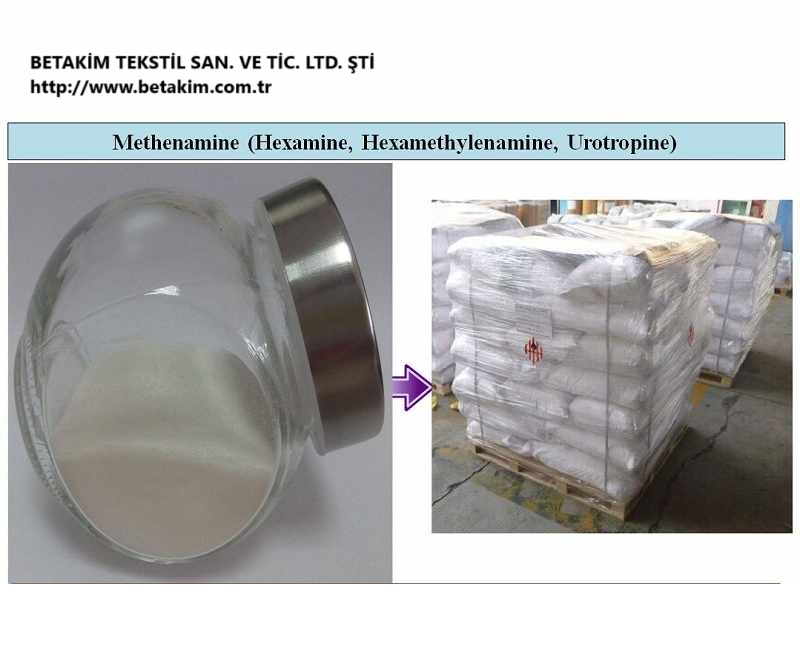
| Appearance | White, crystalline powder or granules; practically odourless, faint amine character |
Note: The product is synthesized by the controlled condensation of formaldehyde and ammonia, followed by crystallization and drying. It exhibits a cage-like, tetrahedral heterocyclic structure. It is a weak base and forms complexes with many metal ions (Bi, Co, Cu, Mn, Mg, Li, Pt, In, Th, etc.).
2. PHYSICAL AND CHEMICAL PROPERTIES
| Property | Value |
|---|---|
| Melting point | Does not melt; sublimes and decomposes at ~280–300 °C |
| Density | ~1.33 g/cm³ (crystalline) |
| Solubility in water (20 °C) | Freely soluble (~85 g/100 mL) |
| Solubility in ethanol | Slightly soluble |
| Solubility in chloroform | Slightly soluble |
| pH (aqueous solution) | Weakly alkaline (~8–9) |
| Decomposition | Hydrolyses in acidic media to release formaldehyde and ammonia; decomposes at elevated temperatures |
| Thermal stability | Stable below 280 °C; sublimes without melting |
| Flash point | Not applicable (solid, combustible but non-flammable in dust form) |
| Vapour pressure | Very low at ambient temperature |
3. FUNCTIONAL PROPERTIES
-
Formaldehyde donor: Under heat or acidic conditions, reversibly releases formaldehyde, used as a curing agent and crosslinker.
-
Curing agent (phenolic resins): Reacts with novolak resins to produce highly crosslinked structures, providing hardness, thermal resistance, and chemical durability.
-
Vulcanization accelerator: In rubber systems (H‑accelerator family), promotes sulfur crosslinking.
-
Crosslinking agent: Used in plastics, adhesives, and coatings to build three-dimensional networks.
-
Fuel: Pressed tablets burn with a clean, hot flame, low in smoke, used for camping and military rations.
-
Complexing agent: Forms stable complexes with many metal ions, valuable for analytical chemistry and metal recovery.
-
Preservative (E239, restricted): Historically used in cheese, but now limited or banned in many jurisdictions; check local regulations.
4. ALTERNATIVE NAMES AND SYNONYMS
-
Hexamethylenetetramine
-
Hexamine
-
Methenamine (pharmaceutical)
-
Urotropine
-
Formin
-
Aminoform
-
HMTA
-
E239 (food additive code, restricted)
-
Hexa (industrial abbreviation)
5. PRODUCT GRADES AND SPECIFICATIONS
| Grade | Description | Main Applications |
|---|---|---|
| Stabilized (Inhibited) | Contains trace stabilizer to reduce discolouration and degradation over time; controlled reactivity. | Phenolic resin curing, rubber vulcanization, textile finishing |
| Unstabilized (Uninhibited) | Pure product without additives; slightly more reactive. | Organic synthesis, fuel tablets, analytical reagents |
| Pharma grade (Methenamine) | High purity meeting pharmacopoeial standards (USP, EP). | Urinary antiseptic, topical antiperspirant |
| High purity / Analytical grade | Very low metal traces, controlled particle size. | Laboratory, chromatography, complexometric analysis |
| Typical Specification | Value |
|---|---|
| Purity (on dry basis) | ≥ 99.0% |
| Water content | ≤ 0.5% |
| Ash content | ≤ 0.05% |
| Colour (Gardner/Hazen) | Low, white to off-white |
| Particle size | As required (powder, granules, tablets) |
6. SECTORAL APPLICATIONS, USAGE RATES, AND EXAMPLE FORMULATIONS
| Sector | Purpose | Grade / Form | Notes |
|---|---|---|---|
| Fuel Tablets | Portable heating, camping stoves, military rations | Unstabilized, tablets/granules | Clean, hot flame; ensure ventilation |
| Organic Synthesis | Reagent/precursor for pharmaceuticals, plastic intermediates, explosives | Unstabilized, powder | Formaldehyde + ammonia source |
| Phenolic Resins | Curing agent for novolak resins, foundry sand binders, brake pads, laminates | Stabilized, powder/granules | Provides hardness and durability |
| Rubber | Vulcanization accelerator (H‑accelerator) | Stabilized, powder | Enhances crosslinking |
| Textile | Anti-shrink finishing, resin finishing systems | Stabilized, powder | Used in conjunction with resins |
| Pharmaceuticals | Urinary antiseptic (methenamine hippurate/mandelate), topical antiperspirant | Pharma grade | Requires strict purity |
| Analytical Chemistry | Complexometric reagent for Bi, Mn, Co, Pt, Mg, Li, Cu, etc. | High purity, unstabilized | Also used in chromatography |
| Gas Absorbers | In combination with sodium phenolate/NaOH for light gas absorption | Stabilized, powder | Niche application |
| Pesticide Production | Intermediate in certain syntheses | Unstabilized, powder | Controlled processes |
| Adhesives/Coatings | Crosslinker, curing accelerator | Stabilized | Improves thermal/chemical resistance |
Example Formulations:
-
Phenolic Novolak Moulding Compound:
-
Novolak resin: 100 parts
-
HMTA (stabilized): 10–15 parts (curing agent)
-
Fillers (wood flour, minerals): 100–200 parts
-
Lubricant: 1–2 parts
Mix, grind, and compression mould at 150–180 °C; HMTA decomposes to provide formaldehyde for crosslinking.
-
-
Rubber Vulcanization (SBR/BR Compound):
-
SBR 1502: 100 parts
-
Carbon black: 50 parts
-
Zinc oxide: 3 parts
-
Stearic acid: 2 parts
-
Sulfur: 2 parts
-
HMTA (as H‑accelerator): 1–2 parts
Typical cure at 150 °C; HMTA promotes faster, more uniform crosslinking.
-
-
Fuel Tablet (Simple Composition):
-
HMTA (unstabilized): 100 parts
-
Wax/binder (optional): 1–2 parts (to improve mechanical strength)
Press into tablets; ignite in a well-ventilated area.
-
7. REGULATORY STATUS AND SAFETY
-
GHS Classification (CLP Regulation):
-
Signal word: Warning
-
Hazard statements:
-
H228: Flammable solid.
-
H317: May cause an allergic skin reaction.
-
H335: May cause respiratory irritation.
-
-
Precautionary statements: P210, P261, P272, P280, P302+P352, P333+P313, P363, P403+P233, P501.
-
-
Food additive (E239): The use of hexamethylenetetramine as a preservative is no longer permitted in most jurisdictions or is severely restricted. Always verify local food regulations.
-
Environment: Not readily biodegradable; avoid release to aquatic environment. Dispose via licensed waste treatment.
-
Storage: Keep in tightly sealed containers, in a cool, dry, well-ventilated area (<30 °C). Protect from moisture and light. Incompatible with strong acids (hydrolysis, formaldehyde release) and strong oxidizers.
-
Packaging: 25 kg PE‑lined kraft bags, 500–1000 kg big bags, or as tablets in retail packaging.
8. FREQUENTLY ASKED QUESTIONS
Q1. What is the difference between stabilized and unstabilized grades?
Stabilized HMTA contains a small amount of inhibitor (often a mild base or amine) that retards decomposition and discolouration during storage. It gives more controlled reactivity in resin curing. Unstabilized is the pure form, preferred where no additive is allowed (e.g., synthesis, fuel).
Q2. Can HMTA be used as a food preservative?
Historically it was listed as E239 for certain cheeses, but this use is now banned or very limited in the EU, Turkey, and many other countries. Do not use industrial grade for food applications; pharmaceutical grade may be used for non‑food medicinal purposes only.
Q3. How does HMTA cure phenolic resins?
Upon heating, HMTA decomposes to release formaldehyde, which then reacts with the novolak resin to form methylene bridges, creating a highly crosslinked, rigid network.
Q4. Is HMTA explosive?
By itself it is not classified as explosive, but it is a flammable solid. It can be used as a precursor in the synthesis of certain explosives (RDX, etc.) when nitrated. Proper handling is required.
Q5. Does HMTA sublime at room temperature?
Sublimation is very slow at ambient conditions; it becomes significant above 200 °C. For storage, keep containers closed.
Q6. Is HMTA soluble in organic solvents?
It has limited solubility in ethanol and chloroform, and is practically insoluble in non‑polar solvents. It is highly soluble in water.
Q7. What is methenamine used for in medicine?
Methenamine (pharmaceutical grade) is used as a urinary antiseptic (often as hippurate or mandelate salt) because it releases formaldehyde in acidic urine, inhibiting bacterial growth. It is also used in some over‑the‑counter antiperspirant products.
Q8. How should HMTA be handled safely?
Avoid breathing dust; use in well‑ventilated areas. Wear gloves and safety glasses. May cause skin sensitization. If a large quantity is spilled, avoid generating dust and use an explosion‑proof vacuum.
9. QUICK REFERENCE TABLE
| Property | Value |
|---|---|
| CAS | 100-97-0 |
| Formula | C₆H₁₂N₄ |
| Molecular weight | 140.19 g/mol |
| Appearance | White crystalline powder |
| Purity | ≥ 99% |
| Ash | ≤ 0.05% |
| Main grades | Stabilized, unstabilized, pharma, high‑purity |
| Key uses | Phenolic curing, fuel tablets, rubber (H‑accelerator), pharma, synthesis |