We unleash your business potential by maximize the business innovation.
Send EmailButyl Acrylate, Acrylate Monomer, n-Butyl Acrylate, n-Butyl propenoate, Butyl prop-2-enoate, BA, 141-32-2
BUTYL ACRYLATE (BA)
Revision Date: April 2026
Chemical Family: Acrylate Monomer
1. PRODUCT DESCRIPTION & CHEMICAL IDENTITY
| Property | Value |
|---|---|
| Chemical Name (IUPAC) | Butyl prop-2-enoate |
| Trade Name | Butyl Acrylate (BA) / n-Butyl Acrylate |
| CAS Number | 141-32-2 |
| Molecular Formula | C₇H₁₂O₂ |
| Molecular Weight | 128.17 g/mol |
| Structural Description | Monofunctional monomer produced by the acid-catalyzed esterification of acrylic acid with n-butanol. |
| Synonyms | n-Butyl propenoate, Acrylic acid butyl ester, 2-Propenoic acid butyl ester |
2. SPECIFICATIONS (SALES SPECIFICATION)
| Parameter | Unit | Specification Value | Test Method |
|---|---|---|---|
| Purity | % (GC) | min. 99.5 | GC-FID |
| Acid Content | % (as Acrylic Acid) | max. 0.01 | Titration |
| Water Content | % | max. 0.05 | Karl Fischer |
| Color | APHA / Pt-Co | max. 10 | ASTM D1209 |
| Inhibitor (MEHQ) | ppm | 15 ± 5 | HPLC |
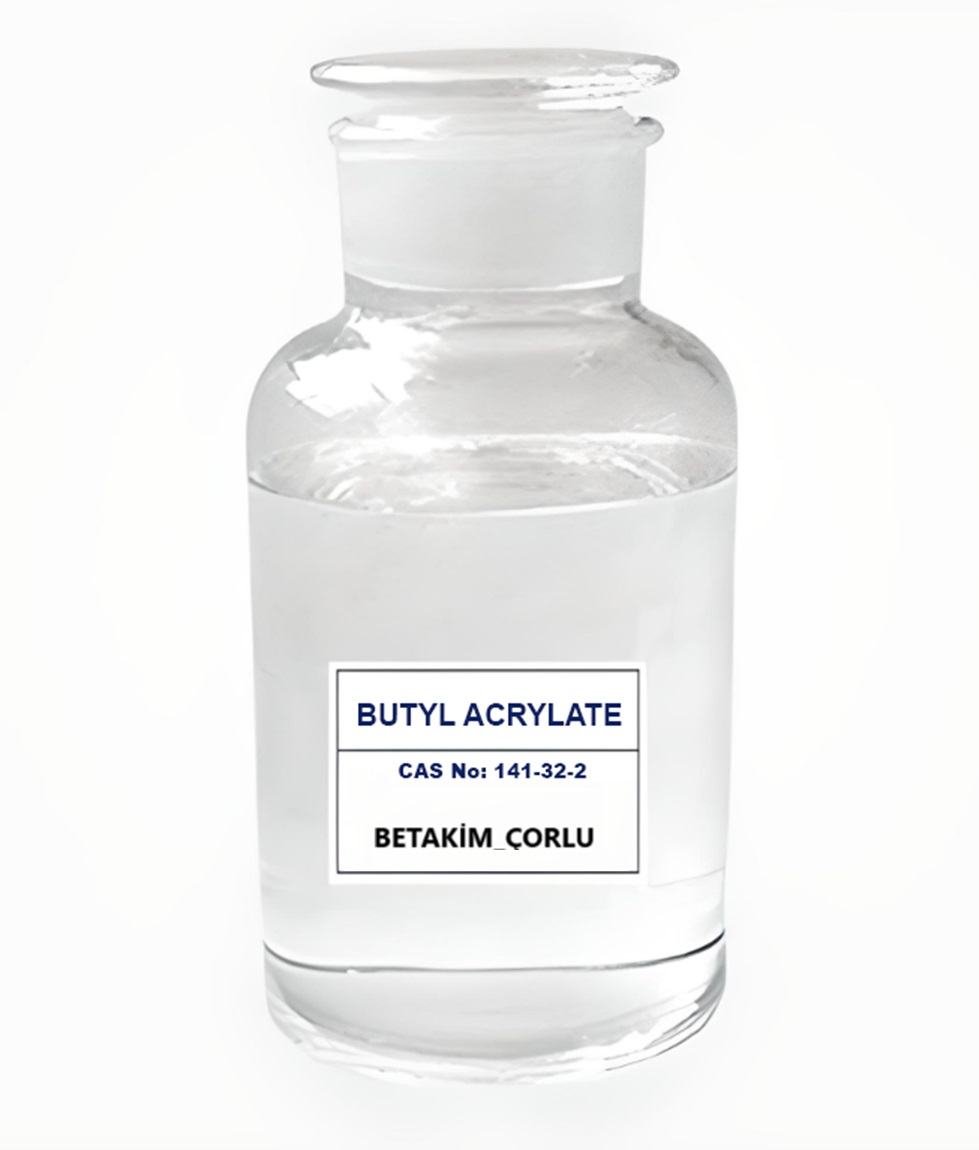
| Appearance | - | Clear, Colorless Liquid | Visual |
3. PHYSICAL AND CHEMICAL PROPERTIES
| Property | Value | Remarks |
|---|---|---|
| Physical State | Liquid | At room temperature |
| Odor | Pungent / Fruity | Characteristic ester odor |
| Density (20°C) | 0.898 g/cm³ | Lighter than water |
| Boiling Point | 145 - 148 °C | At 1013 hPa |
| Melting / Freezing Point | - 64 °C | Remains liquid at very low temperatures |
| Flash Point | 29 °C | Flammable Liquid (Closed Cup) |
| Vapor Pressure (20°C) | 4 - 5.4 mbar / hPa | Volatile |
| Viscosity (20°C) | 0.92 mPa·s | Low viscosity |
| Solubility in Water (20°C) | ~ 0.1% | Slightly soluble; miscible with organic solvents |
4. APPLICATIONS & FUNCTIONAL BENEFITS
Butyl Acrylate is a critical comonomer used to impart low Tg (Glass Transition Temperature), providing flexibility, adhesion, and low-temperature performance to polymer chains.
| Application Sector | Purpose / End Product |
|---|---|
| Paints & Coatings | Water-based architectural paints, industrial varnishes, wood and metal coatings. |
| Adhesives | Acrylic dispersion-based pressure-sensitive adhesives, cellulosic tapes. |
| Textiles & Leather | Leather finishing coatings, textile sizings, carpet backing. |
| Paper & Cellulose | Paper coating binders, impregnation resins. |
| Plastics & Caulks | Organic glass modification, acrylic fillers and sealants. |
5. PACKAGING, STORAGE & SAFETY
Stability and Inhibitor:
The product polymerizes readily. It is commercially stabilized with 15±5 ppm MEHQ (Hydroquinone Monomethyl Ether) . To maintain inhibitor effectiveness, the product must be stored in an oxygen-containing atmosphere (air gap in tanks); do not store under inert nitrogen blanket.
Storage Conditions:
-
Temperature: < 30°C (Preferably 15-25°C). High temperatures increase the risk of hazardous polymerization.
-
Materials: Stainless steel (316), aluminum, or phenolic-lined tanks are recommended. Avoid copper and its alloys.
-
Shelf Life: 6-12 months from the date of manufacture under proper conditions.
Safety Warnings:
-
Signal Word: Danger
-
Hazard Statements: H226 (Flammable liquid and vapor), H315 (Causes skin irritation), H317 (May cause an allergic skin reaction), H335 (May cause respiratory irritation).
-
Precaution: Keep away from heat/sparks/open flames. Ensure adequate ventilation in confined spaces.
6. COPOLYMERIZATION PROPERTIES
BA monomer readily copolymerizes with Methacrylates, Styrene, Vinyl Acetate, Acrylonitrile, and Maleic Anhydride. It imparts the following characteristics to the polymer:
-
Hydrophobicity & Water Resistance
-
Tack (Adhesion)
-
Low-Temperature Flexibility
-
UV Resistance & Weatherability
Important Disclaimer: This information is provided for technical guidance only. The user is responsible for testing the product in their specific process and application. Please refer to the current Safety Data Sheet (SDS) from your supplier for detailed safety information.