We unleash your business potential by maximize the business innovation.
Send EmailPotassium Fluoride, Potassium Fluoride Anhydrous, 7789-23-3, 12178-06-2
POTASSIUM FLUORIDE (ANHYDROUS)
PRODUCT IDENTIFIER INFORMATION
| Parameter | Information |
|---|---|
| Product Name | Potassium Fluoride |
| Chemical Name (IUPAC) | Potassium Fluoride |
| CAS Number | 7789-23-3; 12178-06-2 |
| EC Number (EINECS) | 232-151-5 |
| Molecular Formula | KF |
| Molecular Weight | 58.10 g/mol |
CHEMICAL STRUCTURE
    K⁺  F⁻

    Potassium Fluoride (KF)
    Ionic Structure
Potassium Fluoride Molecular Structure
Molecular Formula: KF
SMILES: [F-].[K+]
InChI: 1S/FH.K/h1H;/q;+1/p-1
InChIKey: NROKBHXJSPEDAR-UHFFFAOYSA-M
BRN Number: 3902818
SECTION 1: CHEMICAL IDENTITY AND DESCRIPTION
| Parameter | Information |
|---|---|
| Product Name | Potassium Fluoride |
| Chemical Name (IUPAC) | Potassium Fluoride |
| Synonyms (English) | Potassium Fluoride, Potassium Fluoride Anhydrous, Anhydrous Potassium Fluoride, Potassium Fluoride Solution, Potassium Fluoride Spray Dried, Potassium Fluoride on Alumina, Potassium Fluoride on Celite, Potassium Fluoride Anhydrous Pure, Potassium Fluoride Anhydrous Reagent, Potassium Fluoride in D₂O NMR Reference Standard |
| CAS Number | 7789-23-3; 12178-06-2 |
| EC Number (EINECS) | 232-151-5 |
| Molecular Formula | KF |
| Molecular Weight | 58.10 g/mol |
| Chemical Class | Inorganic compound; alkali metal halide; fluoride salt |
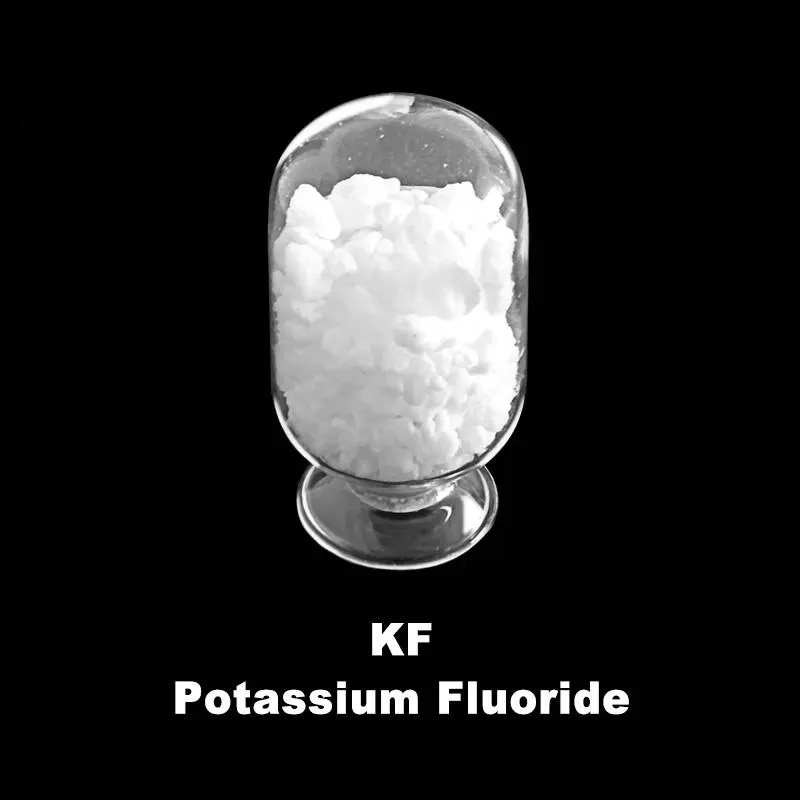
| Physical State (20°C) | Colorless cubic crystals or white crystalline powder |
| Odor | Odorless |
| Appearance | White, spray-dried powder or colorless cubic crystals |
| Deliquescence | Deliquescent (absorbs moisture from air and dissolves) |
SECTION 2: PHYSICAL AND CHEMICAL PROPERTIES
| Property | Value | Test Method / Note |
|---|---|---|
| Appearance | Colorless cubic crystals or white crystalline powder | Visual |
| Color | White | Visual |
| Odor | Odorless | Olfactometric |
| Molecular Weight | 58.10 g/mol | Calculated |
| Density | 2.48 g/cm³ | ASTM D4052 |
| Specific Gravity | 2.481 | - |
| Melting Point | 858 °C | DSC |
| Boiling Point | 1505 °C | - |
| Flash Point | 1505 °C | - |
| Refractive Index | 1.363 | Refractometry |
| Vapor Pressure | 1.3 hPa (at 885°C) | - |
| Vapor Density | 2 (vs air) | - |
| Solubility in Water (18°C) | 92.3 g/100 mL | General Method |
| Solubility in Water (20°C) | 94.9 g/100 mL | General Method |
| Solubility in Water (100°C) | > 150 g/100 mL | General Method |
| Solubility in Hydrofluoric Acid | Soluble | General Method |
| Solubility in Liquid Ammonia | Soluble | General Method |
| Solubility in Alcohol | Slightly soluble | General Method |
| Solubility in Acetone | Slightly soluble | General Method |
| pH (1M Solution, 25°C) | 7.0 - 8.5 (alkaline) | pH Meter |
| Hygroscopicity | Highly hygroscopic; deliquescent | - |
| Corrosivity | Corrodes glass and porcelain | - |
| Stability | Stable; protect from moisture; incompatible with strong acids and strong bases | - |
| Maximum Wavelength | λ: 260 nm Amax: 0.01; λ: 280 nm Amax: 0.01 | - |
| LogP | -0.77 at 25°C | - |
SECTION 3: CHEMICAL PROPERTIES AND REACTIVITY
| Parameter | Information |
|---|---|
| Chemical Character | Inorganic ionic compound; alkaline salt; aqueous solution is alkaline; powerful fluorinating agent |
| Stability | Stable under normal conditions; deliquescent; decomposes slightly at sublimation temperature |
| Reactivity | Reacts with strong acids to release hydrogen fluoride; forms acid salts (KHF₂) with excess HF; corrodes glass and porcelain; reacts with hydrogen peroxide to form KF·H₂O₂ adduct |
| Incompatible Materials | Strong acids, strong bases, glass, porcelain, moisture, oxidizing agents |
| Polymerization | Does not polymerize |
| Decomposition Products (Heating) | Potassium oxide, Hydrogen fluoride, Fluorine gas |
| Hazardous Reactions | Reacts with acids to release toxic HF gas; corrodes glass and porcelain; molten potassium fluoride is highly reactive and can corrode refractory materials |
| Reaction with Water | Dissolves exothermically; alkaline solution |
| Reaction with Acids | KF + HCl → KCl + HF (releases toxic HF gas) |
| Reaction with HF | KF + HF → KHF₂ (potassium hydrogen fluoride) |
| Hydrate Formation | Forms dihydrate (KF·2H₂O) below 40.2°C; forms tetrahydrate (KF·4H₂O) at lower temperatures |
| Adduct Formation | Forms adduct KF·H₂O₂ with hydrogen peroxide |
SECTION 4: PRODUCTION METHOD
Neutralization Method (Most Common):
Reaction:
KOH + HF → KF + H₂O
or
K₂CO₃ + 2HF → 2KF + H₂O + CO₂
Process:
-
Solid potassium hydroxide is dissolved in an equal amount of water in a neutralization tank
-
Anhydrous hydrofluoric acid (or 40% hydrofluoric acid) is introduced
-
Reaction is carried out until pH = 7-8
-
Anhydrous hydrofluoric acid feed is stopped
-
The solution is allowed to settle for 24 hours
-
The clear liquid (containing about 40% potassium fluoride) is obtained
-
The clear liquid is sent to a vacuum evaporator for vacuum concentration (pressure: 79993 Pa)
-
When most crystals are present in the solution, filtration is carried out (pressure: 0.2-0.3 MPa)
-
Vacuum drying is performed (pressure: 79993 Pa) for 6 hours
-
Potassium fluoride product is obtained
Process Notes:
-
Temperature control is important to prevent decomposition
-
Anhydrous hydrofluoric acid is used for anhydrous product
-
Vacuum concentration and drying are critical for purity
-
Proper ventilation and corrosion-resistant equipment are required
SECTION 5: FUNCTIONAL PROPERTIES AND MECHANISM OF ACTION
| Property | Description |
|---|---|
| Fluorinating Agent | One of the most commonly used fluorinating agents; provides active fluoride ions for halogen exchange reactions (R-Cl + KF → R-F + KCl); essential for fluorine chemical industry |
| Etching Agent | Used for glass etching and engraving; corrodes glass and porcelain surfaces |
| Flux Agent | Used as welding flux; facilitates metal joining and soldering |
| Catalyst | Used as a catalyst in various organic reactions; utilizes strong binding strength of fluoride ions with hydrogen ions |
| Condensing Agent | Increasingly used as a condensing agent in organic reactions |
| Absorbent | Used as an absorbent for hydrogen fluoride (HF) and moisture |
| Preservative | Used as food preservative and fermentation inhibitor |
| Pesticide Intermediate | Used in agricultural pesticide production and pesticide intermediates |
| Pharmaceutical Intermediate | Used as raw material in the pharmaceutical industry |
| Wood Preservative | Used for wood preservation |
SECTION 6: MAIN APPLICATION AREAS
| Industry / Application | Function | Typical Use |
|---|---|---|
| Organic Fluorine Chemistry | Fluorinating agent | Production of organic fluorinated compounds; halogen exchange reactions; synthesis of fluorinated pharmaceuticals and agrochemicals |
| Fine Chemicals | Fluorinating agent | Synthesis of fine chemical intermediates; fluorinated aromatic compounds; specialty chemicals |
| Glass Industry | Etching / engraving agent | Glass engraving and etching; surface modification of glass; decorative glass production |
| Metal Processing | Flux / welding agent | Welding flux; metal joining; soldering applications |
| Agriculture | Pesticide intermediate | Production of agricultural pesticides; pesticide intermediates; wood preservatives |
| Pharmaceutical Industry | Raw material | Pharmaceutical intermediates; drug synthesis; organic fluorinated raw materials |
| Chemical Industry | Catalyst / absorbent | Catalytic reactions; HF and moisture absorbent; drying agent |
| Food Industry | Preservative / fermentation inhibitor | Food preservation; fermentation inhibition |
| Analytical Chemistry | Complexing agent | Complexometric titration; drop-wise analysis of tantalum; masking agent |
| Electroplating | Additive | Electroplating bath additive |
| Construction | Additive | Building material additives; special applications |
SECTION 7: QUALITY SPECIFICATIONS (TECHNICAL GRADE - ANHYDROUS)
| Parameter | Specification | Test Method |
|---|---|---|
| Appearance | White crystalline powder or spray-dried powder | Visual |
| Assay (KF) | ≥ 98.0 - 99.5 % | Titrimetric |
| Loss on Drying | ≤ 1.0 % | Gravimetric |
| Free Acid (as HF) | ≤ 0.3 % | Titrimetric |
| Free Base (as KOH) | ≤ 0.3 % | Titrimetric |
| Water Insoluble Matter | ≤ 0.05 % | Gravimetric |
| Chlorides (as Cl) | ≤ 0.05 % | Nephelometry |
| Sulfates (as SO₄) | ≤ 0.05 % | Turbidimetric |
| Iron (Fe) | ≤ 0.005 % | AAS / ICP |
| Heavy Metals (as Pb) | ≤ 0.005 % | AAS / ICP |
| pH (1M Solution, 25°C) | 7.0 - 8.5 | pH Meter |
| Particle Size | As specified by customer requirement | Sieve / Laser Diffraction |
| Density | 2.48 g/cm³ | ASTM D4052 |
| Melting Point | 858 °C | DSC |
SECTION 8: TOXICOLOGICAL PROFILE
| Parameter | Value |
|---|---|
| Acute Oral Toxicity (LD50, Rat) | ~ 245 mg/kg (high toxicity) |
| Acute Dermal Toxicity | Toxic in contact with skin |
| Acute Inhalation Toxicity | Toxic if inhaled |
| Skin Irritation | Strong destructive effect on skin tissue; causes burns |
| Eye Irritation | Strong destructive effect on eyes; causes severe damage |
| Respiratory Irritation | Strong destructive effect on upper respiratory tract and mucous membranes; inhalation may cause laryngeal and bronchial inflammation, edema, spasm, chemical pneumonia, pulmonary edema and death |
| Chronic Toxicity | Fluoride toxicity (fluorosis); damage to bones and teeth; prolonged exposure may cause skeletal fluorosis |
| Carcinogenicity | Not classified (IARC) |
| Mutagenicity | Not classified |
| Reproductive Toxicity | May affect reproductive health at high doses |
| Target Organs | Respiratory system, skin, eyes, mucous membranes, bones, teeth |
| Poisoning Symptoms | Burning sensation, cough, wheezing, laryngitis, shortness of breath, headache, nausea, vomiting |
| Occupational Exposure Limit (8h TWA) | 2.5 mg/m³ (as F, ACGIH/OSHA) |
| Short-Term Exposure Limit (STEL) | 5.0 mg/m³ (as F, ACGIH) |
| IDLH (Immediately Dangerous to Life and Health) | 250 mg/m³ |
| Special Toxicity Note | Highly toxic; LD50 245 mg/kg (oral, rat). Strong destructive effect on mucous membranes, upper respiratory tract, eyes, and skin tissue. Inhalation may be fatal due to laryngeal and bronchial inflammation, edema, spasm, chemical pneumonia and pulmonary edema. MLD in guinea pigs: 250 mg/kg orally, 350 mg/kg s.c.; in frogs: 375 mg/kg s.c. |
SECTION 9: GHS CLASSIFICATION AND LABELING
GHS Classification (according to 1272/2008/EC and UN GHS):
| Hazard Class | Category | H-Statement |
|---|---|---|
| Acute Toxicity (Oral) | Category 3 | H301 |
| Acute Toxicity (Dermal) | Category 4 | H312 |
| Acute Toxicity (Inhalation) | Category 3 | H331 |
| Skin Corrosion/Irritation | Category 1 | H314 |
| Serious Eye Damage/Irritation | Category 1 | H318 |
| Specific Target Organ Toxicity - SE | Category 3 | H335 |
Signal Word: DANGER
Hazard Pictograms: GHS06 (Skull and Crossbones), GHS05 (Corrosion), GHS07 (Exclamation Mark)
Hazard Statements (H-Codes):
| Code | Statement |
|---|---|
| H301 | Toxic if swallowed |
| H312 | Harmful in contact with skin |
| H314 | Causes severe skin burns and eye damage |
| H318 | Causes serious eye damage |
| H331 | Toxic if inhaled |
| H335 | May cause respiratory irritation |
Risk Codes:
| Code | Statement |
|---|---|
| R25 | Toxic if swallowed |
| R23/24/25 | Toxic by inhalation, in contact with skin and if swallowed |
Safety Descriptions:
| Code | Statement |
|---|---|
| S26 | In case of contact with eyes, rinse immediately with plenty of water and seek medical advice |
| S36/37 | Wear suitable protective clothing and gloves |
| S45 | In case of accident or if you feel unwell, seek medical advice immediately |
NFPA 704 Hazard Classification:
| Health | Flammability | Reactivity | Special |
|---|---|---|---|
| 3 | 0 | 1 | - |
| (Severe health hazard) | (Non-flammable) | (Slightly reactive) | (None) |
SECTION 10: PRECAUTIONARY STATEMENTS (P-CODES)
| Code | Statement |
|---|---|
| P260 | Do not breathe dust/fume/gas/mist/vapors/spray |
| P262 | Do not get in eyes, on skin, or on clothing |
| P264 | Wash thoroughly after handling |
| P270 | Do not eat, drink or smoke when using this product |
| P271 | Use only outdoors or in a well-ventilated area |
| P280 | Wear protective gloves / protective clothing / eye protection / face protection |
| P301+P310 | IF SWALLOWED: Immediately call a POISON CENTER / doctor |
| P301+P330+P331 | IF SWALLOWED: Rinse mouth. Do NOT induce vomiting |
| P302+P352 | IF ON SKIN: Wash with plenty of soap and water |
| P303+P361+P353 | IF ON SKIN (or hair): Take off immediately all contaminated clothing. Rinse skin with water/shower |
| P304+P340 | IF INHALED: Remove person to fresh air and keep comfortable for breathing |
| P305+P351+P338 | IF IN EYES: Rinse cautiously with water for several minutes. Remove contact lenses if present and easy to do. Continue rinsing |
| P310 | Immediately call a POISON CENTER / doctor |
| P330 | Rinse mouth |
| P403+P233 | Store in a well-ventilated place. Keep container tightly closed |
| P405 | Store locked up |
| P501 | Dispose of contents/container in accordance with local/regional/national/international regulations |
SECTION 11: FIRST AID MEASURES
| Exposure Route | Action to Take |
|---|---|
| Inhalation | Move to fresh air immediately. Keep at rest in a position comfortable for breathing. If breathing is difficult, give oxygen. Seek immediate medical attention. Note: Inhalation may cause laryngeal and bronchial inflammation, edema, and chemical pneumonia. |
| Skin Contact | Remove contaminated clothing immediately. Rinse skin with copious amounts of water for at least 15-20 minutes. Wash with soap and water. Seek medical attention. |
| Eye Contact | Rinse immediately with plenty of water for at least 15-20 minutes. Hold eyelids open. Remove contact lenses if present. Seek immediate medical attention. |
| Ingestion | Rinse mouth. Do NOT induce vomiting. Give milk or calcium-containing liquids (milk, calcium gluconate solution) if conscious. Seek immediate medical attention. |
SECTION 12: FIRE-FIGHTING MEASURES
| Parameter | Information |
|---|---|
| Fire Hazard | Non-flammable; may decompose at high temperatures to release toxic and corrosive fumes |
| Hazards During Fire | Thermal decomposition produces toxic gases including hydrogen fluoride (HF) and potassium oxide fumes |
| Suitable Extinguishing Media | Dry chemical powder, CO₂, water fog (for cooling), alcohol-resistant foam |
| Unsuitable Extinguishing Media | Water jet (may spread hazardous material; may create corrosive solutions) |
| Special Protective Equipment | Self-contained breathing apparatus (SCBA), full protective clothing, acid-resistant gloves |
| Special Precautions | Cool containers with water fog from safe distance; prevent runoff water from entering drains and waterways; avoid contact with acids and moisture |
| Fire Extinguishing Method | Dry powder, sand |
SECTION 13: STORAGE AND SHELF LIFE
| Parameter | Information |
|---|---|
| Storage Conditions | Cool, dry, well-ventilated area; away from heat, moisture, acids and glass; protect from humidity; store at +5°C to +30°C |
| Container Requirements | Tightly closed, properly labeled containers; use moisture-resistant packaging; do not use glass containers; use plastic containers |
| Materials to Protect From | Strong acids, strong bases, glass, porcelain, moisture, oxidizing agents, edible chemical products |
| Shelf Life | 24 months (in unopened original packaging, under proper storage conditions) |
| Stability Note | Stable under normal conditions; highly hygroscopic and deliquescent; absorbs moisture from air; corrodes glass and porcelain; decomposes slightly at sublimation temperature |
SECTION 14: PACKAGING OPTIONS
| Packaging Type | Quantity | Material |
|---|---|---|
| Plastic Bag | 10 kg, 25 kg | Double-layer PE bag |
| Plastic Drum | 10 kg, 25 kg, 50 kg | HDPE / Polypropylene |
| Fiber Drum | 50 kg | PE-lined fiberboard |
| Bulk Bag (FIBC) | 500 kg, 1000 kg | PE-lined woven PP |
SECTION 15: TRANSPORT INFORMATION
| Parameter | Information |
|---|---|
| UN Number | UN 1812 (Potassium fluoride) |
| Hazard Class | 6.1 (Toxic Substance) |
| Packing Group | III |
| ADR/RID | UN 1812, Potassium fluoride, 6.1, PG III |
| IMDG Code | UN 1812, Potassium fluoride, 6.1, PG III, Marine Pollutant: Yes |
| IATA (Air) | UN 1812, Potassium fluoride, 6.1, PG III |
| Marine Pollutant | Yes |
| Transport Temperature | Ambient; protect from moisture |
| HS Code | 2826 19 90 |
SECTION 16: REGULATORY STATUS
| Region / Authority | Status |
|---|---|
| European Union | REACH registered; restricted under various regulations |
| USA (TSCA) | Listed |
| Turkey | Industrial chemical; subject to KKDIK regulation |
| IARC | Not classified as carcinogenic |
| OSHA | Regulated (toxic and corrosive substance) |
| WGK Germany | 3 |
| RTECS | TT0700000 |
SECTION 17: OTHER NAMES AND SYNONYMS
| Type | Name |
|---|---|
| English Synonyms | Potassium Fluoride, Potassium Fluoride Anhydrous, Anhydrous Potassium Fluoride, Potassium Fluoride Solution, Potassium Fluoride Spray Dried, Potassium Fluoride on Alumina, Potassium Fluoride on Celite, Potassium Fluoride Anhydrous Pure, Potassium Fluoride Anhydrous Reagent, Potassium Fluoride in D₂O NMR Reference Standard |
| Turkish Synonyms | Potasyum Florür, Susuz Potasyum Florür |
| Chemical Names | Potassium Fluoride; Potassium Monofluoride |
| CAS Number | 7789-23-3; 12178-06-2 |
| EC Number | 232-151-5 |
SECTION 18: DOWNSTREAM PRODUCTS
| Product | Application |
|---|---|
| Potassium Hydrogen Fluoride (KHF₂) | Fluorine production; glass etching; metallurgical flux |
| Fluorinated Organic Compounds | Pharmaceuticals, agrochemicals, fine chemicals |
| Methyl Fluoroacetate | Chemical synthesis |
| Fluorinated Aromatics | Various fluorinated aromatic compounds (2-fluorophenol, 4-fluoroaniline, 2,4-difluoroaniline, etc.) |
| 2,3,4-Trifluoronitrobenzene | Chemical intermediate |
| Hexaflumuron | Pesticide |
| Potassium Hydroxide (KOH) | Produced from potassium fluoride |
SECTION 19: SUMMARY TABLE
| Parameter | Value |
|---|---|
| Product | Potassium Fluoride (Anhydrous) |
| CAS Number | 7789-23-3; 12178-06-2 |
| Molecular Formula | KF |
| Molecular Weight | 58.10 g/mol |
| Appearance | Colorless cubic crystals or white crystalline powder |
| Density | 2.48 g/cm³ |
| Melting Point | 858 °C |
| Boiling Point | 1505 °C |
| Solubility in Water | 92.3 g/100 mL (18°C); 94.9 g/100 mL (20°C) |
| Primary Function | Fluorinating agent, etching agent, flux, catalyst |
| Main Applications | Organic fluorine chemistry, glass etching, metal processing, agriculture, pharmaceuticals |
| Shelf Life | 24 months |
| GHS Signal Word | DANGER |
| UN Number | UN 1812 |
| Hazard Class | 6.1 (Toxic) |
SECTION 20: CRITICAL WARNINGS AND BEST PRACTICES
CRITICAL WARNINGS:
-
Toxic if swallowed, inhaled, or in contact with skin (H301/H331/H312). LD50: 245 mg/kg (oral, rat).
-
Causes severe skin burns and eye damage (H314/H318). Use full PPE.
-
Strong destructive effect on mucous membranes, upper respiratory tract, eyes, and skin tissue.
-
Inhalation may be fatal due to laryngeal and bronchial inflammation, edema, spasm, chemical pneumonia and pulmonary edema.
-
Poisoning symptoms: Burning, cough, wheezing, laryngitis, shortness of breath, headache, nausea, vomiting.
-
Corrodes glass and porcelain. Do not store in glass containers; use plastic containers.
-
Highly hygroscopic and deliquescent. Absorbs moisture from air; store in tightly closed containers.
-
Incompatibilities: Strong acids, strong bases, glass, porcelain, moisture, oxidizing agents.
-
This substance is harmful to the environment. Special attention should be paid to pollution of water bodies.
-
Do not store with edible chemical products, acids and alkalis.
BEST PRACTICE RECOMMENDATIONS:
-
Organic Fluorine Chemistry: Use as fluorinating agent for halogen exchange reactions; ensure anhydrous conditions for optimal reactivity; use under inert atmosphere when required.
-
Glass Etching: Use for glass engraving and etching; handle with extreme care; use plastic or PTFE equipment.
-
Metal Processing: Use as welding flux; ensure proper ventilation and PPE.
-
Handling: Use in well-ventilated areas or under fume hood; wear chemical-resistant gloves (neoprene, butyl rubber), safety goggles, face shield, and appropriate respiratory protection; avoid creating dust.
-
Personal Protective Equipment: Wear chemical safety glasses, suitable protective clothing, chemical protective gloves; use respirator when airborne concentration exceeds standards; for emergency rescue, use self-contained breathing apparatus.
-
Hygiene: Do not eat, drink or smoke at work; shower and change clothes after work; work clothes should not be taken to non-work sites; maintain good hygiene practices.
-
Storage: Store in tightly closed, properly labeled plastic containers in cool, dry, well-ventilated conditions; keep away from heat, acids, glass, and moisture; store separately from edible chemical products, acids and alkalis.
-
Spill Response: Avoid creating dust; wear full PPE; vacuum or wet sweep; place in sealed plastic containers for disposal; neutralize with appropriate alkaline materials; do not use acids (releases HF gas).
-
Disposal: Dispose of in accordance with local, regional, and national regulations; do not discharge into drains or water bodies; fluoride compounds are regulated as hazardous waste.
-
Wastewater Treatment: Treat fluoride-containing wastewater by: (1) Calcium salt precipitation method; (2) Calcium salt-aluminum sulfate co-precipitation method; (3) Calcium salt-phosphate method.
LEGAL DISCLAIMER:
The information provided in this document is based on our current knowledge and experience and is presented in good faith. However, as all conditions of use are beyond our control, it does not constitute a binding specification or warranty. This Technical Data Sheet is for informational purposes only. Users are responsible for testing the suitability of the product for their specific applications. For complete safety, storage, use, handling, waste, and regulatory compliance information, please refer to the official Safety Data Sheet (SDS/MSDS) provided by the manufacturer/supplier.