We unleash your business potential by maximize the business innovation.
Send EmailCamphor, Terpenoid, Bornanone, Camphanone, Gum Camphor, Laurel Camphor, 76-22-2
CAMPHOR
PRODUCT IDENTIFIER INFORMATION
| Parameter | Information |
|---|---|
| Product Name | Camphor |
| Chemical Name (IUPAC) | 1,7,7-Trimethylbicyclo[2.2.1]heptan-2-one |
| CAS Number | 76-22-2 |
| EC Number (EINECS) | 200-945-0 |
| Molecular Formula | C10H16O |
| Molecular Weight | 152.23 g/mol |
SECTION 1: CHEMICAL IDENTITY AND DESCRIPTION
| Parameter | Information |
|---|---|
| Chemical Name (IUPAC) | 1,7,7-Trimethylbicyclo[2.2.1]heptan-2-one |
| Other Chemical Names | 2-Bornanone, 2-Camphanone, Bornan-2-one, 1,7,7-Trimethylbicyclo(2.2.1)-2-Heptanone |
| Common Names | Camphor, DL-Camphor (racemic mixture), Gum Camphor, Laurel Camphor |
| Trade Names | Synthetic Camphor, Natural Camphor, Pharmaceutical Camphor |
| CAS Number | 76-22-2 |
| EC Number (EINECS) | 200-945-0 |
| Chemical Class | Terpenoid (Monoterpenoid) |
| Subclass | Bicyclic Monoterpene |
| Functional Group | Ketone |
| Structural Feature | Bornane skeleton; [2.2.1] bridged system; oxo group (C=O) at position 2 |
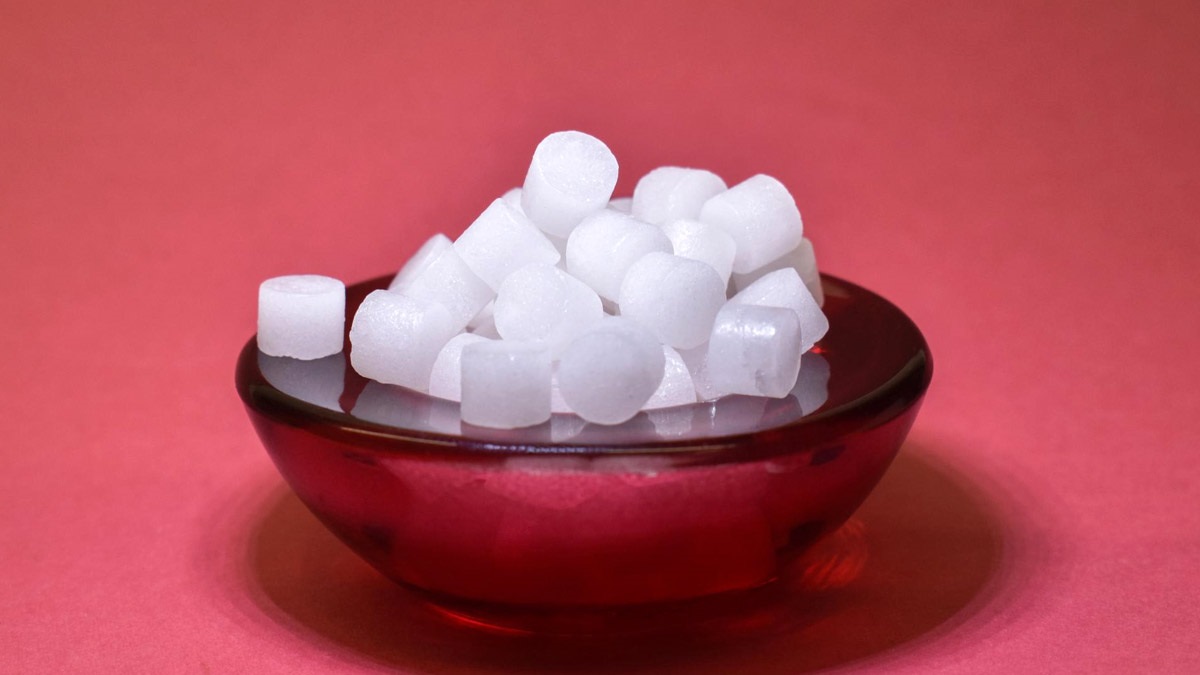
| Physical State (20°C) | Solid (colorless or white crystalline powder, transparent crystalline masses) |
| Optical Activity | Natural: Dextrorotatory (+)-camphor; Synthetic: Racemic (DL-) mixture (optically inactive) |
SECTION 2: PHYSICAL AND CHEMICAL PROPERTIES
| Property | Value | Test Method |
|---|---|---|
| Appearance | Colorless or white crystalline powder, transparent crystalline masses or pressed sticks | Visual |
| Odor | Characteristic, pungent, aromatic, refreshing | Olfactometric |
| Taste | Sharp, pungent, cooling (menthol-like) | Sensory |
| Molecular Weight | 152.23 g/mol | Calculated |
| Melting Point | 174-179°C; pure camphor ~180°C | DSC / Capillary Tube |
| Boiling Point | 204°C | ASTM D86 |
| Sublimation | Pronounced sublimation below boiling point; slow evaporation even at room temperature | Visual |
| Density (25°C) | 0.99 g/cm3 | ASTM D4052 |
| Vapor Pressure (20°C) | ~27 Pa (0.2 mmHg) | Calculated |
| Flash Point | 64°C (closed cup) | ASTM D93 |
| Autoignition Temperature | 466°C | ASTM E659 |
| Solubility in Water | Practically insoluble (~1.2 g/L, 25°C) | Ph. Eur. |
| Solubility in Ethanol | Freely soluble | Ph. Eur. |
| Solubility in Ether | Freely soluble | Ph. Eur. |
| Solubility in Chloroform | Freely soluble | Ph. Eur. |
| Solubility in Oils | Freely soluble | Ph. Eur. |
| Solubility in DMSO | Soluble | General Method |
| Solubility in Carbon Disulfide | Freely soluble | General Method |
SECTION 3: CHEMICAL STRUCTURE AND CLASSIFICATION
| Parameter | Information |
|---|---|
| Chemical Class | Terpenoid (Monoterpenoid) |
| Subclass | Bicyclic Monoterpene |
| Functional Group | Ketone |
| Skeleton Structure | Bornane skeleton; [2.2.1] bridged system (C1 and C4 bridgehead carbons) |
| Ketone Position | Oxo group (C=O) at position 2 |
| Molecular Characteristics | High volatility, sublimation ability, easy passage through biological membranes |
| Natural Source | Essential oil of camphor tree (Cinnamomum camphora) |
| Synthetic Source | Catalytic isomerization and oxidation of alpha-pinene from turpentine oil |
| Optical Isomers | D-(+)-Camphor (natural), L-(-)-Camphor, DL-(±)-Camphor (synthetic, racemic) |
SECTION 4: PRODUCTION METHODS AND PURITY GRADES
| Method | Description |
|---|---|
| Natural Production (Historical) | Steam distillation of camphor tree (Cinnamomum camphora) wood, crystallization and purification via cooling and sublimation |
| Synthetic Production (Current) | Catalytic isomerization of alpha-pinene from turpentine oil to bornyl acetate, then to borneol, and finally to camphor |
Purity Grades:
| Grade | Purity | Intended Use |
|---|---|---|
| Industrial Grade | Lower purity | Plasticizer, fragrance agent, chemical intermediate |
| Pharmaceutical Grade | >99% | Use in medicines, creams, and lotions |
| Food Grade | High purity | Flavoring agent, reference material in food packaging migration analysis |
SECTION 5: FUNCTIONAL PROPERTIES AND MECHANISM OF ACTION
| Property | Description |
|---|---|
| Topical Analgesic | Effective in relieving muscle pain, sprains, and arthritis-related pain |
| Anti-inflammatory | Reduces mild skin inflammation |
| Antipruritic | Anti-itch effect |
| Antimicrobial | Effective against fungal and bacterial infections |
| Decongestant | Relieves nasal congestion; used for colds and coughs |
| Antitussive | Cough suppressant effect |
| Rubefacient | Increases local blood circulation when applied to skin |
| Mechanism of Action | Activates TRP (Transient Receptor Potential) ion channels; cooling and analgesic effect primarily via TRPV1, TRPV3, and TRPM8 receptors |
| Membrane Passage | Easily crosses biological membranes due to its lipophilic structure |
SECTION 6: PRIMARY APPLICATION AREAS
| Sector | Application |
|---|---|
| Pharmaceutical | Muscle pain creams, arthritis ointments, anti-itch lotions, decongestant vapor rubs, cough inhalers, antifungal and antibacterial topical medications |
| Cosmetic | Soaps, detergents, room fresheners, perfume components |
| Industrial | Cellulose nitrate (celluloid) plasticizer, explosive stabilizer, chemical intermediate |
| Food | Flavoring agent in traditional sweets and liqueurs (very low amounts), reference material in food packaging migration analysis |
| Traditional Medicine | Traditional applications for conditions such as anxiety, low libido, and hair loss (scientific evidence is limited) |
SECTION 7: QUALITY SPECIFICATIONS (PHARMACEUTICAL GRADE)
| Parameter | Specification | Test Method |
|---|---|---|
| Appearance | Colorless or white crystalline powder, transparent crystalline masses | Visual |
| Odor | Characteristic, pungent, aromatic | Olfactometric |
| Identification (IR) | Conforms to reference standard | Ph. Eur. |
| Identification (GC) | Retention time matches standard | GC-FID |
| Purity (GC) | ≥ 99.0% | GC-FID |
| Melting Point | 174-179°C | Capillary Tube / DSC |
| Optical Rotation (Natural) | +41° to +44° (c=10, ethanol) | Polarimetry |
| Optical Rotation (Synthetic Racemic) | -1.5° to +1.5° | Polarimetry |
| Non-Volatile Residue | ≤ 0.05% | Gravimetric (105°C) |
| Chloride (Cl-) | ≤ 100 ppm | Ion Chromatography |
| Sulfate (SO4 2-) | ≤ 100 ppm | Ion Chromatography |
| Heavy Metals (as Pb) | ≤ 10 ppm | ICP-MS |
| Lead (Pb) | ≤ 2 ppm | ICP-MS |
| Arsenic (As) | ≤ 3 ppm | ICP-MS |
| Mercury (Hg) | ≤ 1 ppm | ICP-MS |
| Cadmium (Cd) | ≤ 1 ppm | ICP-MS |
| Water Content | ≤ 0.5% | Karl Fischer Titration |
| Halogenated Compounds | ≤ 100 ppm | Combustion + Ion Chromatography |
| Total Microbial Count | ≤ 100 CFU/g | Ph. Eur. |
| Yeast and Mold | ≤ 10 CFU/g | Ph. Eur. |
| E. coli | Negative in 1g | Ph. Eur. |
| Salmonella spp. | Negative in 25g | Ph. Eur. |
SECTION 8: TOXICOLOGICAL PROFILE
| Parameter | Value |
|---|---|
| Acute Oral Toxicity (LD50, Rat) | ~1,310 mg/kg |
| Acute Dermal Toxicity (LD50, Rabbit) | > 2,000 mg/kg |
| Toxic Dose (Human, Oral) | Children: ~500 mg; Adults: ~2 g |
| Lethal Dose (LD50, Human) | Approximately 50-500 mg/kg (estimated) |
| Skin Irritation | Mild-moderate irritant |
| Eye Irritation | Irritant |
| Skin Sensitization | Not sensitizing or weak |
| Carcinogenicity | Not classified (IARC, NTP) |
| Mutagenicity | Negative in standard tests |
| Reproductive Toxicity | Limited data; not recommended during pregnancy |
| Neurotoxicity | Convulsions, seizures, respiratory depression at high doses |
SECTION 9: GHS CLASSIFICATION AND LABELING
GHS Classification (compliant with 1272/2008/EC):
| Hazard Class | Category | H-Statement |
|---|---|---|
| Flammable Solid | Category 2 | H228 |
| Acute Toxicity (Oral) | Category 4 | H302 |
| Skin Irritation | Category 2 | H315 |
| Serious Eye Damage/Irritation | Category 2 | H319 |
| Specific Target Organ Toxicity (STOT - SE) | Category 3 | H335 |
Signal Word: WARNING
Hazard Pictograms:
┌─────────┐   ┌─────────┐
│   !     │   │   🔥    │
└─────────┘   └─────────┘
  GHS07          GHS02
Exclamation      Flame
   Mark
Hazard Statements (H-Codes):
| Code | Statement |
|---|---|
| H228 | Flammable solid |
| H302 | Harmful if swallowed |
| H315 | Causes skin irritation |
| H319 | Causes serious eye irritation |
| H335 | May cause respiratory irritation |
SECTION 10: PRECAUTIONARY STATEMENTS (P-CODES)
Prevention:
| Code | Statement |
|---|---|
| P210 | Keep away from heat, hot surfaces, sparks, open flames. No smoking. |
| P261 | Avoid breathing dust/vapor |
| P280 | Wear protective gloves/eye protection/face protection |
Response:
| Code | Statement |
|---|---|
| P301+P312 | IF SWALLOWED: Call a POISON CENTER/doctor if you feel unwell |
| P302+P352 | IF ON SKIN: Wash with plenty of water and soap |
| P305+P351+P338 | IF IN EYES: Rinse cautiously with water for several minutes. Remove contact lenses, if present and easy to do. Continue rinsing |
| P370+P378 | In case of fire: Use CO2, dry chemical powder, or water mist to extinguish |
Storage:
| Code | Statement |
|---|---|
| P403+P233 | Store in a well-ventilated place. Keep container tightly closed |
Disposal:
| Code | Statement |
|---|---|
| P501 | Dispose of contents/container to an approved waste disposal facility |
SECTION 11: FIRST AID MEASURES
| Exposure Route | Action to Take |
|---|---|
| Inhalation | Move to fresh air. Seek medical attention if respiratory irritation persists. |
| Skin Contact | Wash with plenty of water and soap for at least 15 minutes. Seek medical attention if irritation persists. |
| Eye Contact | Rinse immediately with plenty of water for at least 15 minutes. Remove contact lenses if present. Seek medical attention. |
| Ingestion | Rinse mouth. Do NOT induce vomiting. Drink plenty of water. Seek immediate medical attention or call Poison Information Center. |
Poisoning Symptoms: Burning sensation in mouth and throat, nausea, vomiting, dizziness, agitation, muscle twitching, epileptic seizures, respiratory depression.
SECTION 12: CONTRAINDICATIONS AND SPECIAL WARNINGS
| Condition | Warning |
|---|---|
| Pregnancy and Lactation | Use not recommended. May trigger uterine contractions and pass to infant. |
| Infants and Young Children | Due to risk of seizures, camphor-containing products (especially chest rubs) should be used with caution; oral intake must be absolutely avoided. |
| Liver and Biliary Tract Diseases | Caution advised as camphor is metabolized in the liver. |
| Damaged Skin | Do not apply to open wounds or irritated skin; absorption is accelerated and toxicity risk increases. |
| Epilepsy / Seizure Disorder | Use is contraindicated. |
SECTION 13: FIREFIGHTING MEASURES
| Parameter | Information |
|---|---|
| Fire Hazard | Flammable solid |
| Flash Point | 64°C (closed cup) |
| Autoignition Temperature | 466°C |
| Suitable Extinguishing Media | CO2, dry chemical powder, water mist (fog) |
| Unsuitable Extinguishing Media | Direct water jet (may spread dust) |
| Hazards During Fire | Emits CO, CO2, and irritating fumes when heated or burned |
| Protective Equipment | Self-contained breathing apparatus (SCBA), full protective clothing |
SECTION 14: STORAGE AND SHELF LIFE
| Parameter | Information |
|---|---|
| Storage Conditions | Cool (15-25°C), dry, well-ventilated area; away from heat and ignition sources |
| Container Requirements | Tightly closed, light-resistant containers |
| Keep Away From | Heat, direct sunlight, open flames, strong oxidizing agents |
| Shelf Life | 48 months (unopened original packaging under appropriate storage conditions) |
| Stability Note | Store in tightly closed containers due to sublimation tendency; slowly evaporates even at room temperature |
SECTION 15: PACKAGING OPTIONS
| Packaging Type | Quantity | Material |
|---|---|---|
| Aluminum foil pouch | 1 kg | Laminated aluminum |
| Aluminum foil pouch | 5 kg | Laminated aluminum |
| Fiber drum with PE liner | 25 kg | Fiberboard + PE |
| Kraft bag with PE inner liner | 25 kg | Kraft paper + PE |
| HDPE drum | 25 kg | HDPE |
SECTION 16: TRANSPORTATION INFORMATION
| Parameter | Information |
|---|---|
| UN Number | 2717 (Flammable solid, n.o.s.) |
| Hazard Class | 4.1 (Flammable Solids) |
| Packing Group | III |
| ADR/RID | UN 2717, Flammable Solid, 4.1, PG III |
| IMDG Code | UN 2717, Flammable Solid, 4.1, PG III |
| IATA (Air) | UN 2717, Flammable Solid, 4.1, PG III |
| Marine Pollutant | No |
| Transport Temperature | Ambient (15-25°C) |
SECTION 17: ACCIDENTAL RELEASE AND CLEANUP
| Parameter | Information |
|---|---|
| Personal Protection | Nitrile gloves, safety goggles, dust mask (N95) |
| Cleanup Methods | Sweep up or collect mechanically; absorb with inert material (sand, vermiculite). Dispose in closed containers. |
| Environmental Precautions | Prevent entry into drains, soil, and surface water. |
| Waste Disposal | According to local regulations; incineration at licensed disposal facilities. |
SECTION 18: REGULATORY STATUS
| Region / Authority | Status |
|---|---|
| European Union | Specific use restrictions under Cosmetics Regulation (EC 1223/2009); pharmacopoeia monograph available |
| USA (FDA) | Approved as OTC topical analgesic; GRAS as flavoring agent in foods |
| Turkey | Under Cosmetics Regulation and Turkish Food Codex; pharmacopoeia monograph available |
| European Pharmacopoeia | Official monograph (Ph. Eur.) |
| USP-NF | Official monograph (USP) |
| JECFA (FAO/WHO) | Evaluated as food flavoring agent |
SECTION 19: OTHER NAMES AND SYNONYMS
| Type | Name |
|---|---|
| Chemical Names | 1,7,7-Trimethylbicyclo[2.2.1]heptan-2-one, 2-Bornanone, 2-Camphanone, Bornan-2-one |
| Common Names | Camphor, DL-Camphor, Gum Camphor, Laurel Camphor |
| Natural Form | D-(+)-Camphor, Japanese Camphor, Formosa Camphor |
| Synthetic Form | DL-Camphor, Synthetic Camphor, Racemic Camphor |
| Trade Names | Synthetic Camphor, Pharmaceutical Camphor |
| CAS Number | 76-22-2 |
| EC Number | 200-945-0 |
| FEMA Number | 2230 |
| INCI Name | Camphor |
SECTION 20: SUMMARY TABLE
| Parameter | Value |
|---|---|
| Product | Camphor |
| CAS Number | 76-22-2 |
| Molecular Formula | C10H16O |
| Molecular Weight | 152.23 g/mol |
| Appearance | Colorless or white crystalline powder |
| Melting Point | 174-179°C |
| Boiling Point | 204°C |
| Flash Point | 64°C |
| Solubility in Water | Practically insoluble |
| Primary Function | Topical analgesic, decongestant, antimicrobial |
| Shelf Life | 48 months (unopened original packaging) |
| GHS Signal Word | Warning |
| UN Number | 2717 (Flammable Solid, 4.1, PG III) |
SECTION 21: COMPARISON WITH SIMILAR TERPENOIDS
| Property | Camphor | Menthol | Eucalyptol (1,8-Cineole) | Thymol |
|---|---|---|---|---|
| Chemical Class | Bicyclic Monoterpene Ketone | Cyclic Monoterpene Alcohol | Monoterpene Ether | Monoterpene Phenol |
| CAS Number | 76-22-2 | 89-78-1 (DL) | 470-82-6 | 89-83-8 |
| Molecular Formula | C10H16O | C10H20O | C10H18O | C10H14O |
| Primary Sensation | Cooling, pungent | Strong cooling | Cooling, fresh | Warming, pungent |
| Primary TRP Target | TRPV1, TRPV3, TRPM8 | TRPM8 | TRPM8 | TRPV3, TRPA1 |
| Melting Point | ~180°C | ~42°C | 1.5°C (liquid) | ~51°C |
| Primary Use | Analgesic, decongestant | Analgesic, antipruritic | Decongestant, mucolytic | Antimicrobial, antiseptic |
SECTION 22: CRITICAL WARNINGS AND BEST PRACTICES
CRITICAL SAFETY WARNINGS:
-
Flammable Solid: Camphor is a flammable solid. Keep away from heat, sparks, open flames, and hot surfaces.
-
Oral Toxicity: Oral intake can cause serious poisoning. Toxic dose is considered ~500 mg in children and ~2 g in adults. May cause seizures and respiratory depression.
-
Keep Away from Children: Due to risk of seizures in infants and young children, camphor-containing products should be stored out of reach of children.
-
Pregnancy and Lactation: Use not recommended.
-
Do Not Apply to Damaged Skin: Absorption from open wounds or irritated skin is accelerated and toxicity risk increases.
-
Sublimation: Slowly evaporates even at room temperature; must be stored in tightly closed containers.
BEST PRACTICE RECOMMENDATIONS:
-
Limit to Topical Use: Camphor is for external use only. Absolutely avoid oral intake.
-
Use Appropriate Concentration: Typically used at 1-11% concentration range in topical products.
-
Wash Hands: Wash hands thoroughly after application; avoid contact with eyes and mucous membranes.
-
Close Tightly: Close container tightly immediately after use; prevent sublimation loss.
-
Quality Verification: Always use high-purity (>99%) camphor conforming to pharmacopoeia standards for pharmaceutical applications.
-
Fire Precautions: Keep fire extinguishing equipment available in storage and use areas due to flammability.
SECTION 23: PROCESS AND APPLICATION GUIDE
A. Topical Analgesic Formulation (Typical):
| Step | Procedure | Control Point |
|---|---|---|
| 1 | Weigh camphor at 1-11% of total formulation | Analytical balance |
| 2 | Dissolve camphor in appropriate solvent (ethanol, oil phase) | Complete dissolution |
| 3 | Incorporate into cream/ointment base | Homogeneous mixing |
| 4 | Homogenize until uniform | Visual check |
| 5 | Package in sealed containers | Prevent sublimation loss |
B. Decongestant Vapor Rub Formulation:
| Step | Procedure | Control Point |
|---|---|---|
| 1 | Combine camphor (typically 4-6%) with menthol, eucalyptus oil | Weigh accurately |
| 2 | Melt petrolatum/paraffin base at 50-60°C | Temperature control |
| 3 | Add active ingredients to melted base | Stir until dissolved |
| 4 | Cool with continuous stirring | Prevent crystallization separation |
| 5 | Fill into jars while still pourable | Airtight sealing |
LEGAL DISCLAIMER:
The information provided in this document is presented in good faith based on our current knowledge and experience; however, since all usage conditions are beyond our control, it does not constitute a binding specification or warranty. This Technical Data Sheet is for informational purposes only and does not constitute medical advice. Users are obligated to test the suitability for their own applications. For complete safety, storage, handling, transportation, disposal, and regulatory compliance information, refer to the official Safety Data Sheet (SDS/MSDS) provided by the manufacturer/supplier. This product is not intended to diagnose, treat, cure, or prevent any disease.