We unleash your business potential by maximize the business innovation.
Send EmailDidecyl Dimethyl Ammonium Chloride, Didecyldimonium Chloride, DDAC, 7173-51-5
DIDECYL DIMETHYL AMMONIUM CHLORIDE (DDAC)
PRODUCT IDENTIFIER INFORMATION
| Parameter | Information |
|---|---|
| Product Name | Didecyl Dimethyl Ammonium Chloride (DDAC) |
| Chemical Class | Quaternary Ammonium Compound (Quat) |
| CAS Number | 7173-51-5 |
| EC Number (EINECS) | 230-525-2 |
| Molecular Formula | C22H48ClN |
| Molecular Weight | 362.08 g/mol |
SECTION 1: CHEMICAL IDENTITY AND DESCRIPTION
| Parameter | Information |
|---|---|
| Chemical Name (IUPAC) | N,N-Didecyl-N,N-dimethylammonium chloride |
| Synonyms | Didecyl Dimethyl Ammonium Chloride, DDAC, Didecyldimonium Chloride, Quaternium-12, Didesil Dimetil Amonyum Klorür |
| Trade Names | Bardac 2280, BTC 1010, Maquat 4450-E, Fentacare D0821, Arquad 2.10-50, Noramium DA 50 |
| CAS Number | 7173-51-5 |
| EC Number (EINECS) | 230-525-2 |
| Molecular Formula | C22H48ClN |
| Molecular Weight | 362.08 g/mol |
| Chemical Class | Quaternary ammonium compound (cationic surfactant) |
| INCI Name | Quaternium-12 |
| Structural Feature | Central nitrogen atom bonded to two long-chain decyl (C10) groups, two methyl groups, and chloride anion |
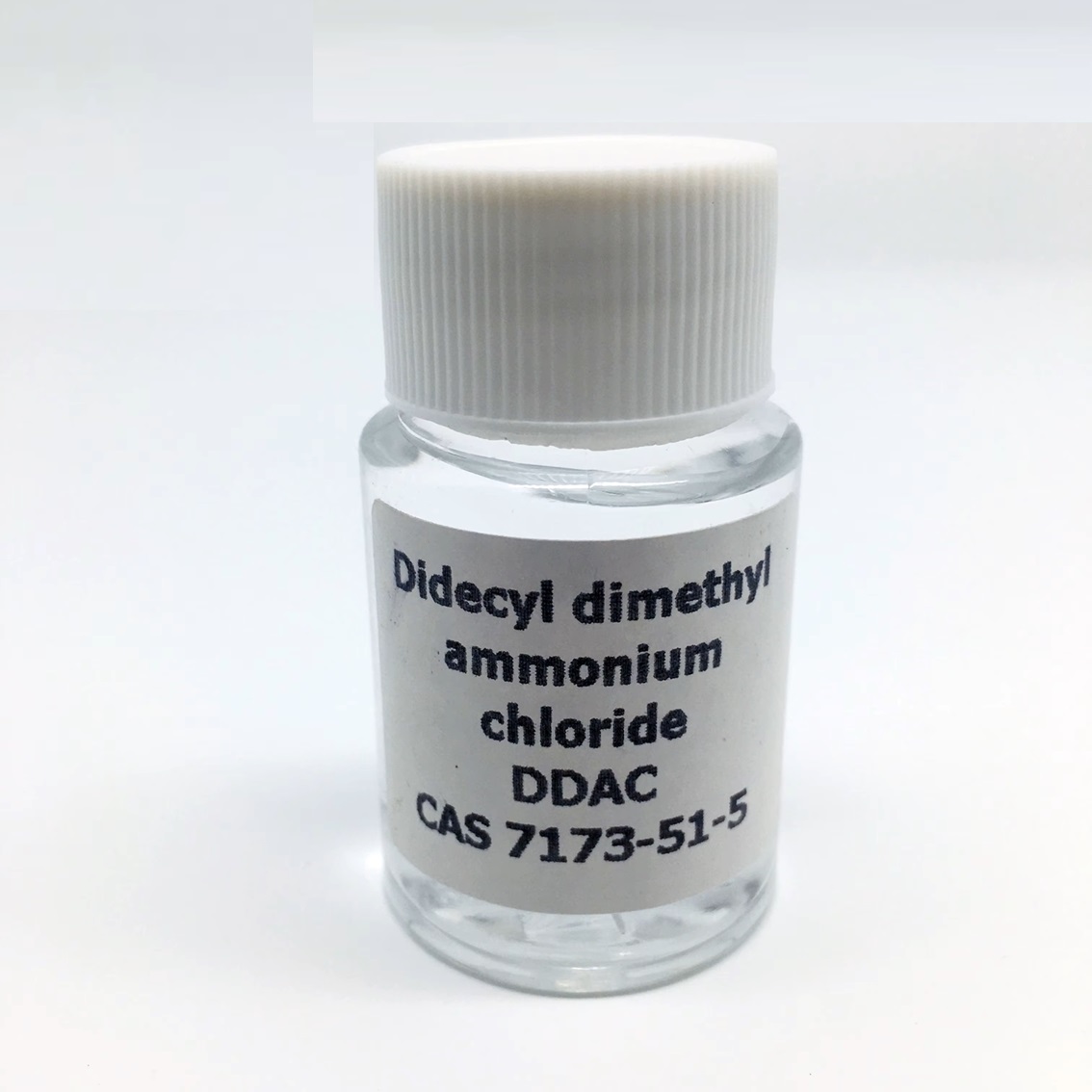
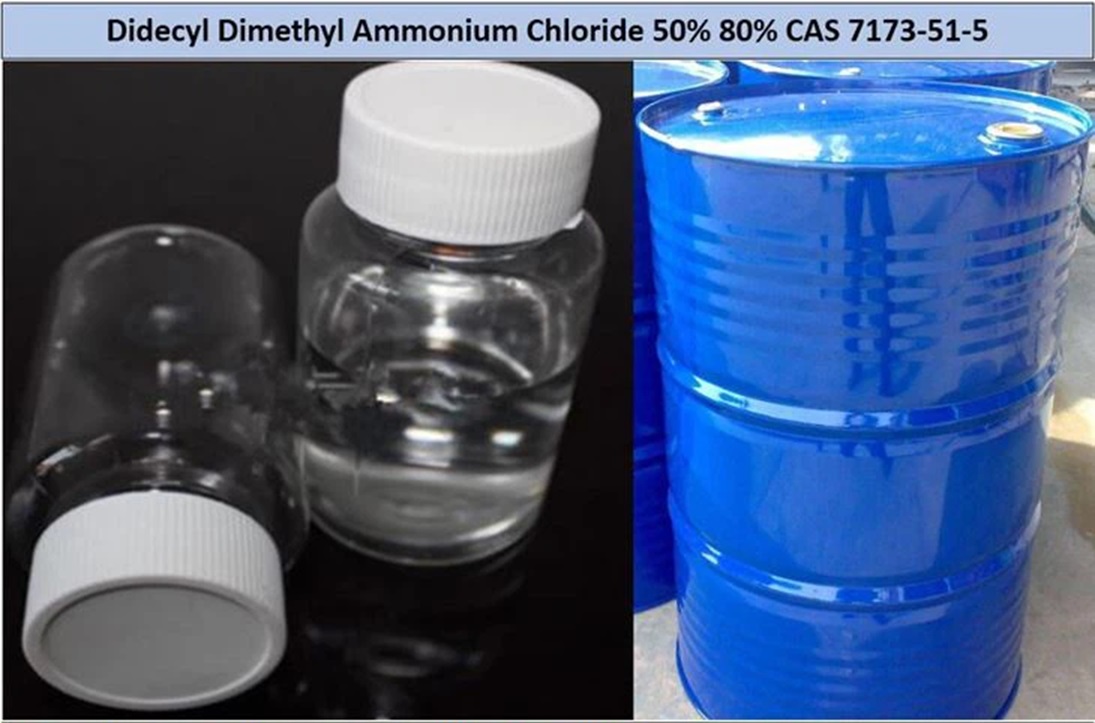
| Physical State (20°C) | Pure: colorless crystalline solid; Commercial: clear, pale yellow to colorless liquid solution |
| Odor | Slight characteristic odor (mushroom-like or slightly alcoholic) |
| Chemical Character | Cationic surfactant; strong biocide |
SECTION 2: PHYSICAL AND CHEMICAL PROPERTIES
| Property | Value | Test Method |
|---|---|---|
| Appearance (Pure) | Colorless crystalline solid | Visual |
| Appearance (Commercial Solution) | Clear, pale yellow to colorless liquid | Visual |
| Odor | Slight characteristic (mushroom-like/alcoholic) | Olfactometric |
| Molecular Weight | 362.08 g/mol | Calculated |
| Melting Point (Pure) | ~88-92°C | DSC |
| Boiling Point | >200°C (decomposes) | ASTM D86 |
| Density (20°C, 50% solution) | ~0.92-0.95 g/cm3 | ASTM D4052 |
| pH (1% solution, 25°C) | 6.0 - 8.0 | pH Meter |
| Solubility in Water | Completely soluble | General Method |
| Solubility in Ethanol | Soluble | General Method |
| Solubility in Isopropanol | Soluble | General Method |
| Solubility in Acetone | Slightly soluble | General Method |
| Solubility in Hydrocarbons | Insoluble | General Method |
| Viscosity (25°C, 50% solution) | 50-150 cP | ASTM D445 |
| Flash Point (50% solution) | >100°C (non-flammable) | ASTM D93 |
| Stability | Stable under normal conditions; may slowly degrade upon exposure to air and light | |
| Biodegradability | Slowly biodegradable (dependent on alkyl chain length) | |
| Photodegradation | Susceptible to degradation by sunlight |
SECTION 3: CHEMICAL PROPERTIES AND REACTIVITY
| Parameter | Information |
|---|---|
| Chemical Character | Cationic surfactant; strong biocide |
| Ionic Character | Cationic (positively charged) |
| Stability | Stable under normal conditions; thermal stability up to 50°C |
| Decomposition Products (Heating) | Carbon monoxide (CO), carbon dioxide (CO2), nitrogen oxides (NOx), hydrogen chloride (HCl) |
| Incompatible Materials | Strong oxidizing agents (hypochlorite, peroxides, permanganate), anionic surfactants, strong acids, strong bases |
| Reaction with Anionic Substances | Forms precipitate with anionic surfactants (soaps, sulfonates); biocidal efficacy is lost |
| Reaction with Oxidizing Agents | Reacts with strong oxidizing agents (such as bleach) losing efficacy |
| Efficacy in Hard Water | May form precipitate with anionic substances in hard water; efficacy may decrease |
| Hazardous Polymerization | Does not occur |
SECTION 4: PRODUCTION METHOD (QUATERNIZATION REACTION)
| Step | Description | Chemical Reaction |
|---|---|---|
| 1. Raw Material Preparation | Didecyl methyl amine (tertiary amine) and methyl chloride (alkyl halide) are prepared | - |
| 2. Quaternization | Tertiary amine is reacted with methyl chloride; reaction is carried out in a solvent (isopropanol or water) under controlled temperature and pressure | R2N-CH3 + CH3-Cl → [R2N(CH3)2]+ Cl- (R = decyl alkyl chain -C10H21) |
| 3. Purification | Reaction mixture is purified; excess reactants are removed | - |
| 4. Concentration Adjustment | Active content is adjusted to commercial forms (50%, 80% solutions) | - |
SECTION 5: MECHANISM OF ACTION (ANTIMICROBIAL ACTIVITY)
| Step | Mechanism | Description |
|---|---|---|
| 1. Electrostatic Attraction | Positively charged DDAC molecule is electrostatically attracted and binds to the negatively charged microorganism surface (cell wall/membrane) | |
| 2. Membrane Penetration | Hydrophobic long alkyl chains (decyl groups) of DDAC penetrate the lipid bilayer of the microbial cell membrane | |
| 3. Membrane Disruption | Cell membrane structure is disrupted; permeability increases; membrane integrity is lost | |
| 4. Cell Death | Vital intracellular components (K+ ions, amino acids, nucleic acids) leak out; cellular homeostasis is disrupted; microorganism dies |
Antimicrobial Spectrum:
| Microorganism Type | Efficacy |
|---|---|
| Gram-positive Bacteria | Highly effective (Staphylococcus aureus, Enterococcus faecalis) |
| Gram-negative Bacteria | Effective (Escherichia coli, Pseudomonas aeruginosa) |
| Enveloped Viruses | Effective (Influenza, Herpes simplex, HIV) |
| Non-enveloped Viruses | Limited efficacy |
| Fungi | Effective (Candida albicans, Aspergillus niger) |
| Algae | Effective |
| Bacterial Spores | Limited efficacy (not sporicidal) |
SECTION 6: FUNCTIONAL PROPERTIES
| Property | Description |
|---|---|
| Biocide / Antimicrobial | Broad-spectrum microbicide against bacteria, fungi, viruses, and algae |
| Cationic Surfactant | Reduces surface tension; wetting, spreading, and penetration properties |
| Disinfectant | Provides rapid and effective disinfection on hard surfaces |
| Sanitizer | Used for sanitization of food contact surfaces |
| Algicide | Prevents algae formation in water systems |
| Wood Preservative | Protects wood against fungal decay and insect damage |
| Antistatic Agent | Antistatic properties in hair conditioners and fabric softeners |
| Softener | Softening effect in fabric and hair products |
| Wetting Agent | Wetting and spreading properties in agricultural formulations |
SECTION 7: PRIMARY APPLICATION AREAS
| Sector | Application | Typical Concentration |
|---|---|---|
| Industrial/Institutional Cleaning | Surface disinfectant in hospitals, schools, restaurants, and food processing facilities | 0.05-0.5% (active) |
| Healthcare | Disinfection of medical equipment and hard surfaces | 0.1-0.5% (active) |
| Food Industry | Sanitization of food contact surfaces (rinsing may be required) | 0.02-0.2% (active) |
| Agriculture / Animal Husbandry | Disinfection of poultry houses, barns, and animal shelters | 0.1-0.5% (active) |
| Wood Preservation | Impregnation against fungal decay and insect damage | 0.5-2.0% (active) |
| Water Treatment | Biocide and algicide in cooling towers, swimming pools, industrial water systems | 5-50 ppm (active) |
| Petroleum Industry | Microbial control in oil extraction processes | 10-100 ppm (active) |
| Personal Care / Cosmetics | Antistatic and softening in hair conditioners and fabric softeners (Quaternium-12) | 0.1-1.0% |
| Pharmaceutical Industry | Active ingredient or preservative in topical antiseptic solutions | 0.01-0.5% |
| Agricultural Irrigation | Algae and bacterial control in irrigation systems | 5-20 ppm (active) |
SECTION 8: QUALITY SPECIFICATIONS (COMMERCIAL 50% SOLUTION)
| Parameter | Specification | Test Method |
|---|---|---|
| Appearance | Clear, pale yellow to colorless liquid | Visual |
| Active Content (DDAC) | 49.0 - 51.0% | Two-Phase Titration (Epton) |
| pH (1% solution) | 6.0 - 8.0 | pH Meter |
| Free Amine + Amine Salt | ≤ 2.0% | Acid-Base Titration |
| Color (Gardner) | ≤ 3 | ASTM D1544 |
| Density (20°C) | 0.92 - 0.95 g/cm3 | ASTM D4052 |
| Viscosity (25°C) | 50 - 150 cP | ASTM D445 |
| Water Content (Karl Fischer) | 47 - 51% | Karl Fischer Titration |
| Heavy Metals (as Pb) | ≤ 10 ppm | ICP-MS |
| Lead (Pb) | ≤ 2 ppm | ICP-MS |
| Arsenic (As) | ≤ 3 ppm | ICP-MS |
| Mercury (Hg) | ≤ 1 ppm | ICP-MS |
| Cadmium (Cd) | ≤ 1 ppm | ICP-MS |
SECTION 9: TOXICOLOGICAL PROFILE
| Parameter | Value |
|---|---|
| Acute Oral Toxicity (LD50, Rat) | ~238-500 mg/kg (harmful) |
| Acute Dermal Toxicity (LD50, Rabbit) | ~1,000-2,000 mg/kg (harmful) |
| Skin Irritation | Severe irritant; may cause chemical burns (H314) |
| Eye Irritation | Risk of serious eye damage; may cause permanent damage (H318) |
| Respiratory Irritation | Harmful if inhaled; irritation of throat and respiratory tract (H332) |
| Skin Sensitization | May cause allergic reactions in sensitive individuals |
| Carcinogenicity | Not classified (IARC, NTP) |
| Mutagenicity | Negative in in vitro tests |
| Reproductive Toxicity | May affect reproductive system at high doses |
| Chronic Toxicity | Long-term exposure may trigger asthma-like symptoms |
| Environmental Toxicity (LC50, Fish) | 0.5-2.0 mg/L (96 hours) - Very toxic |
| Environmental Toxicity (EC50, Daphnia) | 0.01-0.1 mg/L (48 hours) - Very toxic |
| Environmental Toxicity (EC50, Algae) | 0.05-0.5 mg/L (72 hours) - Very toxic |
SECTION 10: GHS CLASSIFICATION AND LABELING
GHS Classification (compliant with 1272/2008/EC):
| Hazard Class | Category | H-Statement |
|---|---|---|
| Acute Toxicity (Oral) | Category 4 | H302 |
| Acute Toxicity (Dermal) | Category 4 | H312 |
| Skin Corrosion/Irritation | Category 1B | H314 |
| Serious Eye Damage/Irritation | Category 1 | H318 |
| Acute Toxicity (Inhalation) | Category 4 | H332 |
| Chronic Aquatic Toxicity | Category 1 | H410 |
Signal Word: DANGER
Hazard Pictograms:
┌─────────┐   ┌─────────┐   ┌─────────┐
│   ☠     │   │   !     │   │   🌍    │
│   ☠     │   │         │   │   ☠    │
└─────────┘   └─────────┘   └─────────┘
  GHS05          GHS07          GHS09
 Corrosive     Exclamation    Environmental
                 Mark          Toxicity
Hazard Statements (H-Codes):
| Code | Statement |
|---|---|
| H302 | Harmful if swallowed |
| H312 | Harmful in contact with skin |
| H314 | Causes severe skin burns and eye damage |
| H318 | Causes serious eye damage |
| H332 | Harmful if inhaled |
| H410 | Very toxic to aquatic life with long lasting effects |
SECTION 11: PRECAUTIONARY STATEMENTS (P-CODES)
Prevention:
| Code | Statement |
|---|---|
| P260 | Do not breathe dust/fume/gas/mist/vapors/spray |
| P264 | Wash hands thoroughly after handling |
| P273 | Avoid release to the environment |
| P280 | Wear protective gloves/protective clothing/eye protection/face protection |
Response:
| Code | Statement |
|---|---|
| P301+P330+P331 | IF SWALLOWED: Rinse mouth. Do NOT induce vomiting |
| P303+P361+P353 | IF ON SKIN (or hair): Take off immediately all contaminated clothing. Rinse skin with water/shower |
| P304+P340 | IF INHALED: Remove person to fresh air and keep comfortable for breathing |
| P305+P351+P338 | IF IN EYES: Rinse cautiously with water for several minutes. Remove contact lenses, if present and easy to do. Continue rinsing |
| P310 | Immediately call a POISON CENTER/doctor |
Storage:
| Code | Statement |
|---|---|
| P405 | Store locked up |
Disposal:
| Code | Statement |
|---|---|
| P501 | Dispose of contents/container to hazardous waste disposal facility |
SECTION 12: FIRST AID MEASURES
| Exposure Route | Action to Take |
|---|---|
| Inhalation | Move to fresh air. Apply artificial respiration if not breathing. Seek immediate medical attention. |
| Skin Contact | Remove contaminated clothing immediately. Wash skin with plenty of water and soap for at least 15 minutes. Seek medical attention. |
| Eye Contact | Rinse cautiously with plenty of water for at least 15 minutes, holding eyelids open. Remove contact lenses if present. Seek immediate medical attention. |
| Ingestion | Rinse mouth. Do NOT induce vomiting. Seek immediate medical attention. |
Acute Poisoning Symptoms: Nausea, vomiting, diarrhea, abdominal pain, burning sensation on skin, numbness, itching, throat and respiratory tract irritation, coughing, shortness of breath.
SECTION 13: FIREFIGHTING MEASURES
| Parameter | Information |
|---|---|
| Fire Hazard | Non-flammable; aqueous solutions do not burn |
| Hazards During Fire | Toxic fumes when heated or burned: CO, CO2, NOx, HCl |
| Suitable Extinguishing Media | Water mist (fog), CO2, dry chemical powder, alcohol-resistant foam |
| Special Protective Equipment | Self-contained breathing apparatus (SCBA), full chemical protective clothing |
| Special Precautions | Cool containers exposed to fire with water mist. Prevent firefighting water from entering the environment. |
SECTION 14: STORAGE AND SHELF LIFE
| Parameter | Information |
|---|---|
| Storage Conditions | Cool (15-30°C), dry, well-ventilated area; protect from direct sunlight |
| Container Requirements | Tightly closed, original packaging; stainless steel, HDPE, or glass containers |
| Critical Separation | Store separately from strong oxidizing agents, anionic surfactants, strong acids |
| Keep Away From | Freezing (may crystallize below 0°C), excessive heat, direct sunlight |
| Shelf Life | 24 months (unopened original packaging under appropriate storage conditions) |
| Stability Note | Thermally stable up to 50°C; unaffected by freeze-thaw cycles; may slowly degrade upon exposure to air and light |
SECTION 15: PACKAGING OPTIONS
| Packaging Type | Quantity | Material |
|---|---|---|
| Plastic pail | 25 kg | HDPE |
| Plastic drum | 50 kg | HDPE |
| Plastic drum | 200 kg | HDPE |
| IBC Container | 1,000 kg | HDPE |
| Bulk tanker | 20-25 tons | Stainless steel / HDPE |
SECTION 16: TRANSPORTATION INFORMATION
| Parameter | Information |
|---|---|
| UN Number | UN 2922 (Corrosive Liquid, Toxic, n.o.s.) |
| Hazard Class | 8 (Corrosive) + 6.1 (Toxic) |
| Packing Group | II |
| ADR/RID | UN 2922, Corrosive Liquid, Toxic, n.o.s., 8 (6.1), PG II |
| IMDG Code | UN 2922, Corrosive Liquid, Toxic, n.o.s., 8 (6.1), PG II |
| IATA (Air) | UN 2922, Corrosive Liquid, Toxic, n.o.s., 8 (6.1), PG II |
| Marine Pollutant | Yes (H410) |
| Transport Temperature | Ambient (15-30°C); protect from freezing |
SECTION 17: ACCIDENTAL RELEASE AND CLEANUP
| Parameter | Information |
|---|---|
| Personal Protection | Full chemical protective clothing, nitrile/butyl gloves, safety goggles/face shield, organic vapor cartridge respirator |
| Cleanup Methods | Absorb spilled liquid with inert absorbent material (sand, vermiculite, diatomite). Collect in closed, labeled containers. Wash residue with plenty of water. |
| Environmental Precautions | Absolutely prevent entry into drains, soil, and surface water. |
| Waste Disposal | Dispose as hazardous waste according to local/national regulations at licensed disposal facility. |
SECTION 18: REGULATORY STATUS
| Region / Authority | Status |
|---|---|
| European Union | Approved active substance under Biocidal Products Regulation (BPR, EU 528/2012) (Product Type 1, 2, 3, 4, 8) |
| USA (EPA) | Registered as pesticide; approved for disinfectant and sanitizer applications |
| USA (FDA) | Approved for sanitization of food contact surfaces (21 CFR 178.1010) |
| Turkey | Licensed active substance under Biocidal Products Regulation |
| OECD | Evaluated as High Production Volume (HPV) chemical |
| REACH | Subject to registration and evaluation |
| INCI | Quaternium-12 (cosmetic ingredient name) |
SECTION 19: OTHER NAMES AND SYNONYMS
| Type | Name |
|---|---|
| Chemical Names | Didecyl Dimethyl Ammonium Chloride, N,N-Didecyl-N,N-dimethylammonium chloride |
| Abbreviations | DDAC, DDACl |
| INCI Name | Quaternium-12 |
| Other Chemical Names | Didecyldimonium Chloride, Didesildimonium Klorür |
| Trade Names | Bardac 2280, BTC 1010, Maquat 4450-E, Fentacare D0821, Arquad 2.10-50, Noramium DA 50 |
| CAS Number | 7173-51-5 |
| EC Number | 230-525-2 |
SECTION 20: QUATERNARY AMMONIUM COMPOUNDS COMPARISON
| Property | DDAC (C10) | BAK (C12-C16) | ADBAC (C12-C18) | Quaternium-15 |
|---|---|---|---|---|
| CAS Number | 7173-51-5 | 8001-54-5 | 68424-85-1 | 4080-31-3 |
| Alkyl Chain Length | C10 (decyl) | C8-C18 (mixed) | C12-C16 (mixed) | - |
| Biocidal Efficacy | Very High | High | High | Low (preservative) |
| Surfactant Property | Good | Good | Very Good | Weak |
| Foam Formation | Moderate | High | High | Low |
| Hard Water Tolerance | Moderate | Moderate | Moderate | Good |
| Biodegradability | Slow | Moderate | Moderate | Fast |
| Primary Use | Disinfectant, biocide, wood preservation | General disinfectant, antiseptic | General disinfectant | Cosmetic preservative |
SECTION 21: SUMMARY TABLE
| Parameter | Value |
|---|---|
| Product | Didecyl Dimethyl Ammonium Chloride (DDAC) |
| CAS Number | 7173-51-5 |
| Molecular Formula | C22H48ClN |
| Molecular Weight | 362.08 g/mol |
| Appearance (Commercial) | Clear, pale yellow to colorless liquid |
| Active Content (Commercial) | 50% or 80% solution |
| pH (1% solution) | 6.0 - 8.0 |
| Primary Function | Cationic surfactant; broad-spectrum biocide and disinfectant |
| Shelf Life | 24 months (unopened original packaging) |
| GHS Signal Word | Danger |
| UN Number | UN 2922 (Corrosive Liquid, Toxic, n.o.s., 8 (6.1), PG II) |
SECTION 22: CRITICAL WARNINGS AND BEST PRACTICES
CRITICAL SAFETY WARNINGS:
-
Corrosive: Causes severe skin burns and eye damage. Do not handle without protective equipment.
-
Environmental Toxicity: Very toxic to aquatic organisms. Absolutely prevent entry into environment, water sources, and sewers.
-
Incompatibility with Anionic Substances: Do not use with soaps and anionic detergents; precipitate forms and biocidal efficacy is lost.
-
Do Not Induce Vomiting: If swallowed, do not induce vomiting; may increase aspiration risk.
-
Respiratory Protection: Avoid breathing vapors or mist of concentrated form; may trigger asthma-like symptoms.
-
Eye Protection: Always wear safety goggles or face shield against splash risk.
BEST PRACTICE RECOMMENDATIONS:
-
Proper Dilution: Dilute to recommended concentrations before use; typical use concentrations are 0.01-0.5% active substance.
-
Contact Time: Ensure minimum 5-10 minutes contact time for effective disinfection.
-
Compatibility Testing: Perform compatibility testing before mixing with anionic substances.
-
Use in Hard Water: Efficacy may decrease in hard water; formulate with chelating agents (such as EDTA).
-
Storage Temperature: Protect from freezing; may crystallize below 0°C. If crystallization occurs, allow to stand at room temperature and mix until homogeneous.
-
Empty Containers: Triple-rinse empty containers; recover rinse water to process or dispose as hazardous waste.
LEGAL DISCLAIMER:
The information provided in this document is presented in good faith based on our current knowledge and experience; however, since all usage conditions are beyond our control, it does not constitute a binding specification or warranty. This Technical Data Sheet is for informational purposes only and does not constitute medical advice. Users are obligated to test the suitability for their own applications. For complete safety, storage, handling, transportation, disposal, and regulatory compliance information, refer to the official Safety Data Sheet (SDS/MSDS) provided by the manufacturer/supplier. This product is not intended to diagnose, treat, cure, or prevent any disease.