We unleash your business potential by maximize the business innovation.
Send EmailCopper Carbonate, Cupric Carbonate, 1184-64-1
COPPER CARBONATE (CUPRIC CARBONATE)
PRODUCT IDENTIFIER INFORMATION
| Parameter | Information |
|---|---|
| Product Name | Copper Carbonate (Cupric Carbonate) |
| Chemical Name (IUPAC) | Copper(II) Carbonate |
| CAS Number | 1184-64-1 |
| EC Number (EINECS) | 214-671-4 |
| Molecular Formula | CuCO3 |
| Molecular Weight | 123.55 g/mol |
SECTION 1: CHEMICAL IDENTITY AND DESCRIPTION
| Parameter | Information |
|---|---|
| Chemical Name (IUPAC) | Copper(II) Carbonate |
| Synonyms | Copper Carbonate, Cupric Carbonate, Carbonic Acid Copper Salt, Copper Monocarbonate, Copper(II) Carbonate |
| CAS Number | 1184-64-1 |
| EC Number (EINECS) | 214-671-4 |
| Molecular Formula | CuCO3 |
| Molecular Weight | 123.55 g/mol |
| Chemical Class | Inorganic salt (metal carbonate) |
| Copper Content | ≥ 55% (variable depending on production process) |
| Copper Oxidation State | +2 (Cu2+) |
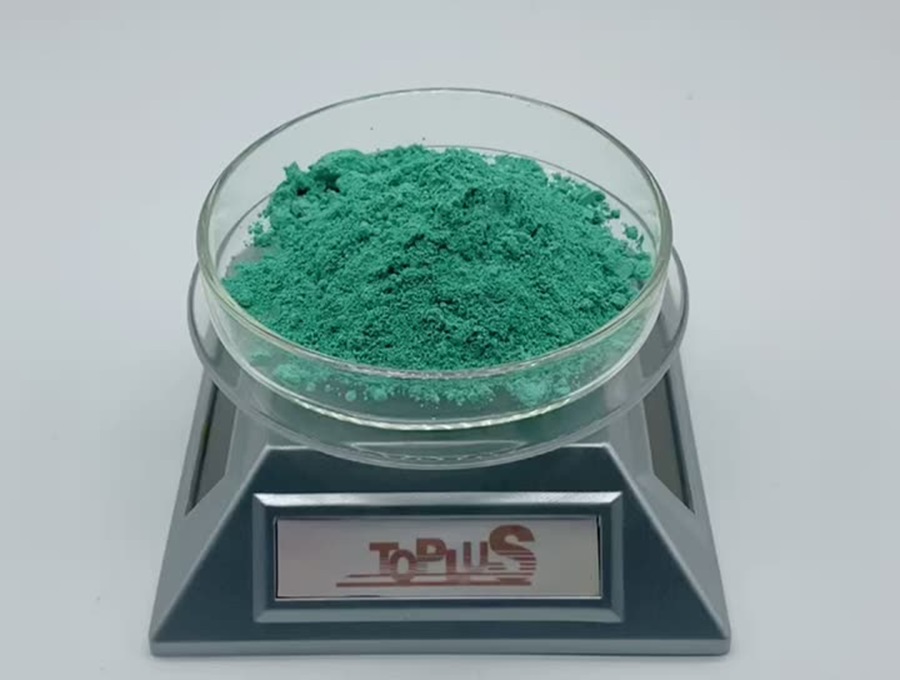
| Physical State (20°C) | Solid (green powder) |
| Odor | Odorless |
SECTION 2: PHYSICAL AND CHEMICAL PROPERTIES
| Property | Value | Test Method |
|---|---|---|
| Appearance | Green powder | Visual |
| Odor | Odorless | Olfactometric |
| Molecular Weight | 123.55 g/mol | Calculated |
| Density | 3.70 g/cm3 | ASTM D4052 |
| Solubility in Water | Insoluble | General Method |
| Solubility in Acids | Soluble (releases CO2 gas) | General Method |
| Solubility in Ammonia Solution | Soluble (forms copper-ammonia complex) | General Method |
| Solubility in Organic Solvents | Insoluble | General Method |
| pH (Aqueous Suspension) | 7.0 – 8.0 (neutral-slightly alkaline) | pH Meter |
| Thermal Decomposition | >200°C: CuCO3 → CuO + CO2↑ | TGA |
| Hygroscopicity | Low (does not absorb moisture) | Visual |
| Flash Point | Non-flammable | Not applicable |
SECTION 3: CHEMICAL PROPERTIES AND REACTIVITY
| Parameter | Information |
|---|---|
| Chemical Character | Inorganic metal carbonate; basic character |
| Stability | Stable under normal conditions |
| Thermal Decomposition | >200°C: CuCO3 → CuO (copper(II) oxide) + CO2 (carbon dioxide) |
| Reaction with Acids | Dissolves releasing CO2 gas: CuCO3 + 2HCl → CuCl2 + H2O + CO2↑ |
| Reaction with Ammonia | Forms soluble copper-ammonia complex: [Cu(NH3)4]2+ |
| Reaction with Reducing Agents | Cu2+ → Cu+ or Cu0 (metallic copper) reduction |
| Incompatible Materials | Strong acids, strong reducing agents, ammonium salts |
| Hazardous Decomposition Products | CO2 gas when heated; CO2 gas upon contact with acids |
SECTION 4: PRODUCTION METHODS
| Method | Description | Chemical Reaction |
|---|---|---|
| Classical Precipitation Method | Sodium carbonate (Na2CO3) is added to aqueous copper sulfate (CuSO4) solution; the precipitate is filtered and dried | CuSO4 + Na2CO3 → CuCO3↓ + Na2SO4 |
| Recycling Method (Circular Economy) | Scrap copper metals, amine (ammonia), and oxidizing compound are used to obtain basic copper salts | Copper + NH3 + Oxidizer → Copper-Amine Complex → Copper Carbonate |
SECTION 5: COPPER COMPOUNDS COMPARISON
| Property | Copper Carbonate (CuCO3) | Copper Sulfate (CuSO4·5H2O) | Copper Oxide (CuO) | Basic Copper Carbonate Cu2(OH)2CO3 |
|---|---|---|---|---|
| CAS Number | 1184-64-1 | 7758-99-8 | 1317-38-0 | 12069-69-1 |
| Molecular Formula | CuCO3 | CuSO4·5H2O | CuO | Cu2(OH)2CO3 |
| Copper Content | ~51% | ~25% | ~80% | ~55% |
| Appearance | Green powder | Blue crystals | Black powder | Green-blue powder |
| Solubility in Water | Insoluble | Very soluble | Insoluble | Insoluble |
| Solubility in Acids | Soluble (releases CO2) | Soluble | Soluble | Soluble (releases CO2) |
| Primary Use | Pigment, catalyst, agriculture | Pesticide, algicide, electroplating | Pigment, catalyst, ceramics | Pigment, agriculture, catalyst |
SECTION 6: FUNCTIONAL PROPERTIES AND MECHANISM OF ACTION
| Property | Description |
|---|---|
| Pigment / Colorant | Produces green, turquoise, and red (in reduction kiln) color tones in ceramic glazes and slips |
| Catalyst Precursor | Starting material in the manufacture of copper chromite catalysts |
| Micronutrient Source (Agriculture) | Provides controlled copper release in soil due to water insolubility; used in seed treatment |
| Antimicrobial / Fungicide | Copper ions (Cu2+) inhibit enzyme systems of microorganisms |
| Algicide | Prevents growth of marine plants (algae) |
| Insecticide Precursor | Used with arsenic to produce acetoarsenite (insecticide) |
| Wood Preservative | Protects wood against fungal decay and insect damage |
| Heat-Induced Color Change | Oxidizes to CuO upon heat application; different color tones obtained |
SECTION 7: PRIMARY APPLICATION AREAS
| Sector | Application | Description |
|---|---|---|
| Ceramics and Glass | Glaze and slip colorant | Green, turquoise, and red (reduction) tones |
| Paint Industry | Pigment | Artists' paints and varnish formulations |
| Agriculture | Seed treatment | Micronutrient support with controlled copper release |
| Agriculture | Plant disease control | Fungicidal effect combined with Polyacrylic Acid |
| Agriculture | Insecticide production | In form of acetoarsenite (copper arsenite) as insecticide |
| Animal Husbandry | Feed additive | Copper source in animal feeds |
| Chemical Industry | Catalyst manufacturing | Production of copper chromite catalysts |
| Chemical Industry | Fatty methyl esters production | Catalyst component in biodiesel production |
| Wood Preservation | Wood impregnation | Protection against fungal and insect damage |
| Plant Cultivation | Algae control | Prevention of marine plant growth |
| Plant Cultivation | Root growth control | Controlled root elongation in plastic pots |
SECTION 8: QUALITY SPECIFICATIONS (TECHNICAL GRADE)
| Parameter | Specification | Test Method |
|---|---|---|
| Appearance | Green powder | Visual |
| Copper Content (as Cu) | ≥ 51.0% (theoretical) / ≥ 55.0% (technical) | Iodometric Titration / AAS |
| Purity (CuCO3) | ≥ 95.0% | Iodometric Titration |
| Moisture Content | ≤ 2.0% | Gravimetric (105°C) |
| Water Insoluble Matter | ≥ 99.0% | Gravimetric |
| Acid Insoluble Matter | ≤ 0.5% | Gravimetric |
| Chloride (Cl-) | ≤ 0.1% | Argentometric |
| Sulfate (SO4 2-) | ≤ 0.3% | Gravimetric (BaSO4) |
| Iron (Fe) | ≤ 0.1% | AAS / Colorimetric |
| Lead (Pb) | ≤ 50 ppm | ICP-MS / AAS |
| Arsenic (As) | ≤ 10 ppm | ICP-MS / AAS |
| Cadmium (Cd) | ≤ 10 ppm | ICP-MS |
| Particle Size | Per customer specification (typical: below 325 mesh) | Sieve Analysis |
| pH (Aqueous Suspension) | 7.0 – 8.0 | pH Meter |
SECTION 9: TOXICOLOGICAL PROFILE
| Parameter | Value |
|---|---|
| Acute Oral Toxicity (LD50, Rat) | ~1,350 mg/kg (harmful) |
| Acute Dermal Toxicity (LD50, Rabbit) | > 2,000 mg/kg |
| Skin Irritation | Irritant |
| Eye Irritation | Severe irritant |
| Respiratory Irritation | Inhalation of dust irritates respiratory tract |
| Skin Sensitization | Not sensitizing |
| Carcinogenicity | Not classified (IARC, NTP) |
| Mutagenicity | Limited data in in vitro tests |
| Reproductive Toxicity | May have effects at high doses |
| Chronic Toxicity | Long-term exposure may cause copper accumulation (Wilson's disease-like) |
| Environmental Toxicity | Very toxic to aquatic organisms (H400, H410) |
SECTION 10: GHS CLASSIFICATION AND LABELING
GHS Classification (compliant with 1272/2008/EC):
| Hazard Class | Category | H-Statement |
|---|---|---|
| Acute Toxicity (Oral) | Category 4 | H302 |
| Serious Eye Damage/Irritation | Category 2 | H319 |
| Skin Irritation | Category 2 | H315 |
| Specific Target Organ Toxicity (STOT - SE) | Category 3 | H335 |
| Acute Aquatic Toxicity | Category 1 | H400 |
| Chronic Aquatic Toxicity | Category 1 | H410 |
Signal Word: WARNING
Hazard Pictograms: GHS07 (Exclamation Mark), GHS09 (Environmental Toxicity)
Hazard Statements (H-Codes):
| Code | Statement |
|---|---|
| H302 | Harmful if swallowed |
| H315 | Causes skin irritation |
| H319 | Causes serious eye irritation |
| H335 | May cause respiratory irritation |
| H400 | Very toxic to aquatic life |
| H410 | Very toxic to aquatic life with long lasting effects |
Precautionary Statements (P-Codes):
| Code | Statement |
|---|---|
| P261 | Avoid breathing dust |
| P273 | Avoid release to the environment |
| P280 | Wear protective gloves/eye protection |
| P301+P312 | IF SWALLOWED: Call a POISON CENTER/doctor if you feel unwell |
| P305+P351+P338 | IF IN EYES: Rinse cautiously with water for several minutes |
| P501 | Dispose of contents/container to an approved waste disposal facility |
SECTION 11: FIRST AID MEASURES
| Exposure Route | Action to Take |
|---|---|
| Inhalation | Move to fresh air. Seek medical attention if respiratory irritation persists. |
| Skin Contact | Wash with plenty of water and soap for at least 15 minutes. Seek medical attention if irritation persists. |
| Eye Contact | Rinse immediately with plenty of water for at least 15 minutes. Remove contact lenses if present. Seek medical attention. |
| Ingestion | Rinse mouth with water. Do NOT induce vomiting. Drink plenty of water. Seek medical attention. |
SECTION 12: FIREFIGHTING MEASURES
| Parameter | Information |
|---|---|
| Fire Hazard | Non-flammable |
| Hazards During Fire | Releases CO2 gas and CuO particulates when heated above 200°C |
| Suitable Extinguishing Media | Any extinguishing media appropriate for surrounding fire |
| Special Protective Equipment | Self-contained breathing apparatus (SCBA), full protective clothing |
SECTION 13: STORAGE AND SHELF LIFE
| Parameter | Information |
|---|---|
| Storage Conditions | Cool (15-25°C), dry, well-ventilated area; containers tightly closed |
| Container Requirements | Moisture-proof containers; HDPE, PP, or stainless steel |
| Critical Separation | Strong acids, strong reducing agents, ammonium salts |
| Shelf Life | 36 months (unopened original packaging under appropriate storage conditions) |
| Stability Note | Non-hygroscopic; stable under appropriate conditions |
SECTION 14: PACKAGING OPTIONS
| Packaging Type | Quantity | Material |
|---|---|---|
| Kraft bag with PE inner liner | 25 kg | Kraft paper + PE |
| PP woven bag with PE inner liner | 25 kg | PP woven + PE |
| Plastic pail | 25 kg | HDPE |
| Fiber drum | 50 kg | Fiberboard + PE |
| Big-Bag | 500-1000 kg | Polypropylene (with PE inner liner) |
SECTION 15: TRANSPORTATION INFORMATION
| Parameter | Information |
|---|---|
| UN Number | UN 3077 (Environmentally Hazardous Substance, Solid, n.o.s.) |
| Hazard Class | 9 (Environmentally Hazardous Substances) |
| Packing Group | III |
| ADR/RID | UN 3077, Environmentally Hazardous Substance, 9, PG III |
| IMDG Code | UN 3077, Environmentally Hazardous Substance, 9, PG III |
| IATA (Air) | UN 3077, Environmentally Hazardous Substance, 9, PG III |
| Marine Pollutant | Yes |
| Transport Temperature | Ambient (15-25°C) |
SECTION 16: ACCIDENTAL RELEASE AND CLEANUP
| Parameter | Information |
|---|---|
| Personal Protection | Nitrile gloves, safety goggles, dust mask (N95/FFP2) |
| Cleanup Methods | Sweep up or vacuum dry. Collect in closed, labeled containers. |
| Environmental Precautions | Absolutely prevent entry into drains, soil, and surface water. |
| Waste Disposal | Dispose as hazardous waste according to local/national regulations at licensed disposal facility. |
SECTION 17: REGULATORY STATUS
| Region / Authority | Status |
|---|---|
| European Union | Registered under REACH (if applicable) |
| USA (EPA) | Registered for pesticide applications |
| USA (FDA) | Suitability for food contact applications must be evaluated |
| Turkey | Approved for agricultural and animal husbandry applications; under Chemical Registration, Evaluation and Authorization Regulation |
| IATA / IMDG | Regulated due to environmental hazard (UN 3077) |
SECTION 18: OTHER NAMES AND SYNONYMS
| Type | Name |
|---|---|
| Chemical Names | Copper(II) Carbonate, Cupric Carbonate, Carbonic Acid Copper Salt, Copper Monocarbonate |
| Other Names | Copper Carbonate, Copper(II) Carbonate |
| Mineral Name | (Pure CuCO3 mineral is rare in nature; generally found as malachite Cu2(OH)2CO3) |
| CAS Number | 1184-64-1 |
| EC Number | 214-671-4 |
SECTION 19: SUMMARY TABLE
| Parameter | Value |
|---|---|
| Product | Copper Carbonate (Cupric Carbonate) |
| CAS Number | 1184-64-1 |
| Molecular Formula | CuCO3 |
| Molecular Weight | 123.55 g/mol |
| Appearance | Green powder |
| Copper Content | ≥ 55% |
| Solubility in Water | Insoluble |
| Primary Function | Pigment, catalyst precursor, micronutrient source, fungicide |
| Shelf Life | 36 months |
| GHS Signal Word | Warning |
| UN Number | UN 3077 (Environmentally Hazardous, 9, PG III) |
SECTION 20: CRITICAL WARNINGS AND BEST PRACTICES
CRITICAL SAFETY WARNINGS:
-
Aquatic Toxicity: Very toxic to aquatic organisms. Absolutely prevent entry into environment, water sources, and sewers.
-
Dust Control: Fine dust may irritate respiratory tract. Minimize dust generation; use dust mask.
-
Contact with Acids: Contact with acids releases CO2 gas; may build pressure in closed containers.
-
Eye Protection: Causes serious eye irritation. Wear protective goggles.
-
Heavy Metal: As a copper compound, subject to heavy metal regulations; follow hazardous waste procedures for disposal.
BEST PRACTICE RECOMMENDATIONS:
-
Dry Storage: Although non-hygroscopic, store under dry conditions to maintain product integrity.
-
Separate from Acids: Store separately from strong acids and acidic environments.
-
Ceramic Applications: Reduction kiln atmosphere required for red color tones; oxidation atmosphere sufficient for green and turquoise.
-
Agricultural Applications: Provides controlled copper release in soil due to water insolubility; avoid overdosing.
-
Waste Management: Treat copper-containing waste as hazardous; never dispose in regular trash or sewer.
LEGAL DISCLAIMER:
The information provided in this document is presented in good faith based on our current knowledge and experience; however, since all usage conditions are beyond our control, it does not constitute a binding specification or warranty. This Technical Data Sheet is for informational purposes only. Users are obligated to test the suitability for their own applications. For complete safety, storage, handling, transportation, disposal, and regulatory compliance information, refer to the official Safety Data Sheet (SDS/MSDS) provided by the manufacturer/supplier.