We unleash your business potential by maximize the business innovation.
Send EmailTaurine, Tauric Acid, Amino Ethane Sulfonic Acid, Aminoethanesulfonic Acid, Amino Ethyl Sulfonate, 107-35-7
Product Name: Taurine
Chemical Name: 2-Aminoethanesulfonic acid
Version: 1.0
Issue Date: [Current Date]
1. CHEMICAL IDENTITY
| Parameter | Value |
|---|---|
| Molecular Formula | C₂H₇NO₃S |
| Molecular Weight | 125.15 g/mol |
| Chemical Name | Taurine |
| IUPAC Name | 2-Aminoethanesulfonic acid |
| CAS Number | 107-35-7 |
| EINECS Number | 203-483-8 |
| Natural Source | Sulfur amino acid derived from methionine and cysteine metabolism; found free in animal tissues |
2. PHYSICAL AND CHEMICAL PROPERTIES
| Parameter | Value |
|---|---|
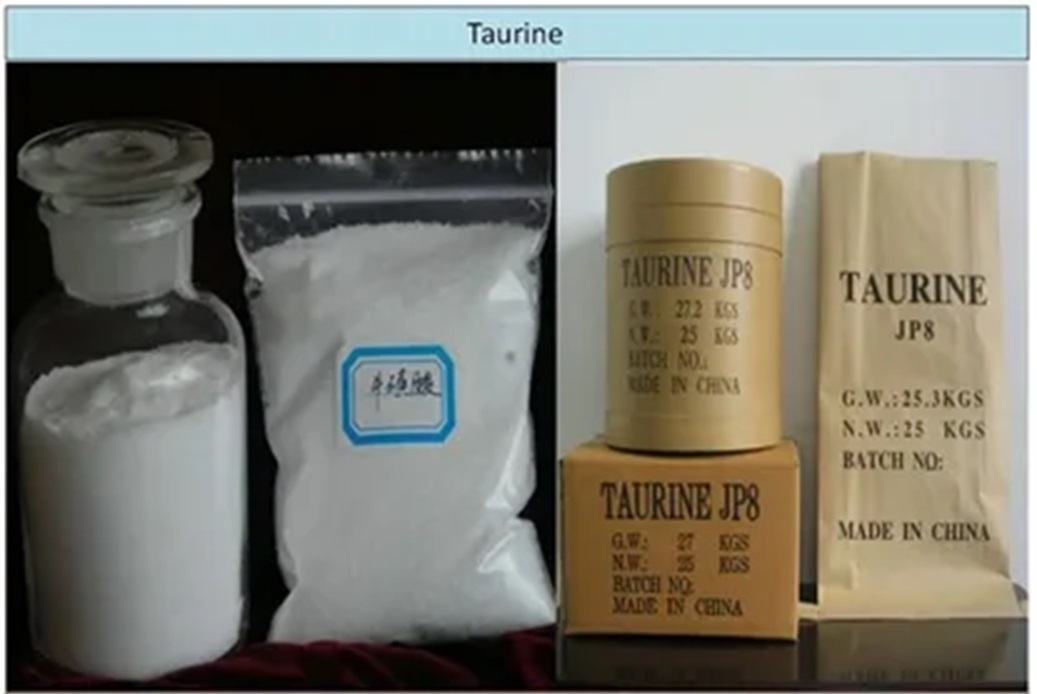
| Appearance | White or colorless crystalline powder |
| Taste/Odor | Slightly acidic taste, odorless |
| Melting Point | >300 °C (approx. 325–328 °C) |
| Density | ~1.7 g/cm³ |
| Solubility in Water | 65 g/L (23–25 °C) |
| Solubility in Organics | Insoluble in ethanol, ether, acetone |
| pH (0.5 M aqueous solution) | 4.5 – 6.0 |
| Stability | Hygroscopic; stable for 36 months in closed packaging under dry conditions |
| Incompatibilities | Strong oxidizing agents |
3. MANUFACTURING METHODS
A. Chemical Synthesis (Industrial)
-
Ethylene oxide + sodium bisulfite → intermediates
-
Addition of liquid ammonia and sulfuric acid to obtain taurine
-
Crystallization, centrifugation, drying, and purification
B. Natural Extraction
-
Sources: Fish, seafood (squid, mussels, shrimp), mammalian organs (liver, heart, brain)
-
Historical: First isolated from gallstones (bezoar)
4. BIOLOGICAL FUNCTIONS
| Function | Mechanism / Role |
|---|---|
| Osmoregulation | Maintains intracellular fluid balance |
| Antioxidant | Reduces free radicals, protects cells |
| Cardiovascular | Regulates blood pressure, antiarrhythmic effect |
| Nervous System | Brain development, neurotransmission, calming effect |
| Eye Health | High concentration in retina, supports visual function |
| Liver & Bile | Conjugates with bile acids, facilitates lipid digestion |
5. APPLICATIONS
Pharmaceutical / Medical
-
Retinal degeneration treatment
-
Prevention of dilated cardiomyopathy in cats (mandatory additive)
-
Adjunctive therapy for Parkinson's and neurological disorders
-
Metabolic syndrome treatment (obesity, cholesterol, insulin resistance, hypertension)
-
Periodontal diseases, alopecia treatment
-
Excipient in pharmaceutical formulations (tablets, capsules, eye drops)
Sports Nutrition
-
Performance enhancer with caffeine in energy drinks
-
Fatigue management and endurance support
Cosmetics
-
Enhances cell membrane vitality → skin care creams
-
Anti-aging and skin rejuvenation products
Veterinary / Animal Nutrition
-
Mandatory supplement for cats (cannot synthesize taurine endogenously)
-
Added to dog, bird, and other animal feeds
Food / Nutraceuticals
-
Functional beverages, dairy products, infant formulas
-
Usage limits (China, EU): 0.1 – 0.5 g/kg
6. RISK AND SAFETY INFORMATION
| Parameter | Value / Description |
|---|---|
| Acute toxicity (LD50, oral, rabbit) | >5000 mg/kg (low toxicity) |
| Risk Codes | R36/37/38 – Irritant to eyes, respiratory system, and skin |
| Safety Precautions | Use protective clothing and gloves. In case of eye contact, rinse thoroughly with plenty of water. |
| Storage | Opaque, closed packaging in a dry, cool environment |
| Shelf Life | 36 months under proper storage conditions |
7. REGULATORY INFORMATION (Summary)
| Region | Status |
|---|---|
| USA (FDA) | Generally Recognized as Safe (GRAS) for energy drinks and supplements |
| European Union | Permitted in food supplements and infant formulas; subject to maximum levels |
| Turkey (Ministry of Agriculture and Forestry) | Permitted as food and feed additive; subject to dietary supplement regulations |
Note: Country-specific regulations must be verified prior to use.
8. SUMMARY AND DISCLAIMER
Summary:
Taurine is a sulfur-containing amino sulfonic acid that does not participate in protein synthesis but is critical for homeostasis, cardiovascular health, nervous system function, eye health, and metabolism. It has a wide range of applications from sports nutrition and pharmaceuticals to cosmetics and veterinary feeds.
1. Sectoral Suitability Table
Taurine is used across a wide range of industries due to its functional properties.
| Sector | Suitability | Typical Application | Remarks |
|---|---|---|---|
| Food & Beverage | High | Energy drinks, functional beverages, infant formula, dairy products | Approved as a food additive and flavoring agent in the EU, China, and Australia |
| Nutraceuticals / Supplements | High | Dietary supplements (capsules, tablets, powder forms) | One of the fastest-growing segments |
| Pharmaceuticals | High | Eye drops, cardiovascular drugs, neurological treatments | Requires pharmaceutical grade purity |
| Veterinary / Animal Nutrition | High | Mandatory additive in cat food, dog and bird food | Vital for heart and retinal health in cats (cannot synthesize endogenously) |
| Cosmetics | Medium | Skin care creams, anti-aging products | Used to enhance cell membrane vitality |
| Sports Nutrition | High | Performance enhancers, fatigue management supplements | Often combined with caffeine |
Market Note: The global taurine market was valued at approximately $520-550 million in 2024 and is expected to reach $840-950 million by 2032-2033, growing at a CAGR of ~6-7%.
2. Usage Rates and Maximum Limits
Usage rates vary depending on the application and country-specific regulations.
| Application Area | Typical Usage / Maximum Limit | Notes |
|---|---|---|
| Energy Drinks | 200 - 400 mg / 100 mL (Turkey, typical) | Varies by country; some have no defined maximum |
| Infant Formula | 0.1 - 0.5 g / kg (EU, China) | Added for brain and eye development |
| Dairy Products | Maximum 0.5 g / kg (China) | Used in functional products |
| Dietary Supplements | 500 - 2000 mg daily (common range) | Consumed in capsule, tablet, or powder form |
| Cat Food (Dry) | Minimum 1000 mg / kg (typical requirement) | Mandatory and vital for feline health |
Important Regulatory Note:
-
In Australia and China, taurine is used under GMP (Good Manufacturing Practices) following the "minimum required amount" principle.
-
In China, its use is prohibited in certain basic food categories such as pasteurized milk, fresh fruits/vegetables, and some infant foods.
3. Other Names and Identifiers
Taurine is known by various chemical and trade names.
| Category | Name / Identifier |
|---|---|
| IUPAC Name | 2-Aminoethanesulfonic acid |
| Other Chemical Names | 2-Ethanesulfonic acid, Aminoethylsulfonic acid, Beta-Aminoethylsulfonate, Tauric acid |
| Trade Names | TATU, TURIN (specific brands) |
| CAS Number | 107-35-7 |
| EINECS Number | 203-483-8 |
| FEMA Number | 3813 (as a flavoring agent) |
4. Alternatives to Taurine
Taurine has a unique molecular structure (sulfonic acid) and functions. No single compound perfectly mimics all its effects, but for specific applications, some ingredients can be considered.
| Compound | Mechanism / Application | Comparison to Taurine |
|---|---|---|
| Beta-Alanine | Uses the same taurine transporter (TauT) and can lower intracellular taurine levels. Used in sports nutrition to increase muscle buffering capacity. | Different: Reduces taurine levels. Preferred for increasing muscle carnosine and buffering lactic acid during high-intensity exercise. |
| GABA (Gamma-aminobutyric acid) | Acts as an inhibitory neurotransmitter in the central nervous system. Calming and anti-anxiety effects. | Different: Shares some calming effects on the nervous system but lacks taurine's cellular functions (osmoregulation, antioxidant). |
| Glycine | The simplest amino acid. Can conjugate with bile acids (like taurine) and has antioxidant properties. | Similarity: Can partially substitute for taurine in bile salt formation. Difference: Not as potent as a cell protectant or osmolyte. |
| Creatine | Plays a role in energy metabolism. Draws water into muscle cells and improves high-intensity exercise performance. | Different: Often used alongside taurine in energy drinks, but has a completely different mechanism of action (energy buffering). |
| Inositol | Found in cell membranes and involved in signal transmission. Often used together with taurine in energy drinks. | Different: Does not perform taurine's core functions such as osmoregulation (cell volume regulation). |
Summary Table of Alternatives
| Alternative | Best For | Key Difference from Taurine |
|---|---|---|
| Beta-Alanine | Sports performance (buffering capacity) | Lowers taurine levels; different mechanism |
| GABA | Calming / nervous system support | No cellular protection or osmoregulation |
| Glycine | Bile acid conjugation (partial) | Less potent as an antioxidant/osmolyte |
| Creatine | Energy metabolism / muscle volume | Completely different mechanism |
| Inositol | Cell signaling | Does not regulate cell volume |
Conclusion: If a specific function of taurine is targeted (e.g., cellular protection, osmoregulation), there is no complete substitute. However, for certain applications (e.g., sports supplements or nervous system support), compounds like Beta-Alanine or GABA may provide similar benefits through different mechanisms.
5. Regulatory Status by Region (Quick Reference)
| Region | Status for Taurine |
|---|---|
| USA (FDA) | Generally Recognized as Safe (GRAS) for energy drinks and supplements |
| European Union (EFSA) | Permitted in food supplements and infant formulas; subject to maximum levels |
| China | Permitted with limits (0.1-0.5 g/kg); prohibited in certain basic foods |
| Australia | Permitted as a flavoring substance and nutritional supplement under GMP |
| Turkey | Permitted as a food and feed additive; subject to dietary supplement regulations |