We unleash your business potential by maximize the business innovation.
Send EmailCalcium Lactate, Calphosan, Conclyte Calcium Dilactate, Calcium Lactate Trihydrate, E327, 814-80-2, 5743-48-6
Chemical Identity
-
CAS Numbers: 814-80-2; 5743-48-6
-
Molecular Formula: C₃H₈CaO₃
-
Molar Mass: 132.17 g/mol
-
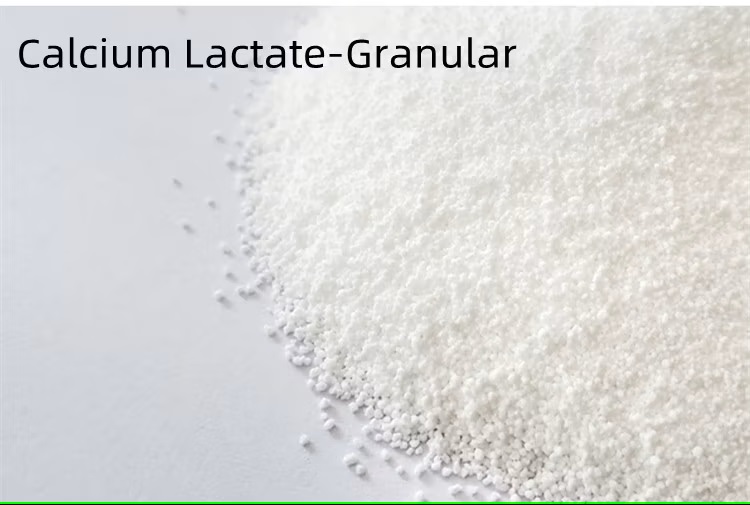
Appearance: White crystalline powder or granules, odorless, tasteless
-
Solubility: Soluble in water (better in hot water), insoluble in ethanol, ether, chloroform
-
pH: 7–8.5 depending on concentration
Physical and Chemical Properties
-
Loses water of crystallization at 120 °C.
-
Slightly weathered when exposed to air.
-
Boiling point: 120 °C.
-
Storage: Sealed, at room temperature.
Production Methods
-
Fermentation Method:
-
Starch or rice flour is fermented with Lactobacillus to produce lactic acid.
-
Neutralization with calcium carbonate or calcium hydroxide.
-
Crystallization yields calcium lactate.
-
Reaction:
-
2C3H6O3+Ca(OH)2→(C3H5O3)2Ca+2H2O
-
Neutralization Method:
-
Direct reaction of lactic acid with calcium hydroxide or calcium carbonate.
-
-
Alternative Sources:
-
Eggshell powder, cuttlebone, corn, or potato can be used as raw materials.
-
Applications
-
Food Industry:
-
Calcium fortifier in infant formula, dairy products, bread, cakes, candy, soy products, pickled vegetables.
-
Buffer, stabilizer, dough regulator, leavening agent.
-
Hardening agent in fruit and vegetable processing.
-
-
Pharmaceuticals:
-
Treatment of calcium deficiency (rickets, tetany, skeletal dysplasia).
-
Used in hypocalcemia related to chronic renal failure.
-
Supportive therapy for allergic diseases and tuberculosis.
-
As a coagulant.
-
-
Animal Feed:
-
Improves milk yield, reduces broken eggs, supports growth in young animals.
-
Dosage and Forms
-
Tablets: 0.25 g, 0.3 g, 0.5 g.
-
Adult dosage: 1–4 g/day (with Vitamin D for better absorption).
-
Children dosage: 0.3–0.6 g, 2–3 times/day.
-
Side effects: Belching, constipation, abdominal discomfort. Overdose may cause hypercalcemia (loss of appetite, nausea, vomiting, arrhythmia).
Safety and Toxicity
-
Risk Codes: R36/37/38 (irritant to eyes, respiratory system, skin).
-
Acute Toxicity: LD₅₀ (mouse, IV) = 140 mg/kg.
-
Fire Hazard: Produces irritating smoke upon thermal decomposition.
-
Extinguishing Agents: Water, dry powder, CO₂, foam.
Standards and Limits
-
Purity: 98–103% (dry basis).
-
Food Limits:
-
Cereals: 12–24 g/kg
-
Infant food: 23–46 g/kg
-
Beverages: 3–6 g/kg
-
FDA: GRAS, no restrictions (GMP).
-
FAO/WHO: Specific limits for jams, canned vegetables, etc.
-
Summary
Calcium lactate is a widely used calcium supplement and food fortifier. It is preferred over inorganic calcium salts due to its higher absorption rate and safety profile. Its versatility allows applications in medicine, food, and animal feed. Production can be achieved via fermentation or neutralization, with raw materials ranging from lactic acid to natural calcium sources like eggshells.
Synonyms and Alternative Names
-
Calphosan
-
Conclyte Ca
-
Calcium dilactate
-
Calcium DL-lactate
-
Calcium lactate trihydrate
-
L-(+)-Lactic Acid, Calcium Salt
-
Lactic Acid Calcium Salt, Trihydrate
-
2-Hydroxypropanoic Acid Calcium Salt, Trihydrate
Identifiers
-
CAS Numbers: 814-80-2; 5743-48-6
-
EINECS: 212-406-7
-
InChI: InChI=1/2C3H6O3.Ca/c21-2(4)3(5)6;/h22,4H,1H3,(H,5,6);/q;;+2/p-2