We unleash your business potential by maximize the business innovation.
Send EmailCalcium Lactate, Calcium Dilactate, Calcium DL-Lactate, Calcium Lactate Trihydrate, E327, 814-80-2, 5743-48-6
CALCIUM LACTATE / CALCIUM DILACTATE
PRODUCT IDENTIFIER INFORMATION
| Parameter | Information |
|---|---|
| Product Name | Calcium Lactate / Calcium Dilactate |
| Chemical Name | Calcium bis(2-hydroxypropanoate) |
| CAS Number | 814-80-2 (Anhydrous) / 5743-48-6 (Trihydrate) |
| EC Number (EINECS) | 212-406-7 |
| Food Additive Code | E327 |
| Molecular Formula (Anhydrous) | C6H10CaO6 |
| Molecular Formula (Trihydrate) | C6H10CaO6·3H2O |
| Molecular Weight (Anhydrous) | 218.22 g/mol |
| Molecular Weight (Trihydrate) | 272.27 g/mol |
SECTION 1: CHEMICAL IDENTITY AND DESCRIPTION
| Parameter | Information |
|---|---|
| Chemical Name (IUPAC) | Calcium bis(2-hydroxypropanoate) |
| Synonyms | Calcium Lactate, Calcium Dilactate, Calcium DL-Lactate, Calcium Lactate Trihydrate, Lactic Acid Calcium Salt, 2-Hydroxypropanoic Acid Calcium Salt |
| Trade Names | Calphosan, Conclyte Ca |
| CAS Number (Anhydrous) | 814-80-2 |
| CAS Number (Trihydrate) | 5743-48-6 |
| EC Number (EINECS) | 212-406-7 |
| Food Additive Code | E327 |
| Molecular Formula (Anhydrous) | C6H10CaO6 |
| Molecular Formula (Trihydrate) | C6H10CaO6·3H2O |
| Molecular Weight (Anhydrous) | 218.22 g/mol |
| Molecular Weight (Trihydrate) | 272.27 g/mol |
| Chemical Class | Organic acid salt (calcium salt of lactic acid) |
| Calcium Content (Anhydrous) | ~18.4% |
| Calcium Content (Trihydrate) | ~14.7% |
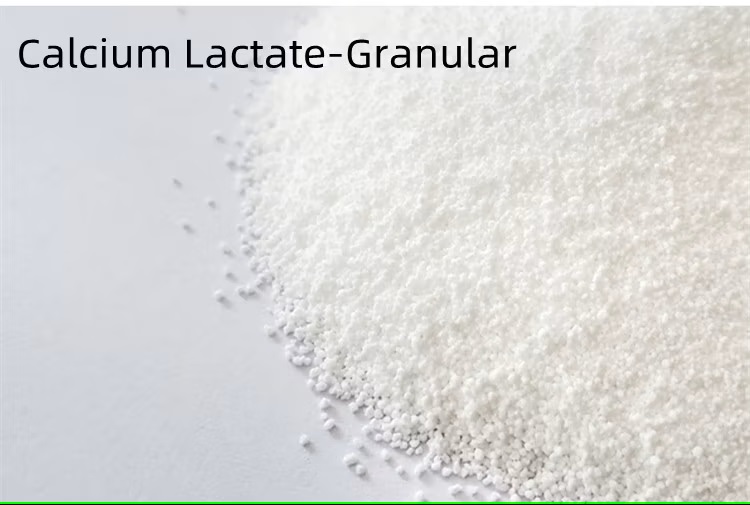
| Physical State (20°C) | Solid (white granules or powder) |
| Odor | Odorless |
| Taste | Tasteless or slight characteristic |
SECTION 2: PHYSICAL AND CHEMICAL PROPERTIES
| Property | Value | Test Method |
|---|---|---|
| Appearance | White granules or powder | Visual |
| Odor | Odorless | Olfactometric |
| Taste | Tasteless or slight characteristic | Sensory |
| Molecular Weight (Anhydrous) | 218.22 g/mol | Calculated |
| Molecular Weight (Trihydrate) | 272.27 g/mol | Calculated |
| Calcium Content (Anhydrous) | ~18.4% | AAS / Complexometric Titration |
| Calcium Content (Trihydrate) | ~14.7% | AAS / Complexometric Titration |
| Melting Point | 120°C (trihydrate loses crystal water) | DSC |
| Boiling Point | >240°C (decomposes) | TGA |
| Solubility in Water (25°C) | Soluble (~5-10 g/100 mL); better in hot water | Gravimetric |
| Solubility in Ethanol | Insoluble | General Method |
| Solubility in Ether | Insoluble | General Method |
| Solubility in Chloroform | Insoluble | General Method |
| pH (5% solution, 25°C) | 7.0 – 8.5 (neutral-slightly alkaline) | pH Meter |
| Hygroscopicity | Moderate (trihydrate); low (anhydrous) | Visual |
| Stability in Open Air | Easily deteriorates (weathering) | Visual |
| Flash Point | Non-flammable | Not applicable |
SECTION 3: CHEMICAL PROPERTIES AND REACTIVITY
| Parameter | Information |
|---|---|
| Chemical Character | Organic calcium salt; slightly alkaline character |
| Stability | Stable under normal conditions; deteriorates in open air (weathering) |
| Decomposition Products (Heating) | Loses crystal water at 120°C; decomposes above 240°C; CO, CO2, CaO, lactic acid derivatives |
| Incompatible Materials | Strong oxidizing agents, strong acids, sulfates, phosphates |
| Reaction with Acids | Releases lactic acid with strong acids |
| Reaction with Sulfates/Phosphates | May form insoluble calcium sulfate/phosphate precipitate |
| Hazardous Polymerization | Does not occur |
SECTION 4: PRODUCTION METHODS
| Method | Description | Chemical Reaction |
|---|---|---|
| Fermentation Method | Starch or rice flour fermented with Lactobacillus → lactic acid → neutralization with calcium carbonate or calcium hydroxide → crystallization | 2C3H6O3 + Ca(OH)2 → Ca(C3H5O3)2 + 2H2O |
| Direct Neutralization | Lactic acid + calcium carbonate / calcium hydroxide → calcium lactate | 2C3H6O3 + CaCO3 → Ca(C3H5O3)2 + CO2 + H2O |
| Alternative Sources | Can be derived from eggshell, cuttlefish bone, potato, or corn | - |
SECTION 5: CALCIUM SALTS COMPARISON
| Property | Calcium Lactate | Calcium Carbonate | Calcium Citrate | Calcium Gluconate | Calcium Chloride |
|---|---|---|---|---|---|
| CAS Number | 814-80-2 | 471-34-1 | 813-94-5 | 299-28-5 | 10043-52-4 |
| Molecular Formula | Ca(C3H5O3)2 | CaCO3 | Ca3(C6H5O7)2 | Ca(C6H11O7)2 | CaCl2 |
| Calcium Content | ~18.4% | ~40% | ~21% | ~9% | ~36% |
| Bioavailability | High | Low-Moderate (requires acid) | High | Moderate | High |
| Solubility in Water | Soluble | Insoluble | Slightly soluble | Soluble | Very soluble |
| Taste | Tasteless | Chalky | Slightly acidic | Tasteless | Bitter/salty |
| Gastric Irritation | Low | Low | Low | Low | Moderate |
| Primary Use | Food supplement, fortification | Supplement, antacid | Supplement | Supplement, injection | Supplement, food processing |
SECTION 6: FUNCTIONAL PROPERTIES AND MECHANISM OF ACTION
| Property | Description |
|---|---|
| Calcium Supplementation | Highly bioavailable organic calcium source; essential for bone and dental health, muscle contraction, nerve transmission, blood coagulation |
| Calcium Fortification | Ideal for adding calcium to foods; neutral taste and good solubility do not affect food matrix |
| Firming Agent | Firms texture in fruit and vegetable processing; cross-links with pectin strengthening cell walls |
| Dough Conditioner | Improves dough properties in bread and bakery products |
| Buffering Agent | Provides buffering capacity in pH range 7.0-8.5 |
| Leavening Agent | Participates in leavening systems in certain bakery products |
| Coagulant | Used as blood coagulation Factor IV (Ca2+) source in medical applications |
| Animal Feed Additive | Increases milk yield, reduces egg breakage rate, supports growth of young animals |
SECTION 7: PRIMARY APPLICATION AREAS
| Sector | Application | Typical Usage / Dosage |
|---|---|---|
| Food - Infant Formula | Calcium fortification | 23 – 46 g/kg |
| Food - Dairy Products | Calcium supplementation | 3 – 6 g/kg |
| Food - Cereals | Calcium fortification | 12 – 24 g/kg |
| Food - Bread/Cakes | Dough conditioner, leavening | 0.2 – 1.0% |
| Food - Confectionery | Firming agent, buffering | 0.1 – 0.5% |
| Food - Fruit/Vegetable Processing | Firming agent (pickles, canned) | 0.1 – 1.0% |
| Food - Soy Products | Calcium fortification (tofu coagulant) | 0.2 – 0.5% |
| Pharmaceutical - Tablets | Calcium supplementation (with vitamin D) | 1 – 4 g/day (adult); 0.3 – 0.6 g (child) |
| Pharmaceutical - Injection | Hypocalcemia treatment | Under medical supervision |
| Animal Feed | Milk yield, egg quality, growth support | 0.5 – 2.0% |
SECTION 8: PHARMACEUTICAL FORMS AND DOSAGE
| Parameter | Information |
|---|---|
| Tablet Forms | 0.25 g, 0.3 g, 0.5 g |
| Adult Dosage | 1 – 4 g/day (with vitamin D) |
| Child Dosage | 0.3 – 0.6 g, 2 – 3 times daily |
| Route of Administration | Oral; IV (injectable forms) |
| Side Effects | Belching, constipation, abdominal discomfort |
| High Dose Risk | Hypercalcemia (anorexia, nausea, vomiting, arrhythmia) |
| Contraindications | Hypercalcemia, severe renal failure, ventricular fibrillation |
SECTION 9: QUALITY SPECIFICATIONS (FOOD/PHARMACEUTICAL GRADE)
| Parameter | Specification | Test Method |
|---|---|---|
| Appearance | White granules or powder | Visual |
| Odor | Odorless | Olfactometric |
| Purity (Dry Basis) | 98.0 – 103.0% | Complexometric Titration (EDTA) |
| Calcium Content (Ca) | 17.5 – 18.5% (anhydrous); 14.0 – 15.0% (trihydrate) | AAS / Complexometric Titration |
| Loss on Drying (120°C) | ≤ 1.0% (anhydrous); 22.0 – 27.0% (trihydrate) | Gravimetric |
| pH (5% solution, 25°C) | 7.0 – 8.5 | pH Meter |
| Water Insoluble Matter | ≤ 0.1% | Gravimetric |
| Chloride (Cl-) | ≤ 0.05% | Argentometric |
| Sulfate (SO4 2-) | ≤ 0.075% | Turbidimetric |
| Fluoride (F-) | ≤ 30 ppm | Ion Selective Electrode |
| Heavy Metals (as Pb) | ≤ 20 ppm | ICP-MS / USP <231> |
| Lead (Pb) | ≤ 3 ppm | ICP-MS |
| Arsenic (As) | ≤ 3 ppm | ICP-MS |
| Mercury (Hg) | ≤ 1 ppm | ICP-MS |
| Cadmium (Cd) | ≤ 1 ppm | ICP-MS |
| Iron (Fe) | ≤ 50 ppm | AAS / Colorimetric |
| Magnesium and Alkali Salts | ≤ 1.0% | Gravimetric |
| Total Microbial Count | ≤ 1,000 CFU/g | USP <61> |
| Yeast and Mold | ≤ 100 CFU/g | USP <61> |
| E. coli | Negative in 10g | USP <62> |
| Salmonella spp. | Negative in 25g | USP <62> |
SECTION 10: TOXICOLOGICAL PROFILE
| Parameter | Value |
|---|---|
| Acute Oral Toxicity (LD50, Rat) | > 5,000 mg/kg (low toxicity) |
| Acute IV Toxicity (LD50, Mouse) | ~140 mg/kg |
| Skin Irritation | Irritant (R36/37/38) |
| Eye Irritation | Irritant |
| Respiratory Irritation | Inhalation of dust may cause mechanical irritation |
| Skin Sensitization | Not sensitizing |
| Carcinogenicity | Not classified |
| Mutagenicity | Negative in in vitro tests |
| Reproductive Toxicity | No known adverse effects |
| Chronic Toxicity | Hypercalcemia, kidney stone risk at high doses |
| Tolerable Upper Intake Level (UL) | 2,500 mg Ca/day for adults |
| GRAS Status | Recognized as GRAS by FDA (unlimited under GMP) |
SECTION 11: GHS CLASSIFICATION AND LABELING
GHS Classification (compliant with 1272/2008/EC):
| Hazard Class | Category | H-Statement |
|---|---|---|
| Skin Irritation | Category 2 | H315 |
| Eye Irritation | Category 2 | H319 |
| Specific Target Organ Toxicity (STOT - SE) | Category 3 | H335 |
Signal Word: WARNING
Hazard Pictograms: GHS07 (Exclamation Mark)
Hazard Statements (H-Codes):
| Code | Statement |
|---|---|
| H315 | Causes skin irritation |
| H319 | Causes serious eye irritation |
| H335 | May cause respiratory irritation |
Precautionary Statements (P-Codes):
| Code | Statement |
|---|---|
| P261 | Avoid breathing dust |
| P280 | Wear protective gloves/eye protection |
| P302+P352 | IF ON SKIN: Wash with plenty of water and soap |
| P305+P351+P338 | IF IN EYES: Rinse cautiously with water for several minutes |
SECTION 12: FIRST AID MEASURES
| Exposure Route | Action to Take |
|---|---|
| Inhalation | Move to fresh air. Seek medical attention if respiratory irritation persists. |
| Skin Contact | Wash with plenty of water and soap for at least 15 minutes. Seek medical attention if irritation persists. |
| Eye Contact | Rinse immediately with plenty of water for at least 15 minutes. Remove contact lenses if present. Seek medical attention. |
| Ingestion | Rinse mouth with water. Drink plenty of water. Seek medical attention if you feel unwell. |
SECTION 13: FIREFIGHTING MEASURES
| Parameter | Information |
|---|---|
| Fire Hazard | Non-flammable |
| Hazards During Fire | Irritating fumes upon thermal decomposition (CO, CO2, CaO) |
| Suitable Extinguishing Media | Water, dry chemical powder, CO2, foam |
| Special Protective Equipment | Self-contained breathing apparatus (SCBA), full protective clothing |
SECTION 14: STORAGE AND SHELF LIFE
| Parameter | Information |
|---|---|
| Storage Conditions | Cool (15-25°C), dry, well-ventilated area; closed packaging |
| Container Requirements | Tightly closed, moisture-proof containers |
| Keep Away From | Moisture, open air (weathering), direct sunlight, strong oxidizing agents, strong acids |
| Shelf Life | 36 months (unopened original packaging under appropriate storage conditions) |
| Stability Note | Easily deteriorates in open air (weathering); store in tightly closed containers |
SECTION 15: PACKAGING OPTIONS
| Packaging Type | Quantity | Material |
|---|---|---|
| Aluminum foil pouch (moisture-proof) | 1 kg | Laminated aluminum |
| Aluminum foil pouch (moisture-proof) | 5 kg | Laminated aluminum |
| Kraft bag with PE inner liner | 25 kg | Kraft paper + PE |
| PP woven bag with PE inner liner | 25 kg | PP woven + PE |
| Fiber drum | 25-50 kg | Fiberboard + PE |
SECTION 16: TRANSPORTATION INFORMATION
| Parameter | Information |
|---|---|
| UN Number | Not regulated (not hazardous) |
| Hazard Class | Not applicable |
| Packing Group | Not applicable |
| ADR/RID | Not regulated |
| IMDG Code | Not regulated |
| IATA (Air) | Not regulated |
| Marine Pollutant | No |
| Transport Temperature | Ambient (15-25°C); protect from moisture |
SECTION 17: REGULATORY STATUS
| Region / Authority | Status |
|---|---|
| European Union | Food additive E327; approved for use quantum satis in all foods |
| USA (FDA) | GRAS (21 CFR 184.1207); unlimited use under GMP |
| USP-NF | Official monograph available (USP Calcium Lactate) |
| JECFA (FAO/WHO) | ADI not limited |
| Turkey | Approved under Turkish Food Codex Regulation on Food Additives |
| Halal | Available |
| Kosher | Available |
| Vegetarian/Vegan | Suitable |
SECTION 18: OTHER NAMES AND SYNONYMS
| Type | Name |
|---|---|
| Common Names | Calcium Lactate, Calcium Dilactate, Calcium DL-Lactate, Calcium Lactate Trihydrate, Lactic Acid Calcium Salt |
| Trade Names | Calphosan, Conclyte Ca |
| CAS Number (Anhydrous) | 814-80-2 |
| CAS Number (Trihydrate) | 5743-48-6 |
| EC Number | 212-406-7 |
| Food Additive Code | E327 |
SECTION 19: SUMMARY TABLE
| Parameter | Value |
|---|---|
| Product | Calcium Lactate / Calcium Dilactate |
| CAS Number | 814-80-2 / 5743-48-6 |
| Molecular Formula | C6H10CaO6 |
| Molecular Weight | 218.22 g/mol (Anhydrous) |
| Appearance | White granules or powder |
| Calcium Content (Anhydrous) | ~18.4% |
| pH (5% solution) | 7.0 – 8.5 |
| Primary Function | Calcium supplementation, food fortification, firming agent |
| Shelf Life | 36 months |
| GHS Signal Word | Warning |
SECTION 20: CRITICAL WARNINGS AND BEST PRACTICES
CRITICAL WARNINGS:
-
Hypercalcemia Risk: High doses (above 2,500 mg/day) may cause hypercalcemia; anorexia, nausea, vomiting, arrhythmia may occur.
-
Weathering: Easily deteriorates in open air; store in tightly closed containers.
-
Drug Interactions: May reduce absorption of tetracycline antibiotics, bisphosphonates, and iron preparations; should be taken at least 2 hours apart.
-
Renal Failure: Contraindicated in patients with severe renal failure.
BEST PRACTICE RECOMMENDATIONS:
-
Dosage: Daily 1-4 g for adults; taking with vitamin D enhances absorption.
-
Solution Preparation: Soluble in water; better solubility in hot water.
-
Food Fortification: Neutral taste does not affect food matrix; ideal for infant formula and dairy products.
-
Storage: Protect from moisture and open air; store in airtight containers after opening.
-
Quality Verification: Account for calcium content difference between trihydrate and anhydrous forms in your calculations.
LEGAL DISCLAIMER:
The information provided in this document is presented in good faith based on our current knowledge and experience; however, since all usage conditions are beyond our control, it does not constitute a binding specification or warranty. This Technical Data Sheet is for informational purposes only and does not constitute medical advice. Users are obligated to test the suitability for their own applications. For complete safety, storage, handling, transportation, disposal, and regulatory compliance information, refer to the official Safety Data Sheet (SDS/MSDS) provided by the manufacturer/supplier. This product is not intended to diagnose, treat, cure, or prevent any disease.