We unleash your business potential by maximize the business innovation.
Send EmailSodium Sulfate, Sodium Sulphate, Disodium Sulfate, Glauber's Salt, E514, 7757-82-6
SODIUM SULFATE
1. PRODUCT DEFINITION AND CHEMICAL IDENTITY
| Parameter | Description |
|---|---|
| Chemical Name | Sodium Sulfate |
| Common Names | Sodium Sulphate, Glauber's Salt (decahydrate), Thenardite (anhydrous mineral), Mirabilite (decahydrate mineral), Sal Mirabilis |
| CAS Number | 7757-82-6 (anhydrous) / 7727-73-3 (decahydrate) |
| E Code | E514 (food additive) |
| Molecular Formula | Na₂SO₄ |
| Molecular Weight | 142.04 g/mol (anhydrous) / 322.20 g/mol (decahydrate) |
| Appearance | White crystalline powder or granules |
| Odour | Odourless |
Note: Sodium sulfate is a neutral, inorganic salt. It occurs naturally in mineral deposits (as thenardite or mirabilite) in saline lakes and springs, and is also obtained as a chemical by-product from various industrial processes. Natural sodium sulfate is free from toxic heavy metals such as lead, arsenic, chromium, and zinc, making it a preferred additive in many sectors. It is widely used as a filler, processing aid, and raw material across the detergent, paper, glass, and textile industries.
2. PHYSICAL AND CHEMICAL PROPERTIES
| Property | Value / Description |
|---|---|
| Physical form | White crystalline powder or granules |
| Density | 2.68 g/cm³ (anhydrous); 1.46 g/cm³ (decahydrate) |
| Melting Point | 884 °C (anhydrous); 32.4 °C (decahydrate, loses water) |
| Boiling Point | 1429 °C (anhydrous, decomposes) |
| Solubility in Water (20 °C) | 19.5 g/100 mL (anhydrous); solubility increases with temperature, peaking at ~33 °C |
| pH (aqueous solution) | Neutral (~6.5 – 7.5) |
| Hygroscopy | Anhydrous form is slightly hygroscopic; the decahydrate effloresces in dry air |
| Stability | Chemically inert under normal conditions; stable in storage |
| Reactivity | A neutral salt; does not react with acids or bases under standard conditions. Will react with strong reducing agents at high temperatures. |
3. FUNCTIONAL PROPERTIES AND MODE OF ACTION
-
Inert Filler / Bulking Agent: Its primary role, especially in powdered detergents, is to act as an inert, cost-effective filler. It provides the necessary bulk and free-flowing properties to the formulation without affecting the chemical activity of the surfactants. It also helps standardize detergent formulations to a target concentration.
-
Processing Aid (Pulping): In the kraft (sulfate) paper pulping process, it is a key chemical used in the cooking liquor to break down wood fibres, facilitating the separation of cellulose from lignin.
-
Levelling Agent (Textile Dyeing): In textile dyeing, it acts as a levelling agent. By moderately increasing the ionic strength of the dyebath, it retards the rate of dye uptake by the fibre, ensuring a more uniform and homogenous colour penetration and preventing streaking.
-
Flux and Refining Agent (Glass Manufacturing): In the glass melt, it acts as a flux, lowering the melting temperature of silica (SiO₂) and aiding in the removal of gas bubbles, which helps produce a homogenous, defect-free glass. It also prevents the formation of a scum layer on the molten glass surface.
-
Source of Sulfate Ions: It serves as a key raw material for the chemical synthesis of other sulfate compounds, including potassium sulfate, aluminum sulfate, and sodium sulfide.
4. PRODUCTION METHODS
Sodium sulfate is obtained from two primary sources:
A. Natural Extraction:
Natural sodium sulfate is extracted from mineral deposits, primarily from saline lakes or underground brines.
-
Mirabilite (Na₂SO₄·10H₂O): Harvested from lake beds, it is then dehydrated to produce the anhydrous form.
-
Thenardite (Na₂SO₄): Mined directly as an anhydrous mineral. Natural sources are free of heavy metals (lead, arsenic, chromium, zinc), which is a significant advantage for many applications.
B. Synthetic By-Product (Chemical Process):
A significant portion of sodium sulfate is produced as a by-product of various chemical manufacturing processes, most notably:
-
The production of rayon (viscose fiber).
-
The manufacture of hydrochloric acid, lithium carbonate, and other chemicals where sulfuric acid is neutralized with sodium hydroxide or sodium chloride.
5. SECTORAL APPLICATIONS AND USAGE RATES
| Sector | Application | Typical Usage Rate / Notes |
|---|---|---|
| Detergent Industry | Filler, bulking agent, and flow aid in powder and granular laundry detergents | Typically ~16% of formulation; can be up to ~40% in some products. Natural pH and non-toxic nature are crucial. |
| Paper Industry (Kraft Process) | Key chemical in cooking liquor for digesting wood fibers to produce cellulose pulp | A major consumer; used in substantial quantities in the pulping process |
| Glass Industry | Flux, fining agent (removes gas bubbles), and prevents scum formation on the molten glass surface | ~3% of the glass batch; a key component in container and flat glass manufacturing |
| Textile Industry | Levelling agent in dyeing to ensure uniform, homogenous colour penetration into the fabric | 1 – 10 g/L in the dyebath, depending on the dye and process |
| Chemical Industry | Raw material for synthesizing other chemicals like potassium sulfate, aluminum sulfate, sodium silicate, sodium sulfide | Stoichiometric usage; a key sulfate ion source |
6. ALTERNATIVES AND COMPARISON
| Alternative | Application Area | Comparison with Sodium Sulfate |
|---|---|---|
| Sodium Chloride (NaCl, Salt) | Detergent filler, textile dyeing | Cheaper, but highly corrosive to metal equipment. Sodium sulfate is non-corrosive and inert. |
| Sodium Carbonate (Na₂CO₃, Soda Ash) | Detergent builder, glass flux | Chemically active (alkaline), acts as a builder and water softener. Sodium sulfate is a neutral, inert filler; they serve different, often complementary, functions. |
| Potassium Sulfate (K₂SO₄) | Chemical synthesis, glass manufacturing | More expensive. Used in applications where potassium is specifically required, such as specialty glass or fertilizers. |
7. SAFETY, STORAGE, AND REGULATORY INFORMATION
-
GHS Classification: Not classified as a hazardous substance or mixture under CLP (EC 1272/2008).
-
Toxicity: Very low order of acute oral toxicity (LD50 > 5,000 mg/kg). Generally recognized as a non-irritant to skin and eyes. The E514 food additive status confirms its safety for regulated food applications.
-
Storage: Store in a cool, dry, and well-ventilated area. Keep containers tightly closed. While chemically stable, the anhydrous form is slightly hygroscopic, and the decahydrate can effloresce; protection from extreme humidity and temperature cycles is recommended to prevent caking.
-
Personal Protection: As with all fine powders, avoid creating and breathing dust. Standard industrial hygiene practices (safety goggles, gloves) are sufficient for handling bulk quantities.
-
Environmental Impact: Sodium sulfate is a naturally occurring, water-soluble salt. It is not considered harmful to the environment in dispersed quantities. However, large discharges to freshwater systems should be avoided as they can increase salinity.
-
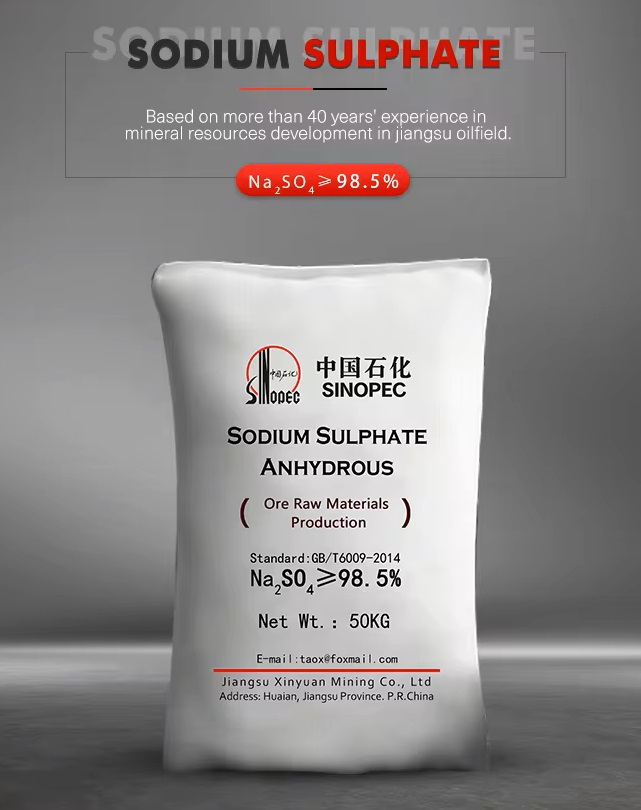
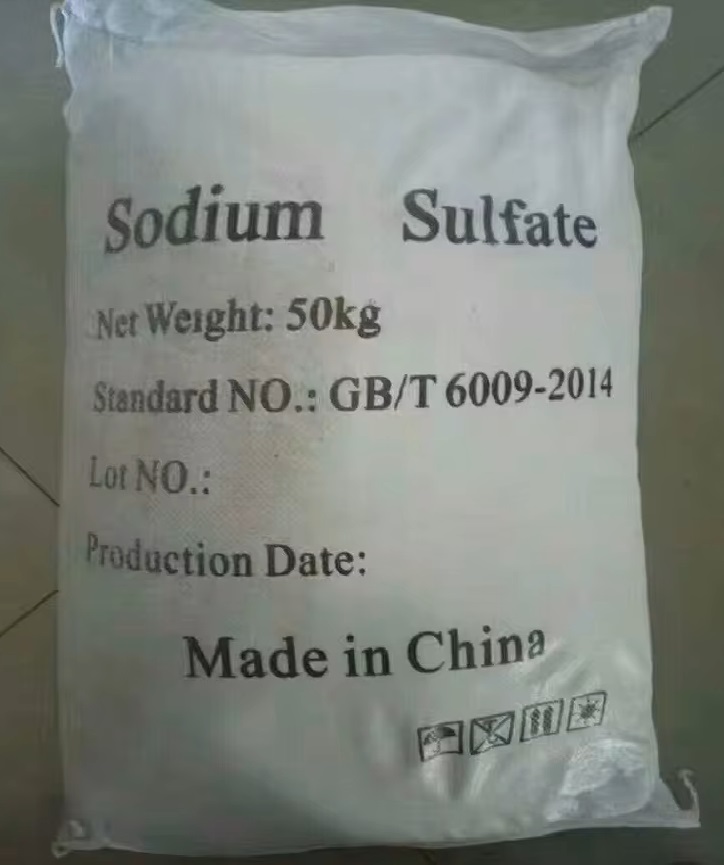
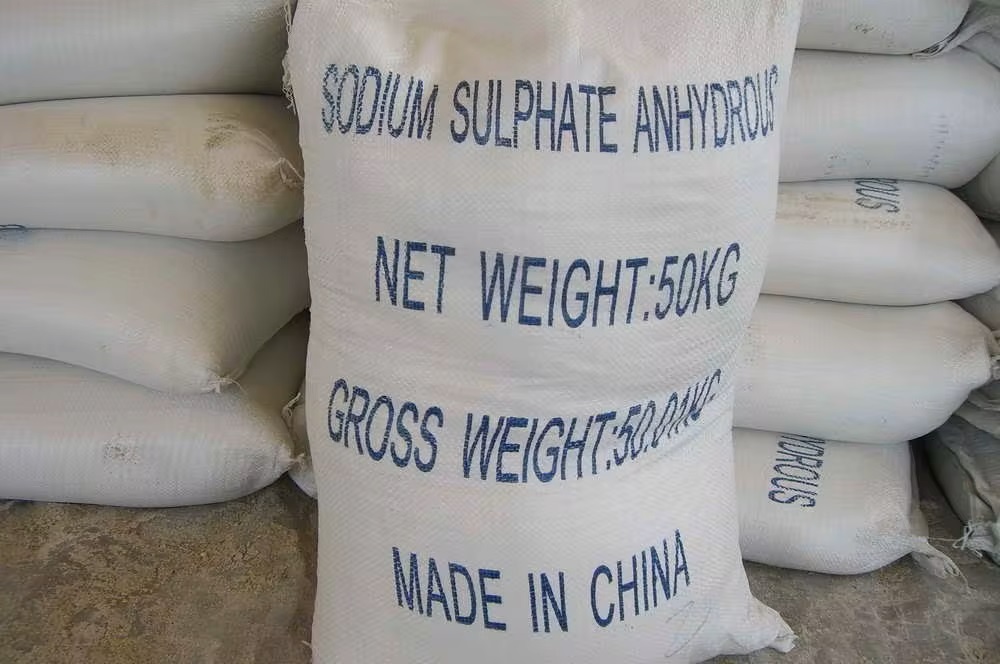
Packaging: Typically supplied in 25 kg or 50 kg PE-lined kraft paper bags, 500-1000 kg big bags, or in bulk.
8. QUICK REFERENCE TABLE
| Property | Value |
|---|---|
| CAS (Anhydrous) | 7757-82-6 |
| Formula | Na₂SO₄ |
| Molecular Weight | 142.04 g/mol |
| Appearance | White crystalline powder or granules |
| Solubility (20 °C) | 19.5 g/100 mL water |
| pH | Neutral (~7) |
| Main Uses | Detergent filler, paper pulping, textile dyeing, glass flux |
| E Code | E514 |