We unleash your business potential by maximize the business innovation.
Send EmailPeracetic Acid, Ethaneperoxoic Acid, Peroxyacetic Acid, Acetic Peroxide, Acetyl Hydroperoxide, Peroxoacetic Acid, PAA, 79-21-0
PERACETIC ACID (PAA)
1. PRODUCT DEFINITION AND CHEMICAL IDENTITY
| Parameter | Description |
|---|---|
| Chemical Name (IUPAC) | Ethaneperoxoic acid |
| Common Name | Peracetic Acid (PAA) |
| Other Names | Peroxyacetic acid, Acetic peroxide, Acetyl hydroperoxide, Peroxoacetic acid |
| CAS Number | 79-21-0 |
| EC Number | 201-186-8 |
| Molecular Formula | C₂H₄O₃ (CH₃CO₃H) |
| Molecular Weight | 76.05 g/mol |
| Appearance | Clear, colourless liquid with a pungent, vinegar-like (acrid) odour |
Warning: Peracetic acid is a strong oxidising agent and can be corrosive and explosive at high concentrations (>15%) or when heated. It is typically handled, stored, and transported as an equilibrium solution in water containing acetic acid and hydrogen peroxide. Always consult the Safety Data Sheet (SDS) before handling.
2. PHYSICAL AND CHEMICAL PROPERTIES
| Property | Value |
|---|---|
| Physical state (at 20 °C) | Clear, colourless liquid |
| Odour | Pungent, sharp, vinegar-like (acrid) |
| Melting point | 0 °C (approx.) |
| Boiling point | 110 °C (decomposes; may decompose violently at higher temperatures) |
| Flash point | 40 – 50 °C (for equilibrium solutions; depends on concentration) |
| Density (20 °C) | ~1.11 – 1.15 g/cm³ (for 5–15% solution) |
| Vapour pressure (20 °C) | 14 – 20 hPa |
| pH (typical solution) | < 1 – 2 (strongly acidic) |
| Solubility in water | Completely miscible |
| Solubility in organics | Miscible with alcohols, ethers; soluble in polar organic solvents |
| Stability | Decomposes on heating, releasing oxygen; stabilised with hydrogen peroxide in commercial equilibrium solutions |
3. PRODUCTION AND TYPICAL COMMERCIAL FORMS
Peracetic acid is most commonly produced by the reaction of acetic acid with hydrogen peroxide, using a strong acid catalyst (e.g., sulfuric acid). The reaction is an equilibrium:
CH₃COOH + H₂O₂ ⇌ CH₃CO₃H + H₂O
Typical commercial equilibrium solutions:
-
5% PAA: Used for light disinfection; often contains 20-25% hydrogen peroxide.
-
15% PAA: Common for industrial sanitation.
-
22-40% PAA: Highly concentrated; typically used after dilution or in specialised closed systems.
4. FUNCTIONAL PROPERTIES AND MECHANISM OF ACTION
-
Broad-spectrum biocide: Extremely effective against a wide range of microorganisms, including bacteria, fungi, yeasts, viruses, and spores.
-
Rapid oxidation: Acts by denaturing proteins, disrupting cell wall permeability, and oxidising sulfhydryl and sulfur bonds in enzymes. kill kinetics are very fast.
-
Low-foaming: Suitable for use in CIP (Clean-in-Place) systems and spray applications.
-
No harmful decomposition products: Breaks down into acetic acid (vinegar), water, and oxygen, leaving no toxic or environmentally persistent residues.
-
Effective in hard water: Its biocidal activity is not significantly affected by water hardness.
-
Works at low temperatures: Remains effective even in cold water applications.
-
Synergy: Often combined with hydrogen peroxide for enhanced efficacy.
5. ALTERNATIVE NAMES AND SYNONYMS
-
Peracetic Acid (PAA)
-
Peroxyacetic Acid
-
Ethaneperoxoic Acid (IUPAC)
-
Acetyl Hydroperoxide
-
Acetic Peroxide (historically, but misleading; true acetic peroxide is a different compound)
-
Peroxoacetic Acid
6. SECTORAL APPLICATIONS, USAGE RATES, AND EXAMPLE FORMULATIONS
| Sector / Application | Purpose | Typical Usage Concentration (as PAA) |
|---|---|---|
| Food & Beverage Processing | CIP cleaning, tank and pipe sanitisation, aseptic packaging disinfection | 50 – 500 ppm (0.005 – 0.05%) |
| Healthcare & Medical | Cold sterilisation of endoscopes and medical devices, surface disinfection | 0.1 – 0.3% (1000 – 3000 ppm) for instruments |
| Water Treatment | Wastewater disinfection, cooling tower biocide, legionella control | 1 – 10 ppm (continuous); 10 – 50 ppm (shock dosing) |
| Brewing & Winery | Fermenter and tank sanitising, bottle rinsing | 100 – 500 ppm |
| Pulp & Paper | Slime control in paper machines, microbial control in process water | 10 – 50 ppm |
| Agriculture | Seed treatment, greenhouse sanitation, irrigation water disinfection | 50 – 500 ppm |
| Laundry | Hospital and industrial laundry bleaching and disinfection | 100 – 500 ppm in wash bath |
| Membrane Cleaning | Biofouling control in reverse osmosis (RO) and ultrafiltration systems | 50 – 200 ppm |
Example Formulations / Dilution Guidelines:
-
General Surface Sanitiser (100 ppm PAA):
Dilute a 5% PAA commercial solution 1:500 with water (approx. 20 mL in 10 L of water). Apply by spraying or wiping with a contact time of 1-5 minutes. -
Aseptic Packaging Bath (500 ppm PAA):
Dilute a 15% PAA solution 1:300 with water. Use as a final rinse for packaging material before filling.
Important Dilution Note: Always add the concentrated PAA solution to water, never the reverse. Use only in well-ventilated areas.
7. ALTERNATIVES AND COMPARISON
| Alternative Disinfectant | Active | Comparison to PAA |
|---|---|---|
| Sodium Hypochlorite (Bleach) | Chlorine-based | Cheaper; but highly corrosive, forms harmful chlorinated by-products (THMs), ineffective at high pH. PAA is more environmentally friendly. |
| Chlorine Dioxide | ClO₂ | Very effective; but must be generated on-site, more complex handling. PAA is a simpler liquid. |
| Hydrogen Peroxide | H₂O₂ | Milder oxidiser; requires higher concentrations/longer contact times. Often used as a stabiliser in PAA solutions. |
| Glutaraldehyde | Aldehyde-based | Effective biocide; but toxic, a respiratory sensitiser, and leaves fixative residues. PAA is safer and leaves no toxic residue. |
| Ozone | O₃ | Very strong oxidant; must be generated on-site, degasses rapidly. PAA is more cost-effective for routine liquid disinfection. |
| Quaternary Ammonium Compounds (Quats) | Cationic surfactants | Good for general cleaning; but less effective against spores, can be inactivated by hard water and soils. PAA is more robust. |
8. REGULATORY STATUS, SAFETY, AND ENVIRONMENT
-
GHS Classification (for a typical 15% equilibrium solution):
-
Signal word: Danger
-
Hazard statements:
-
H226: Flammable liquid and vapour.
-
H302+H312: Harmful if swallowed or in contact with skin.
-
H314: Causes severe skin burns and eye damage.
-
H335: May cause respiratory irritation.
-
H400: Very toxic to aquatic life.
-
-
Precautionary statements: P210, P260, P280, P301+P330+P331, P303+P361+P353, P304+P340+P310, P305+P351+P338, P310, P403+P235.
-
-
Environment: Decomposes rapidly to acetic acid, water, and oxygen. It does not form persistent toxic by-products. However, the concentrated product is acutely toxic to fish and should not be released into waterways.
-
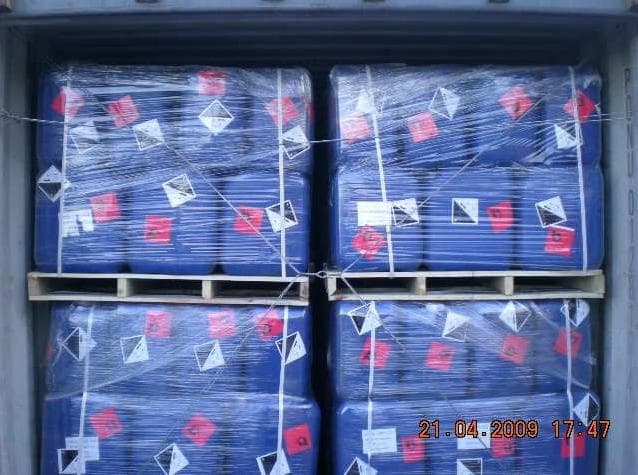
Storage: Store in a cool (<25 °C), well-ventilated area away from direct sunlight, heat sources, and incompatible materials (alkalis, reducing agents, metals). Containers must be vented to prevent pressure build-up from oxygen release. Use only approved materials (e.g., HDPE, stainless steel 316L). Never store in sealed, unvented containers.
-
Personal Protection: Use chemical-resistant gloves (butyl rubber or neoprene), a full-face shield, and acid-resistant clothing. In case of inadequate ventilation, use respiratory protection with an acid gas filter.
9. FREQUENTLY ASKED QUESTIONS
Q1. What is the difference between peracetic acid and hydrogen peroxide?
Peracetic acid is a much stronger oxidiser and biocide. It acts faster than hydrogen peroxide at the same concentration. Equilibrium commercial products contain both PAA and H₂O₂ for optimal stability and efficacy.
Q2. Does peracetic acid leave a residue?
No, it decomposes into acetic acid (vinegar), oxygen, and water. This makes it excellent for food processing, as it requires no final rinse in many applications (at low concentrations and as per local regulations).
Q3. Is it flammable?
Yes, solutions above 5% PAA are classified as flammable liquids (H226). Flames are invisible. Storage areas must be kept away from ignition sources.
Q4. Can it be used with other chemicals?
Do not mix with alkaline detergents, reducing agents, or other concentrated chemicals, as this may cause rapid decomposition and oxygen release. After CIP cleaning with caustic, thorough rinsing is mandatory before introducing PAA.
Q5. What materials are compatible?
Stainless steel (316L), HDPE, and PTFE are compatible. It is corrosive to carbon steel, copper, brass, and many elastomers. Always check material compatibility for long-term use.
Q6. How is its concentration measured?
The concentration of commercial PAA solutions is typically measured by iodometric titration. Quick-check test strips are also widely used for on-site concentration verification during routine sanitation.
Q7. What is the shelf life?
Under proper, cool storage conditions, the typical shelf life of an equilibrium solution is 12 months. Over time, the product will slowly lose activity (decompose). Once opened, use as soon as possible.
10. QUICK REFERENCE TABLE
| Property | Typical Value (for 5-15% solution) |
|---|---|
| CAS | 79-21-0 |
| Formula | C₂H₄O₃ |
| Molecular weight | 76.05 g/mol |
| Appearance | Clear, colourless liquid |
| Odour | Pungent, vinegar-like |
| pH | < 1 – 2 |
| Density | ~1.11 – 1.15 g/cm³ |
| Main decomposition products | Acetic acid, oxygen, water |
| Key uses | Disinfection, sterilisation, water treatment |