We unleash your business potential by maximize the business innovation.
Send EmailBenzyl Paraben, Benzyl 4-hydroxybenzoate, 94-18-8
Benzylparaben
Benzylparaben (also known as Benzyl 4-hydroxybenzoate) is a chemical compound belonging to the paraben family, which are esters of *p*-hydroxybenzoic acid . It is primarily valued for its antimicrobial and preservative properties in various commercial and industrial products.
1. Chemical Identity and Basic Information
-
Common Name: Benzylparaben
-
IUPAC Name: Benzyl 4-hydroxybenzoate
-
CAS Number: 94-18-8
-
Molecular Formula: C₁₄H₁₂O₃
-
Molecular Weight: 228.24 g/mol
-
Chemical Structure: It consists of a hydroxybenzoic acid linked to a benzyl alcohol group .
2. Physical and Chemical Properties
Benzylparaben is a synthetic compound with distinct physical characteristics that make it suitable as a preservative.
| Property | Typical Value | Source |
|---|---|---|
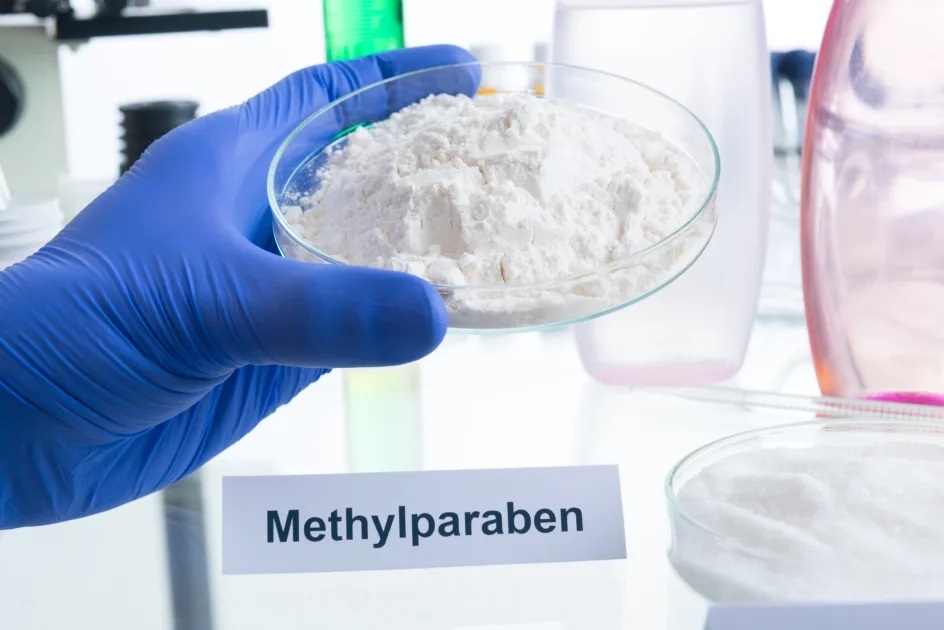
| Physical State | White to off-white crystalline powder | |
| Odor/Taste | Odorless with a slight burnt taste | |
| Melting Point | 109 - 114 °C (228 - 237 °F) | |
| Boiling Point | > 300 °C (> 572 °F) at 760 mmHg | |
| Density | 1.2 ± 0.1 g/cm³ | |
| Solubility in Water | Very low (approx. 50-100 mg/L at 25°C). It is lipophilic (fat-loving). | |
| log P | 3.56 (Octanol-Water Partition Coefficient), indicating it is hydrophobic. | |
| Flash Point | 168 °C (334 °F) | |
| Stability | Stable under normal temperatures and pressures. |
3. Applications and Uses
The primary function of benzylparaben is as an antimicrobial preservative. It is effective against a broad spectrum of fungi and bacteria .
-
Cosmetics and Personal Care Products: It is used to prevent microbial growth and extend the shelf life of products such as shampoos, conditioners, lotions, creams, makeup (foundations, mascara), deodorants, and sunscreens .
-
Pharmaceuticals: It serves as a preservative in topical medications, creams, ointments, oral liquids, and even bandages .
-
Food Industry: It is used as an antimicrobial agent in various processed foods, including baked goods, sauces, frozen dairy products, and beverages .
-
Industrial Applications: It can also be found in non-consumer products like shoe polishes, textiles, and glues .
4. Mechanism of Action
As a paraben, benzylparaben exerts its antimicrobial effect by damaging the cell membranes of microorganisms and interfering with intracellular proteins, which disrupts essential enzymatic activities and leads to microbial cell death .
5. Safety, Toxicology, and Regulatory Status
This is the most critical aspect of benzylparaben's profile, as it is subject to significant regulation and scientific debate.
5.1. Toxicological Concerns
-
Endocrine Disruption: The primary health concern surrounding parabens, including benzylparaben, is their potential to act as endocrine disruptors. Studies have shown that benzylparaben can mimic or interfere with the body's hormones, particularly estrogen (agonistic and antagonistic activity) .
-
Irritation: It is classified as an irritant. According to the Globally Harmonized System (GHS), it can cause skin irritation (Category 2), serious eye irritation (Category 2), and respiratory irritation (Category 3) .
-
Aquatic Toxicity: Benzylparaben is considered harmful to aquatic life, with long-term effects .
-
Allergic Reactions: Although relatively rare, it can cause allergic contact dermatitis, which may manifest as a rash, especially when applied to already irritated or broken skin .
5.2. Regulatory Status (Crucial Update)
The regulatory status of benzylparaben varies significantly by region, with the European Union taking the most precautionary stance.
-
European Union (EU): Benzylparaben is banned in cosmetic products in the EU. Due to insufficient data to guarantee its safety and concerns over endocrine disruption, its use was prohibited entirely. Since July 30, 2015, products containing benzylparaben can no longer be placed on the EU market .
-
United States (US): The use of benzylparaben in cosmetics and pharmaceuticals is still permitted by the FDA, provided products are safe under conditions of use. However, there is growing legislative pressure to ban it. A bill titled the "No Toxic Chemicals in Cosmetics Act" (H.R. 8360) was introduced in Congress in 2024 to deem any cosmetic containing parabens (including benzylparaben) as adulterated . This reflects a trend towards stricter regulation.
-
Other Regions: Its status varies. It is permitted in many other parts of the world, such as parts of Asia and Latin America, often within specified maximum concentration limits .
6. Market Context
Despite regulatory restrictions in some regions, the global benzylparaben market was valued at approximately USD 200 million in 2023 and is projected to grow . Key players in its production include major chemical companies like BASF, Lonza, and Clariant . The market is driven by demand in the personal care and pharmaceutical sectors, particularly in emerging economies, but faces challenges from the rising consumer demand for "paraben-free" products and the search for natural alternatives .
Summary for Consumers
-
What it is: A synthetic preservative used to stop germs from growing in products.
-
Where to find it: In some cosmetics, lotions, medicines, and processed foods.
-
The Concern: It is a suspected endocrine disruptor and can cause skin/eye irritation.
-
Regulation: It is banned in the EU but still legal in the US and many other countries. To avoid it, check product labels for "benzylparaben" or opt for "paraben-free" products.
Sectoral Usage and Regulatory Compliance Table for Benzylparaben
The table below summarizes the applications of Benzylparaben across different industries, the properties that make it suitable for these uses, and its current regulatory status in key global markets. Regulatory information is based on current trends and official stances from major authorities.
| Sector / Industry | Primary Function / Application | Key Properties for Use | Regulatory Compliance & Regional Status |
|---|---|---|---|
| Personal Care & Cosmetics | Preservative: Used in shampoos, conditioners, creams, lotions, makeup (foundations, mascara), deodorants, and sunscreens to prevent the growth of bacteria, yeast, and mold, extending product shelf life. | Broad-spectrum antimicrobial activity, cost-effectiveness, chemically stable, and does not typically alter the color or odor of the final product. | • European Union (EU): BANNED. Its use in cosmetic products is prohibited due to safety concerns over potential endocrine disruption . • United States (USA): REGULATED / PERMITTED. Allowed by the FDA within specific concentration limits. However, it faces significant consumer pressure due to the "paraben-free" trend . • Turkey: BANNED. Compliant with EU cosmetics legislation. |
| Pharmaceuticals | Preservative / Excipient: Used to protect topical creams, ointments, oral liquids, and other drug formulations from microbial contamination. | Effective antimicrobial properties, stability across a wide pH range, and a well-established safety profile (when used within permitted limits). | • General Status: Permitted in many countries as a pharmaceutical excipient. It is listed in major pharmacopoeias (e.g., USP, EP) as a reference standard for quality control . Its use is subject to specific concentration limits set by health authorities. |
| Food & Beverage | Preservative: Used to extend the shelf life of processed foods (such as baked goods, sauces, frozen dairy products) and beverages by inhibiting spoilage microorganisms . | Effectiveness against a range of food spoilage organisms. | • General Status: Approval for food use is highly variable and much stricter than for cosmetics or pharmaceuticals. Its use as a direct food additive has declined in many regions and is often limited to specific product categories. |
| Industrial & Laboratory | • Analytical Reference Standard: Widely used in laboratories for analytical method development, validation, and routine quality control (e.g., in HPLC, GC, UV/Vis spectroscopy) . • Industrial Preservative: Can be used in non-consumer products like textiles, polishes, and adhesives . |
High purity, well-defined chemical structure, traceability, and stability. | • General Status: Industrial and laboratory use is subject to fewer restrictions compared to consumer-facing sectors like cosmetics and food. However, these uses are typically governed by occupational safety and environmental regulations and are explicitly marked as "not for human |
Other Names / Synonyms for Benzylparaben (CAS: 94-18-8)
Systematic / IUPAC Names
-
Benzyl 4-hydroxybenzoate
-
4-Hydroxybenzoic acid benzyl ester
-
Benzoic acid, 4-hydroxy-, phenylmethyl ester
-
p-Hydroxybenzoic acid benzyl ester
-
Benzyl p-hydroxybenzoate
Common / Trivial Names
-
Benzylparaben
-
Benzyl paraben
Brand / Trade Names (Historical & Commercial)
-
Benzyl Parasept
-
Benzyl Tegosept
-
Nipabenzyl
-
Parosept
-
Solbrol Z
-
Solbrol Z (Benzyl ester)
-
Tegosept B
-
Uniphen P-23 (bileşenlerden biri olarak)
Other Identifiers / Descriptors
-
4-(Benzyloxycarbonyl)phenol
-
Benzylis parahydroxybenzoas
-
p-Carbophenoxy benzyl alcohol
-
NSC 8080
-
Phenylmethyl 4-hydroxybenzoate