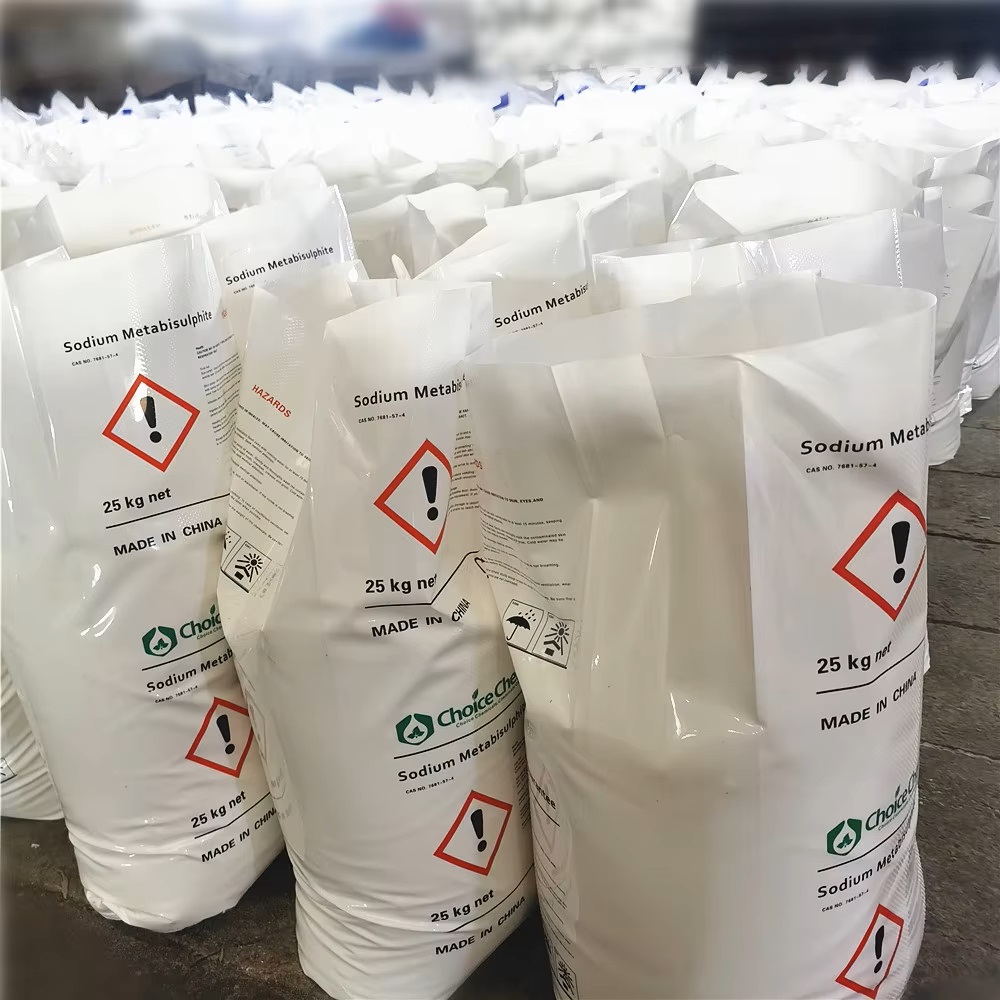
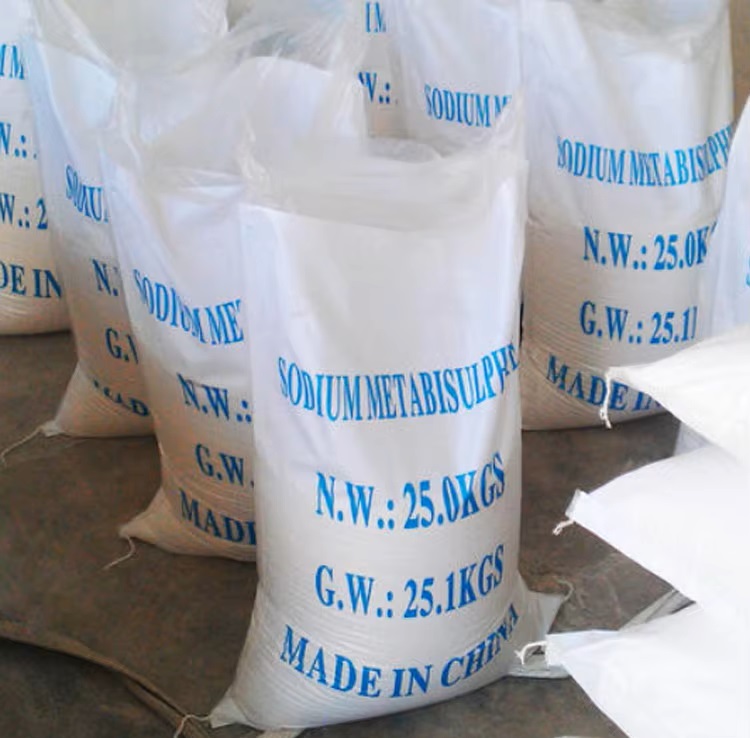
We unleash your business potential by maximize the business innovation.
Send EmailSodium Metabisulfite, Disodium Disulfite, Sodium Pyrosulfite, Natrium Pyrosulfite, SMBS, E223, 7681-57-4
SODIUM METABISULFITE (SMBS, E223)
1. Chemical Identity and Material Classification
-
Chemical Name: Sodium Metabisulfite, Disodium Disulfite, Sodium Pyrosulfite
-
Synonyms: SMBS, Sodium Bisulfite Anhydrous (misnomer – actually metabisulfite), Disodium Pyrosulfite
-
CAS Number: 7681-57-4
-
EC Number (EINECS): 231-673-0
-
Molecular Formula: Na₂S₂O₅
-
Molecular Weight: 190.11 g/mol
-
E Number: E223 (food additive)
-
Chemical Class: Inorganic sulfite salt (reducing agent)
-
HS Code: 2832.10
-
UN Number: Not regulated (for solid); 1759 (corrosive solid, n.o.s. – for solution, depending on concentration)
2. Physical Properties
2.1 General Physical Properties
| Property | Value |
|---|---|
| Appearance | White to off-white crystalline powder or granules |
| Physical state (20°C) | Solid (crystalline) |
| Odor | Faint sulfur dioxide (SO₂) odor |
| Taste | Saline, bitter, sulfite taste |
| Density (20°C) | 1.48 g/cm³ |
| Bulk density (typical) | 1.0–1.3 g/cm³ |
| Melting point | 150°C (decomposes – does not melt) |
| Boiling point | Decomposes before boiling |
| Flash point | Non-flammable |
| Vapor pressure | Negligible |
| Refractive index (nD20) | 1.560 |
2.2 Solubility in Water
| Temperature (°C) | Solubility (g/100 mL water) |
|---|---|
| 0°C | 45.0 |
| 10°C | 50.0 |
| 20°C | 54.0 |
| 25°C | 65.3 |
| 30°C | 58.0 |
| 40°C | 62.0 |
| 50°C | 67.0 |
| 60°C | 72.0 |
| 80°C | 82.0 |
| 100°C | 95.0 |
2.3 Solubility in Other Solvents
| Solvent | Solubility |
|---|---|
| Water | Very soluble (540 g/L at 20°C) |
| Ethanol | Slightly soluble |
| Methanol | Slightly soluble |
| Acetone | Insoluble |
| Glycerol | Slightly soluble |
2.4 Aqueous Solution Properties
| Parameter | Value |
|---|---|
| pH (1% solution, 20°C) | 4.0–5.0 (acidic) |
| pH (10% solution, 20°C) | 3.5–4.5 |
| pH (saturated solution) | ~3.5 |
| Heat of solution | Endothermic (cools water) |
3. Chemical Properties
3.1 Molecular Structure
Structure: NaO–S(=O)–S(=O)–ONa (sodium salt of disulfurous acid)
-
Contains two sulfur atoms in +4 oxidation state
-
Dissolves in water to form sodium bisulfite (NaHSO₃): Na₂S₂O₅ + H₂O → 2NaHSO₃
-
Strong reducing agent (reduces Fe³⁺, Cr⁶⁺, I₂, O₂)
-
Releases sulfur dioxide (SO₂) upon acidification
3.2 Solution Equilibria
Na₂S₂O₅ + H₂O ⇌ 2NaHSO₃ ⇌ 2Na⁺ + 2HSO₃⁻
HSO₃⁻ ⇌ H⁺ + SO₃²⁻ (pKa₂ ≈ 7.2)
HSO₃⁻ + H⁺ ⇌ H₂O + SO₂↑ (gas evolution)
3.3 Chemical Reactivity
| Reaction | Description |
|---|---|
| With acids | Na₂S₂O₅ + 2H⁺ → 2SO₂↑ + H₂O + 2Na⁺ (releases toxic SO₂ gas) |
| With water | Na₂S₂O₅ + H₂O → 2NaHSO₃ (sodium bisulfite) |
| With oxygen (air oxidation) | 2Na₂S₂O₅ + O₂ → 2Na₂S₂O₆ (sodium dithionate) |
| With aldehydes | Forms bisulfite addition compounds (R–CH(OH)–SO₃Na) – used for purification |
| With iodine (reduction) | Na₂S₂O₅ + I₂ + H₂O → Na₂SO₄ + 2HI |
| With chlorine (antichlor) | Na₂S₂O₅ + Cl₂ + H₂O → Na₂SO₄ + 2HCl |
3.4 Reducing Agent Properties
| Oxidizing Species | Reduced Product | Application |
|---|---|---|
| Chlorine (Cl₂) | Chloride (Cl⁻) | Antichlor in textile bleaching |
| Iodine (I₂) | Iodide (I⁻) | Iodometric titrations |
| Oxygen (O₂) | Not applicable (self-oxidizes) | Oxygen scavenger |
| Iron(III) (Fe³⁺) | Iron(II) (Fe²⁺) | Reducing agent |
| Chromium(VI) (Cr⁶⁺) | Chromium(III) (Cr³⁺) | Wastewater treatment |
3.5 Stability and Decomposition
| Parameter | Behavior |
|---|---|
| Stability in dry air | Relatively stable |
| Stability in moist air | Gradually decomposes, releases SO₂ |
| Thermal decomposition | >150°C → Na₂SO₃ + SO₂↑ (sodium sulfite + sulfur dioxide) |
| Hydrolysis (aqueous solution) | Bisulfite ions, slowly oxidized by air oxygen |
| Light sensitivity | Stable |
3.6 Incompatibilities
| Substance | Hazard |
|---|---|
| Strong acids (H₂SO₄, HCl, HNO₃) | Violent reaction, SO₂ gas evolution (toxic) |
| Strong oxidizing agents (chlorates, permanganates, peroxides, chromates) | Redox reaction, may be vigorous |
| Water (prolonged exposure) | Slow decomposition, SO₂ release |
| Heat (>150°C) | Decomposition to SO₂ |
| Metals (in presence of moisture) | Corrosion |
4. Quality Specifications
4.1 Food Grade (FCC / E223)
| Parameter | Specification | Test Method |
|---|---|---|
| Assay (Na₂S₂O₅, w/w) | 90.0–100.5% (on dried basis) | Titration |
| Sodium metabisulfite content | ≥ 96.0% (typical) | Titration |
| Loss on drying (40°C, vacuum) | ≤ 1.0% | Gravimetric |
| SO₂ content | ~67% (calculated) | Titration |
| Iron (Fe) | ≤ 10 ppm | Colorimetric |
| Heavy metals (as Pb) | ≤ 10 ppm | Colorimetric |
| Arsenic (As) | ≤ 3 ppm | Atomic absorption |
| Selenium (Se) | ≤ 30 ppm | Colorimetric |
| Chlorides (Cl) | ≤ 0.05% | Turbidimetric |
| Thiosulfate (S₂O₃²⁻) | Passes test | Titration |
| pH (1% solution) | 4.0–5.0 | pH meter |
| Appearance | White to off-white crystalline powder | Visual |
4.2 Technical / Industrial Grade
| Parameter | Specification |
|---|---|
| Assay (Na₂S₂O₅) | ≥ 95.0% |
| SO₂ content | ≥ 63.0% |
| Iron (Fe) | ≤ 50 ppm |
| Chlorides (Cl) | ≤ 0.1% |
| Water insolubles | ≤ 0.1% |
| Appearance | White to slight yellow powder |
5. Production Methods
5.1 Industrial Process (SO₂ Absorption)
Process:
-
Sulfur is burned to produce sulfur dioxide (SO₂)
-
SO₂ gas is passed through a solution of sodium carbonate (Na₂CO₃) or sodium sulfite (Na₂SO₃)
-
Sodium bisulfite (NaHSO₃) is formed
-
Crystallization yields sodium metabisulfite (Na₂S₂O₅)
Reactions:
-
Na₂CO₃ + 2SO₂ + H₂O → 2NaHSO₃ + CO₂
-
2NaHSO₃ → Na₂S₂O₅ + H₂O
5.2 From Sodium Sulfite
Reaction: 2Na₂SO₃ + 2SO₂ + H₂O → Na₂S₂O₅ + 2NaHSO₃ (complex)
6. Mechanism of Action
6.1 Antimicrobial Mechanism (Food Preservation)
-
SO₂ (released from metabisulfite) penetrates microbial cell membranes
-
Reacts with disulfide bonds in proteins and cofactors
-
Disrupts enzyme function (especially in bacteria, yeasts, molds)
-
Inhibits microbial growth and reproduction
6.2 Antioxidant Mechanism
-
Sodium metabisulfite acts as a reducing agent
-
Scavenges oxygen (O₂)
-
Prevents oxidation of sensitive compounds (vitamins, flavors, colors)
-
Synergistic with other antioxidants
6.3 Antichlor Mechanism (Textile Bleaching)
Na₂S₂O₅ + Cl₂ + H₂O → Na₂SO₄ + 2HCl
-
Neutralizes residual chlorine after bleaching
-
Prevents fiber damage from chlorine
7. Industrial Applications
7.1 Food Industry (E223) – Largest Application
| Application | Function | Typical Concentration |
|---|---|---|
| Wine and must (grape juice) | Preservative, antioxidant, fermentation control, prevents browning | 50–200 mg/L (as SO₂) |
| Dried fruits (apricots, raisins, figs, apples) | Preservative, color stabilizer (prevents browning), antimicrobial | 500–2,000 mg/kg |
| Fruit juices and concentrates | Antioxidant, prevents browning | 50–150 mg/L (as SO₂) |
| Canned fruits and vegetables | Preservative, color retention | 50–200 mg/kg |
| Pickles and sauerkraut | Antimicrobial, preserves crispness | 50–200 mg/kg |
| Frozen fruits and vegetables | Prevents enzymatic browning | 50–150 mg/kg |
| Jams, jellies, marmalades | Preservative, color retention | 50–100 mg/kg |
| Potato products (pre-peeled, dehydrated) | Prevents browning, preservative | 50–200 mg/kg |
| Seafood (fresh, frozen shrimp, crab, lobster) | Preservative (prevents melanosis/black spot) | 1–10% solution dip |
| Beer and cider | Antioxidant, preservative | 10–50 mg/L |
| Soft drinks (lemonade, citrus beverages) | Preservative | 10–50 mg/L |
| Gelatin and pectin | Preservative | 100–500 mg/kg |
Food additive status: E223 – permitted as food preservative and antioxidant
Regulatory limits (EU, US, Codex):
-
Wine: max 200–400 mg/L total SO₂ (varies by wine type)
-
Dried fruits: max 500–2,000 mg/kg (depending on fruit)
-
Most foods: max 50–300 mg/kg
7.2 Textile Industry
| Application | Function | Typical Concentration |
|---|---|---|
| Antichlor (after bleaching) | Neutralizes residual chlorine | 1–5 g/L |
| Dyeing auxiliary (vat dyes, sulfur dyes) | Reducing agent for dye solubilization | 1–10 g/L |
| Discharge printing | Reducing agent | 5–20 g/L |
| Wool processing | Anti-shrink treatment (reduces disulfide bonds) | 1–5% on weight of wool |
| Bleaching (cotton, linen) | Stabilizer for hydrogen peroxide bleach | 0.5–2 g/L |
7.3 Leather Industry
| Application | Function |
|---|---|
| Depilatory (hair removal) | Reduces disulfide bonds in hair keratin |
| Liming auxiliary | Preservative, prevents putrefaction |
| Tanning auxiliary | Reducing agent in chrome tanning |
7.4 Paper and Pulp Industry
| Application | Function |
|---|---|
| Pulp bleaching (antichlor) | Neutralizes residual chlorine |
| Preservation of pulp slurries | Prevents bacterial growth |
| De-inking (recycled paper) | Reducing agent in de-inking formulations |
7.5 Chemical Industry
| Application | Product |
|---|---|
| Sodium hydrosulfite (dithionite) production | Na₂S₂O₅ + reducing agents → Na₂S₂O₄ |
| Rubber vulcanization accelerator | Intermediate |
| Organic synthesis | Reducing agent, sulfonation reactions |
| Aldehyde purification | Forms bisulfite addition compounds |
| Antioxidant for oils and fats | Stabilizer |
| Treatment of industrial wastewater | Chromium(VI) reduction to Cr(III) |
7.6 Water Treatment
| Application | Function | Typical Dosage |
|---|---|---|
| Dechlorination | Removes chlorine from water | 1.5–3 mg per mg Cl₂ |
| Oxygen scavenger (boiler water) | Removes dissolved oxygen | 10–50 mg/L |
| Chromium(VI) reduction | Reduces toxic Cr⁶⁺ to Cr³⁺ | 10–50 mg/L |
| Corrosion control | Oxygen removal | Variable |
7.7 Cosmetics and Personal Care
| Application | Function |
|---|---|
| Hair waving and straightening preparations | Reducing agent (breaks disulfide bonds) |
| Hair bleaching | Antioxidant, stabilizer |
| Skin care products | Preservative (limited) |
| Shampoos and conditioners | Antioxidant (for color-treated hair) |
7.8 Photography
| Application | Function |
|---|---|
| Developing solutions | Preservative, antioxidant |
| Fixing baths | Preservative |
7.9 Mining and Metallurgy
| Application | Function |
|---|---|
| Flotation agents | Depressant in mineral flotation |
| Gold extraction | Reducing agent |
7.10 Rubber and Plastics
| Application | Function |
|---|---|
| Rubber vulcanization | Accelerator component |
| Polymer stabilization | Antioxidant |
8. Toxicology and Safety
8.1 Acute Toxicity
| Parameter | Value | Classification |
|---|---|---|
| Oral LD₅₀ (rat) | 1,300–2,000 mg/kg | Acute Tox. 4 (H302) |
| Dermal LD₅₀ (rabbit) | >2,000 mg/kg | Not classified |
| Inhalation LC₅₀ (rat, 4 hours) | 0.5–1.0 mg/L (as SO₂) | Acute Tox. 3 (H331) |
| Skin irritation | May cause irritation | Irritant |
| Eye irritation | May cause severe irritation | Eye Dam. 1 |
| Skin sensitization | May cause allergic reactions (especially in asthmatics) | Resp. Sens. 1 (H334) |
8.2 Chronic Toxicity
| Endpoint | Classification |
|---|---|
| Carcinogenicity | Not classified |
| Mutagenicity | Negative (some in vitro positive) |
| Reproductive toxicity | Not classified |
| Target organ toxicity | Respiratory system (sulfite sensitivity, asthma) |
8.3 Special Hazards
| Hazard | Description |
|---|---|
| Allergy risk (sulfite sensitivity) | 0.5–5% of asthmatics react to sulfites; may cause bronchospasm, anaphylaxis |
| SO₂ release upon acidification | Toxic gas (corrosive, asphyxiant) – avoid contact with acids |
| Decomposition | Releases SO₂ upon heating (>150°C) or in moist air |
8.4 GHS Classification
| Classification | Category |
|---|---|
| Signal word | Danger |
| Hazard statements | H302 – Harmful if swallowed |
| H318 – Causes serious eye damage | |
| H334 – May cause allergy or asthma symptoms or breathing difficulties if inhaled | |
| Precautionary statements | P261, P264, P280, P301+P312, P305+P351+P338, P310, P342+P311 |
8.5 NFPA Rating
| Health | Flammability | Reactivity |
|---|---|---|
| 2 | 0 | 1 |
9. Safety Precautions and Personal Protective Equipment (PPE)
-
Hazards:
-
Harmful if swallowed (H302)
-
Causes serious eye damage (H318)
-
May cause allergy or asthma symptoms (H334) – sulfite sensitivity
-
Toxic SO₂ gas released upon contact with acids or heating
-
Hygroscopic – absorbs moisture from air
-
-
PPE (mandatory):
-
Chemical splash goggles (EN 166) – mandatory (eye hazard)
-
Dust mask (FFP2/N95) – for dusty operations
-
Chemical-resistant gloves (nitrile)
-
Protective clothing (dust protection)
-
Respiratory protection: Type E (yellow) filter for SO₂
-
-
Engineering controls:
-
Local exhaust ventilation (LEV) for dust control
-
Avoid acid contact (SO₂ gas)
-
Eyewash stations and safety showers
-
-
Storage conditions:
-
Keep tightly closed in original container (HDPE, PP, lined steel)
-
Store in cool, dry, well-ventilated area (5–30°C)
-
Protect from moisture (hygroscopic – decomposes in moist air)
-
Store away from acids (SO₂ gas hazard) and strong oxidizing agents
-
Do not store near food (decomposition products)
-
-
First aid:
-
Inhalation: Move to fresh air; if breathing difficult, give oxygen; if stopped, give artificial respiration; seek medical attention
-
Eye contact: Rinse with water for at least 15 minutes, lifting eyelids; remove contact lenses; seek immediate medical attention
-
Skin contact: Wash with soap and water
-
Ingestion: Rinse mouth; do NOT induce vomiting; drink water; seek medical attention
-
10. Environmental Fate
| Parameter | Value |
|---|---|
| Biodegradability | Not applicable (inorganic) |
| Aquatic toxicity (fish, LC₅₀, 96 hours) | 100–500 mg/L (moderate toxicity) |
| Daphnia magna (EC₅₀, 48 hours) | 50–200 mg/L |
| Algal toxicity (EC₅₀, 72 hours) | 10–100 mg/L |
| SO₂ release (acidification) | Toxic to aquatic life |
| Bioaccumulation | Low potential |
| WGK Germany | 1 (low hazard to water) |
| Disposal method | Neutralization → landfill (non-hazardous waste) |
11. Storage and Shelf Life
11.1 Storage Conditions
| Parameter | Requirement |
|---|---|
| Storage temperature | 5–30°C (room temperature) |
| Container | Keep tightly closed in original container (HDPE, PP, lined steel) |
| Protect from | Moisture (hygroscopic – decomposes in moist air), acids (SO₂ release), strong oxidizing agents |
| Environment | Cool, dry, well-ventilated area |
11.2 Shelf Life
| Parameter | Value |
|---|---|
| Shelf life (sealed, dry) | 12–24 months |
| Degradation indicators | Caking (moisture absorption), yellowing (oxidation), SO₂ odor (decomposition) |
11.3 Decomposition Products (upon moisture/heat)
-
SO₂ (sulfur dioxide) – toxic, corrosive
-
Na₂SO₃ (sodium sulfite) – less effective
-
Na₂SO₄ (sodium sulfate) – inert
12. Transport Information
| Regulation | Classification |
|---|---|
| UN Number | Not regulated (solid); 1759 (solution, depending on concentration) |
| ADR/RID | Not classified as dangerous goods (solid) |
| IMDG | Not regulated (solid) |
| IATA | Not regulated (solid) |
| Proper shipping name | Sodium metabisulfite (non-hazardous) |
13. Synonyms and Common Names
-
English: Sodium Metabisulfite, SMBS, Sodium Pyrosulfite, Disodium Disulfite, Sodium Bisulfite Anhydrous (misnomer)
-
Trade names: Soda SO₂, Sodium Metabi, Sulfite 223
-
French: Métabisulfite de sodium
-
German: Natriummetabisulfit
-
Spanish: Metabisulfito de sodio
-
Turkish: Sodyum Metabisülfit, Sodyum Pirosülfit, SMBS, E223
14. Regulatory Status
| Regulation | Status |
|---|---|
| REACH (EU) | Registered |
| TSCA (US) | Listed |
| FDA | GRAS – food additive (E223) – 21 CFR § 182.3766 |
| EFSA | Permitted as food additive (E223) – restrictions apply |
| EU Food Additive | E223 – approved with maximum residue limits |
| CODEX | Permitted preservative (220–228) |
15. Why Choose Sodium Metabisulfite?
| Advantage | Description |
|---|---|
| Effective preservative | Broad antimicrobial spectrum (bacteria, yeasts, molds) |
| Strong antioxidant | Prevents oxidative deterioration (browning, vitamin loss) |
| Excellent reducing agent | Reduces chlorine, chromate, oxygen, and other oxidizers |
| Low cost | Economical compared to many other preservatives/antioxidants |
| Water soluble | Highly soluble (54 g/100 mL at 20°C) – easy to apply |
| Versatile | Multiple applications across food, textile, leather, paper, water treatment |
| Antichlor agent | Neutralizes residual chlorine after bleaching |
| SO₂ delivery system | Convenient solid source of SO₂ (67% SO₂ by weight) |
| GRAS for food use | Approved preservative in many countries (E223) |
| Long shelf life | 12–24 months when stored properly |
Limitations:
-
Allergy risk (sulfite sensitivity) – 0.5–5% of asthmatics may react; requires labeling on food products
-
Toxic SO₂ release upon acidification – Do not mix with acids
-
Hygroscopic – Absorbs moisture; requires airtight storage
-
Decomposes in moist air – Loss of SO₂ content over time
-
Corrosive – Causes serious eye damage; requires PPE (goggles)
-
Not suitable for thiamine-rich foods (vitamin B1) – Sulfites destroy thiamine
16. Comparison with Other Sulfites
| Property | Sodium Metabisulfite (Na₂S₂O₅) | Sodium Sulfite (Na₂SO₃) | Sodium Bisulfite (NaHSO₃) | Potassium Metabisulfite (K₂S₂O₅) |
|---|---|---|---|---|
| SO₂ content | ~67% | ~51% | ~61% | ~58% |
| Solubility (20°C) | 54 g/100 mL | 27 g/100 mL | Very soluble | 45 g/100 mL |
| pH (1% solution) | 4.0–5.0 | 9.0–10.0 | 3.5–5.0 | 3.5–5.0 |
| Form | Solid (powder) | Solid (crystals) | Solid, solution | Solid (powder) |
| Cost | Low | Lower | Higher | Moderate |
| Primary use | Preservative, antichlor | Antichlor, water treatment | Preservative, reducing agent | Wine preservative |
17. Sulfite Sensitivity – Labeling Requirements
Warning: Sulfites may cause allergic reactions (hives, itching, swelling, difficulty breathing, anaphylaxis) in sensitive individuals, particularly asthmatics.
| Region | Labeling Requirement |
|---|---|
| USA (FDA) | Label if sulfites >10 ppm (as SO₂) |
| EU | Label if sulfites >10 mg/kg or mg/L (as SO₂) |
| Codex Alimentarius | Label if sulfites added as preservative |
18. Frequently Asked Questions (FAQs)
Q1: Is sodium metabisulfite the same as sodium bisulfite?
A1: No. Sodium metabisulfite (Na₂S₂O₅) dissociates in water to form sodium bisulfite (NaHSO₃). They are chemically different but often used interchangeably in solution (same active species – HSO₃⁻).
Q2: Is sodium metabisulfite safe to eat?
A2: Yes, food-grade sodium metabisulfite (E223) is GRAS for use as a preservative and antioxidant. However, sulfite-sensitive individuals (especially asthmatics) may have allergic reactions.
Q3: How does sodium metabisulfite preserve wine?
A3: It releases SO₂, which: (1) kills unwanted microorganisms (bacteria, wild yeasts), (2) acts as an antioxidant (prevents browning), and (3) stabilizes color and flavor.
Q4: Why does sodium metabisulfite smell like rotten eggs?
A4: The characteristic "sulfur" or "rotten egg" smell is from sulfur dioxide (SO₂) released upon decomposition or acidification. Fresh, dry SMBS has only a faint SO₂ odor.
Q5: How do I dispose of sodium metabisulfite?
A5: Dissolve in water, neutralize with sodium carbonate if needed, and flush to wastewater treatment (check local regulations). Do NOT mix with acids (releases toxic SO₂ gas).
19. Storage Recommendations
| Condition | Recommendation |
|---|---|
| Containers | HDPE, polypropylene, lined steel (not carbon steel – corrodes) |
| Temperature | 5–30°C (avoid high temperatures – accelerates decomposition) |
| Humidity | <50% RH (hygroscopic) |
| Shelf life | 12–24 months (sealed container) |
| After opening | Use within 3–6 months; reseal tightly; store with desiccant |
| Compatibility | Store away from acids, oxidizing agents |
20. Summary Table – Key Specifications at a Glance
| Parameter | Value |
|---|---|
| Product Name | Sodium Metabisulfite (SMBS, E223) |
| CAS Number | 7681-57-4 |
| EC Number | 231-673-0 |
| Molecular Formula | Na₂S₂O₅ |
| Molecular Weight | 190.11 g/mol |
| Appearance | White to off-white crystalline powder |
| Density | 1.48 g/cm³ |
| Melting Point | 150°C (decomposes) |
| pH (1% solution) | 4.0–5.0 |
| Water Solubility (20°C) | 54 g/100 mL (540 g/L) |
| Assay (food grade) | 90.0–100.5% |
| SO₂ content | ~67% |
| E Number | E223 |
| Primary Applications | Food preservative (wine, dried fruits), textile antichlor, water treatment dechlorination, reducing agent |
| GHS Signal Word | Danger |
| Hazard Statements | H302, H318, H334 |
| Oral LD₅₀ (rat) | 1,300–2,000 mg/kg |
| Biodegradability | Not applicable (inorganic) |
| Shelf Life | 12–24 months |
This TDS is prepared in compliance with ISO 11014-1 format and is intended for food technologists, winemakers, textile engineers, water treatment specialists, chemical engineers, and procurement professionals. Certificates of Analysis (CoA), Safety Data Sheets (SDS), and sample validation reports are available upon request.