We unleash your business potential by maximize the business innovation.
Send EmailAmmonium Bifluoride, Ammonium Hydrogen Difluoride, Ammonium Hydrogen Fluoride, Ammonium Acid Fluoride, ABF, 1341-49-7
AMMONIUM BIFLUORIDE (ABF)
PRODUCT IDENTIFIER INFORMATION
| Parameter | Information |
|---|---|
| Product Name | Ammonium Bifluoride (ABF) |
| Chemical Name (IUPAC) | Ammonium Hydrogen Difluoride |
| CAS Number | 1341-49-7 |
| EC Number (EINECS) | 215-676-4 |
| Molecular Formula | NH₄HF₂ |
| Molecular Weight | 57.04 g/mol |
SECTION 1: CHEMICAL IDENTITY AND DESCRIPTION
| Parameter | Information |
|---|---|
| Chemical Name (IUPAC) | Ammonium Hydrogen Difluoride |
| Systematic Name | Ammonium Bifluoride |
| Synonyms | Ammonium Bifluoride, Ammonium Hydrogen Fluoride, ABF, Ammonium Acid Fluoride, Ammonium Hydrogendifluoride |
| CAS Number | 1341-49-7 |
| EC Number (EINECS) | 215-676-4 |
| Molecular Formula | NH₄HF₂ |
| Molecular Weight | 57.04 g/mol |
| Chemical Class | Inorganic ammonium salt; bifluoride |
| Structure | Ammonium cation (NH₄⁺) + bifluoride anion (HF₂⁻); strong hydrogen bond in HF₂⁻ ion provides high reactivity |
| Physical State (20°C) | Solid (white, odorless crystals – rhombic/tetragonal/orthorhombic) |
| Odor | Odorless |
| Note | Critical industrial intermediate; releases hydrofluoric acid upon dissolution |
SECTION 2: PHYSICAL AND CHEMICAL PROPERTIES
| Property | Value | Test Method |
|---|---|---|
| Appearance | White crystalline solid | Visual |
| Odor | Odorless | Olfactometric |
| Molecular Weight | 57.04 g/mol | Calculated |
| Melting Point | 125.6°C | DSC |
| Boiling Point | 240°C (decomposes) | TGA |
| Density (25°C) | 1.50 g/cm³ | ASTM D4052 |
| pH (5% solution, 25°C) | ~3.5 | pH Meter |
| Solubility in Water | Highly soluble | Gravimetric |
| Solubility in Ethanol | Highly soluble | General Method |
| Solubility in Ether | Low solubility | General Method |
| Hygroscopicity | Yes (absorbs moisture) | Visual |
| Reactivity | Reacts violently with bases; corrodes glass, cement, and metals in humid environments | |
| Stability | Stable under normal conditions; hygroscopic |
SECTION 3: CHEMICAL PROPERTIES AND REACTIVITY
| Parameter | Information |
|---|---|
| Chemical Character | Inorganic bifluoride salt; controlled source of hydrofluoric acid (HF) |
| Dissolution Behavior | Dissolves in water releasing HF: NH₄HF₂ → NH₄F + HF |
| Reaction with Bases | Violent exothermic reaction; releases ammonia and fluoride salts |
| Reaction with Silica/Silicates | Dissolves glass and silica: SiO₂ + 4HF → SiF₄↑ + 2H₂O |
| Incompatible Materials | Strong bases, strong oxidizing agents, glass, cement, metals (in humid conditions), sodium, potassium |
| Corrosivity | Corrosive to metals in presence of moisture; attacks glass and silica-containing materials |
| Decomposition Products (Heating) | NH₃, HF, NOx |
| Hazardous Polymerization | Does not occur |
SECTION 4: FLUORIDE CHEMICALS COMPARISON
| Property | Ammonium Bifluoride (ABF) | Hydrofluoric Acid (HF) | Ammonium Fluoride (NH₄F) | Sodium Fluoride (NaF) |
|---|---|---|---|---|
| CAS Number | 1341-49-7 | 7664-39-3 | 12125-01-8 | 7681-49-4 |
| Formula | NH₄HF₂ | HF | NH₄F | NaF |
| Physical State | Solid (crystals) | Liquid/Gas | Solid (crystals) | Solid (powder) |
| HF Release | Controlled (upon dissolution/heating) | Immediate (pure acid) | Moderate | Low |
| Corrosivity | High | Extreme | Moderate | Low |
| Primary Use | Glass etching, metal treatment, oil & gas | Chemical synthesis, etching | Glass etching, wood preservation | Water fluoridation, toothpaste |
| Ease of Handling | Solid (safer transport than HF) | Extremely hazardous | Solid (moderate hazard) | Solid (low hazard) |
SECTION 5: FUNCTIONAL PROPERTIES AND MECHANISM OF ACTION
| Property | Description |
|---|---|
| Controlled HF Source | Releases hydrofluoric acid upon dissolution or heating; provides safer handling than liquid HF |
| Glass Etching Agent | HF released attacks silica (SiO₂) structure; dissolves glass surface creating matte or smooth finish |
| Metal Surface Treatment | Removes rust and scale from steel; etches and polishes aluminum surfaces |
| Silicate Dissolution (Oil & Gas) | Dissolves silicate minerals in sandstone formations; controls deconsolidation during well acidizing |
| Cleaning and Descaling | Removes calcium-silica deposits in cooling towers and power plant equipment |
| Sterilization Agent | Used in dairy and food equipment sterilization due to strong antimicrobial properties |
| Pickling Agent | Surface preparation of metals prior to coating, plating, or welding |
SECTION 6: PRIMARY APPLICATION AREAS
| Sector / Application | Function | Typical Concentration / Usage |
|---|---|---|
| Glass Industry | Glass etching, matting, frosting, polishing | 5 – 20% solution |
| Electronics | Surface cleaning, etching chemicals | Variable |
| Metal Processing - Steel | Rust removal, surface preparation, pickling | 5 – 15% solution |
| Metal Processing - Aluminum | Polishing, etching, brightening | 5 – 10% solution |
| Oil & Gas | Well acidizing, silicate dissolution, sandstone treatment | 1 – 5% in treatment fluids |
| Power Plants | Cooling tower descaling (calcium-silica deposits) | 5 – 15% solution |
| Food Industry | Dairy and food equipment sterilization | 0.1 – 1.0% solution |
| Ceramics and Coatings | Bright dip baths, surface treatment | Variable |
| Cleaning Products | Degreasing, heavy soil removal formulations | 1 – 10% |
SECTION 7: QUALITY SPECIFICATIONS (TECHNICAL GRADE)
| Parameter | Specification | Test Method |
|---|---|---|
| Appearance | White crystalline solid | Visual |
| Purity (NH₄HF₂) | ≥ 95.0% | Titrimetric |
| Ammonium Fluoride (NH₄F) | ≤ 5.0% | Titrimetric |
| Sulfate (SO₄²⁻) | ≤ 0.5% | Turbidimetric |
| Chloride (Cl⁻) | ≤ 0.1% | Argentometric |
| Heavy Metals (as Pb) | ≤ 20 ppm | ICP-MS |
| Lead (Pb) | ≤ 5 ppm | ICP-MS |
| Arsenic (As) | ≤ 3 ppm | ICP-MS |
| Iron (Fe) | ≤ 50 ppm | AAS |
| Loss on Drying (105°C) | ≤ 2.0% | Gravimetric |
SECTION 8: TOXICOLOGICAL PROFILE
| Parameter | Value |
|---|---|
| Acute Oral Toxicity (LD50, Rat) | ~130-200 mg/kg (toxic) |
| Acute Dermal Toxicity (LD50, Rabbit) | > 2,000 mg/kg (corrosive) |
| Skin Irritation | Severe burns; corrosive |
| Eye Irritation | Severe damage; risk of blindness |
| Respiratory Irritation | Dust and vapors are severely irritating; acute poisoning risk |
| Inhalation Hazard | HF release causes pulmonary edema, respiratory failure |
| Carcinogenicity | Not classified |
| Mutagenicity | Limited data |
| Systemic Toxicity | Hypocalcemia, ventricular dysrhythmia, cardiac arrest (fluoride poisoning) |
| Target Organs | Skin, eyes, respiratory system, bones, cardiovascular system |
SECTION 9: GHS CLASSIFICATION AND LABELING
GHS Classification (compliant with 1272/2008/EC):
| Hazard Class | Category | H-Statement |
|---|---|---|
| Acute Toxicity (Oral) | Category 3 | H301 |
| Acute Toxicity (Dermal) | Category 3 | H311 |
| Acute Toxicity (Inhalation) | Category 3 | H331 |
| Skin Corrosion/Irritation | Category 1B | H314 |
| Serious Eye Damage/Irritation | Category 1 | H318 |
Signal Word: DANGER
Hazard Pictograms: GHS05 (Corrosive), GHS06 (Skull and Crossbones)
Hazard Statements (H-Codes):
| Code | Statement |
|---|---|
| H301 | Toxic if swallowed |
| H311 | Toxic in contact with skin |
| H314 | Causes severe skin burns and eye damage |
| H318 | Causes serious eye damage |
| H331 | Toxic if inhaled |
SECTION 10: PRECAUTIONARY STATEMENTS (P-CODES)
| Code | Statement |
|---|---|
| P260 | Do not breathe dust/fume/gas/mist/vapors/spray |
| P280 | Wear protective gloves/protective clothing/eye protection/face protection |
| P301+P310 | IF SWALLOWED: Immediately call a POISON CENTER/doctor |
| P301+P330+P331 | IF SWALLOWED: Rinse mouth. Do NOT induce vomiting |
| P303+P361+P353 | IF ON SKIN (or hair): Take off immediately all contaminated clothing. Rinse skin with water/shower |
| P304+P340 | IF INHALED: Remove person to fresh air and keep comfortable for breathing |
| P305+P351+P338 | IF IN EYES: Rinse cautiously with water for several minutes. Remove contact lenses if present |
| P310 | Immediately call a POISON CENTER/doctor |
| P405 | Store locked up |
| P501 | Dispose of contents/container to approved hazardous waste facility |
SECTION 11: FIRST AID MEASURES
| Exposure Route | Action to Take |
|---|---|
| Inhalation | Move to fresh air immediately. Administer oxygen if breathing difficulty. Seek immediate medical attention. |
| Skin Contact | Remove contaminated clothing immediately. Wash with plenty of water for at least 15 minutes. Apply calcium gluconate gel (2.5%). Seek immediate medical attention. |
| Eye Contact | Rinse immediately with plenty of water for at least 15 minutes. Remove contact lenses if present. Seek immediate emergency medical attention. |
| Ingestion | Rinse mouth with water. Do NOT induce vomiting. Give milk or calcium-containing antacid. Seek immediate medical attention. |
Fluoride Poisoning Symptoms: Hypocalcemia (muscle cramps, tetany), ventricular dysrhythmia, respiratory difficulty, cardiac arrest.
SECTION 12: FIREFIGHTING MEASURES
| Parameter | Information |
|---|---|
| Fire Hazard | Non-flammable; decomposes releasing toxic and corrosive gases |
| Hazards During Fire | Hydrogen fluoride (HF), ammonia (NH₃), nitrogen oxides (NOx) |
| Suitable Extinguishing Media | Any extinguishing media appropriate for surrounding fire; avoid water if possible (may release HF) |
| Unsuitable Extinguishing Media | Water jet (may spread contamination) |
| Special Protective Equipment | Self-contained breathing apparatus (SCBA), full chemical protective clothing (acid-resistant) |
| Special Precautions | Cool containers with water mist from safe distance; contain firefighting water |
SECTION 13: STORAGE AND SHELF LIFE
| Parameter | Information |
|---|---|
| Storage Conditions | Cool (15-25°C), dry, well-ventilated area; tightly closed containers |
| Container Requirements | Plastic (HDPE, PP) containers only; NEVER use glass or metal containers |
| Keep Away From | Strong bases, strong oxidizing agents, glass, cement, moisture, foodstuffs |
| Shelf Life | 24 months (unopened original packaging under appropriate storage conditions) |
| Stability Note | Hygroscopic; absorbs moisture; keep containers tightly closed |
SECTION 14: PACKAGING OPTIONS
| Packaging Type | Quantity | Material |
|---|---|---|
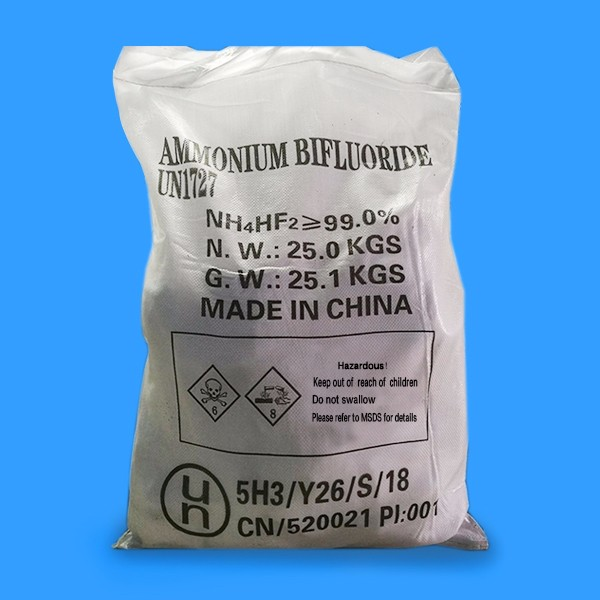
| HDPE drum | 25 kg | HDPE |
| HDPE drum | 50 kg | HDPE |
| Plastic pail | 25 kg | HDPE / PP |
Note: NEVER use glass or metal containers for storage or packaging.
SECTION 15: TRANSPORTATION INFORMATION
| Parameter | Information |
|---|---|
| UN Number | UN 1727 (Ammonium Hydrogen Difluoride, Solid) |
| Hazard Class | 8 (Corrosive) |
| Packing Group | II |
| ADR/RID | UN 1727, Corrosive Solid, 8, PG II |
| IMDG Code | UN 1727, Corrosive Solid, 8, PG II |
| IATA (Air) | UN 1727, Corrosive Solid, 8, PG II |
| Marine Pollutant | No |
| Transport Temperature | Ambient; protect from moisture |
SECTION 16: REGULATORY STATUS
| Region / Authority | Status |
|---|---|
| European Union | REACH registered; industrial chemical; subject to strict handling regulations |
| USA (TSCA) | Listed |
| USA (EPA) | Regulated under Clean Water Act and Clean Air Act |
| Turkey | Industrial chemical; subject to chemical registration and hazardous substance regulations |
| International | Subject to international chemical safety and customs regulations |
SECTION 17: OTHER NAMES AND SYNONYMS
| Type | Name |
|---|---|
| Common Names | Ammonium Bifluoride, ABF, Ammonium Hydrogen Fluoride |
| Chemical Names | Ammonium Hydrogen Difluoride, Ammonium Acid Fluoride, Ammonium Hydrogendifluoride |
| Turkish Names | Amonyum Biflorür, Amonyum Hidrojen Florür |
| CAS Number | 1341-49-7 |
| EC Number | 215-676-4 |
SECTION 18: CRITICAL DIFFERENCES FROM RELATED COMPOUNDS
| Property | Ammonium Bifluoride (ABF) | Hydrofluoric Acid (HF) | Ammonium Chloride (NH₄Cl) |
|---|---|---|---|
| Form | Solid (crystals) | Liquid/Gas | Solid (powder) |
| Primary Hazard | Corrosive, toxic (HF release) | Extreme corrosive, toxic | Irritant, low toxicity |
| HF Content | Releases HF upon dissolution | Pure HF | No fluorine |
| Glass Attack | Yes (etches glass) | Yes (dissolves glass) | No |
| Primary Use | Etching, metal treatment, oil & gas | Chemical synthesis, etching | Fertilizer, flux, food additive |
| Handling | Solid (safer than HF liquid) | Extreme caution required | Generally safe |
SECTION 19: SUMMARY TABLE
| Parameter | Value |
|---|---|
| Product | Ammonium Bifluoride (ABF) |
| CAS Number | 1341-49-7 |
| Molecular Formula | NH₄HF₂ |
| Molecular Weight | 57.04 g/mol |
| Appearance | White crystalline solid |
| Melting Point | 125.6°C |
| pH (5% solution) | ~3.5 |
| Primary Function | Controlled HF source; glass etching, metal treatment, oil & gas acidizing |
| Shelf Life | 24 months |
| GHS Signal Word | Danger |
| UN Number | UN 1727 (Corrosive Solid, 8, PG II) |
SECTION 20: CRITICAL WARNINGS AND BEST PRACTICES
CRITICAL WARNINGS:
-
HF Release: Dissolves in water and decomposes upon heating to release highly toxic and corrosive hydrofluoric acid (HF).
-
Glass Attack: NEVER store or use in glass containers; attacks silica and glass vigorously.
-
Metal Corrosion: Corrodes metals in presence of moisture; use only plastic (HDPE, PP) equipment.
-
Severe Burns: Causes severe skin burns and eye damage; HF penetrates skin causing deep tissue damage and systemic fluoride poisoning.
-
Calcium Gluconate: Always have calcium gluconate gel (2.5%) available for first aid treatment of skin exposure.
-
Inhalation Hazard: Dust and fumes are severely irritating; use in well-ventilated areas with appropriate respiratory protection.
-
Environmental Hazard: Releases fluoride ions harmful to aquatic life; prevent release to environment.
BEST PRACTICE RECOMMENDATIONS:
-
Glass Etching: Use 5-20% solution; control contact time for desired matte or smooth finish.
-
Metal Treatment: Use 5-15% solution for steel rust removal; 5-10% for aluminum polishing.
-
Oil & Gas: Use 1-5% in treatment fluids for silicate dissolution in sandstone formations.
-
Equipment: Use only HDPE, PP, or PTFE equipment; never use glass, metal, or ceramic containers.
-
PPE: Always wear acid-resistant gloves (neoprene/butyl rubber), chemical splash goggles, face shield, and acid-resistant clothing.
-
Emergency Preparedness: Keep calcium gluconate gel, emergency shower, and eyewash station readily accessible.
-
Storage: Store in original sealed plastic containers in a cool, dry, well-ventilated area away from incompatible materials.
LEGAL DISCLAIMER:
The information provided in this document is presented in good faith based on our current knowledge and experience; however, since all usage conditions are beyond our control, it does not constitute a binding specification or warranty. This Technical Data Sheet is for informational purposes only. Users are obligated to test the suitability for their own applications. For complete safety, storage, handling, transportation, disposal, and regulatory compliance information, refer to the official Safety Data Sheet (SDS/MSDS) provided by the manufacturer/supplier.