We unleash your business potential by maximize the business innovation.
Send EmailSodium Alpha Olefin Sulfonate, Sodium Tetradecene Sulfonate, AOS, 68439-57-6, 68439-58-7
ALPHA OLEFIN SULFONATE (AOS)
1. PRODUCT DEFINITION AND CHEMICAL IDENTITY
| Parameter | Description |
|---|---|
| Chemical Name | Sodium Alpha-Olefin Sulfonate |
| Common Abbreviation | AOS |
| CAS Number | 68439-57-6 (general); 68439-58-7 (C14-16 specific) |
| Molecular Formula | CₙH₂ₙ₋₁SO₃Na (where n = 14–16 predominantly) |
| Molecular Weight | ~324 g/mol (average, depending on chain length distribution) |
| Chemical Class | Anionic Surfactant |
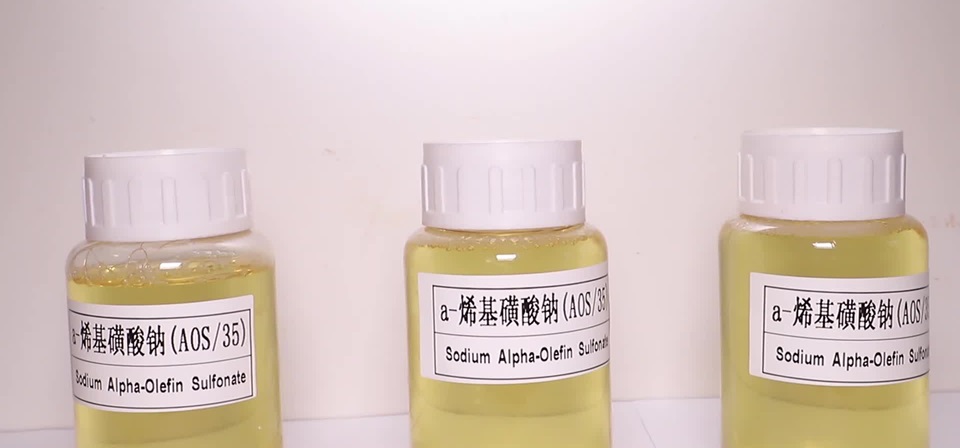
| Appearance | Slightly yellowish powder or liquid (depending on concentration and form) |
Note: Alpha Olefin Sulfonate is a high-performance anionic surfactant produced by the sulfonation of linear alpha-olefins (typically C14-C16), followed by hydrolysis and neutralization with sodium hydroxide. It is known for its excellent foaming power, hard water tolerance, mildness to the skin, and high biodegradability. It is widely used as a primary surfactant in personal care, household cleaning, and industrial applications, and is a preferred choice in "sulfate-free" formulations as an alternative to SLS/SLES.
2. PHYSICAL AND CHEMICAL PROPERTIES
| Property | Value / Description |
|---|---|
| Physical form | Slightly yellowish powder (solid form) or clear, slightly yellowish liquid (aqueous solution) |
| Solubility in water | Freely soluble; high foaming on dissolution |
| Ionic Character | Anionic |
| pH (1% aqueous solution) | 7.0 – 8.5 (neutral to mildly alkaline) |
| Stability | Stable over a wide pH range; excellent hard water tolerance |
| Biodegradability | Readily biodegradable (meets OECD 301 criteria) |
| Foam Quality | Excellent; rapid foam generation with rich, dense, and stable lather, even in hard water |
3. FUNCTIONAL PROPERTIES AND MODE OF ACTION
-
Excellent Foaming Agent: AOS generates a rich, dense, and remarkably stable foam very quickly, even in the presence of hard water ions (Ca²⁺, Mg²⁺) and soils. This makes it a primary foaming agent in shampoos, body washes, and liquid soaps.
-
Mildness and Skin Compatibility: Unlike SLS (Sodium Lauryl Sulfate), AOS has a significantly lower irritation potential. This makes it a preferred, mild, and "sulfate-free" primary surfactant for personal care products designed for sensitive skin and baby formulations.
-
High Cleaning Power: Effectively removes oily soils and particulate dirt from fabrics and hard surfaces. Its wetting and emulsifying properties are excellent.
-
Hard Water Tolerance: Its performance is not diminished by water hardness, making it an ideal choice for laundry and dishwashing detergents in all regions.
-
Sulfate-Free Formulations: As an olefin sulfonate (not a lauryl sulfate), it is the surfactant of choice for products marketed as "sulfate-free."
-
Compatibility: Highly compatible with other anionic, non-ionic, and amphoteric co-surfactants (such as Cocamidopropyl Betaine), allowing for synergistic performance and viscosity building.
4. COMPARISON WITH SLS (SODIUM LAURYL SULFATE)
| Property | AOS (Alpha Olefin Sulfonate) | SLS (Sodium Lauryl Sulfate) |
|---|---|---|
| Irritation Potential | Low; mild and gentle to the skin | High; can be irritating and drying |
| Foam Quality | Rich, stable foam; effective in hard water | Abundant foam; sensitive to water hardness |
| Hard Water Tolerance | Excellent | Moderate to Low |
| Sulfate Status | Sulfate-free (contains sulfonate, not sulfate group) | Contains sulfate group |
| Biodegradability | Readily biodegradable | Biodegradable |
| Cost | Generally more expensive than SLS | Cheaper; a commodity surfactant |
| Primary Use | Premium personal care, sulfate-free, and mild formulations | Industrial cleaners, toothpaste, cost-sensitive products |
5. SECTORAL APPLICATIONS, SUITABILITY, AND USAGE RATES
| Sector | Application | Typical Usage Rate (% in formulation) |
|---|---|---|
| Household Cleaning | Laundry detergents, dishwashing liquids, liquid soaps. High foaming, hard water compatible. | 5 – 20% (as active) |
| Personal Care | Shampoos, shower gels, facial cleansers, hand soaps, toothpaste. Preferred in sulfate-free products. | 4 – 15% (as active) |
| Cosmetics | Creams, lotions, pet shampoos, facial cleansers. Acts as a mild, good emulsifier. | 2 – 10% (as active) |
| Industrial & Institutional Cleaning | Car wash liquids, heavy-duty degreasers. Powerful oil and soil remover. | 10 – 30% (as active) |
| Textile & Dyeing | Wetting and cleaning agent; compatible with polymers. | 5 – 15% (as active) |
| Construction | Concrete additive (as an air-entraining agent, increasing density). | Process-specific |
| Agriculture | Pesticide emulsifier, wetting agent. | 2 – 8% (as active) |
| Firefighting Foam | Foam stabilizer; high foaming property is critical. | 5 – 10% (as active) |
6. ADVANTAGES AND DISADVANTAGES
| Advantages | Disadvantages |
|---|---|
| High foaming power and excellent foam stability, even in hard water | Generally more expensive than traditional SLS |
| Mild to the skin; low irritation potential | The powder form requires careful handling to avoid dust inhalation |
| Readily biodegradable; environmentally friendly | |
| Can be used in "sulfate-free" product claims | |
| Excellent compatibility with other surfactants |
7. ALTERNATIVE NAMES AND SYNONYMS
| Category | Names |
|---|---|
| Common Names | Alpha Olefin Sulfonate, AOS, Sodium Alpha-Olefin Sulfonate |
| Chemical Descriptors | Sodium C14-16 Olefin Sulfonate, Sodium Tetradecene Sulfonate, Linear Alpha Olefin Sulfonate |
| Product Forms | AOS Powder, AOS Liquid |
8. SAFETY, STORAGE, AND REGULATORY INFORMATION
-
GHS Classification: Not classified as a hazardous substance or mixture. The concentrated powder may cause mild skin and eye irritation upon prolonged contact.
-
Storage:
-
Store in a dry, cool (<30 °C), and well-ventilated area, away from moisture and direct heat.
-
Keep containers tightly sealed, especially the powder form, to prevent moisture absorption which can cause caking.
-
-
Personal Protection: For handling the powder form in large quantities, use a dust mask to avoid mechanical irritation from inhalation. Standard nitrile gloves are sufficient for handling the liquid form.
-
Regulatory: Meets the criteria for ready biodegradability (OECD 301). Approved for use in cosmetics under the EU Cosmetics Regulation.
9. FREQUENTLY ASKED QUESTIONS
Q1: Is AOS truly sulfate-free?
Yes. Although its name contains "sulfonate," a sulfonate group is chemically different from a sulfate group. Products made with AOS can legitimately make a "sulfate-free" claim, as it does not contain the lauryl sulfate (SLS) or laureth sulfate (SLES) molecules that the claim targets.
Q2: How does AOS perform in hard water compared to traditional soaps?
This is one of AOS's greatest strengths. Unlike traditional soaps (fatty acid carboxylates), which form insoluble scum with calcium and magnesium ions in hard water, AOS remains fully active and soluble. Its foam and cleaning power are virtually unaffected by water hardness.
Q3: What is the difference between AOS and SLES?
While both are high-foaming, mild anionic surfactants, the key difference is chemical. SLES (Sodium Lauryl Ether Sulfate) is a sulfate, produced by ethoxylation and sulfation. AOS (Alpha Olefin Sulfonate) is a sulfonate, produced by a different process. AOS is often considered to produce a slightly denser, creamier foam and has a different molecular structure, allowing for a true "sulfate-free" label.
10. QUICK REFERENCE TABLE
| Property | Value / Description |
|---|---|
| Common Name | AOS (Alpha Olefin Sulfonate) |
| CAS | 68439-57-6 |
| Class | Anionic Surfactant |
| Appearance | Slightly yellowish powder or liquid |
| Main Function | Primary foaming, cleansing, and wetting agent |
| Key Differentiator | Excellent hard water tolerance, mild, and sulfate-free |
| Typical Usage | 2 – 30% active matter in final formulation |
, 68439-57-6.jpg)
, AOS toz, ALFONAT30,.jpg)