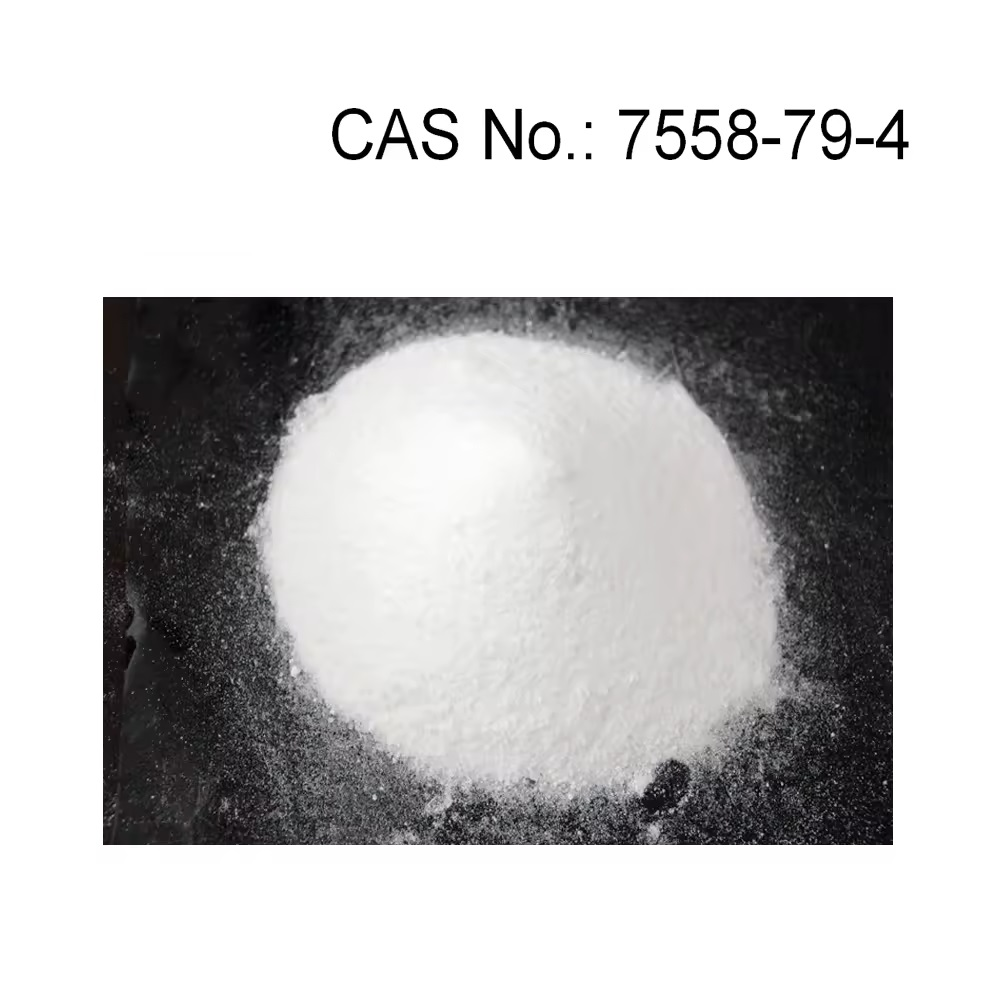
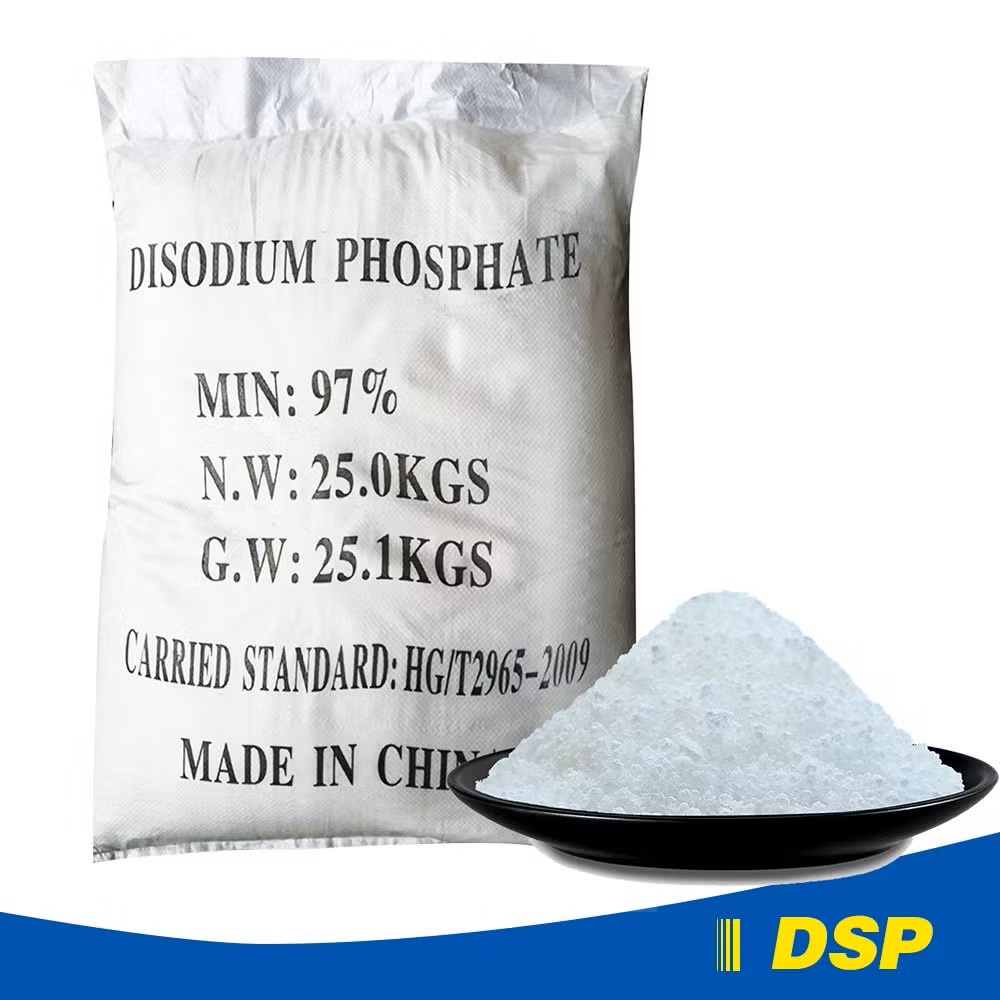
Disodium Phosphate, Sodium Hydrogen Phosphate, Disodium Hydrogen Phosphate, DSP, E450iii 7558-79-4
DISODIUM PHOSPHATE (DSP)
CAS Number: 7558-79-4
EC Number (EINECS): 231-448-7
Molecular Formula: Na₂HPO₄
Molecular Weight: 141.96 g/mol (anhydrous)
E Number: E339(ii)
SECTION 1: PRODUCT IDENTIFICATION AND CHEMICAL IDENTITY
| Parameter |
Description |
| Chemical Name (IUPAC) |
Disodium hydrogen phosphate |
| Other Names |
Disodium Phosphate, Sodium Hydrogen Phosphate, Sodium Acid Phosphate (anhydrous), Sodium Orthophosphate (anhydrous), Sodium Monohydrogen Phosphate, Phosphoric Acid Disodium Salt, Dibasic Sodium Phosphate, Buffer Salt, DSP Anhydrous |
| CAS Number |
7558-79-4 |
| EC Number (EINECS) |
231-448-7 |
| Molecular Formula |
Na₂HPO₄ |
| Molecular Weight |
141.96 g/mol (anhydrous) |
| Chemical Class |
Inorganic phosphate salt |
| E Number |
E339(ii) |
| Appearance |
White crystalline powder or granules (anhydrous); transparent crystals (hydrate forms) |
| Odor |
Odorless |
SECTION 2: PHYSICAL AND CHEMICAL PROPERTIES
2.1. General Properties
| Property |
Value / Range |
| Molecular Formula |
Na₂HPO₄ |
| Molecular Weight |
141.96 g/mol (anhydrous) |
| Appearance |
White crystalline powder (anhydrous) or transparent crystals |
| Odor |
Odorless |
| Density (Anhydrous) |
~1.7 g/cm³ |
| Density (Dihydrate) |
~2.07 g/cm³ |
| Density (Dodecahydrate) |
~1.52 g/cm³ |
| Bulk Density |
0.5 - 1.2 g/cm³ |
| Melting Point |
~250°C (decomposes) |
| Solubility in Water (25°C) |
~11.8 g/100 g water |
| Solubility in Water (20°C) |
~7.7 g/100 g water (anhydrous) |
| Solubility in Ethanol |
Insoluble |
| pH (1% Aqueous Solution, 25°C) |
~9.1 |
| pH Range (1% Solution) |
8.4 - 9.6 |
| Hygroscopicity (Anhydrous) |
Hygroscopic (absorbs moisture from air) |
| Stability (Heptahydrate) |
Stable in air |
| Stability (Dodecahydrate) |
Loses 5 mol water at normal temperature |
| Thermal Decomposition |
When heated, releases toxic phosphorus and sodium oxide fumes |
| Basicity |
More basic than monosodium phosphate |
2.2. Hydrate Forms
| Formula |
Name |
Water Content |
Properties |
| Na₂HPO₄ |
Anhydrous |
- |
Hygroscopic, absorbs moisture from air |
| Na₂HPO₄·2H₂O |
Dihydrate |
2 |
- |
| Na₂HPO₄·7H₂O |
Heptahydrate |
7 |
Stable in air |
| Na₂HPO₄·12H₂O |
Dodecahydrate |
12 |
Loses 5 mol water at normal temperature |
SECTION 3: SOLUBILITY PROFILE
| Solvent |
Solubility |
Condition |
| Water |
Soluble (~11.8 g/100g) |
25°C |
| Water |
~7.7 g/100g |
20°C |
| Ethanol |
Insoluble |
- |
| Methanol |
Slightly soluble |
- |
Critical Note: Disodium phosphate is freely soluble in water but insoluble in ethanol and other organic solvents. The anhydrous form is hygroscopic (absorbs moisture) and absorbs 2-7 mol water. Its aqueous solution is basic (pH ~9.1).
SECTION 4: CHEMICAL PROPERTIES AND REACTIONS
| Property |
Description |
| Chemical Class |
Inorganic phosphate salt |
| Functional Group |
Hydrogen phosphate (HPO₄²⁻) |
| Reactivity |
Exhibits both acidic and basic properties |
| pH Buffering |
Forms effective buffer solutions |
| Thermal Decomposition |
> 250°C converts to sodium pyrophosphate |
| Reaction with Acids |
Forms phosphoric acid and sodium salts |
| Reaction with Bases |
Forms trisodium phosphate |
| Decomposition Products |
Sodium oxides, phosphorus oxides |
4.1. Stability
| Parameter |
Information |
| Thermal Stability |
Stable up to ~250°C |
| Hygroscopicity (Anhydrous) |
Absorbs moisture from air |
| Hydrolytic Stability |
Stable in aqueous solution |
| Incompatibilities |
Strong acids, high temperature |
SECTION 5: MAJOR APPLICATIONS AND END-USES
5.1. Food Additive (Primary Application)
| Application |
Function |
Suitability |
| Acidity Regulator |
pH control and buffering |
High |
| Emulsifier |
Stabilization of oil-water emulsions |
High |
| Moisture Retainer |
Prevents moisture loss in seafood and meat |
High |
| Thickening Agent |
Cheese, yogurt, ice cream production |
High |
| Stabilizer |
Provides stability in food systems |
High |
| Flour Treatment |
Flour enrichment and preservation |
High |
5.2. Food Products
| Application |
Function |
| Processed Cheese |
Hardening and meltability control |
| Dairy Products |
pH buffering, stabilization |
| Ice Cream |
Softness preservation, crystallization control |
| Seafood |
Moisture retention (prevents water loss) |
| Sausages and Processed Meats |
Preservation and moisture retention |
| Beverages |
Acidity regulation, buffering |
| Jellies |
Softness preservation |
| Creams and Sauces |
Emulsion stabilization |
5.3. Industrial Applications
| Application |
Function |
Suitability |
| Boiler Water Treatment |
Scale prevention (with trisodium phosphate) |
High |
| Corrosion Inhibitor |
Provides protection on metal surfaces |
High |
| Coating Additives |
Corrosion protection, lubricity |
High |
| Cleaning Products |
Cleaning and floor care products |
High |
| Textile and Leather |
Buffering in bleaching processes |
High |
| Paint Additives |
Coating and paint formulations |
High |
| Flame Retardant |
Fire retardant use |
Moderate |
| Water Treatment |
Water treatment processes |
Moderate |
| Tobacco Industry |
Moisture retention agent |
Moderate |
5.4. Medical and Pharmaceutical Applications
| Application |
Function |
Suitability |
| Laxative |
Saline laxative for constipation treatment |
High |
| Colonoscopy Preparation |
Bowel cleansing |
High |
| Hypercalcemia Treatment |
Lowers blood calcium levels |
High |
| Hypophosphatemia Treatment |
Increases low phosphate levels |
High |
| Nasal Sprays |
As auxiliary agent |
High |
| Liver Flushing |
Toxin removal |
High |
SECTION 6: INDUSTRY SUITABILITY MATRIX
| Industry |
Suitability |
Explanation |
| Food Industry |
High |
Acidity regulator, emulsifier, moisture retainer |
| Dairy and Cheese |
High |
Hardening, melt control |
| Meat and Seafood |
High |
Moisture retention, preservation |
| Beverages |
High |
Acidity regulation, buffering |
| Pharmaceuticals |
High |
Laxative, hypercalcemia treatment |
| Textile |
High |
Bleaching buffering |
| Water Treatment |
High |
Scale prevention, corrosion inhibitor |
| Cleaning Products |
High |
Cleaning and shine |
| Coatings |
Moderate |
Corrosion protection, lubricity |
| Cosmetics |
Limited |
Only in specific formulations |
SECTION 7: OTHER NAMES AND IDENTIFIERS
| Type |
Name / Description |
| IUPAC Name |
Disodium hydrogen phosphate |
| E Number |
E339(ii) |
| Commercial Names |
DSP, Disodium Phosphate, Disodium Hydrogen Phosphate |
| Synonyms |
Sodium Phosphate Dibasic, Phosphoric Acid Disodium Salt, Sodium Acid Phosphate (anhydrous), Sodium Orthophosphate (anhydrous), Sodium Monohydrogen Phosphate, Sec-Sodium Phosphate, Buffer Salt |
| CAS Number |
7558-79-4 |
| EC Number |
231-448-7 |
| HS Code |
28352200 |
SECTION 8: PRODUCTION METHOD
8.1. Main Production Methods
| Method |
Description |
| Phosphoric Acid + Sodium Carbonate |
Neutralization of phosphoric acid with soda ash (Na₂CO₃) |
| Phosphoric Acid + Caustic Soda |
Neutralization of phosphoric acid with sodium hydroxide (NaOH) |
| Dicalcium Phosphate Precipitation |
Precipitation from dicalcium phosphate solution with soda ash |
8.2. Production Details
| Parameter |
Description |
| Reaction |
H₃PO₄ + 2 NaOH → Na₂HPO₄ + 2 H₂O |
| Crystallization |
Dodecahydrate crystallizes, separated by centrifugation |
| Anhydrous Form |
Obtained by dehydration (water removal) or spray drying |
| Quality |
Thermal phosphoric acid used for food-grade production |
| Cost |
Low cost in USA due to soda ash usage |
SECTION 9: TOXICOLOGY AND HEALTH EFFECTS
| Parameter |
Value / Description |
| GHS Classification |
Warning |
| Hazard Statements |
H315 (Causes skin irritation), H319 (Causes serious eye irritation), H335 (May cause respiratory irritation) |
| Precautionary Statements |
P261 (Avoid breathing dust), P280 (Wear protective gloves/eye protection), P305+P351+P338 (IF IN EYES: Rinse cautiously with water) |
| Oral LD50 (Rat) |
~4,000-6,000 mg/kg (low toxicity) |
| Skin Irritation |
Mild irritant |
| Eye Irritation |
Irritant |
| Skin Sensitization |
Not sensitizing |
| Mutagenicity |
Negative |
| Carcinogenicity |
Not classified |
| Target Organs |
Skin, eyes, respiratory system |
SECTION 10: ECOTOXICOLOGY AND ENVIRONMENTAL BEHAVIOR
| Parameter |
Value / Description |
| Biodegradability |
Not biodegradable (inorganic) |
| Water Solubility |
High |
| Eutrophication |
Can cause eutrophication in aquatic environments (phosphate source) |
| Bioaccumulation Potential |
Low |
| Water Hazard Class (WGK Germany) |
WGK 1 (slight hazard to water) |
Ecotoxicological Summary: Disodium phosphate, as a phosphate source, can cause eutrophication (excessive algae growth) in aquatic environments. Release to the environment should be avoided.
SECTION 11: SAFETY AND STORAGE
| Parameter |
Information |
| Storage Conditions |
Cool, dry, well-ventilated area |
| Temperature |
Room temperature (15-30°C) |
| Container |
Tightly closed, original packaging (25 kg bags) |
| Special Requirements |
Protect from moisture (anhydrous form is hygroscopic) |
| Materials to Avoid |
Strong acids, high temperature |
| Shelf Life |
24 months (under recommended conditions) |
| Packaging |
25 kg bags, 500 kg big bags |
SECTION 12: TRANSPORT INFORMATION
| Parameter |
Information |
| UN Number |
Not regulated (not classified as dangerous goods) |
| Hazard Class |
Not applicable |
| Packing Group |
Not applicable |
| Proper Shipping Name |
Disodium Phosphate |
| ADR/RID |
Not regulated |
| IMDG Code |
Not regulated |
| IATA (Air) |
Not regulated |
| Marine Pollutant |
No |
SECTION 13: FIRE-FIGHTING MEASURES
| Parameter |
Information |
| Fire Hazard |
Not combustible |
| Extinguishing Media |
Water fog, CO₂, dry chemical |
| Special Hazards |
When heated, releases toxic phosphorus and sodium oxide fumes |
| Decomposition Products |
Sodium oxides, phosphorus oxides |
| Protective Equipment |
Self-contained breathing apparatus (SCBA), full protective clothing |
SECTION 14: ACCIDENTAL RELEASE AND CLEANUP
| Parameter |
Information |
| Personal Protection |
Gloves, safety goggles, dust mask |
| Ventilation |
Increase ventilation |
| Cleanup Methods |
Sweep while preventing dust formation; collect in sealed containers |
| Environmental Precautions |
Prevent entry into drains (eutrophication risk) |
| Waste Disposal |
According to local regulations |
SECTION 15: FIRST AID MEASURES
| Exposure Route |
Action |
| Inhalation |
Move to fresh air. Seek medical attention if symptoms persist. |
| Skin Contact |
Remove contaminated clothing. Wash with soap and plenty of water. |
| Eye Contact |
Rinse with plenty of water for at least 15 minutes. Seek medical attention if irritation persists. |
| Ingestion |
Do NOT induce vomiting. Drink plenty of water. Seek medical attention. |
SECTION 16: REGULATORY INFORMATION
| Region / Authority |
Status |
| EU REACH |
Registered |
| Turkey KKDİK |
Registration required |
| USA TSCA |
Listed |
| USA FDA |
GRAS as food additive (E339(ii)) |
| EU Food Additives |
Approved as E339(ii) |
| EINECS |
231-448-7 |
| HS Code |
28352200 |
SECTION 17: SUMMARY AND CRITICAL WARNINGS
Product Summary
| Parameter |
Value |
| Product |
Disodium Phosphate (DSP) |
| CAS |
7558-79-4 |
| Appearance |
White crystalline powder |
| Molecular Weight |
141.96 g/mol |
| pH (1% Solution) |
~9.1 |
| Water Solubility |
Soluble (~11.8 g/100g) |
| E Number |
E339(ii) |
| Key Industries |
Food, pharmaceuticals, textiles, water treatment |
CRITICAL WARNINGS
-
Food Additive: Disodium phosphate is a widely used food additive (E339(ii)) as an acidity regulator, emulsifier, and moisture retainer.
-
Buffering Properties: Forms an effective buffer solution with pH ~9.1. This property provides pH control in food and industrial applications.
-
Hydrate Forms: Exists in four different hydrate forms: anhydrous, dihydrate, heptahydrate, and dodecahydrate. The anhydrous form is hygroscopic (absorbs moisture).
-
Water Solubility: Freely soluble in water, insoluble in organic solvents.
-
Medical Uses: Used as a laxative, for hypercalcemia treatment, and for bowel cleansing prior to colonoscopy.
-
Seafood Processing: Used as a moisture retainer in seafood products. Without DSP, products experience significant water loss.
-
Environmental Impact: As a phosphate source, can cause eutrophication in aquatic environments. Release to the environment should be avoided.
-
High pH: Aqueous solution is basic (pH ~9.1). Avoid contact with skin and eyes.
-
Thermal Decomposition: When heated (> 250°C), releases toxic phosphorus and sodium oxide fumes. Use appropriate protective equipment in case of fire.
-
Storage: The anhydrous form is hygroscopic, so store in cool, dry, well-ventilated areas. Protect from moisture.
IMPORTANT DISCLAIMER: This Technical Data Sheet (TDS) is for informational purposes only and is based on available technical data. The user is solely responsible for determining the product's suitability for their specific application and for complying with all applicable local, national, and international regulations. For complete safety, storage, handling, transportation, disposal, and regulatory compliance information, always refer to the official Safety Data Sheet (SDS/MSDS) provided by the manufacturer/supplier. Users are responsible for testing the product in their own processes and applications. All local, national, and international regulations must be followed when working with Disodium Phosphate.