We unleash your business potential by maximize the business innovation.
Send EmailMyristamine Oxide, Myristyl Dimethyl Amine Oxide, Tetradecyl Dimethyl Amine Oxide, N,N-Dimethyltetradecylamine N-oxide, 3332-27-2
MYRISTAMINE OXIDE (TETRADECYL DIMETHYL AMINE OXIDE)
1. Chemical Identity and Material Classification
-
Chemical Name: Myristamine Oxide, Tetradecyl Dimethyl Amine Oxide, N,N-Dimethyltetradecylamine N-oxide
-
Synonyms: Myristyl Dimethyl Amine Oxide, C14 Amine Oxide, Tetradecyl Amine Oxide, N,N-Dimethyl-1-tetradecanamine N-oxide
-
CAS Number: 3332-27-2
-
EC Number (EINECS): 222-059-3
-
Molecular Formula: C₁₆H₃₅NO
-
Molecular Weight: 257.46 g/mol
-
Chemical Class: Amine oxide (zwitterionic / non-ionic surfactant)
-
REACH Status: Registered (≥1,000 to <10,000 tonnes/year in EEA)
2. Physical Properties
2.1 General Physical Properties (30% Aqueous Solution)
| Property | Value |
|---|---|
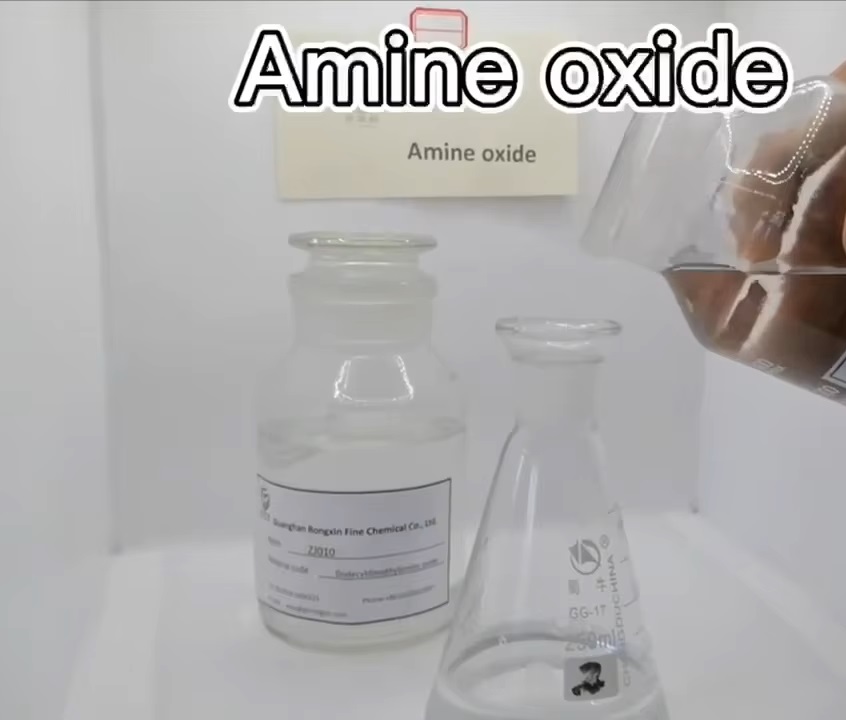
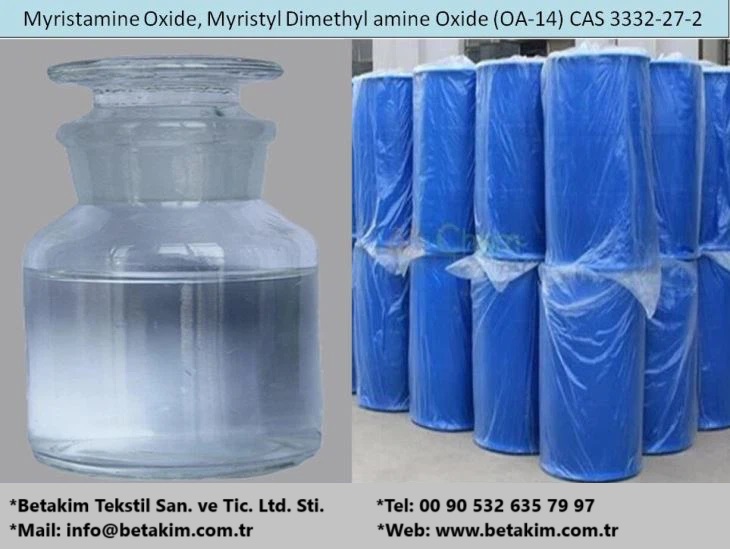
| Appearance | Clear to pale yellow liquid |
| Physical state (25°C) | Liquid |
| Odor | Mild, characteristic amine oxide odor |
| Active content | 30% (typical commercial grade) |
| Density (25°C) | 0.96 g/cm³ |
| Specific gravity (25°C) | 0.96 |
| Viscosity (25°C) | 2,336 cP (2.336 Pa·s) – highly viscous |
| Flash point | >94°C (201°F) – combustible |
| Freezing point | 1°C (34°F) |
| Pour point | 4°C (39°F) |
| Cloud point | 3°C (37°F) |
| Vapor pressure | Negligible |
| RVOC (U.S. EPA) | 0% |
2.2 Surface Activity Parameters
| Parameter | Value |
|---|---|
| Surface tension (25°C) | 29.4 mN/m |
| Interfacial tension (nM/M) | 4.1 nM/M |
| Wetting time (Draves test) | 2 seconds (very fast) |
| CMC (Critical Micelle Concentration) | 32.0 mg/L |
| pH (as supplied) | 6.5–8.5 (typical) |
2.3 pH-Dependent Properties
| pH Range | Behavior | Surfactant Type |
|---|---|---|
| pH < 4 (acidic) | Protonated (cationic) | Cationic surfactant |
| pH 4–8 (neutral) | Mixed / equilibrium | Zwitterionic / non-ionic |
| pH > 8 (alkaline) | Unprotonated (amine oxide) | Non-ionic surfactant |
2.4 Thermal Properties
| Parameter | Value |
|---|---|
| Freezing point | 1°C – protect from freezing |
| Cloud point | 3°C – may become hazy below this temperature |
| Thermal stability | Stable up to 50°C |
3. Chemical Properties
3.1 Molecular Structure
Structure: CH₃(CH₂)₁₃–N⁺(CH₃)₂–O⁻
Chain length: C14 (tetradecyl – 14 carbon atoms)
Type: Tertiary amine oxide
Key features:
-
Longer hydrophobic chain than lauramine oxide (C12) – provides different performance profile
-
pH-responsive charge behavior
-
Excellent foam boosting and stabilization
-
Antimicrobial properties
3.2 Comparison with Lauramine Oxide (C12)
| Property | Myristamine Oxide (C14) | Lauramine Oxide (C12) |
|---|---|---|
| Chain length | C14 | C12 |
| Antimicrobial activity | Slightly higher against S. aureus and E. coli | Slightly lower |
| Viscosity | Higher (2,336 cP) | Lower |
| Wetting time | 2 seconds | Similar |
| CMC | 32 mg/L | ~40–50 mg/L |
| Freezing point | 1°C | Lower |
3.3 Antimicrobial Properties
Myristamine oxide is antimicrobial, showing slightly better efficacy than lauramine oxide against common bacteria:
-
Staphylococcus aureus (Gram-positive)
-
Escherichia coli (Gram-negative)
3.4 Chemical Stability
| Parameter | Behavior |
|---|---|
| Thermal stability | Stable up to 50°C; decomposes at >80°C |
| Hydrolytic stability | Stable in neutral and alkaline conditions |
| Oxidative stability | Good (saturated C14 chain) |
| pH stability | Stable at pH 4–10 |
3.5 Incompatibilities
-
Strong oxidizing agents
-
Strong reducing agents (may reduce amine oxide to tertiary amine)
-
Strong acids (protonation; extreme conditions may cause decomposition)
4. Production Method
4.1 Synthesis Route (Hydrogen Peroxide Oxidation)
Reaction: C₁₄H₂₉N(CH₃)₂ + H₂O₂ → C₁₄H₂₉N(CH₃)₂→O + H₂O
Process:
-
Tetradecyl dimethyl tertiary amine is reacted with hydrogen peroxide in aqueous solution
-
Reaction temperature: 50–80°C
-
pH control: 7–9 (using chelating agents to prevent metal-catalyzed decomposition)
-
Reaction time: 4–8 hours
-
Excess peroxide is neutralized with reducing agent
-
Product is filtered and adjusted to final concentration (typically 30% active)
Typical yield: >95%
5. Quality Specifications
5.1 Typical Specifications (30% Aqueous Solution)
| Parameter | Specification | Test Method |
|---|---|---|
| Appearance | Clear to pale yellow liquid | Visual |
| Active content (amine oxide, w/w) | 29.0–31.0% | Titration |
| Free amine (tertiary amine) | ≤ 0.5% | Titration |
| Hydrogen peroxide (residual) | ≤ 0.1% | Titration |
| pH (as supplied) | 6.5–8.5 | pH meter |
| Density (25°C) | 0.96 ± 0.02 g/cm³ | Hydrometer |
| Viscosity (25°C) | 2,000–2,500 cP | Brookfield |
| Cloud point | 3°C ± 1°C | Visual |
| Freezing point | 1°C ± 1°C | Visual |
| Color (APHA) | ≤ 100 | Visual |
| Iron (Fe) | ≤ 5 ppm | ICP-OES |
6. Mechanism of Action
6.1 Surface Activity
| Mechanism | Description |
|---|---|
| Hydrophobic tail | C14 alkyl chain provides oil solubility and surface activity |
| Hydrophilic head | Amine oxide group (N→O) is highly polar, providing water solubility |
| pH-responsive charge | Cationic at low pH, non-ionic at neutral/alkaline pH |
| Foam stabilization | Stabilizes foam bubbles; excellent foam booster |
| Viscosity building | Increases viscosity in certain formulations |
6.2 Thickening Effect
Myristamine oxide provides significant viscosity building, especially in:
-
Anionic surfactant systems (e.g., SLES-based shampoos, body washes)
-
Hypochlorite solutions
-
Acidic cleaning formulations
Viscosity behavior: pH has a strong effect on viscosity – highest at neutral to slightly alkaline pH.
6.3 Foam Boosting
| Parameter | Performance |
|---|---|
| Foam volume | Very high |
| Foam stability | Excellent |
| Lime soap dispersant | Good |
7. Industrial Applications
7.1 Personal Care and Cosmetics (Primary Application)
| Application | Function | Typical Concentration |
|---|---|---|
| Shampoos | Foam booster, thickener, conditioner, antistatic | 1–5% |
| 2-in-1 shampoos | Foam booster, conditioner | 1–3% |
| Body washes | Foam booster, viscosity builder | 1–5% |
| Facial cleansers | Mild surfactant, foam booster | 0.5–3% |
| Hand soaps | Foam booster, thickener | 1–5% |
| Hair conditioners | Antistatic, detangling | 0.5–2% |
| Bar soaps | Skin feel enhancer | 1–3% |
Benefits in personal care:
-
Excellent foam boosting and stabilization
-
Provides conditioning and antistatic properties
-
Viscosity builder in anionic systems
-
Mild to skin (reduces irritation of anionic surfactants)
-
Works synergistically with other surfactants
7.2 Hypochlorite (Bleach) Formulations
| Parameter | Value |
|---|---|
| Function | Perfume solubilizer, thickener in hypochlorite solutions |
| Typical concentration | 1–5% |
| Benefits | Increases viscosity of bleach; solubilizes fragrances; stable in hypochlorite |
7.3 Detergents and Cleaning Products
| Application | Function | Typical Concentration |
|---|---|---|
| Automatic dishwashing detergents | Foam control, wetting agent | 0.5–2% |
| Hand dishwashing liquids | Foam booster, grease emulsifier | 2–5% |
| Laundry detergents | Foam stabilizer, soil suspension | 1–3% |
| Hard surface cleaners | Wetting agent, emulsifier | 0.5–3% |
| Floor cleaners | Wetting, soil suspension | 0.5–2% |
| Kitchen cleaners | Grease emulsifier | 1–3% |
7.4 Industrial and Institutional Cleaning
| Application | Function |
|---|---|
| Car wash (automatic) | Foam booster, wetting agent |
| Car wash (hand) | Foam booster, lubricant |
| Truck wash | Wetting agent, emulsifier |
| Metalworking cleaners | Emulsifier, corrosion inhibitor |
| Industrial degreasers | Surfactant, emulsifier |
7.5 Water Treatment
| Application | Function |
|---|---|
| Water treatment chemicals | Surfactant, wetting agent, dispersant |
7.6 Paints and Coatings
| Application | Function |
|---|---|
| Polishes and waxes | Emulsifier, wetting agent |
| Floor polishes | Leveling agent |
7.7 Agricultural Formulations
| Application | Function |
|---|---|
| Tank mix adjuvants | Wetting agent, dispersant |
| Pesticide adjuvants | Improves spray coverage |
7.8 Antifreeze and De-icing Products
| Application | Function |
|---|---|
| Antifreeze products | Wetting agent |
| De-icing products | Wetting agent, surfactant |
8. Compatibility and Formulation
8.1 Surfactant Compatibility
| Surfactant Type | Compatibility |
|---|---|
| Anionic (SLES, SLS, LAS) | Excellent – viscosity building synergy |
| Cationic | Excellent |
| Non-ionic | Excellent |
| Amphoteric | Excellent |
| Hypochlorite | Excellent (stable, thickens) |
8.2 Viscosity Building
Myristamine oxide is particularly effective at building viscosity in:
-
SLES-based formulations
-
High electrolyte systems
-
Acidic cleaning products
8.3 pH Effect on Viscosity
| pH | Viscosity Behavior |
|---|---|
| Low (<4) | Cationic form – lower viscosity |
| Neutral (5–7) | Highest viscosity |
| Alkaline (>8) | Non-ionic form – moderate viscosity |
9. Toxicology and Safety
9.1 Acute Toxicity
| Parameter | Value |
|---|---|
| Oral LD₅₀ (rat) | 2,000–5,000 mg/kg (low to moderate toxicity) |
| Dermal LD₅₀ (rabbit) | >2,000 mg/kg |
| Skin irritation | Mild irritant |
| Eye irritation | Moderate to severe irritant (concentrated product) |
| Skin sensitization | Generally non-sensitizer |
| Inhalation | Not expected to be hazardous |
9.2 Antimicrobial Properties
Myristamine oxide exhibits antimicrobial activity:
-
Effective against Staphylococcus aureus (Gram-positive)
-
Effective against Escherichia coli (Gram-negative)
-
Slightly more effective than lauramine oxide
9.3 GHS Classification (Concentrated Product)
| Classification | Category |
|---|---|
| Signal word | Warning |
| Hazard statements | H315 – Causes skin irritation |
| H319 – Causes serious eye irritation | |
| H411 – Toxic to aquatic life with long-lasting effects | |
| Precautionary statements | P264, P280, P302+P352, P305+P351+P338, P332+P313, P337+P313, P273, P391, P501 |
10. Environmental Fate
| Parameter | Value |
|---|---|
| Biodegradability | Readily biodegradable |
| Aquatic toxicity (fish) | Moderate to high |
| Bioaccumulation | Low potential |
| REACH tonnage | 1,000–10,000 tonnes/year (EEA) |
11. Safety Precautions and PPE
-
Hazards:
-
Causes eye and skin irritation
-
Toxic to aquatic life with long-lasting effects
-
Avoid environmental release
-
-
PPE (recommended):
-
Chemical-resistant gloves (nitrile)
-
Safety glasses (EN 166) or chemical goggles
-
Protective clothing
-
-
First aid:
-
Eye contact: Rinse with water for 15 minutes; seek medical attention
-
Skin contact: Wash with soap and water
-
Inhalation: Move to fresh air
-
Ingestion: Rinse mouth; do NOT induce vomiting; seek medical attention
-
12. Storage and Handling
12.1 Storage Conditions
| Parameter | Requirement |
|---|---|
| Temperature | 5–40°C (protect from freezing – freezing point 1°C) |
| Container | Keep tightly closed in original container (HDPE, stainless steel) |
| Protect from | Freezing (gels upon freezing; thaw and mix before use) |
| Environment | Cool, dry, well-ventilated area |
| Shelf life (sealed) | 12–24 months |
| Shelf life (opened) | 6–12 months |
12.2 Freeze-Thaw Behavior
| Condition | Behavior | Recovery |
|---|---|---|
| Freezing below 1°C | Forms gel or semi-solid | Returns to liquid upon warming (15–25°C) with mild agitation |
13. Transport Information
| Regulation | Classification |
|---|---|
| UN Number | Not regulated (typically) |
| ADR/RID | Not classified as dangerous goods |
| IMDG | Not regulated |
| IATA | Not regulated |
14. Synonyms and Common Names
-
English: Myristamine Oxide, Tetradecyl Dimethyl Amine Oxide, N,N-Dimethyltetradecylamine N-oxide, Myristyl Dimethyl Amine Oxide, C14 Amine Oxide, Tetradecyl Amine Oxide
-
Trade names: Chemoxide MO-PF, Aromox M-14, Barlox 14, Ammonyx MO
-
French: Oxyde de myristamine
-
German: Myristaminoxid
-
Spanish: Óxido de miristamina
-
Turkish: Miristil Amin Oksit, Miristamin Oksit, Tetradesil Dimetil Amin Oksit
15. Regulatory Status
| Regulation | Status |
|---|---|
| REACH (EU) | Registered (1,000–10,000 tonnes/year) |
| TSCA (US) | Listed |
| EINECS | 222-059-3 |
| EU Detergent Regulation | Permitted as surfactant |
| EU Cosmetics Regulation | Permitted (rinse-off products) |
16. Why Choose Myristamine Oxide?
| Advantage | Description |
|---|---|
| Excellent foam booster | Significantly enhances foam volume and creaminess |
| Superior viscosity builder | Higher viscosity building than lauramine oxide (2,336 cP) |
| Effective thickener for bleach | Stable in hypochlorite; thickens bleach formulations |
| Antimicrobial properties | Slightly more effective than C12 amine oxide against S. aureus and E. coli |
| Peroxide-free formulation | Suitable for peroxide-free secondary surfactant applications |
| Good wetting agent | Very fast wetting (2 seconds) |
| pH-responsive | Cationic at low pH, non-ionic at neutral/alkaline pH |
| Mild to skin | Reduces irritation of anionic surfactants |
| Versatile | Multiple applications across industries |
| Good solubility | Clear liquid at room temperature (but freezes at 1°C) |
Limitations:
-
High viscosity – 2,336 cP at 25°C (requires pumping consideration)
-
Freezes near 0°C – Freezing point 1°C; protect from freezing; store above 5°C
-
Eye and skin irritant – requires handling precautions
-
Aquatic toxicity – Toxic to aquatic life; avoid environmental release
17. Applications Summary Table
| Sector | Application | Typical Concentration |
|---|---|---|
| Personal Care | Shampoos, body washes, facial cleansers | 1–5% |
| Hair Care | 2-in-1 shampoos, conditioners | 1–3% |
| Oral Care | Toothpaste (limited) | 0.5–2% |
| Detergents | Hand dishwashing, automatic dishwashing | 1–5% |
| Laundry | Liquid detergents | 1–3% |
| Industrial Cleaning | Car wash, truck wash, metal cleaning | 1–5% |
| Bleach Products | Thickener, perfume solubilizer | 1–5% |
| Water Treatment | Surfactant, wetting agent | 0.5–2% |
| Agriculture | Adjuvants, tank mix additives | 0.1–1% |
| Polishes | Floor polishes, waxes | 0.5–2% |
18. Formulation Examples
18.1 High-Viscosity Shampoo
| Component | % w/w |
|---|---|
| SLES (70%) | 10.0 |
| Cocamidopropyl Betaine | 3.0 |
| Myristamine Oxide (30%) | 2.0 |
| Sodium chloride | 0.5–1.0 |
| Preservative | q.s. |
| Water | to 100 |
18.2 Thickened Bleach (Hypochlorite) Formulation
| Component | % w/w |
|---|---|
| Sodium hypochlorite (12%) | 50.0 |
| Myristamine Oxide (30%) | 2.0–4.0 |
| Fragrance | 0.2–0.5 |
| Water | to 100 |
19. Comparison with Other Amine Oxides
| Property | Myristamine Oxide (C14) | Lauramine Oxide (C12) | C12-14 Amine Oxide | Cocoamine Oxide |
|---|---|---|---|---|
| Chain length | C14 only | C12 only | C12-14 mixed | C10-16 mixed |
| Viscosity (30% soln) | 2,336 cP | Lower | Lower | Lower |
| Freezing point | 1°C | Lower | 0–5°C | Lower |
| Antimicrobial | Slightly higher | Moderate | Moderate | Moderate |
| Wetting time | 2 sec | Similar | Good | Good |
| CMC (mg/L) | 32 | 40–50 | ~35–45 | ~40–50 |
| Primary use | Thickening, bleach | Foaming, personal care | General purpose | General purpose |
20. Summary Table – Key Specifications at a Glance
| Parameter | Value |
|---|---|
| Product Name | Myristamine Oxide (Tetradecyl Dimethyl Amine Oxide) |
| CAS Number | 3332-27-2 |
| EC Number | 222-059-3 |
| Molecular Formula | C₁₆H₃₅NO |
| Molecular Weight | 257.46 g/mol |
| Appearance (30% soln) | Clear to pale yellow liquid |
| Active Content (typical) | 30% |
| Density (25°C) | 0.96 g/cm³ |
| Viscosity (25°C) | 2,336 cP |
| Flash Point | >94°C |
| Freezing Point | 1°C |
| Cloud Point | 3°C |
| Surface Tension | 29.4 mN/m |
| Wetting Time | 2 seconds |
| CMC | 32.0 mg/L |
| pH (as supplied) | 6.5–8.5 |
| Primary Applications | Shampoos, body washes, bleach thickening, detergents |
| Biodegradability | Readily biodegradable |
| GHS Signal Word | Warning |
| Hazard Statements | H315, H319, H411 |
This TDS is prepared in compliance with ISO 11014-1 format and is intended for personal care formulators, detergent chemists, cleaning product manufacturers, industrial cleaners, and procurement professionals. Certificates of Analysis (CoA), Safety Data Sheets (SDS), and sample validation reports are available upon request.