We unleash your business potential by maximize the business innovation.
Send EmailAmino Trimethylene Phoshonic Acid, Nitrilotrimethylene Triphosphonic Acid, NTP, AMP, ATMP, ATMPA, 6419-19-8
AMINO TRIMETHYLENE PHOSPHONIC ACID (ATMP)
PRODUCT IDENTIFIER INFORMATION
| Parameter | Information |
|---|---|
| Product Name | Amino Trimethylene Phosphonic Acid (ATMP) |
| Chemical Name (IUPAC) | Nitrilotris(methylene)triphosphonic acid |
| CAS Number | 6419-19-8 |
| EC Number (EINECS) | 229-146-5 |
| Molecular Formula | C₃H₁₂NO₉P₃ |
| Molecular Weight | 299.05 g/mol |
SECTION 1: CHEMICAL IDENTITY AND DESCRIPTION
| Parameter | Information |
|---|---|
| Chemical Name (IUPAC) | Nitrilotris(methylene)triphosphonic acid |
| Systematic Name | Nitrilotrimethylphosphonic Acid (NTP) |
| Synonyms | ATMP, ATMPA, AMP, Amino Tri(Methylene Phosphonic Acid), Tris(Methylene Phosphonic Acid) Amine, Nitrilotrimethylphosphonic Acid, Aminotris(methylenephosphonic acid) |
| Trade Names | Dequest 2000, Dequest 2001, Ferrofos 509, Ferrofos 59, Dowell L-37, Briquest 301-50A |
| Abbreviations | ATMP, ATMPA, NTP |
| CAS Number | 6419-19-8 |
| EC Number (EINECS) | 229-146-5 |
| MDL Number | MFCD00002138 |
| Molecular Formula | C₃H₁₂NO₉P₃ |
| Molecular Weight | 299.05 g/mol |
| Chemical Class | Organophosphonic acid (aminophosphonate) |
| Physical State (20°C) | Liquid (clear to pale yellow solution) or crystalline powder (solid) |
| Odor | Slight characteristic |
| Taste | Acidic (not applicable for direct consumption) |
SECTION 2: PHYSICAL AND CHEMICAL PROPERTIES
| Property | Value | Test Method |
|---|---|---|
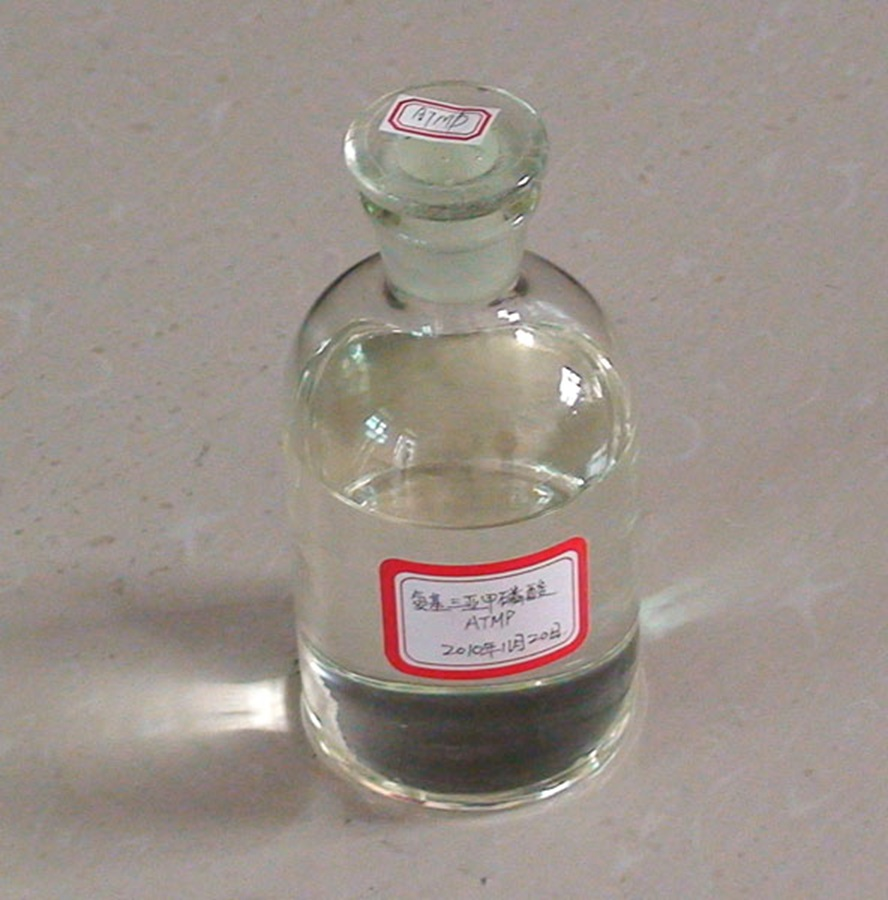
| Appearance (Solution) | Clear to pale yellow liquid | Visual |
| Appearance (Solid) | White crystalline powder | Visual |
| Odor | Slight characteristic | Olfactometric |
| Molecular Weight | 299.05 g/mol | Calculated |
| Density (20°C, Solution) | ~1.30 – 1.40 g/cm³ | ASTM D4052 |
| pH (1% Solution, 25°C) | 1.5 – 2.5 | pH Meter |
| Active Content (Commercial Solution) | 48 – 52% | Titrimetric / HPLC |
| Solubility in Water | Completely soluble | General Method |
| Solubility in Organic Solvents | Low | General Method |
| Thermal Stability | Good; stable up to 200°C | TGA |
| Hydrolytic Stability | Excellent; resistant to hydrolysis over long-term use | |
| Stability | Stable under normal conditions; incompatible with strong oxidizing agents |
SECTION 3: CHEMICAL PROPERTIES AND REACTIVITY
| Parameter | Information |
|---|---|
| Chemical Character | Organophosphonic acid (aminophosphonate); strong chelating agent; scale and corrosion inhibitor |
| Chelation | Forms very stable complexes with Ca²⁺, Mg²⁺, Fe²⁺/Fe³⁺, Cu²⁺, Zn²⁺, Al³⁺ |
| Scale Inhibition | Excellent CaCO₃ scale prevention through threshold effect and crystal distortion |
| Corrosion Inhibition | Effective cathodic corrosion inhibitor; protects metal surfaces |
| Hydrolytic Stability | Resistant to hydrolysis; does not degrade during long-term use in water systems |
| Incompatible Materials | Strong oxidizing agents, strong bases |
| Decomposition Products (Heating) | CO, CO₂, NOx, phosphorus oxides (P₂O₅) |
| Hazardous Polymerization | Does not occur |
SECTION 4: PRODUCTION METHODS
| Method | Description |
|---|---|
| Primary Method | Formaldehyde oxidation → formic acid → reaction with phosphoric acid → TMPO precursor → amidation with ammonia → ATMP |
| Alternative Method | Direct reaction of phosphoric acid with ammonia (less common) |
SECTION 5: PHOSPHONATES COMPARISON
| Property | ATMP | HEDP | PBTC | EDTMP | DTPMP |
|---|---|---|---|---|---|
| CAS Number | 6419-19-8 | 2809-21-4 | 37971-36-1 | 1429-50-1 | 15827-60-8 |
| Chemical Class | Aminophosphonate | Diphosphonate | Phosphonocarboxylate | Aminophosphonate | Polyaminophosphonate |
| Phosphorus Content | ~31% | ~30% | ~11.5% | ~28% | ~27% |
| Chelation Strength | Very High | High | High | Very High | Very High |
| Calcium Tolerance | Good | Excellent | Excellent | Moderate | Good |
| Chlorine Stability | Moderate | Excellent | Excellent | Poor | Poor |
| Thermal Stability | Up to 200°C | Up to 250°C | Up to 200°C | Up to 150°C | Up to 150°C |
| Primary Use | Cooling water, oil & gas, textiles, detergents | Cooling water, boilers, oil & gas | Cooling water, RO, detergents | Cooling water, boilers | Cooling water, oil & gas |
SECTION 6: FUNCTIONAL PROPERTIES AND MECHANISM OF ACTION
| Property | Description |
|---|---|
| Very Strong Chelation | Forms highly stable complexes with multiple metal ions; superior calcium and magnesium binding |
| Scale Inhibition | Prevents CaCO₃ precipitation through threshold effect and crystal growth modification |
| Corrosion Inhibition | Forms protective film on metal surfaces; provides cathodic protection |
| Hydrolytic Stability | Excellent resistance to hydrolysis; maintains performance during extended use in circulating water systems |
| Dispersing Agent | Prevents agglomeration of suspended solids and mineral particles |
| Sequestering Agent | Binds metal ions in textile dyeing and bleaching processes; prevents dye precipitation |
| pH Buffering | Provides buffering capacity in water treatment systems |
SECTION 7: PRIMARY APPLICATION AREAS AND DOSAGE
| Sector / Application | Function | Typical Dosage |
|---|---|---|
| Cooling Water Systems | Scale and corrosion inhibitor | 5 – 20 ppm |
| Boiler Water Treatment | Scale inhibitor | 5 – 15 ppm |
| Oilfield Water Injection | Scale and corrosion prevention in pipelines | 10 – 30 ppm |
| Oilfield - Rock Erosion Control | Reduces rock erosion around wells | 10 – 50 ppm |
| Textile Industry | Sequestering/chelating agent in dyeing and bleaching | 50 – 200 ppm |
| Metal Processing | Rust prevention, surface treatment | 500 – 2000 ppm |
| Detergents | Cleaning agent, washing performance enhancer | 500 – 2000 ppm |
| Paper and Pulp Industry | Precipitation inhibitor, pH regulator | 10 – 50 ppm |
SECTION 8: QUALITY SPECIFICATIONS (COMMERCIAL SOLUTION - 50% ACTIVE)
| Parameter | Specification | Test Method |
|---|---|---|
| Appearance | Clear to pale yellow liquid | Visual |
| Active Content (ATMP) | 48 – 52% | Titrimetric / HPLC |
| Phosphorous Acid (H₃PO₃) | ≤ 2.5% | Titrimetric |
| Phosphoric Acid (H₃PO₄) | ≤ 1.0% | Titrimetric |
| Chloride (Cl⁻) | ≤ 0.01% | Argentometric |
| Iron (Fe) | ≤ 25 ppm | AAS |
| Heavy Metals (as Pb) | ≤ 10 ppm | ICP-MS |
| Density (20°C) | 1.30 – 1.40 g/cm³ | ASTM D4052 |
| pH (1% Solution, 25°C) | 1.5 – 2.5 | pH Meter |
SECTION 9: QUALITY SPECIFICATIONS (SOLID / POWDER FORM)
| Parameter | Specification | Test Method |
|---|---|---|
| Appearance | White crystalline powder | Visual |
| Active Content (ATMP) | ≥ 97.0% | Titrimetric / HPLC |
| Loss on Drying (105°C, 2 hours) | ≤ 1.0% | Gravimetric |
| Iron (Fe) | ≤ 25 ppm | AAS |
| Heavy Metals (as Pb) | ≤ 10 ppm | ICP-MS |
SECTION 10: TOXICOLOGICAL PROFILE
| Parameter | Value |
|---|---|
| Acute Oral Toxicity (LD50, Rat) | > 2,000 mg/kg (low toxicity) |
| Skin Irritation | Irritant |
| Eye Irritation | Risk of serious eye damage |
| Respiratory Irritation | Inhalation of mist may cause irritation |
| Carcinogenicity | Not classified |
| Mutagenicity | Negative in standard tests |
| Environmental Toxicity | Low to moderate aquatic toxicity |
| Biodegradability | Not readily biodegradable |
SECTION 11: GHS CLASSIFICATION AND LABELING
GHS Classification (compliant with 1272/2008/EC):
| Hazard Class | Category | H-Statement |
|---|---|---|
| Acute Toxicity (Oral) | Category 4 | H302 |
| Skin Irritation | Category 2 | H315 |
| Serious Eye Damage/Irritation | Category 1 | H318 |
| STOT - SE | Category 3 | H335 |
Signal Word: DANGER
Hazard Pictograms: GHS05 (Corrosive), GHS07 (Exclamation Mark)
Hazard Statements (H-Codes):
| Code | Statement |
|---|---|
| H302 | Harmful if swallowed |
| H315 | Causes skin irritation |
| H318 | Causes serious eye damage |
| H335 | May cause respiratory irritation |
SECTION 12: PRECAUTIONARY STATEMENTS (P-CODES)
| Code | Statement |
|---|---|
| P261 | Avoid breathing dust/fume/gas/mist/vapors/spray |
| P280 | Wear protective gloves/protective clothing/eye protection/face protection |
| P301+P312 | IF SWALLOWED: Call a POISON CENTER/doctor if you feel unwell |
| P302+P352 | IF ON SKIN: Wash with plenty of water and soap |
| P305+P351+P338 | IF IN EYES: Rinse cautiously with water for several minutes. Remove contact lenses if present |
| P310 | Immediately call a POISON CENTER/doctor |
| P501 | Dispose of contents/container to approved hazardous waste facility |
SECTION 13: FIRST AID MEASURES
| Exposure Route | Action to Take |
|---|---|
| Inhalation | Move to fresh air. Seek medical attention if respiratory irritation persists. |
| Skin Contact | Wash with plenty of water and soap for at least 15 minutes. Remove contaminated clothing. Seek medical attention if irritation persists. |
| Eye Contact | Rinse immediately with plenty of water for at least 15 minutes. Remove contact lenses if present. Seek immediate medical attention. |
| Ingestion | Rinse mouth with water. Do NOT induce vomiting. Drink plenty of water. Seek medical attention. |
SECTION 14: FIREFIGHTING MEASURES
| Parameter | Information |
|---|---|
| Fire Hazard | Non-flammable; decomposes releasing toxic fumes |
| Hazards During Fire | CO, CO₂, NOx, phosphorus oxides (P₂O₅) |
| Suitable Extinguishing Media | Any extinguishing media appropriate for surrounding fire |
| Special Protective Equipment | Self-contained breathing apparatus (SCBA), full protective clothing |
| Special Precautions | Prevent firefighting water from entering environment |
SECTION 15: STORAGE AND SHELF LIFE
| Parameter | Information |
|---|---|
| Storage Conditions | Cool, dry, shaded area; tightly closed containers |
| Container Requirements | Plastic drums (HDPE), IBC tanks; protect from moisture |
| Keep Away From | Strong oxidizing agents, strong bases |
| Shelf Life (Solution) | ~12 months (under appropriate storage conditions) |
| Shelf Life (Solid) | 24 months (unopened original packaging; protect from moisture) |
| Stability Note | Solid form is hygroscopic; protect from moisture absorption; suitable for low-temperature and winter conditions |
SECTION 16: PACKAGING OPTIONS
| Packaging Type | Quantity | Material |
|---|---|---|
| Plastic drum | 200 L | HDPE |
| IBC Tank | 1000 – 1450 kg | HDPE |
| Plastic drum | 30 kg | HDPE |
| Kraft bag (powder form) | 25 kg | Kraft paper + PE liner |
SECTION 17: TRANSPORTATION INFORMATION
| Parameter | Information |
|---|---|
| UN Number | UN 3265 (Corrosive Liquid, Acidic, Organic, n.o.s.) |
| Hazard Class | 8 (Corrosive) |
| Packing Group | III |
| ADR/RID | UN 3265, Corrosive Liquid, 8, PG III |
| IMDG Code | UN 3265, Corrosive Liquid, 8, PG III |
| IATA (Air) | UN 3265, Corrosive Liquid, 8, PG III |
| Marine Pollutant | No |
| Transport Temperature | Ambient; protect from freezing |
SECTION 18: REGULATORY STATUS
| Region / Authority | Status |
|---|---|
| European Union | REACH registered; approved for water treatment and industrial applications |
| USA (EPA) | Registered; approved for cooling water and boiler treatment |
| Turkey | Industrial chemical; subject to chemical registration regulations |
| NSF International | Certified for drinking water treatment chemicals (specific grades) |
SECTION 19: OTHER NAMES AND SYNONYMS
| Type | Name |
|---|---|
| Common Names | ATMP, ATMPA, AMP, Amino Tri(Methylene Phosphonic Acid) |
| Chemical Names | Nitrilotris(methylene)triphosphonic acid, Nitrilotrimethylphosphonic Acid (NTP), Aminotris(methylenephosphonic acid) |
| Trade Names | Dequest 2000, Dequest 2001, Ferrofos 509, Ferrofos 59, Dowell L-37, Briquest 301-50A |
| Turkish Names | Amino Trimetilen Fosforik Asit, Amino Trimetilen Fosfonik Asit |
| CAS Number | 6419-19-8 |
| EC Number | 229-146-5 |
SECTION 20: ALTERNATIVES COMPARISON
| Alternative | Chemical Class | Key Difference |
|---|---|---|
| EDTA | Polyaminocarboxylate | Strong chelator; widely used in detergents and water treatment |
| DTPA | Polyaminocarboxylate | Stronger chelator than EDTA; used in paper and textiles |
| HEDP | Diphosphonate | Common phosphonate alternative; excellent scale inhibitor |
| PBTC | Phosphonocarboxylate | Strong threshold inhibitor in cooling water systems |
| Polyacrylic Acid & Copolymers | Polycarboxylate | Dispersant and scale inhibitor in water treatment |
SECTION 21: APPLICATION DOSAGE SUMMARY TABLE
| Sector | Application | Typical Dosage |
|---|---|---|
| Cooling Water Systems | Scale and corrosion inhibitor | 5 – 20 ppm |
| Boiler Water Treatment | Scale inhibitor | 5 – 15 ppm |
| Oilfield Pipelines | Scale and corrosion prevention | 10 – 30 ppm |
| Oilfield Wells | Rock erosion reduction | 10 – 50 ppm |
| Textile Dyeing/Bleaching | Sequestering agent | 50 – 200 ppm |
| Metal Processing | Rust prevention | 500 – 2000 ppm |
| Detergents | Cleaning agent | 500 – 2000 ppm |
| Paper and Pulp | Precipitation inhibitor | 10 – 50 ppm |
SECTION 22: SUMMARY TABLE
| Parameter | Value |
|---|---|
| Product | Amino Trimethylene Phosphonic Acid (ATMP) |
| CAS Number | 6419-19-8 |
| Molecular Formula | C₃H₁₂NO₉P₃ |
| Molecular Weight | 299.05 g/mol |
| Appearance (Solution) | Clear to pale yellow liquid |
| Appearance (Solid) | White crystalline powder |
| pH (1% Solution) | 1.5 – 2.5 |
| Primary Function | Strong chelating agent, scale inhibitor, corrosion inhibitor |
| Shelf Life (Solution) | ~12 months |
| Shelf Life (Solid) | 24 months |
| GHS Signal Word | Danger |
| UN Number | UN 3265 (Corrosive Liquid, 8, PG III) |
SECTION 23: CRITICAL WARNINGS AND BEST PRACTICES
CRITICAL WARNINGS:
-
Eye Damage: Causes serious eye damage (H318). Always wear chemical splash goggles and face shield.
-
Skin Irritation: Causes skin irritation (H315). Wear acid-resistant gloves and protective clothing.
-
Harmful if Swallowed: May cause gastrointestinal irritation (H302).
-
Acidic Solution: Commercial solution is acidic (pH 1.5-2.5); handle with appropriate acid-resistant equipment.
-
Powder Hygroscopicity: Solid/powder form is hygroscopic; protect from moisture absorption.
BEST PRACTICE RECOMMENDATIONS:
-
Cooling Water: Use at 5-20 ppm for scale and corrosion inhibition; combine with zinc salts and copolymers for enhanced performance.
-
Oilfield: Use at 10-30 ppm for pipeline scale prevention; 10-50 ppm for rock erosion control around wells.
-
Textile: Use at 50-200 ppm as sequestering agent in dyeing and bleaching processes.
-
Detergents: Use at 500-2000 ppm as cleaning agent and washing performance enhancer.
-
Powder Form: Dissolve completely before use; protect from moisture during storage; ideal for low-temperature and winter conditions.
-
Liquid Form: Suitable for automatic dosing pumps; no pre-dissolution required.
LEGAL DISCLAIMER:
The information provided in this document is presented in good faith based on our current knowledge and experience; however, since all usage conditions are beyond our control, it does not constitute a binding specification or warranty. This Technical Data Sheet is for informational purposes only. Users are obligated to test the suitability for their own applications. For complete safety, storage, handling, transportation, disposal, and regulatory compliance information, refer to the official Safety Data Sheet (SDS/MSDS) provided by the manufacturer/supplier.

 ,6419-19-8.jpg)
