We unleash your business potential by maximize the business innovation.
Send EmailSulfamic Acid, Amidosulfonic Acid, Aminosulfonic Acid, Sulfamidic Acid, Amino Sulfuric Acid, 5329-14-6
SULFAMIC ACID
Amidosulfonic Acid / Aminosulfonic Acid / Sulfamidic Acid
CAS Number: 5329-14-6
EC Number: 226-218-8
1. IDENTIFICATION
| Property | Information |
|---|---|
| Chemical Name | Sulfamic Acid |
| Synonyms | Amidosulfonic acid, Aminosulfonic acid, Sulfamidic acid, Imidosulfonic acid, Jumbo |
| Chemical Formula | H₃NO₃S |
| Molecular Weight | 97.09 g/mol |
| CAS Number | 5329-14-6 |
| EC Number (EINECS) | 226-218-8 |
| Appearance | White crystalline powder or orthorhombic crystals |
| Odor | Odorless |
2. PHYSICAL PROPERTIES
| Property | Value |
|---|---|
| Physical State (20°C) | Solid (crystalline powder) |
| Appearance | White, odorless crystals or crystalline powder |
| Density (25°C) | 2.151 g/cm³ (2.126 g/cm³ at 20°C) |
| Melting Point | 215 – 225 °C (decomposes) |
| Boiling Point | 209 °C (decomposes) – estimated -520°C? (data inconsistent) |
| Water Solubility (20°C) | 146.8 – 213 g/L (freely soluble) |
| Vapor Pressure (20°C) | 0.8 Pa |
| Refractive Index | 1.553 |
| pKa | -8.53 ± 0.27 (predicted – very strong acid) |
| pH (10 g/L solution) | 1.2 (strongly acidic) |
| Log P (octanol/water) | 0 (at 20°C) |
3. CHEMICAL PROPERTIES
| Property | Value |
|---|---|
| Chemical Formula | H₃NO₃S |
| Structural Formula | H₂NSO₂OH or H₂NSO₃H |
| Acid Type | Strong inorganic acid (solid strong acid) |
| Corrosivity to Metals | Much lower than hydrochloric acid |
| Hygroscopicity | Non-hygroscopic (does not absorb moisture from air) |
| Volatility | Non-volatile |
| Stability | Stable at room temperature in dry environment |
| Thermal Decomposition | Decomposes above 205-260°C, releasing SO₂, SO₃, N₂, H₂O |
Key Characteristics:
-
Non-hygroscopic solid strong acid
-
Non-volatile
-
Low corrosivity to metals compared to HCl and H₂SO₄
-
Low toxicity to humans (but avoid prolonged contact)
-
Often called "solid sulfuric acid" for its strong acidity
Decomposition Reaction:
2 H₂NSO₃H + Heat → H₂O + SO₂ + SO₃ + N₂ + H₂ (above 260°C)
4. REACTIVITY & STABILITY
| Parameter | Information |
|---|---|
| Stability | Stable in dry room temperature environment; non-hygroscopic; non-volatile |
| Acidity | Strong acid; aqueous solution has similar acidity to HCl and H₂SO₄ |
| Incompatible Materials | Oxidizers (chlorates, hypochlorous acid), alkalis, water (hydrolyzes slowly) |
| Hydrolysis | Slowly hydrolyzes in aqueous solution |
| Thermal Decomposition | Decomposes at high temperature releasing toxic gases (SOₓ, NOₓ) |
| Metal Corrosion | Lower corrosivity than HCl; safe for galvanized metals (up to 10% concentration, max 66°C) |
Reactivity with Common Compounds:
| Reaction Type | Example |
|---|---|
| Metals | 2H₂NSO₃H + Zn → Zn(SO₃NH₂)₂ + H₂ |
| Metal Oxides | FeO + 2HSO₃NH₂ → Fe(SO₃NH₂)₂ + H₂O |
| Carbonates | CaCO₃ + 2HSO₃NH₂ → Ca(SO₃NH₂)₂ + H₂O + CO₂ |
| Nitrates/Nitrites | HNO₂ + HSO₃NH₂ → H₂SO₄ + N₂ + H₂O |
| Oxidants | 2HOCl + HSO₃NH₂ → HSO₃NCl₂ + 2H₂O |
| Alcohols | C₂H₅OH + HSO₃NH₂ → C₂H₅OSO₂ONH₄ |
| Amines | C₂H₅NH₂ + HSO₃NH₂ → C₂H₅NH₂SO₃NH₂ |
5. APPLICATIONS
5.1. Cleaning & Descaling (Primary Use)
| Application | Description |
|---|---|
| Boiler Cleaning | Removes scale from boilers, condensers, heat exchangers |
| Metal Cleaning | Removes rust, scale, and corrosion products from iron, steel, copper, stainless steel |
| Galvanized Metal Cleaning | The only acid safe for cleaning galvanized metal surfaces (max 10% conc., max 66°C) |
| Brewery Equipment | Removes scale from glass-lined storage tanks, kettles, beer coolers, beer barrels |
| Dairy & Food Processing | Removes protein deposits and scale from digesters and processing equipment |
| Air Conditioning Systems | Removes rust and scale from cooling systems and evaporative condensers |
| Marine Applications | Removes algae and scale from seawater evaporators, heat exchangers, salt water heaters |
| Household Cleaning | Cleans copper pots, radiators, dishwashers, silverware, toilets, ceramic tiles |
5.2. Chemical Industry
| Application | Function |
|---|---|
| Sulfonating Agent | Used in dyes, pharmaceuticals, and pigment industries |
| Nitrating Agent | Used in nitration processes |
| Chlorine Stabilizer | Stabilizes chlorine in swimming pools and bleaching solutions |
| Electrochemical Polishing Agent | For metal finishing |
| Asphalt Emulsifier | For asphalt emulsion production |
| Etchant | Used in metal etching processes |
5.3. Textile & Paper Industry
| Application | Function |
|---|---|
| Bleaching Aid | Reduces/eliminates catalytic effect of heavy metal ions; prevents fiber degradation |
| Fiber Softener | Softens fibers and textiles |
| Flame Retardant | Used in fire retardant formulations for paper and textiles |
| Shrink-proofing Agent | Prevents fiber shrinkage |
| Paper Softener | Softens paper products |
5.4. Agriculture
| Application | Function |
|---|---|
| Herbicide | Used as herbicide and anti-wilt agent |
| Calcium Sulfamate | Controls wheat rust |
| Ammonium Sulfamate | Used as herbicide and fire retardant |
5.5. Plastics & Resins
| Application | Function |
|---|---|
| Urea-Formaldehyde Resin Catalyst | Catalyst for UF resin synthesis |
| Resin Crosslinking Accelerator | Speeds up resin crosslinking |
5.6. Electroplating & Metal Finishing
| Application | Function |
|---|---|
| Electroplating Agent | Used in electroplating baths (zinc, nickel sulfamates) |
| Pickling Agent | For metal pickling before electroplating |
| Acid Cleaner | For metal surface preparation |
5.7. Analytical Chemistry
| Application | Function |
|---|---|
| Acid-Base Titration Reference | Used as primary standard for acid-base titrations |
| Analytical Reagent | Standard analytical reagent |
5.8. Other Applications
| Application | Function |
|---|---|
| Dye Industry | De-nitrosation agent in azo dye production |
| Synthetic Sweetener | Used in production of artificial sweeteners |
| Disinfectant | Used as disinfectant in some applications |
6. SULFAMATE DERIVATIVES
| Derivative | Formula | Properties | Applications |
|---|---|---|---|
| Zinc Sulfamate | Zn(H₂NSO₃)₂·4H₂O | White crystals, soluble in water | Electroplating |
| Ammonium Sulfamate | NH₄·SO₃·NH₂ | Colorless hygroscopic crystals, melting point 133°C | Analytical reagent, herbicide, fire retardant, electroplating |
| Calcium Sulfamate | Ca(SO₃NH₂)₂ | Soluble salt | Wheat rust control |
7. COMPARISON WITH OTHER STRONG ACIDS
| Property | Sulfamic Acid | HCl (Muriatric Acid) | H₂SO₄ (Sulfuric Acid) |
|---|---|---|---|
| Physical State | Solid (crystalline) | Liquid (gas) | Liquid |
| Corrosivity to Metals | Low | High | High |
| Hygroscopicity | Non-hygroscopic | High | Very high |
| Volatility | Non-volatile | Very volatile | Low volatility |
| Handling Safety | Easy (solid) | Hazardous (fumes) | Hazardous (burns) |
| Storage | Simple | Special containers required | Special containers required |
| Transport | Safe (solid) | Hazardous | Hazardous |
| Toxicity | Low | Moderate | High |
8. PRODUCTION PROCESS
Urea Method (Liquid Phase Method – Most Common)
| Stage | Description |
|---|---|
| 1. Reaction | Urea is reacted with fuming sulfuric acid (or chlorosulfonic acid) at 40-70°C |
| 2. CO₂ Release | Carbon dioxide gas is released (reaction endpoint) |
| 3. Crystallization | Reaction mixture is transferred to crystallization tank; crude sulfamic acid precipitates |
| 4. Centrifugation | Crude product is separated |
| 5. Recrystallization | Dissolved in hot water (80°C); ethanol added for full crystallization |
| 6. Drying | Crystals are dried and packaged |
Reaction Equation:
text
(NH₂)₂CO + H₂SO₄ + SO₃ → 2 NH₂SO₃H + CO₂↑
(Urea) (Fuming sulfuric acid) → (Sulfamic acid) + (Carbon dioxide)
Raw Material Consumption:
-
Urea: 2,000 kg/ton product
-
Fuming sulfuric acid: 1,500 kg/ton product
Alternative Methods:
-
Gas Phase Method (SO₃ + NH₃) – higher purity but harsher conditions
-
Ammoniation Method (Direct synthesis of SO₃ and NH₃)
9. STORAGE & HANDLING
| Parameter | Information |
|---|---|
| Storage Conditions | Cool, dry, well-ventilated area; store below +30°C |
| Container Requirements | Tightly closed, dry containers |
| Protect From | Moisture, heat, direct sunlight, oxidizers, alkalis |
| Shelf Life | 24-36 months when stored properly |
| Hygroscopicity | Non-hygroscopic (stable in dry environment) |
| Incompatible Materials | Oxidizers (chlorates, hypochlorites), alkalis, water (slow hydrolysis) |
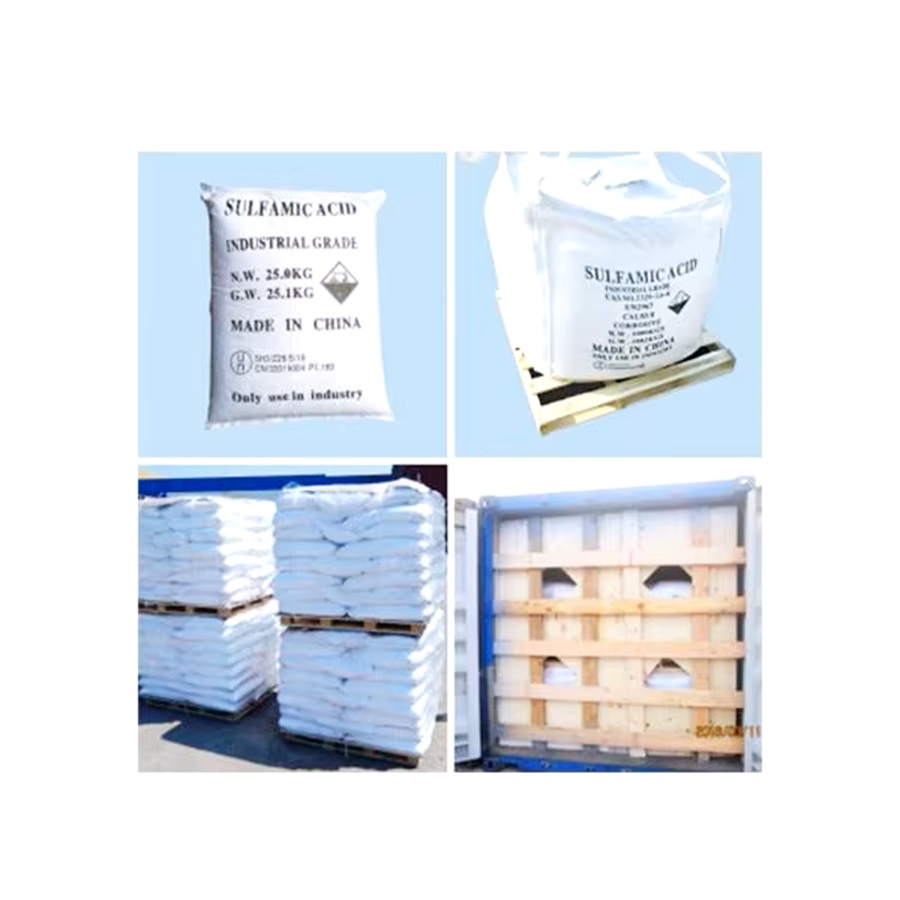
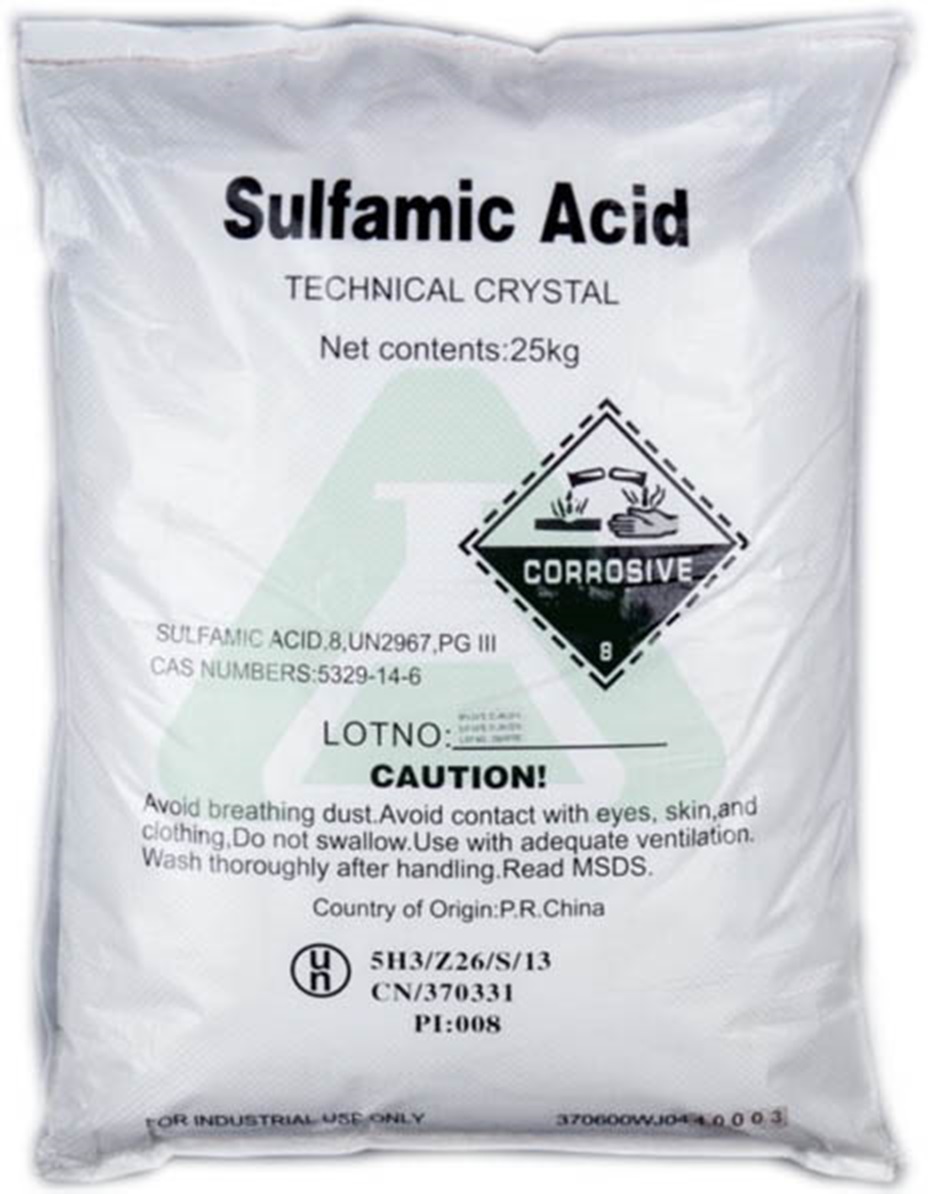
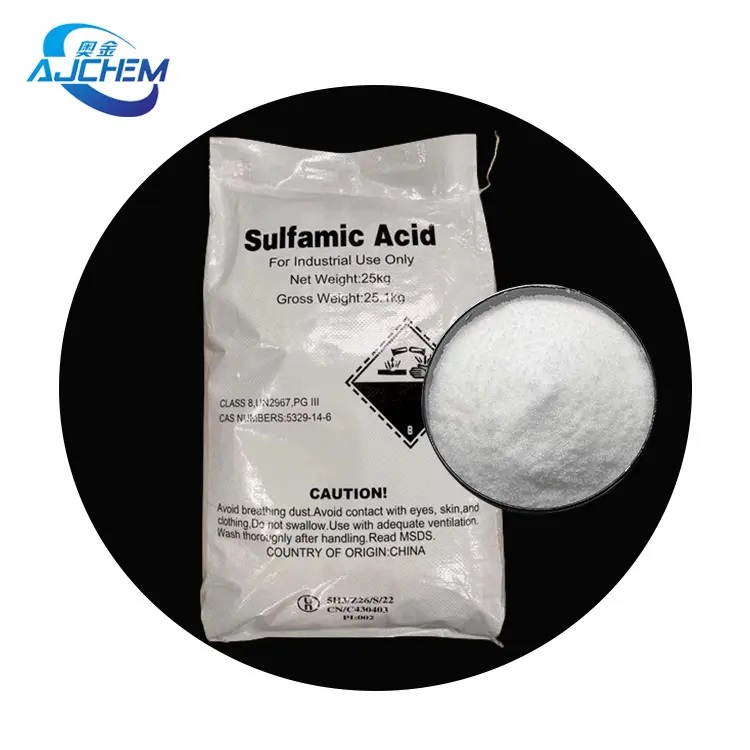
| Packaging Options | 25 kg bags (multi-layer paper/PE), 50 kg drums, FIBC (big bags) |
| Hazard Class (UN) | 8 (Corrosive substance) |
| UN Number | 2967 |
| Packing Group | III |
10. SAFETY & HEALTH INFORMATION
GHS Classification
| Hazard Class | Category |
|---|---|
| Skin Corrosion/Irritation | Category 2 (Causes skin irritation) |
| Eye Irritation | Category 2 (Causes serious eye irritation) |
| Specific Target Organ Toxicity | Category 3 (Respiratory irritation) |
Hazard Statements (H-Codes)
| Code | Statement |
|---|---|
| H315 | Causes skin irritation |
| H319 | Causes serious eye irritation |
| H335 | May cause respiratory irritation |
Precautionary Statements (P-Codes)
| Code | Statement |
|---|---|
| P261 | Avoid breathing dust |
| P264 | Wash thoroughly after handling |
| P280 | Wear protective gloves, protective clothing, eye protection |
| P302+P352 | IF ON SKIN: Wash with plenty of water |
| P305+P351+P338 | IF IN EYES: Rinse cautiously with water for several minutes |
First Aid Measures
| Exposure Route | Action |
|---|---|
| Inhalation | Remove to fresh air. Seek medical attention if respiratory irritation occurs. |
| Skin Contact | Wash with plenty of water and soap. Remove contaminated clothing. |
| Eye Contact | Rinse immediately with plenty of water for at least 15 minutes. Seek medical attention. |
| Ingestion | Rinse mouth. Do NOT induce vomiting. Drink plenty of water. Seek medical attention. |
Toxicological Information
| Parameter | Value |
|---|---|
| Oral LD50 (rat) | 3,160 mg/kg |
| Oral LD50 (mouse) | 1,312 mg/kg |
| MLD (rat) | 1.6 g/kg |
| Skin Irritation (rabbit) | 500 mg/24 hours – severe |
| Eye Irritation (rabbit) | 0.25 mg/24 hours – severe |
| Carcinogenicity | Not classified as carcinogenic |
NFPA 704
| Health (Blue) | Fire (Red) | Reactivity (Yellow) | Special (White) |
|---|---|---|---|
| 2 | 1 | 1 | None |
11. ENVIRONMENTAL INFORMATION
| Parameter | Information |
|---|---|
| Biodegradability | Readily biodegradable |
| Aquatic Toxicity | R52/53 – Harmful to aquatic organisms; may cause long-term effects |
| Bioaccumulation | Not expected |
| Waste Disposal | Dispose according to local regulations. Neutralize with base before disposal. |
12. REGULATORY INFORMATION
| Region | Status |
|---|---|
| EU | REACH registered (CAS 5329-14-6); classified as Xi – Irritant |
| USA (EPA) | TSCA listed |
| Turkey | Compliant with local chemical regulations |
| UN Classification | UN 2967, Class 8 (Corrosive solid), Packing Group III |
Risk Codes:
-
R36/38: Irritating to eyes and skin
-
R52/53: Harmful to aquatic organisms; may cause long-term adverse effects
Safety Codes:
-
S26: In case of contact with eyes, rinse immediately with plenty of water and seek medical advice
-
S28: After contact with skin, wash immediately with plenty of soap-suds
-
S61: Avoid release to the environment
13. TRANSPORT INFORMATION
| Parameter | Information |
|---|---|
| UN Number | 2967 |
| Hazard Class | 8 (Corrosive substance) |
| Packing Group | III |
| Proper Shipping Name | SULFAMIC ACID |
| Marine Pollutant | No |
| ADR/RID Label | 8 |
| HS Code | 28111980 |
14. OTHER NAMES & SYNONYMS
| Name | Description |
|---|---|
| Sulfamic Acid | Most common name |
| Amidosulfonic Acid | IUPAC preferred name |
| Aminosulfonic Acid | Alternative name |
| Sulfamidic Acid | Alternative name |
| Imidosulfonic Acid | Alternative name |
| Jumbo | Trade name |
| Solid Sulfuric Acid | Common trade name (due to strong acidity) |
Database Identifiers:
-
CAS: 5329-14-6
-
EC: 226-218-8
-
MDL: MFCD00011603
-
RTECS: WO5950000
-
PubChem CID: 5987
-
Merck Index: 14,8921
15. SUMMARY
Sulfamic Acid (H₃NO₃S, CAS 5329-14-6) is a strong, solid inorganic acid with excellent cleaning properties. It is non-hygroscopic, non-volatile, and has lower corrosivity to metals compared to hydrochloric and sulfuric acids.
Key Features:
| Feature | Description |
|---|---|
| Physical Form | White crystalline solid (easy to handle and transport) |
| Acid Strength | Strong acid (similar to HCl and H₂SO₄) |
| Hygroscopicity | Non-hygroscopic |
| Volatility | Non-volatile |
| Metal Corrosion | Much lower than HCl/H₂SO₄ |
| Toxicity | Low (but avoid prolonged contact) |
| Solubility | Readily soluble in water |
Main Application Areas:
| Sector | Applications |
|---|---|
| Cleaning & Descaling | Boilers, heat exchangers, condensers, brewery equipment, dairy equipment |
| Metal Treatment | Galvanized metal cleaning, pickling, electroplating |
| Textile & Paper | Bleaching aid, softener, flame retardant |
| Chemical Industry | Sulfonating agent, chlorine stabilizer, catalyst |
| Agriculture | Herbicide, fungicide (calcium sulfamate) |
| Analytical Chemistry | Acid-base titration standard reagent |
16. IMPORTANT NOTES
-
Solid Strong Acid: Sulfamic acid is one of the few strong acids available in solid crystalline form. This makes it much safer and easier to handle, store, and transport than liquid mineral acids.
-
Lower Metal Corrosivity: Unlike hydrochloric acid, sulfamic acid has significantly lower corrosivity to metals. It is the only acid safe for cleaning galvanized metal surfaces (use ≤10% concentration, ≤66°C).
-
Non-Hygroscopic: Unlike many other acids, sulfamic acid does not absorb moisture from air. This makes it stable during storage and easy to handle.
-
"Solid Sulfuric Acid": Due to its strong acidity, sulfamic acid is sometimes called "solid sulfuric acid." However, it has a much better safety profile.
-
Cleaning Temperature: When used for cleaning, temperature should generally be controlled below 66°C to prevent decomposition. Maximum recommended concentration is 10%.
-
Thermal Decomposition: When heated above 205-260°C, sulfamic acid decomposes into toxic gases including sulfur oxides and nitrogen oxides. Avoid excessive heating.
-
Incompatibility: Do not mix with oxidizers (chlorates, hypochlorites) or strong alkalis – violent reactions may occur.
-
Regulatory Status: Classified as Xi (Irritant) – R36/38 (irritating to eyes and skin). Use appropriate PPE during handling.
Important Disclaimer: This Technical Data Sheet (TDS) is for informational purposes only. For complete safety, handling, storage, and regulatory compliance information, always refer to the official Safety Data Sheet (SDS) provided by the manufacturer/supplier.