We unleash your business potential by maximize the business innovation.
Send EmailOleic acid, Red Oil, Oleoate, Metaupon, Omni Pur Oleic Acid, Polishing Compound Red, 112-80-1
OLEIC ACID: TECHNICAL DATA SHEET & COMPREHENSIVE REVIEW
| Property | Detail |
|---|---|
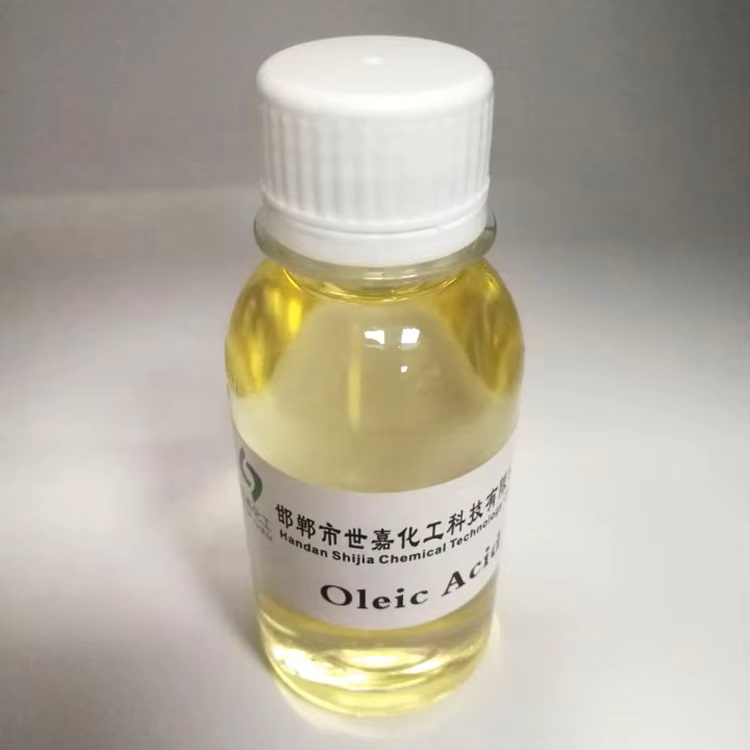
| Appearance | Odorless, colorless or pale yellow liquid |
| Chemical Name | (9Z)-Octadecenoic acid, (9Z)-octadec-9-enoic acid |
| Chemical Formula | C₁₈H₃₄O₂ / C₁₇H₃₃COOH |
| CAS Number | 112-80-1 |
| Molecular Weight | 282.46 g/mol |
| Packaging | 180 kg drum |
| Melting Point | α-form: 13.4 °C / β-form: 16.3 °C |
| Solubility | Insoluble in water; slightly soluble in alcohol, highly soluble in ether and most organic solvents. |
1. INTRODUCTION AND OVERVIEW
Oleic acid is the most common member of the monounsaturated fatty acid (MUFA) family and the primary representative of omega-9 fatty acids. As one of the most abundant fatty acids in nature, oleic acid is found in the structure of triglycerides from both vegetable and animal sources in the form of glycerol esters. It is an indispensable raw material for the soap, cosmetics, and chemical industries. Simultaneously, as the main component of olive oil—the cornerstone of the Mediterranean diet—it holds strategic importance in the fields of nutrition and medicine.
2. CHEMICAL STRUCTURE AND PHYSICAL PROPERTIES
2.1. Molecular Structure
Oleic acid (C₁₇H₃₃COOH) is an 18-carbon carboxylic acid. It contains one double bond (cis configuration) between the ninth (C9) and tenth (C10) carbon atoms. This double bond significantly lowers its melting point compared to its saturated counterpart, stearic acid, causing it to remain liquid at room temperature.
-
Omega-9 Definition: It is classified as an omega-9 fatty acid because the double bond is located at the 9th carbon from the methyl (omega) end of the molecule.
-
Isomerism: The natural form is the cis configuration. Its trans isomer is called elaidic acid, which can form during industrial hydrogenation processes.
2.2. Crystal Forms (Polymorphism)
Oleic acid exhibits two different crystalline structures depending on temperature:
-
α-form (Alpha): Melts at 13.4 °C.
-
β-form (Beta): Melts at 16.3 °C.
2.3. Reactivity
Due to the presence of both a carboxyl group (-COOH) and a double bond (C=C) , the molecule is highly reactive:
-
Addition Reactions: It can bind elements like bromine, iodine, and hydrogen, transforming into a saturated form (formation of stearic acid).
-
Oxidation: Upon contact with air, it gradually develops a pungent, rancid odor.
-
Conversion to Elaidic Acid: When treated with nitrous acid (HNO₂) or sulfur compounds, the cis form isomerizes to the trans form (elaidic acid).
3. SOURCES AND OCCURRENCE
In nature, oleic acid is not typically found free but is esterified with glycerol in the structure of triglycerides.
3.1. Vegetable Sources
| Source | Oleic Acid Content (%) |
|---|---|
| Olive Oil | 55% – 83% |
| Hazelnut Oil | 70% – 80% |
| Canola Oil | 55% – 65% |
| High-Oleic Sunflower Oil | 75% – 85% |
| Avocado Oil | 60% – 70% |
| Almond Oil | 65% – 75% |
3.2. Animal Sources
-
Beef Tallow: ~30%
-
Lard: ~40%
-
Fish Oil (Salmon, Mackerel): While primarily an omega-3 source, it also contains oleic acid.
3.3. Human Body
Oleic acid is the most abundant fatty acid in human adipose tissue, followed by palmitic acid. The body can biosynthesize it through the dehydrogenation of stearic acid.
4. INDUSTRIAL PRODUCTION AND PURIFICATION
-
Extraction: Vegetable/animal oils (triglycerides) are hydrolyzed with water to separate into fatty acids and glycerin. Zinc oxide or aromatic sulfonic acids are used as catalysts.
-
Separation: The mixture obtained from hydrolysis is cooled. Saturated fatty acids (stearic, palmitic) are separated as a solid phase by pressing. The remaining liquid phase is rich in oleic acid.
-
Purification: High-purity oleic acid (70-99%) is obtained through fractional distillation under reduced pressure.
5. AREAS OF APPLICATION
5.1. Chemical and Industrial Applications
-
Soap Industry: Sodium and potassium salts (oleates) are essential raw materials for bar and liquid soap production.
-
Cosmetics: Used as an emulsifier and softening agent in moisturizing creams, lotions, lipsticks, and hair care products.
-
Textile and Leather: Functions as a softening agent, finishing agent, and lubricant.
-
Paint and Varnish: Used in alkyd resin production to improve the flow and leveling of paints.
-
Ink: Serves as a lubricating agent alongside amine derivatives.
-
Metalworking: Used in cutting fluids and lubricants.
5.2. Food Industry
-
Cooking Oils: Preferred for frying due to its high oxidative stability.
-
Emulsifier: Used in the form of glycerol mono-oleate (E471) as a food additive.
5.3. Pharmaceutical and Medical Applications
-
Drug Delivery Systems: Acts as a penetration enhancer in creams and ointments.
-
Experimental Research: Intravenous oleic acid injection is used to induce Acute Lung Injury (ALI) models in laboratory animals. This model is particularly valuable for developing treatments for Respiratory Distress Syndrome (RDS) in premature infants.
6. HEALTH EFFECTS (BASED ON CURRENT SCIENTIFIC DATA)
Oleic acid stands out for its positive health profile compared to saturated fatty acids.
6.1. Cardiovascular Health
-
LDL Cholesterol: Lowers plasma LDL (bad) cholesterol levels.
-
HDL Cholesterol: Maintains or increases HDL (good) cholesterol levels.
-
Blood Pressure: Exhibits antihypertensive effects.
-
Endothelial Function: Shows less toxic effects on vascular endothelial cells compared to stearic acid.
6.2. Metabolic and Hormonal Effects
-
Insulin Sensitivity: Helps regulate blood sugar by reducing insulin resistance in Type 2 diabetes patients.
-
Inflammation: Reduces chronic inflammation by suppressing the release of pro-inflammatory cytokines.
6.3. Cancer Research
As a key component of the Mediterranean diet, oleic acid may offer protective effects against certain cancers:
-
Breast Cancer: Epidemiological data suggests it may suppress the expression of the HER2 receptor.
-
Colorectal Cancer: Proliferation-slowing effects have been observed.
6.4. Skin Health
-
Barrier Function: Penetrates the stratum corneum, increasing the skin's moisture retention capacity.
-
Regeneration: Supports skin renewal by regulating cell membrane fluidity.
7. CURRENT ACADEMIC RESEARCH (2020-2025)
Significant recent studies on oleic acid:
| Researcher(s) | Year | Topic | Findings |
|---|---|---|---|
| Perez-Jimenez F. et al. | 2022 | Cardiovascular risk markers | Demonstrated that a diet rich in oleic acid reduces inflammatory markers (CRP) by up to 20%. |
| López-Miranda J. et al. | 2023 | Autoimmune diseases | Suggested oleic acid may suppress autoimmune responses by modulating T-lymphocyte activation. |
| Solfrizzi V. et al. | 2024 | Neurodegeneration | Reported that a Mediterranean diet high in oleic acid slows cognitive decline. |
| Gaforio J.J. et al. | 2025 | Breast cancer | Found that oleic acid from olive oil triggers apoptosis (programmed cell death) in cancer cells. |
8. OTHER NOMENCLATURE AND CLASSIFICATION
8.1. Common Trade and Chemical Names
-
9-Octadecenoic acid, (9Z)- / (Z)- / cis-
-
cis-Δ9-Octadecenoic acid
-
Elaidic acid (trans isomer)
-
Wecoline OO, Pamolyn 100, Emersol 211, Industrene 105
-
Lunac O-P, O-CA, O-LL
-
Priolene 6906, 6907, 6928, 6930, 6933, 6936
-
Edenor C 18:1-98-100, Edenor FTiO5
-
Crodacid O-P
-
NAA 35, NAA 38
-
Extra Olein 80, 90, 99
-
MeSH ID: D019301
8.2. CAS Number
-
112-80-1 (Primary entry)
9. SUMMARY AND CONCLUSION
Oleic acid is a highly versatile molecule of immense biological and industrial significance. Its abundance in natural sources, particularly olive oil, combined with its non-toxic nature and ease of processing, has established it as a fundamental raw material in the chemical sector. Its importance continues to grow with the increasing demand for vegetable oils and the rise of sustainable chemistry applications. In the field of nutrition, it offers a healthy alternative to saturated fats and plays a key role in the prevention of chronic diseases such as cardiovascular conditions, diabetes, and cancer.