We unleash your business potential by maximize the business innovation.
Send EmailSodium Chlorate, Natrium Chlorate, 7775-09-9
SODIUM CHLORATE (NaClO₃)
Chloric Acid Sodium Salt / Sodium Chlorate(V)
CAS Number: 7775-09-9
EC Number: 231-887-4
1. IDENTIFICATION
| Property | Information |
|---|---|
| Chemical Name | Sodium Chlorate |
| Synonyms | Sodium chlorate(V), Chloric acid sodium salt, Atlacide, Travex, Desolet, Granex O, Shed-A-Leaf |
| Chemical Formula | NaClO₃ |
| Molecular Weight | 106.44 g/mol |
| CAS Number | 7775-09-9 |
| EC Number (EINECS) | 231-887-4 |
| Appearance | White crystalline powder or colorless crystals |
| Odor | Odorless |
2. PHYSICAL PROPERTIES
| Property | Value |
|---|---|
| Physical State (20°C) | Solid (crystalline powder) |
| Appearance | White, odorless crystalline powder |
| Molecular Weight | 106.44 g/mol |
| Melting Point | 248 – 250 °C (480-482 °F) |
| Boiling Point | Decomposes above 300°C (no distinct boiling point) |
| Density (20°C) | ~2.5 g/cm³ |
| Solubility in Water (25°C) | Very high – approx. 100 g/100 mL (1,000 g/L) |
| Solubility in Organic Solvents | Slightly soluble in ethanol, methanol |
| Hygroscopicity | Hygroscopic (absorbs moisture from air) |
| pH (aqueous solution) | Neutral to slightly alkaline (6-8) |
3. CHEMICAL PROPERTIES
| Property | Information |
|---|---|
| Chemical Formula | NaClO₃ |
| Molecular Weight | 106.44 g/mol |
| Chemical Class | Chlorate salt; strong oxidizing agent |
| Oxidizing Properties | Very strong oxidizer (one of the strongest known) |
| Stability | Stable under normal conditions; decomposes on heating |
| Thermal Decomposition | Decomposes above 250-300°C: 4 NaClO₃ → 3 NaClO₄ + NaCl (then NaClO₄ decomposes to NaCl + 2 O₂) |
| Reaction with Acids | Reacts with strong acids to produce chlorine dioxide (ClO₂) and chlorine |
| Reaction with Combustibles | Violent reactions with organic materials, sulfur, phosphorus, metals |
| Incompatible Materials | Organic materials, reducing agents, powdered metals, sulfur, phosphorus, strong acids, ammonium salts |
Decomposition Reactions:
4 NaClO₃ + Heat → 3 NaClO₄ + NaCl
NaClO₄ + Heat → NaCl + 2 O₂↑
Chlorine Dioxide Production (Industrial):
2 NaClO₃ + 4 HCl → 2 ClO₂↑ + Cl₂↑ + 2 NaCl + 2 H₂O
4. PRODUCTION PROCESS
4.1. Electrolysis Method (Primary Industrial Method)
| Stage | Description |
|---|---|
| 1. Brine Preparation | Sodium chloride (NaCl) is dissolved in water to form brine |
| 2. Electrolysis | Brine is electrolyzed in an electrochemical cell |
| 3. Anode Reaction | Cl⁻ + 6 OH⁻ → ClO₃⁻ + 3 H₂O + 6 e⁻ |
| 4. Cathode Reaction | 2 H₂O + 2 e⁻ → H₂↑ + 2 OH⁻ |
| 5. Overall Reaction | NaCl + 3 H₂O → NaClO₃ + 3 H₂↑ |
| 6. Crystallization | Sodium chlorate crystallizes from the solution |
| 7. Centrifugation & Drying | Crystals are separated and dried |
| 8. Packaging | Final product is packaged |
4.2. Chemical Method (Alternative)
| Stage | Description |
|---|---|
| 1. Chlorine Absorption | Chlorine gas is absorbed in hot sodium hydroxide solution |
| 2. Reaction | 3 Cl₂ + 6 NaOH → NaClO₃ + 5 NaCl + 3 H₂O (at 60-80°C) |
| 3. Crystallization | Sodium chlorate crystallizes (sodium chloride is separated by fractional crystallization) |
| 4. Drying & Packaging | Product is dried and packaged |
5. APPLICATIONS
5.1. Pulp & Paper Industry (Largest Use – ~80%)
| Application | Function |
|---|---|
| Chlorine Dioxide (ClO₂) Production | Primary raw material for ClO₂ generation for pulp bleaching |
| Pulp Bleaching | ECF (Elemental Chlorine Free) bleaching sequences |
| Paper Brightening | Increases paper whiteness and brightness |
5.2. Agriculture (Herbicide / Defoliant)
| Application | Function |
|---|---|
| Non-selective Herbicide | Kills all green vegetation (contact herbicide) |
| Defoliant (Desiccant) | Dries and defoliates crops before harvest |
| Crops | Cotton, corn, pepper, safflower, flax, soybean, dry beans, rice, sunflower |
Formulations: Used alone or combined with atrazine, 2,4-D, diuron, glyphosate
5.3. Mining & Metallurgy
| Application | Function |
|---|---|
| Uranium Ore Processing | Oxidizing agent in uranium leaching |
| Vanadium Extraction | Oxidizing agent for vanadium recovery from ores |
| Gold & Silver Extraction | Oxidizing agent in some processes |
5.4. Chemical Industry
| Application | Function |
|---|---|
| Ammonium Perchlorate Production | Key intermediate for rocket propellant oxidizer |
| Potassium Chlorate Production | For fireworks, matches, explosives |
| Calcium Chlorate Production | For herbicides |
| Barium Chlorate Production | For pyrotechnics (green color) |
| Sodium Perchlorate Production | Electrolytic oxidation of sodium chlorate |
5.5. Water Treatment
| Application | Function |
|---|---|
| Chlorine Dioxide Generation | For on-site ClO₂ production for water disinfection |
| Drinking Water Disinfection | As ClO₂ precursor |
| Wastewater Treatment | Odor control, disinfection |
| Cooling Water Treatment | Biofilm control |
5.6. Other Applications
| Application | Function |
|---|---|
| Leather Tanning | Oxidizing agent in tanning processes |
| Textile Bleaching | Bleaching of natural fibers |
| Dye Production | Oxidizing agent in dye synthesis |
| Steel Production | Oxidizing agent in some processes |
| Gasoline Production | Refining processes |
| Rocket Propellant | As ammonium perchlorate precursor |
| Fireworks & Matches | As potassium chlorate precursor |
6. TYPICAL QUALITY SPECIFICATIONS
| Parameter | Technical Grade |
|---|---|
| Purity (NaClO₃) | ≥ 99.5% |
| Sodium Chloride (NaCl) | ≤ 0.2% |
| Sodium Chlorite (NaClO₂) | ≤ 0.1% |
| Sodium Perchlorate (NaClO₄) | ≤ 0.05% |
| Sodium Sulfate (Na₂SO₄) | ≤ 0.05% |
| Iron (Fe) | ≤ 0.002% |
| Calcium (Ca) | ≤ 0.002% |
| Magnesium (Mg) | ≤ 0.002% |
| Moisture | ≤ 0.1% |
| Water Insolubles | ≤ 0.01% |
| pH (5% solution) | 6 – 8 |
| Appearance | White crystalline powder |
7. STORAGE & HANDLING
| Parameter | Information |
|---|---|
| Storage Conditions | Cool, dry, well-ventilated area; protect from moisture |
| Container Requirements | Tightly closed, moisture-proof containers (HDPE, lined drums, plastic bags) |
| Protect From | Moisture, heat, combustible materials, reducing agents, organic materials |
| Shelf Life | 12-24 months (when stored properly) |
| Hygroscopicity | Hygroscopic – absorbs moisture from air; keep sealed |
| Incompatible Materials | Organic materials, reducing agents, powdered metals, sulfur, phosphorus, strong acids, ammonium salts |
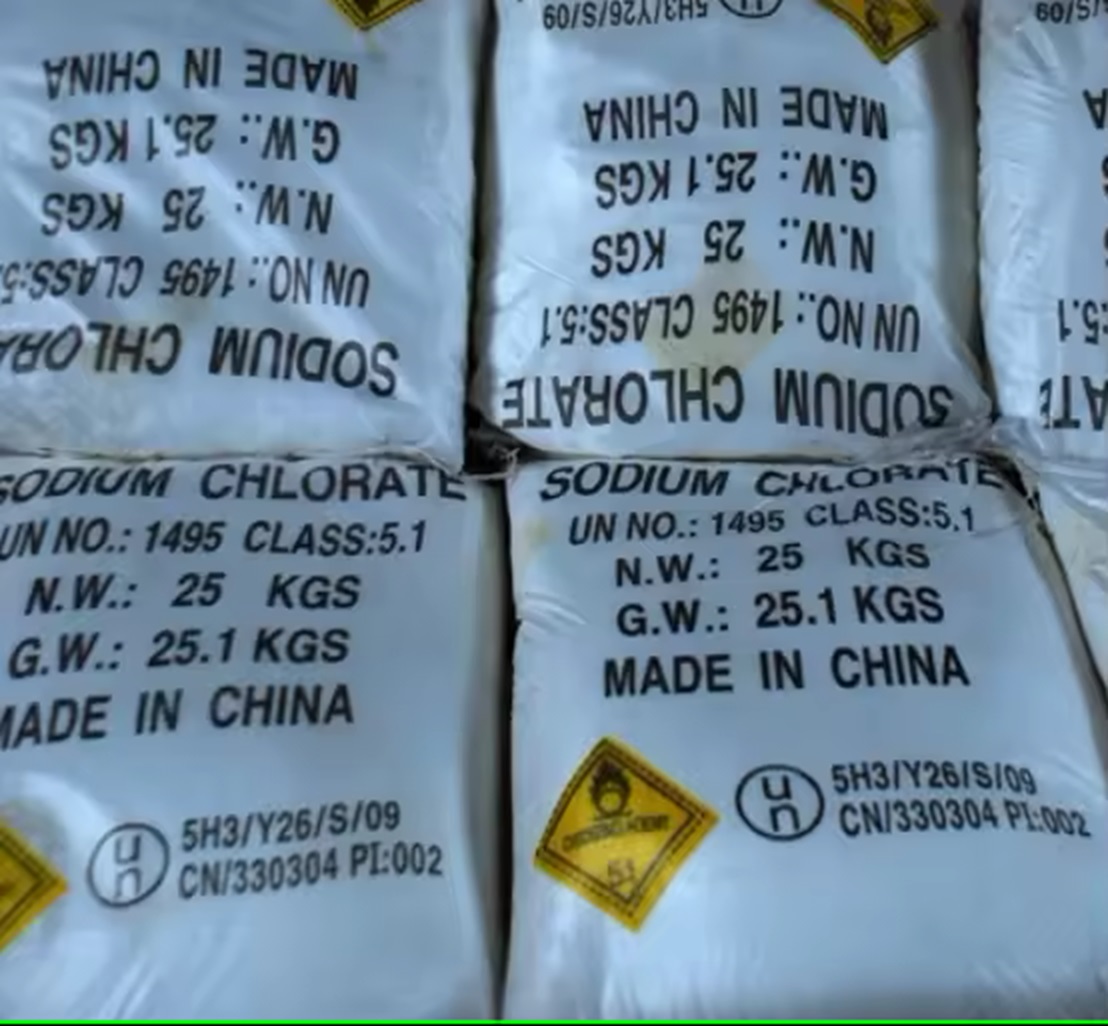
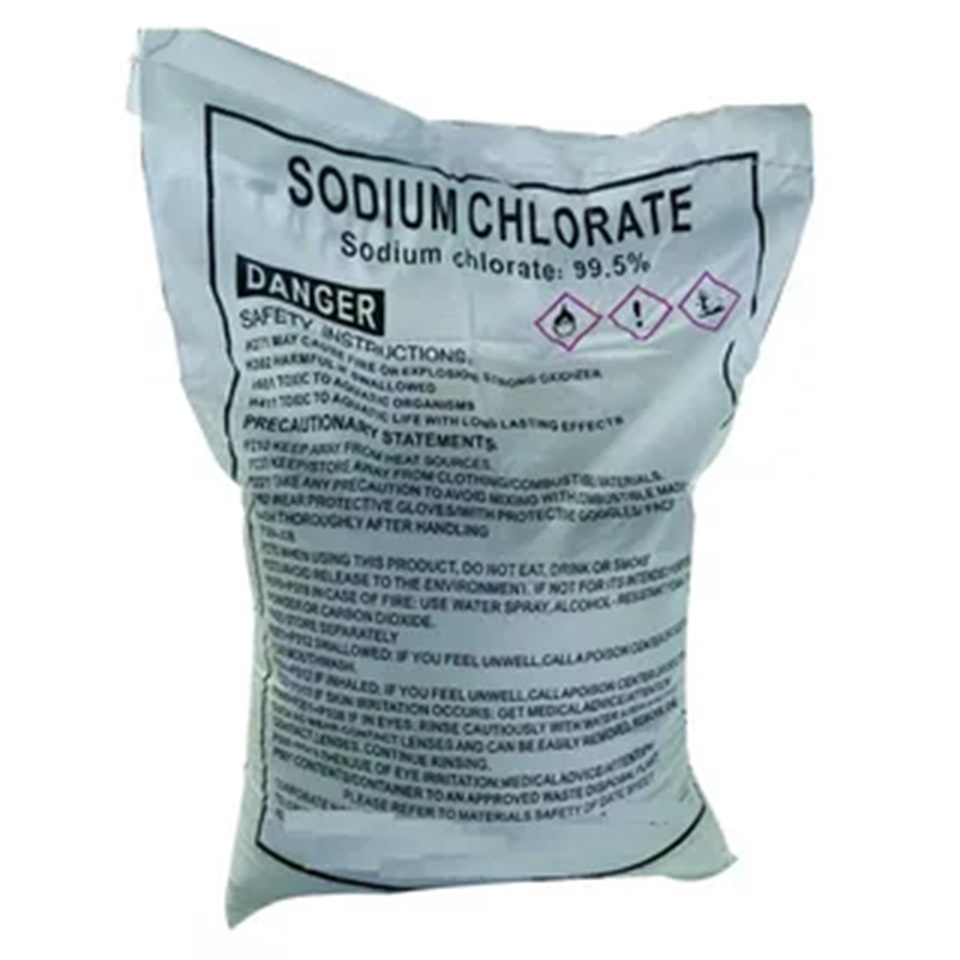
| Packaging Options | 25 kg bags (multi-layer paper/plastic), 50 kg drums, 500 kg/1000 kg FIBC (big bags) |
Critical Safety Notes:
-
DO NOT store near flammable or combustible materials
-
DO NOT allow contact with acids (releases toxic ClO₂/Cl₂ gases)
-
DO NOT allow contamination with organic materials (potential explosion)
-
Use non-sparking tools and explosion-proof equipment
8. SAFETY & HEALTH INFORMATION
GHS Classification
| Hazard Class | Category |
|---|---|
| Oxidizing Solids | Category 1 (H271) |
| Acute Toxicity (Oral) | Category 4 (H302) |
| Acute Toxicity (Inhalation) | Category 4 (H332) |
| Skin Corrosion/Irritation | Category 2 (H315) |
| Serious Eye Damage | Category 2 (H319) |
| Specific Target Organ Toxicity (Single exposure) | Category 3 (H335) |
| Acute Aquatic Toxicity | Category 1 (H400) |
| Chronic Aquatic Toxicity | Category 1 (H410) |
Hazard Statements (H-Codes)
| Code | Statement |
|---|---|
| H271 | May cause fire or explosion; strong oxidizer |
| H302 | Harmful if swallowed |
| H315 | Causes skin irritation |
| H319 | Causes serious eye irritation |
| H332 | Harmful if inhaled |
| H335 | May cause respiratory irritation |
| H400 | Very toxic to aquatic life |
| H410 | Very toxic to aquatic life with long-lasting effects |
Precautionary Statements (P-Codes)
| Code | Statement |
|---|---|
| P210 | Keep away from heat, hot surfaces, sparks, open flames |
| P220 | Keep away from combustible materials |
| P221 | Take any precaution to avoid mixing with combustibles |
| P260 | Do not breathe dust |
| P280 | Wear protective gloves, protective clothing, eye protection, face protection |
| P301+P312 | IF SWALLOWED: Call a POISON CENTER if you feel unwell |
| P302+P352 | IF ON SKIN: Wash with plenty of water |
| P305+P351+P338 | IF IN EYES: Rinse cautiously with water for several minutes |
Toxicological Information
| Parameter | Value |
|---|---|
| Oral LD50 (rat) | 1,200 – 2,500 mg/kg |
| Inhalation LC50 (rat) | > 5 mg/L |
| Dermal LD50 (rabbit) | > 2,000 mg/kg |
| Skin Irritation | Moderate irritant |
| Eye Irritation | Moderate to severe irritant |
Health Effects:
-
Acute (Ingestion): Nausea, vomiting, abdominal pain, hemolysis (red blood cell destruction), methemoglobinemia, kidney failure
-
Acute (Inhalation): Respiratory tract irritation, coughing, shortness of breath
-
Chronic: Liver damage, kidney damage, blood disorders
NFPA 704
| Health (Blue) | Fire (Red) | Reactivity (Yellow) | Special (White) |
|---|---|---|---|
| 3 | 0 | 1 | OX (Oxidizer) |
Personal Protective Equipment (PPE)
| Equipment | Recommendation |
|---|---|
| Respiratory Protection | Dust mask (N95) when handling powder |
| Hand Protection | Chemical-resistant gloves (nitrile, neoprene, butyl rubber) |
| Eye Protection | Chemical safety goggles + face shield |
| Body Protection | Chemical-resistant apron, protective clothing |
First Aid Measures
| Exposure Route | Action |
|---|---|
| Inhalation | Remove to fresh air. Seek medical attention if respiratory irritation occurs. |
| Skin Contact | Wash with plenty of water for at least 15 minutes. Remove contaminated clothing. |
| Eye Contact | Rinse immediately with plenty of water for at least 15 minutes. Seek medical attention. |
| Ingestion | Do NOT induce vomiting. Rinse mouth. Drink water. Seek immediate medical attention. |
9. FIRE FIGHTING MEASURES
| Parameter | Information |
|---|---|
| Fire Hazard | Strong oxidizer – may cause fire or explosion when in contact with combustibles |
| Extinguishing Media | Water spray (large quantities), dry sand, CO₂ (for small fires) |
| Special Hazards | Decomposes when heated, releasing toxic gases (Cl₂, ClO₂, O₂) |
| Protective Equipment | Self-contained breathing apparatus (SCBA), full protective clothing |
10. ENVIRONMENTAL INFORMATION
| Parameter | Information |
|---|---|
| Aquatic Toxicity | Very toxic to fish, algae, and aquatic invertebrates |
| Persistence | Persistent in water; can accumulate in soil |
| Bioaccumulation | Low potential |
| Regulatory Status | Banned in some countries (banned in all EU countries in 2009 for certain uses) |
| Waste Disposal | Dispose according to local regulations. Do not discharge into natural water bodies. |
11. TRANSPORT INFORMATION
| Parameter | Information |
|---|---|
| UN Number | 1495 |
| Hazard Class | 5.1 (Oxidizing substance) |
| Packing Group | II |
| Proper Shipping Name | SODIUM CHLORATE |
| Marine Pollutant | Yes |
| ADR/RID Label | 5.1 |
| EMS | F-A, S-Q |
12. REGULATORY INFORMATION
| Region | Status |
|---|---|
| EU | REACH registered; banned in all EU countries in 2009 (for herbicide use) |
| Turkey (KKDIK) | Mandatory compliance; requires registration |
| USA (EPA) | Registered as pesticide/herbicide (restricted use) |
| Canada | Registered as herbicide; restricted |
13. SYNONYMS & OTHER NAMES
| Turkish Name | English Name |
|---|---|
| Sodyum Klorat | Sodium Chlorate |
| Natrium Klorat | Sodium Chlorate (German origin) |
| Klorik Asit Sodyum Tuzu | Chloric Acid Sodium Salt |
| Sodyum Klorat(V) | Sodium Chlorate(V) |
Trade Names:
-
Atlacide
-
Travex
-
Desolet
-
Shed-A-Leaf
-
Granex O
-
Agrosan
-
Sodakem
-
Chlorate SL
-
Defol 750
-
Defol 5
14. ALTERNATIVES & COMPARISON
| Chemical | Formula | Oxidizing Strength | Applications | Notes |
|---|---|---|---|---|
| Sodium Chlorate | NaClO₃ | Very strong | Pulp bleaching, herbicide, chemical intermediate | Most common for ClO₂ |
| Sodium Perchlorate | NaClO₄ | Very strong (more stable) | Rocket propellant precursor | Stronger but more stable |
| Ammonium Perchlorate | NH₄ClO₄ | Very strong | Rocket propellant | More energetic |
| Potassium Chlorate | KClO₃ | Very strong | Fireworks, matches, explosives | Less soluble than Na salt |
| Sodium Hypochlorite | NaClO | Moderate | Disinfectant, bleach | Less stable, weaker oxidizer |
15. SUMMARY
Sodium Chlorate (NaClO₃, CAS 7775-09-9) is a white crystalline powder and one of the strongest oxidizing agents known. It is highly soluble in water, hygroscopic, and a powerful oxidizer.
Key Features:
| Feature | Description |
|---|---|
| Appearance | White crystalline powder |
| Molecular Weight | 106.44 g/mol |
| Melting Point | 248-250°C |
| Water Solubility | Very high (~100 g/100 mL at 25°C) |
| Oxidizing Class | UN 1495, Class 5.1, PG II |
Main Application Areas:
| Sector | Applications |
|---|---|
| Pulp & Paper | Chlorine dioxide production for pulp bleaching |
| Agriculture | Non-selective herbicide, defoliant (desiccant) |
| Mining | Uranium and vanadium extraction |
| Chemical Industry | Ammonium perchlorate (rocket fuel), potassium chlorate (fireworks) |
| Water Treatment | Chlorine dioxide generation |
| Textile & Leather | Bleaching, tanning |
Key Safety Points:
-
STRONG OXIDIZER – Keep away from combustible materials
-
EXPLOSION HAZARD – May form explosive mixtures with organics
-
TOXIC – Harmful if swallowed, inhaled, or in contact with skin
-
ENVIRONMENTAL HAZARD – Very toxic to aquatic life
-
HYGROSCOPIC – Absorbs moisture; keep sealed
16. IMPORTANT NOTES
-
Strongest Oxidizer: Sodium chlorate is one of the strongest commercial oxidizing agents. It can cause spontaneous ignition of combustible materials on contact.
-
Chlorine Dioxide Production: Approximately 80% of sodium chlorate is used to produce chlorine dioxide (ClO₂) for pulp bleaching. It is the preferred raw material for ECF (Elemental Chlorine Free) bleaching.
-
Herbicide Use – Banned in EU: Sodium chlorate was banned as a herbicide in all EU countries in 2009 due to environmental persistence and toxicity concerns. Check local regulations before use in agriculture.
-
Explosion Hazard with Organics: Mixtures of sodium chlorate with organic materials (sugar, sawdust, oils, sulfur) are highly explosive. Never allow contamination.
-
Reaction with Acids: Contact with strong acids releases toxic and explosive chlorine dioxide (ClO₂) gas and chlorine gas. Use only with proper ventilation and equipment.
-
Hygroscopic Nature: Sodium chlorate absorbs moisture from air, which can cause caking and reduce effectiveness. Store in tightly sealed, moisture-proof containers.
-
Fire Fighting: For fires involving sodium chlorate, use large quantities of water. Do not use dry chemical extinguishers as they may react. Avoid halogenated extinguishing agents.
-
Medical Emergency: Ingestion causes hemolysis (red blood cell destruction), methemoglobinemia, and kidney failure. Immediate medical treatment is essential. Methylene blue is an antidote for methemoglobinemia.
-
Regulatory Status: Due to its strong oxidizing properties and environmental toxicity, sodium chlorate is subject to strict regulations in many countries. Restricted use applies for herbicide applications.
-
Storage Segregation: Store sodium chlorate separately from all combustible materials, reducing agents, acids, and ammonium salts. Use dedicated storage areas with fire-resistant construction.
Important Disclaimer: This Technical Data Sheet (TDS) is for informational purposes only. For complete safety, handling, storage, and regulatory compliance information, always refer to the official Safety Data Sheet (SDS) provided by the manufacturer/supplier.