We unleash your business potential by maximize the business innovation.
Send EmailSodium Persulfate, Sodium Peroxydisulfate, Disodium Peroxydisulfate, 7775-27-1
SODIUM PERSULFATE (SODIUM PEROXYDISULFATE)
Sodium Persulfate / Na₂S₂O₈
CAS Number: 7775-27-1
EC Number: 231-892-1
1. IDENTIFICATION
| Property | Information |
|---|---|
| Chemical Name | Sodium Persulfate |
| Synonyms | Sodium peroxydisulfate, Disodium peroxydisulfate, Peroxydisulfuric acid disodium salt |
| Chemical Formula | Na₂S₂O₈ |
| Molecular Weight | 238.10 g/mol |
| CAS Number | 7775-27-1 |
| EC Number (EINECS) | 231-892-1 |
| PubChem CID | 24435 |
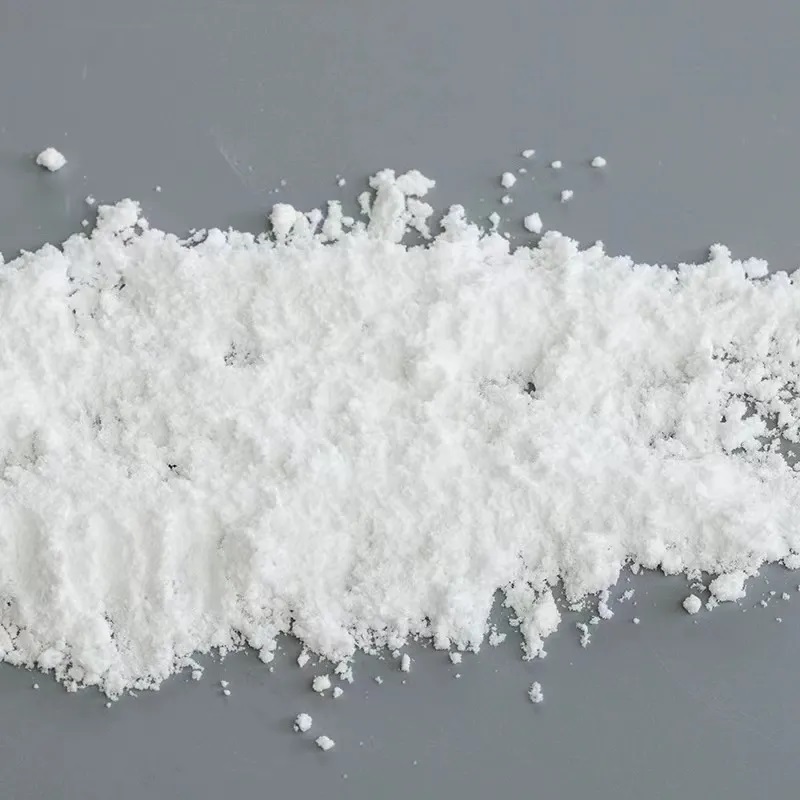
| Appearance | White crystalline powder |
| Odor | Odorless |
| Taste | Tasteless |
2. PHYSICAL PROPERTIES
| Property | Value |
|---|---|
| Physical State (20°C) | Solid (crystalline powder) |
| Appearance | White, crystalline powder |
| Odor | Odorless |
| Molecular Weight | 238.10 g/mol |
| Density (20°C) | 2.4 – 2.6 g/cm³ |
| Melting Point | 100 – 180 °C (decomposes before melting) |
| Solubility in Water (20°C) | 55.6 g/100 mL (high solubility) |
| pH (1% solution) | 3.0 – 5.0 (acidic) |
| Bulk Density | 0.8 – 1.2 g/cm³ |
| Hygroscopicity | Slightly hygroscopic |
| Stability | Stable at room temperature when dry |
3. CHEMICAL PROPERTIES
| Property | Information |
|---|---|
| Chemical Formula | Na₂S₂O₈ |
| Molecular Weight | 238.10 g/mol |
| Active Oxygen Content | ~6.7% |
| Oxidizing Properties | Very strong oxidizing agent |
| Decomposition | Decomposes upon heating, releasing oxygen |
| Thermal Stability | Stable up to ~60°C; decomposes above 60°C |
| Solubility | Freely soluble in water; forms acidic solution |
| Incompatible Materials | Reducing agents, organic materials, combustibles, alkalis, metals (in solution) |
Decomposition Reaction:
Na₂S₂O₈ + Heat → 2 NaSO₄ + O₂↑
Dissociation in Water:
Na₂S₂O₈ → 2 Na⁺ + S₂O₈²⁻
S₂O₈²⁻ + H₂O → 2 HSO₄⁻ + ½ O₂
4. PRODUCTION PROCESS
| Stage | Description |
|---|---|
| 1. Electrolytic Oxidation | Sodium sulfate (Na₂SO₄) is electrolyzed in a specialized cell |
| 2. Persulfate Formation | Sulfate ions are oxidized to persulfate ions (S₂O₈²⁻) at the anode |
| 3. Crystallization | Sodium persulfate crystallizes from the solution |
| 4. Centrifugation | Crystals are separated from mother liquor |
| 5. Drying | Crystals are dried at controlled temperature |
| 6. Milling & Screening | Product is milled and screened to desired particle size |
| 7. Packaging | Final product is packaged |
Reaction Equation (Electrolysis):
Anode:   2 SO₄²⁻ → S₂O₈²⁻ + 2 e⁻
Cathode: 2 H₂O + 2 e⁻ → H₂↑ + 2 OH⁻
Overall: 2 Na₂SO₄ + 2 H₂O → Na₂S₂O₈ + 2 NaOH + H₂↑
5. APPLICATIONS
5.1. Polymerization Industry (Primary Use – 40-50%)
| Application | Function |
|---|---|
| Emulsion Polymerization | Radical initiator for polymerization of monomers (styrene, acrylates, vinyl chloride, vinyl acetate, acrylonitrile) |
| Synthetic Rubber Production | Initiator for SBR (styrene-butadiene rubber), nitrile rubber, neoprene |
| Polymer Modification | Graft polymerization, polymer crosslinking |
| Acrylic Fibers | Polymerization initiator |
Mechanism: Decomposes thermally to generate sulfate radical anions (SO₄⁻•) which initiate polymerization.
5.2. Electronics Industry
| Application | Function |
|---|---|
| PCB (Printed Circuit Board) Etching | Microetching and cleaning of copper surfaces |
| Semiconductor Cleaning | Removal of organic residues |
| Photoresist Stripping | Oxidative removal of photoresist |
5.3. Textile Industry
| Application | Function |
|---|---|
| Bleaching | Bleaching agent for textiles, especially cotton and linen |
| Desizing | Oxidative desizing of starch-based sizing agents |
| Color Correction | Oxidative treatment for color adjustment |
5.4. Cosmetics & Personal Care
| Application | Function |
|---|---|
| Hair Bleaching | Oxidizing agent in hair bleach formulations |
| Hair Colorants | Oxidizing activator in hair dyes |
| Skin Care | Limited use as oxidizing agent |
5.5. Detergents & Cleaning Products
| Application | Function |
|---|---|
| Laundry Detergents | Stain removal, brightening agent |
| Color Protection | Prevents color fading |
| Industrial Cleaners | Heavy-duty oxidative cleaning |
| CIP (Clean-in-Place) | Oxidizing cleaner for food processing equipment |
5.6. Environmental Remediation
| Application | Function |
|---|---|
| In-situ Chemical Oxidation (ISCO) | Oxidizes organic contaminants in groundwater and soil |
| BTEX Removal | Oxidation of benzene, toluene, ethylbenzene, xylene |
| Chlorinated Ethenes | Oxidation of PCE, TCE, DCE, VC |
| Trichloroethane | Oxidation of 1,1,1-TCA |
| Groundwater Remediation | Treatment of contaminated aquifers |
Contaminants Treated:
-
BTEX (Benzene, Toluene, Ethylbenzene, Xylene)
-
Chlorinated ethenes (PCE, TCE, DCE, Vinyl chloride)
-
Chlorinated ethanes (TCA)
-
MTBE, tert-butyl alcohol
-
Polycyclic aromatic hydrocarbons (PAHs)
5.7. Battery Technology
| Application | Function |
|---|---|
| Depolarizer | Used in some battery types as depolarizing agent |
| Electrolyte Additive | Additive in specialized battery formulations |
5.8. Other Applications
| Application | Function |
|---|---|
| Paper Industry | Bleaching and de-inking |
| Water Treatment | Oxidation of organic contaminants |
| Mining | Oxidizing agent in metal recovery |
| Laboratory Reagent | Oxidizing agent, analytical chemistry |
6. TYPICAL QUALITY SPECIFICATIONS
| Parameter | Specification |
|---|---|
| Purity (Na₂S₂O₈) | ≥ 99.0% (typical technical grade) |
| Active Oxygen | ≥ 6.5% |
| Sodium Sulfate (Na₂SO₄) | ≤ 0.2% |
| Chloride (Cl) | ≤ 0.005% |
| Iron (Fe) | ≤ 0.001% |
| Heavy Metals (Pb) | ≤ 0.001% |
| Moisture Content | ≤ 0.1% |
| pH (1% solution) | 3.0 – 5.0 |
| Appearance | White crystalline powder |
| Bulk Density | 0.8 – 1.2 g/cm³ |
| Particle Size | 100% < 600 µm (typical) |
7. COMPARISON WITH OTHER PERSULFATES
| Property | Sodium Persulfate (Na₂S₂O₈) | Ammonium Persulfate ((NH₄)₂S₂O₈) | Potassium Persulfate (K₂S₂O₈) |
|---|---|---|---|
| CAS Number | 7775-27-1 | 7727-54-0 | 7727-21-1 |
| Molecular Weight | 238.10 g/mol | 228.20 g/mol | 270.32 g/mol |
| Solubility (20°C, g/100 mL) | 55.6 | 58.2 | 5.2 |
| pH (1% solution) | 3.0-5.0 | 3.0-5.0 | 3.0-5.0 |
| Thermal Stability | Good | Lower (decomposes faster) | Best |
| Nitrogen Content | None | High | None |
| Cost | Medium | Lower | Higher |
| Primary Use | General oxidizer, polymerization | Polymerization (water-soluble) | Polymerization, specialty |
8. COMPARISON WITH SODIUM SULFATE (Na₂SO₄)
| Property | Sodium Persulfate (Na₂S₂O₈) | Sodium Sulfate (Na₂SO₄) |
|---|---|---|
| Chemical Nature | Strong oxidizer | Inert salt |
| Oxidizing Properties | Yes | No |
| Application | Initiator, oxidizer, bleach | Filler, diluent, drying agent |
| Hazard Class | Oxidizer (Class 5.1) | Not hazardous |
| Redox Potential | +2.01 V | None |
9. STORAGE & HANDLING
| Parameter | Information |
|---|---|
| Storage Conditions | Cool, dry, well-ventilated area; 15-25°C recommended |
| Container Requirements | Tightly closed, corrosion-resistant containers (HDPE, PP, lined drums) |
| Protect From | Heat, moisture, reducing agents, organic materials, alkalis |
| Shelf Life | 12-24 months (when stored properly in original unopened packaging) |
| Hygroscopicity | Slightly hygroscopic – keep container sealed |
| Incompatible Materials | Reducing agents, organic compounds, combustibles, metals (in solution), alkalis |
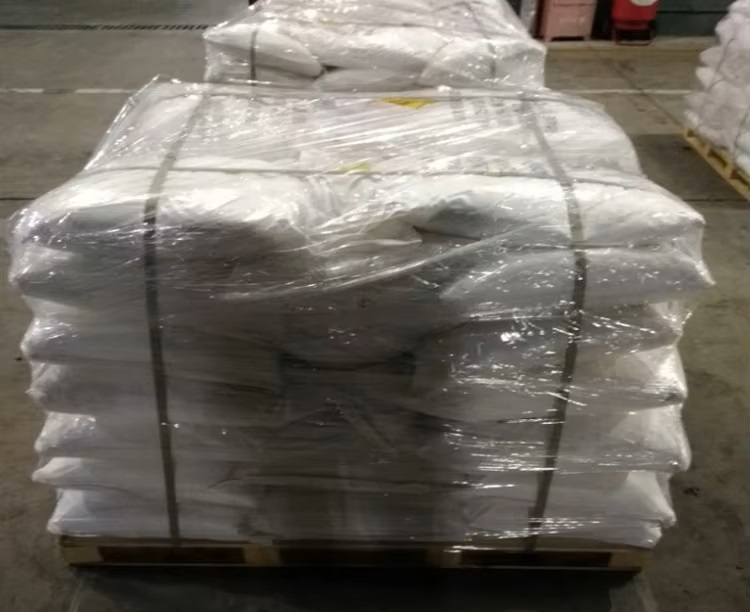
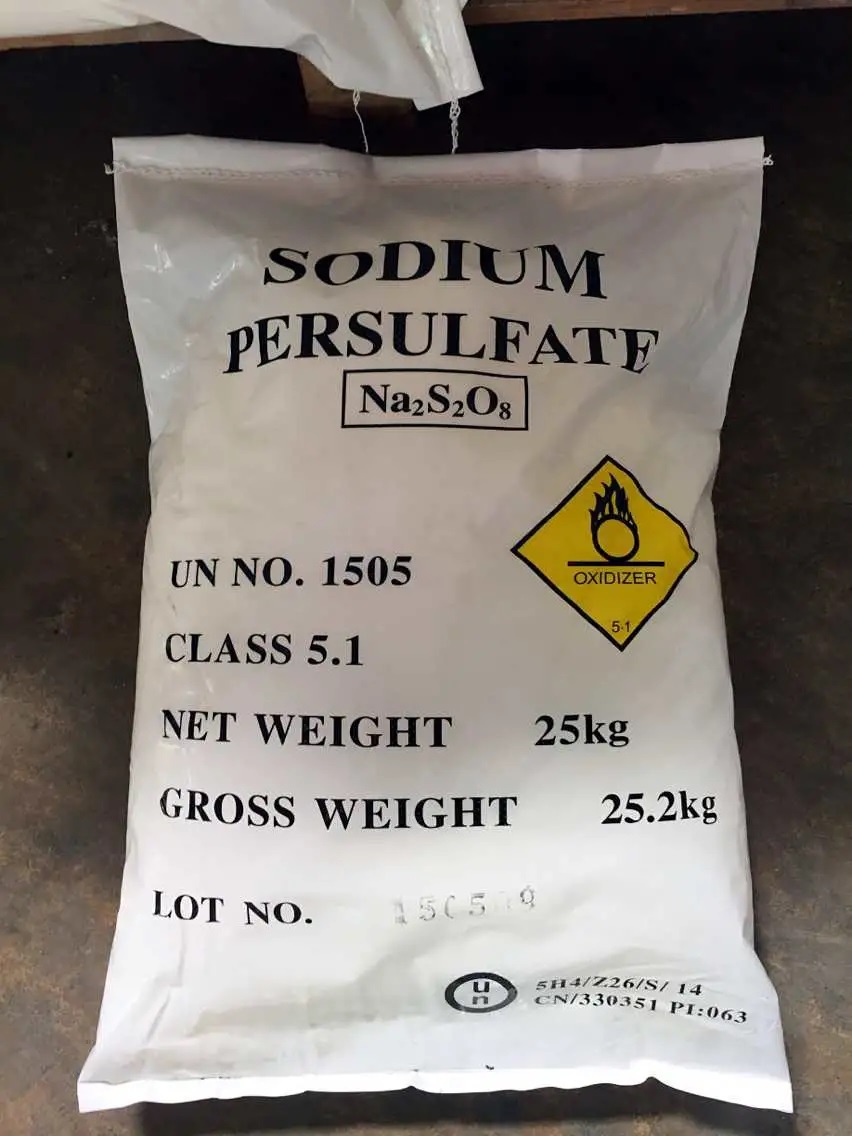
| Packaging Options | 25 kg bags (plastic-lined), 50 kg drums, 500 kg/1000 kg FIBC (big bags) |
10. SAFETY & HEALTH INFORMATION
GHS Classification
| Hazard Class | Category |
|---|---|
| Oxidizing Solids | Category 2 (H272) |
| Acute Toxicity (Oral) | Category 4 (H302) |
| Skin Corrosion/Irritation | Category 2 (H315) |
| Serious Eye Damage | Category 2 (H319) |
| Specific Target Organ Toxicity (Inhalation) | Category 3 (H335) |
| Respiratory Sensitization | Category 1 (H334) |
| Skin Sensitization | Category 1 (H317) |
Hazard Statements (H-Codes)
| Code | Statement |
|---|---|
| H272 | May intensify fire; oxidizer |
| H302 | Harmful if swallowed |
| H315 | Causes skin irritation |
| H317 | May cause an allergic skin reaction |
| H319 | Causes serious eye irritation |
| H334 | May cause allergy or asthma symptoms if inhaled |
| H335 | May cause respiratory irritation |
Precautionary Statements (P-Codes)
| Code | Statement |
|---|---|
| P210 | Keep away from heat, hot surfaces, sparks, open flames |
| P220 | Keep away from combustible materials |
| P261 | Avoid breathing dust |
| P280 | Wear protective gloves, protective clothing, eye protection, face protection |
| P301+P312 | IF SWALLOWED: Call a POISON CENTER if you feel unwell |
| P302+P352 | IF ON SKIN: Wash with plenty of water |
| P304+P340 | IF INHALED: Remove person to fresh air |
| P305+P351+P338 | IF IN EYES: Rinse cautiously with water for several minutes |
Toxicological Information
| Parameter | Value |
|---|---|
| Oral LD50 (rat) | 2,000 – 3,000 mg/kg |
| Dermal LD50 (rabbit) | > 2,000 mg/kg |
| Inhalation LC50 (rat) | > 0.5 mg/L (4 hours) |
| Skin Irritation | Mild to moderate irritant |
| Eye Irritation | Moderate irritant |
| Sensitization | May cause respiratory and skin sensitization |
NFPA 704
| Health (Blue) | Fire (Red) | Reactivity (Yellow) | Special (White) |
|---|---|---|---|
| 2 | 0 | 1 | OX (Oxidizer) |
Personal Protective Equipment (PPE)
| Equipment | Recommendation |
|---|---|
| Respiratory Protection | Dust mask (N95 or higher) |
| Hand Protection | Chemical-resistant gloves (nitrile, neoprene, PVC) |
| Eye Protection | Chemical safety goggles |
| Body Protection | Lab coat, chemical-resistant apron, protective clothing |
First Aid Measures
| Exposure Route | Action |
|---|---|
| Inhalation | Remove to fresh air. Seek medical attention if respiratory irritation occurs. |
| Skin Contact | Wash with plenty of water for at least 15 minutes. Remove contaminated clothing. |
| Eye Contact | Rinse immediately with plenty of water for at least 15 minutes. Seek medical attention. |
| Ingestion | Rinse mouth. Do NOT induce vomiting. Drink water. Seek immediate medical attention. |
11. FIRE FIGHTING MEASURES
| Parameter | Information |
|---|---|
| Fire Hazard | Oxidizer – may intensify fire |
| Extinguishing Media | Water spray, carbon dioxide, dry powder |
| Special Hazards | Decomposes when heated, releasing oxygen and toxic gases (SOₓ) |
| Protective Equipment | Self-contained breathing apparatus (SCBA), full protective clothing |
12. ENVIRONMENTAL INFORMATION
| Parameter | Information |
|---|---|
| Aquatic Toxicity | Moderate; avoid large releases to water bodies |
| Biodegradability | Persulfate is a strong oxidizer – not relevant for biodegradation |
| Bioaccumulation | Not expected |
| Waste Disposal | Dispose according to local regulations. Deactivate with reducing agent before disposal if required. |
13. TRANSPORT INFORMATION
| Parameter | Information |
|---|---|
| UN Number | 1505 |
| Hazard Class | 5.1 (Oxidizing substance) |
| Packing Group | III |
| Proper Shipping Name | SODIUM PERSULFATE |
| ADR/RID Class | 5.1 (Code O2) |
| IMDG Class | 5.1 |
| IATA (Air) Class | 5.1 |
| Marine Pollutant | No |
| EMS | F-A, S-Q |
14. REGULATORY INFORMATION
| Region | Status |
|---|---|
| EU | REACH registered; approved as oxidizing agent |
| Turkey (KKDIK) | Mandatory compliance; requires registration |
| USA (TSCA) | Listed |
| Canada (DSL) | Listed |
| Australia (AICS) | Listed |
| FDA | Not approved for direct food contact |
15. SYNONYMS & OTHER NAMES
| Turkish Name | English Name |
|---|---|
| Sodyum Persülfat | Sodium Persulfate |
| Sodyum Peroksidisülfat | Sodium Peroxydisulfate |
| Disodyum Peroksidisülfat | Disodium Peroxydisulfate |
| Peroksidisülfürik Asit Disodyum Tuzu | Peroxydisulfuric Acid Disodium Salt |
16. SUMMARY
Sodium Persulfate (Na₂S₂O₈, CAS 7775-27-1) is a white crystalline powder with strong oxidizing properties. It is widely used as a radical initiator for emulsion polymerization, as a bleaching and oxidizing agent in textiles and cosmetics, as a cleaning agent in electronics, and as an oxidant for environmental remediation.
Key Features:
| Feature | Description |
|---|---|
| Appearance | White crystalline powder |
| Solubility | 55.6 g/100 mL water (20°C) |
| Oxidizing Class | Strong oxidizer (Class 5.1, UN 1505) |
| Active Oxygen | ~6.7% |
| Stability | Stable at room temperature when dry |
Main Application Areas:
| Sector | Applications |
|---|---|
| Polymerization | Radical initiator for emulsion polymers, synthetic rubber, acrylic fibers |
| Electronics | PCB etching, semiconductor cleaning, photoresist stripping |
| Textile | Bleaching, desizing |
| Cosmetics | Hair bleach, hair color activator |
| Detergents | Stain removal, color protection |
| Environmental | In-situ chemical oxidation (ISCO) of BTEX, chlorinated compounds |
| Batteries | Depolarizer |
Key Safety Points:
-
STRONG OXIDIZER – Keep away from combustible and organic materials
-
HARMFUL – If swallowed, inhaled, or in contact with skin
-
SENSITIZER – May cause allergic reactions
-
IRRITANT – Causes skin and eye irritation
17. IMPORTANT NOTES
-
Strong Oxidizer: Sodium persulfate is a strong oxidizer. Keep away from combustible materials (paper, wood, cloth, oils) and reducing agents. Fire may intensify.
-
Decomposition: Persulfates decompose at elevated temperatures (>60°C), releasing oxygen. This can create a fire hazard in confined spaces if heated.
-
Moisture Sensitivity: Slightly hygroscopic. Keep containers tightly sealed to prevent caking and premature decomposition.
-
Sensitizer Risk: Repeated exposure may cause respiratory and skin sensitization (allergic reactions). Use appropriate PPE and ensure good ventilation.
-
Polymerization Applications: Sodium persulfate is one of the most common initiators for emulsion polymerization due to its water solubility and good thermal stability.
-
Environmental Remediation: Persulfate-based ISCO is effective for a wide range of organic contaminants, including BTEX, chlorinated ethenes (PCE, TCE), and MTBE. Activation by heat, base, or iron is often required.
-
Incompatibility: Do not mix with reducing agents, organic materials, or metals (especially in solution) – violent reactions may occur.
-
Storage: Store in a cool, dry, well-ventilated area away from direct sunlight and heat sources. Do not store near acids or flammables.
-
Alternatives: For applications requiring higher solubility or different thermal decomposition characteristics, consider ammonium persulfate or potassium persulfate.
-
COA Traceability: Each batch should be accompanied by a Certificate of Analysis (COA) with batch number for quality traceability.
Important Disclaimer: This Technical Data Sheet (TDS) is for informational purposes only. For complete safety, handling, storage, and regulatory compliance information, always refer to the official Safety Data Sheet (SDS) provided by the manufacturer/supplier.