We unleash your business potential by maximize the business innovation.
Send EmailThiourea, 2-Thiourea, Thiocarbamide, Sulfourea, Isothiourea, Pseudothiourea, TU, 62-56-6
THIOUREA
1. PRODUCT IDENTIFICATION AND CHEMICAL IDENTITY
| Parameter | Information |
|---|---|
| Product Name | Thiourea |
| Chemical Name (IUPAC) | Thiourea |
| Other Names | 2-Thiourea, Thiocarbamide, Sulfourea, Isothiourea, Pseudothiourea, TU |
| CAS Number | 62-56-6 |
| EC Number (EINECS) | 200-543-5 |
| Molecular Formula | CH₄N₂S or (NH₂)₂CS |
| Molecular Weight | 76.12 g/mol |
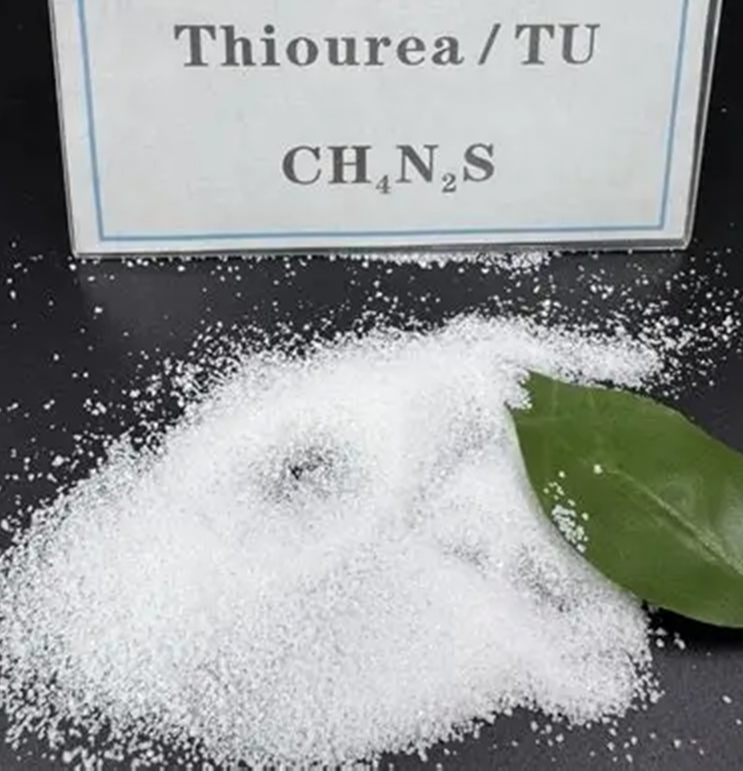
| Appearance | White crystalline powder or granules |
| Odor | Slight characteristic odor |
| Physical State (20°C) | Solid (crystalline) |
WARNING: Thiourea is classified as a suspected carcinogen (Category 2). Appropriate personal protective equipment must be used during handling, and inhalation of dust should be avoided. This product cannot be used in food contact applications.
2. CHEMICAL STRUCTURE
2.1. Molecular Structure
Thiourea is an organosulfur compound structurally similar to urea (NH₂)₂CO, but with a sulfur atom replacing the oxygen atom. This structural difference gives thiourea its unique chemical and physical properties.
Structural Formula:
        S
        ||
    H₂N - C - NH₂
SMILES: NC(=S)N
InChI Key: UMGDCJDMYOKAJW-UHFFFAOYSA-N
2.2. Bond Structure and Geometry
| Parameter | Value |
|---|---|
| C=S Bond Length | ~1.71 Å |
| C-N Bond Length | ~1.32 Å |
| Molecular Geometry | Planar |
| Resonance Stabilization | Molecule is stabilized by multiple resonance structures |
| Sulfur Atom | Carries partial negative charge; responsible for metal complexation |
2.3. Functional Groups
| Group | Description |
|---|---|
| Thiocarbonyl (C=S) | Sulfur-containing double bond; responsible for metal binding and redox reactions |
| Amine Groups (-NH₂) | Two amine groups; participate in hydrogen bonding and acid-base reactions |
3. PHYSICAL AND CHEMICAL PROPERTIES
| Property | Value |
|---|---|
| Physical Form | White crystalline powder or granules |
| Melting Point | ~176 °C |
| Boiling Point | 287 °C (decomposes) |
| Density | 1.914 g/cm³ |
| Solubility in Water (20°C) | 13.6 g/100 mL (soluble) |
| Solubility in Organic Solvents | Soluble in polar solvents (ethanol, methanol); slightly soluble in non-polar solvents |
| pH (aqueous solution) | Neutral to slightly acidic (~6.0 – 7.0) |
| Stability | Stability decreases in humid environments; decomposes at high temperatures releasing H₂S |
| Reactivity | Reacts with strong acids and oxidizing agents; forms complexes with metals |
4. FUNCTIONAL PROPERTIES
| Property | Description |
|---|---|
| Chemical Intermediate | Fundamental building block in dyes, resins, pharmaceuticals, and pesticides synthesis |
| Metal Complexing Agent | Forms stable complexes with gold, silver, copper, platinum, and other transition metals |
| Vulcanization Accelerator | Accelerates sulfur vulcanization in rubber; increases cross-linking density and speed |
| Cross-Linking Agent | Reacts with formaldehyde to form cross-linked structures in resin systems |
| Reducing Agent | Used in classical photography to dissolve silver halides |
| Protein Precipitant | Used in biochemistry with TCA as a protein precipitation agent |
5. REACTION MECHANISM
5.1. Metal Complexation Reaction (Gold Leaching)
Under acidic and oxidizing conditions, thiourea is oxidized on the gold surface to form formamidine disulfide, while gold dissolves as the Au[CS(NH₂)₂]₂⁺ complex:
Au + 2CS(NH₂)₂ → [Au(CS(NH₂)₂)₂]⁺ + e⁻
5.2. Reaction with Acids
Thiourea forms salts with strong acids:
CS(NH₂)₂ + HCl → [CS(NH₂)₂H]⁺Cl⁻
5.3. Oxidation
Thiourea is oxidized by oxidizing agents to thiourea dioxide (CH₄N₂O₂S).
6. OTHER NAMES AND SYNONYMS
-
Thiourea
-
2-Thiourea
-
Thiocarbamide
-
Sulfourea
-
Isothiourea
-
Pseudothiourea
-
TU
7. TYPICAL SPECIFICATIONS (Industrial Grade)
| Parameter | Specification |
|---|---|
| Appearance | White crystalline powder / granules |
| Purity (%) | ≥ 99.0 |
| Melting Point (°C) | ≥ 171 |
| Moisture (%) | ≤ 0.4 |
| Ash (%) | ≤ 0.1 |
| Insoluble in Water (%) | ≤ 0.02 |
8. SECTOR APPLICATIONS AND USAGE RATES
| Sector | Purpose | Typical Usage / Description |
|---|---|---|
| Metallurgy / Mining | Ore flotation; gold/silver extraction; electroplating additive | Flotation: 50-500 g/ton ore; Plating: 1-5 g/L |
| Rubber and Plastics | Vulcanization accelerator | 0.5-2 phr |
| Resin Production | Cross-linking agent in urea-formaldehyde resins | 1-5% (based on resin solids) |
| Textile | Dye synthesis; auxiliary chemical | Process specific |
| Agrochemicals | Intermediate in fungicide and pesticide production | Stoichiometric ratios in synthesis |
| Pharmaceuticals | Pharmaceutical intermediate | Reaction dependent; controlled laboratory conditions |
| Photography | Developing agent; silver halide solvent | 5-15% in developer solutions |
| Analytical Chemistry | Metal ion detection; protein precipitation | 5-10% with TCA |
| Metal Surface Treatment | Corrosion inhibitor; passivation additive | 0.5-2% (in bath solution) |
8.1. Example Formulations
Gold Leaching Solution (Metallurgy):
| Component | Amount |
|---|---|
| Thiourea | 10 g/L |
| Sulfuric acid (conc.) | 5 mL/L (pH ~1.5) |
| Iron(III) sulfate | 2 g/L |
Acidic Metal Cleaning Bath (with Corrosion Inhibitor):
| Component | Amount |
|---|---|
| Hydrochloric acid (30%) | 20% |
| Thiourea | 1.0% |
| Non-ionic surfactant | 0.5% |
| Water | 78.5% |
Rubber Vulcanization Formulation (NR/SBR):
| Component | Parts |
|---|---|
| Natural rubber / SBR | 100 |
| Carbon black | 50 |
| Zinc oxide | 5 |
| Stearic acid | 2 |
| Sulfur | 2 |
| Thiourea | 1.5 |
9. ALTERNATIVES AND COMPARISON
| Alternative | Application Area | Comparison with Thiourea |
|---|---|---|
| Sodium Cyanide (NaCN) | Gold extraction | More effective, but highly toxic |
| Thiourea Dioxide (TDO) | Textile reduction | Reducing agent; functions differ |
| MBT | Rubber vulcanization | More commonly used; thiourea is specific |
| Guanidine Derivatives | Resin cross-linking | Lower toxicity, less reactivity |
| Urea | Chemical intermediate | Less toxic; lacks sulfur content |
10. GHS CLASSIFICATION (CLP)
| Class | Category | H-Statement |
|---|---|---|
| Acute Toxicity (Oral) | Category 4 | H302: Harmful if swallowed |
| Carcinogenicity | Category 2 | H351: Suspected of causing cancer |
| Chronic Aquatic Toxicity | Category 2 | H411: Toxic to aquatic life with long-lasting effects |
Signal Word: Warning
Hazard Pictograms: GHS07, GHS08, GHS09
11. PRECAUTIONARY STATEMENTS (P-CODES)
| Code | Statement |
|---|---|
| P201 | Obtain special instructions before use |
| P202 | Do not handle until all safety precautions have been read and understood |
| P264 | Wash hands thoroughly after handling |
| P270 | Do not eat, drink or smoke when using this product |
| P273 | Avoid release to the environment |
| P280 | Wear protective gloves/protective clothing/eye protection |
| P301+P312 | IF SWALLOWED: Call a POISON CENTER if you feel unwell |
| P308+P313 | IF exposed or concerned: Get medical advice/attention |
| P391 | Collect spillage |
| P501 | Dispose of contents/container in accordance with local regulations |
12. TOXICOLOGY
| Parameter | Value |
|---|---|
| Acute Oral Toxicity (LD50, Rat) | ~1,750 mg/kg |
| Skin Irritation | Irritant |
| Eye Irritation | Irritant |
| Chronic Effects | May affect thyroid function; may cause goiter |
| Carcinogenicity | IARC Group 3; EU Category 2 (suspected) |
13. STORAGE
| Parameter | Condition |
|---|---|
| Temperature | < 30 °C |
| Environment | Cool, dry, well-ventilated |
| Container | Tightly closed, moisture-proof |
| Materials to Avoid | Moisture, strong oxidizing agents, acids, heat sources |
| Separate Storage | Store separately from food and feed materials |
14. PERSONAL PROTECTIVE EQUIPMENT (PPE)
| Equipment | Recommendation |
|---|---|
| Respiratory Protection | Dust mask (N95 / P2) |
| Hand Protection | Chemical-resistant gloves (nitrile, neoprene) |
| Eye Protection | Protective goggles |
| Body Protection | Lab coat or protective clothing |
| Ventilation | Adequate local exhaust ventilation |
15. FIRST AID
| Route of Exposure | Action to Be Taken |
|---|---|
| Inhalation | Move to fresh air. If irritation persists, seek medical attention |
| Skin Contact | Wash with plenty of soap and water. Remove contaminated clothing |
| Eye Contact | Rinse with plenty of water for at least 15 minutes. Seek medical attention |
| Ingestion | Do not induce vomiting. Rinse mouth. Drink water. Seek immediate medical attention |
16. WASTE DISPOSAL
-
Must be disposed of by licensed waste facilities in accordance with local regulations
-
Do not discharge into sewers or waterways
-
Toxic to aquatic life
17. PACKAGING OPTIONS
| Packaging Type | Quantity |
|---|---|
| Kraft bag (PE-lined) | 25 kg |
| Plastic woven bag (PE-lined) | 25 kg |
| Big-Bag | 500 kg, 1000 kg |
18. TRANSPORT INFORMATION
| Parameter | Information |
|---|---|
| UN Number | 3077 |
| Hazard Class | 9 |
| Packing Group | III |
| ADR/RID | Regulated |
| IMDG | Regulated |
| IATA | Regulated |
19. REGULATORY STATUS
| Region / Authority | Status |
|---|---|
| European Union (REACH) | Registered |
| Turkey (KKDIK) | Compliance required |
| TSCA (USA) | Registered |
| Food / Cosmetics | Not approved |
20. QUICK REFERENCE TABLE
| Property | Value |
|---|---|
| CAS Number | 62-56-6 |
| Molecular Formula | CH₄N₂S |
| Molecular Weight | 76.12 g/mol |
| Appearance | White crystalline powder / granules |
| Melting Point | ~176 °C |
| Solubility in Water | 13.6 g/100 mL |
| Main Uses | Metal complexing, vulcanization, resin |
| Risk Warning | Suspected carcinogen (H351), aquatic toxicity (H411) |
| UN Number | 3077 |
| GHS Signal Word | Warning |
21. CRITICAL NOTICES
-
Thiourea is a suspected carcinogen (Category 2). Avoid inhalation of dust.
-
Toxic to aquatic life with long-lasting effects (H411). Do not release into the environment.
-
Stability decreases in humid environments. Store in a dry, closed container.
-
Incompatible with strong oxidizing agents and strong acids.
-
Cannot be used in food contact applications.
-
Use appropriate PPE (mask, gloves, goggles) during handling.
LEGAL DISCLAIMER
This Technical Data Sheet (TDS) is for informational purposes only and is prepared based on available technical data. The user is solely responsible for determining the suitability of the product for their specific application and for complying with all local, national, and international regulations. For complete safety, storage, handling, transport, waste, and regulatory compliance information, the official Safety Data Sheet (SDS/MSDS) provided by the manufacturer/supplier must be consulted. This document does not substitute professional advice. Thiourea is a suspected carcinogen and toxic material; appropriate precautions must be taken during handling.