We unleash your business potential by maximize the business innovation.
Send EmailPotassium Polyacrylate, Super Absorbent Polymer, SAP, 25608-12-2
POTASSIUM POLYACRYLATE (SUPER ABSORBENT POLYMER - SAP)
PRODUCT IDENTIFIER INFORMATION
| Parameter | Information |
|---|---|
| Product Name | Potassium Polyacrylate (Super Absorbent Polymer - SAP) |
| Trade Names | Agricultural Gel, Water Retainer Polymer, Hydrogel, Solid Rain, Rain Gel |
| Chemical Family | Cross-linked acrylic acid potassium salt polymer |
| CAS Number | 25608-12-2 |
| Molecular Formula | (C3H3KO2)n |
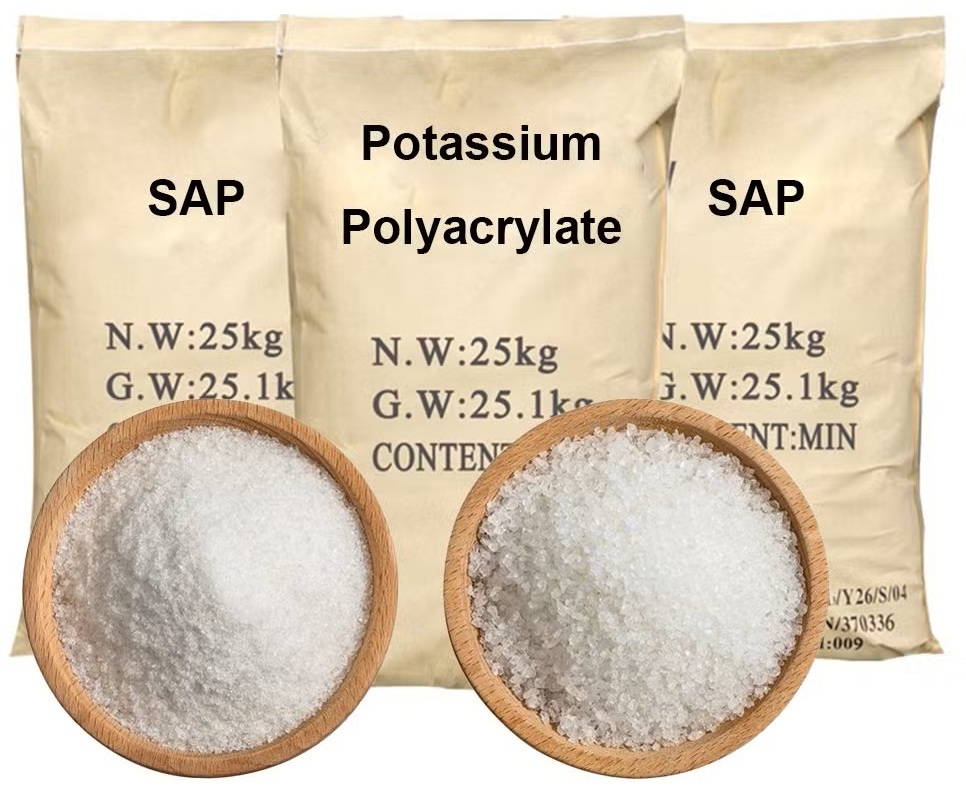
| General Appearance | White granules or powder |
SECTION 1: CHEMICAL IDENTITY AND DESCRIPTION
| Parameter | Information |
|---|---|
| IUPAC Name | Potassium polyprop-2-enoate |
| Other Chemical Names | Cross-linked Potassium Polyacrylate, Polyacrylic Acid Potassium Salt, Potassium SAP |
| Trade Names (Agriculture) | Water Retainer Polymer, Agricultural Gel, Rain Gel, Hydrogel, Solid Rain |
| Trade Names (Consumer) | Water Beads, Artificial Snow, Crystal Soil |
| CAS Number | 25608-12-2 |
| Chemical Class | Cross-linked polyacrylate (super absorbent polymer) |
| Functional Groups | Carboxylate (-COO-K+) |
| Cross-linking | Lightly cross-linked (insoluble in water, but highly swellable) |
| Physical State (20°C) | Solid (white granules or powder) |
| Odor | Odorless |
| Biodegradability | Very slow (partial degradation over years) |
SECTION 2: PHYSICAL AND CHEMICAL PROPERTIES
| Property | Value / Range | Test Method |
|---|---|---|
| Appearance | White granules or powder | Visual |
| Odor | Odorless | Olfactometric |
| Particle Size | 0.2 - 1.0 mm (standard granule) | Sieve Analysis |
| Moisture Content | ≤ 5% | Gravimetric (105°C) |
| pH (0.1% gel) | 6.0 - 8.0 | pH Meter |
| Bulk Density | 0.55 - 0.80 g/cm3 | ASTM D1895 |
| Absorption in Distilled Water | Minimum 300 - 500 g/g | Centrifuge Method |
| Absorption in 0.9% NaCl Solution | Minimum 45 - 60 g/g | Centrifuge Method |
| Absorption Rate (Distilled Water) | Medium-High | Vortex Method |
| Gel Strength (Intra-particle) | High | Rheometer |
| Residual Monomer (Acrylic Acid) | ≤ 300 ppm | HPLC |
| Solubility | Insoluble in water; highly swellable | Visual |
| Melting Point | Does not melt; decomposes >200°C | DSC |
| Thermal Decomposition | >200°C | TGA |
| True Density | ~1.5 g/cm3 | Pycnometer |
SECTION 3: CLASSIFICATION BY PARTICLE SIZE AND APPLICATION TABLE
Potassium polyacrylate is a cross-linked polymer, therefore it is not characterized by a single "molecular weight." Instead, the key physical property determining performance is particle size (mesh range) and the resulting variations in absorption rate, gel strength, and gel blocking risk.
| Particle Size (Mesh) | Physical Form | Absorption Rate | Gel Strength | Suitable Sector and Application |
|---|---|---|---|---|
| 1 - 5 mm (Coarse Granule) | Irregular large particles | Slow but very high capacity | Very High | Agriculture (Afforestation/Landscaping): Best form for preventing soil compaction. Slow release is ideal. Also suitable for waste solidification. |
| 0.2 - 1.0 mm (Standard Granule) | Regular crystal appearance | Medium-High | High | General Agriculture and Horticulture: The most balanced and widely used form for field crops, greenhouses, pots, and turf applications. Suitable for mechanical planting. |
| < 0.2 mm (Fine Powder) | Powder consistency | Very Fast (Risk of lumping) | Low-Medium | Hygiene Products: Used in baby/adult diapers mixed with cellulose for rapid absorption. Industrial: Cable water barrier tapes and instant solidification sprays. |
| 30 - 50 Mesh (Medium-Fine) | Milled granule | Controlled Fast | Medium | Artificial Snow / Potted Plants: Forms instant decorative and transparent gel beads when water is added. |
SECTION 4: COMPARISON OF ALL ACRYLATE TYPES
There are three most common types of polyacrylate salts used in agriculture and industry. The primary difference between them arises from the alkali metal or ammonium ion in their structure.
| Property | Potassium Polyacrylate (K-PAM) | Sodium Polyacrylate (Na-PAM) | Ammonium Polyacrylate (NH4-PAM) |
|---|---|---|---|
| Chemical Formula | (C3H3KO2)n | (C3H3NaO2)n | (C3H6NO2)n |
| CAS Number | 25608-12-2 | 9003-04-7 | Various |
| Appearance / Odor | White granules, odorless | White granules, odorless | White granules, slight ammonia odor |
| pH (Gel) | Neutral (~7.0) | Slightly Alkaline (~7.5 - 8.0) | Slightly Acidic (~6.0 - 6.5) |
| Distilled Water Absorption | 300 - 500 g/g | 400 - 600 g/g (Highest) | 300 - 450 g/g |
| Salt Water Tolerance | Medium | Low (Salts severely reduce absorption) | Low-Medium |
| Plant Nutrition | Yes. Slowly releases potassium (K+) fertilizer after absorption. Positively contributes to plant nutrition. | No. Causes sodium accumulation in soil over time, degrading soil structure and may be phytotoxic to plants. | Yes. Provides nitrogen in ammonium (NH4+) form. However, ammonia loss may occur at high pH. |
| Effect on Soil | Improves soil structure, increases aeration. | May reduce permeability by causing dispersion in soil, can lead to crust formation. | Converted to nitrate by microbial activity and used by plants. |
| Primary Application Area | Agriculture, Horticulture (Gold standard) | Hygiene products (diapers), industrial liquid solidification, ice packs | Agriculture (controlled-release fertilizer systems), wastewater treatment (as flocculant) |
| Biodegradability | Very slow (over years) | Very slow (over years) | Degrades faster compared to polyacrylamides, but cross-linked SAP form is slow. |
| Cost | Medium-High | Low | Medium |
Summary Selection Guide:
-
If you are growing plants and want to improve soil: Potassium Polyacrylate must definitely be selected.
-
If you want to solidify industrial wastewater or produce diapers: Sodium Polyacrylate is the most economical and highest capacity solution.
-
If both water retention and nitrogen fertilizer effect are desired: Ammonium Polyacrylate can be evaluated, but it is not as common as the potassium type due to odor and stability issues.
SECTION 5: ALTERNATIVE PRODUCTS AND COMPARISON
Alternatives to potassium polyacrylate are other synthetic or natural polymers that function as water retainers.
| Alternative Product | Structure | Advantage | Disadvantage |
|---|---|---|---|
| Sodium Polyacrylate | Synthetic, sodium salt | Much cheaper; standard in the diaper industry. | Causes sodium accumulation in soil over time leading to salinization, phytotoxic to plants. |
| Polyvinyl Alcohol (PVA) Based Hydrogels | Synthetic | High durability, used in industrial coolants. | High cost for agriculture, not biodegradable. |
| Natural Starch-Based Polymers | Corn, wheat starch | Completely biodegradable, suitable for organic agriculture. | Low absorption capacity (30-50 times), gel structure degrades quickly, costly. |
| Carboxymethyl Cellulose (CMC) | Cellulose derivative | Soluble in water, used in soil improvement and dust control. | Very low water absorption capacity, does not form gel particles like SAP. |
| Clinoptilolite (Natural Zeolite) | Volcanic Mineral | Non-chemical, permanently retains water and nutrients in soil. However, water absorption mechanism is physical adsorption, not swelling. | Not organic matter, and water retention capacity by weight is much lower than polymers. |
SECTION 6: FUNCTIONAL PROPERTIES AND MECHANISM OF ACTION
| Property | Description |
|---|---|
| Primary Function | Storage and controlled release of water and plant nutrients |
| Water Retention Capacity | Absorbs 300-500 times its own weight in distilled water |
| Nutrient Retention | Controlled release of potassium ions (K+); also retains other cationic nutrients (NH4+, Ca2+, Mg2+) |
| Mechanism of Action | Absorbs water by osmotic pressure difference; cross-linked polymer network swells but does not dissolve |
| Soil Conditioner | Increases soil porosity, prevents compaction, improves aeration |
| Irrigation Frequency | Reduces irrigation frequency by 30-50% |
| Plant Stress | Reduces drought stress; minimizes transplant shock |
| Soil pH | Neutral pH does not affect soil pH |
| Shelf Life Extension | Extends vase life of cut flowers |
| Gel Stability | Resistant to repeated wet-dry cycles |
SECTION 7: PRIMARY APPLICATION AREAS
| Sector | Application |
|---|---|
| Agriculture and Horticulture | Mixed into soil for storage and controlled release of water and plant nutrients (especially potassium) |
| Afforestation and Landscaping | Applied to root zone during seedling planting to increase survival rate |
| Liquid Waste Management | Solidification of aqueous sludges and medical wastes |
| Hygiene Products | Absorbent core of baby diapers and adult incontinence products |
| Industrial | Water blocking in submarine cable armors, cooling gel packs, artificial snow |
| Cut Flower Industry | Hydrogel use to extend vase life |
| Seed Coating | Increases germination by keeping seeds moist |
SECTION 8: USAGE DOSAGE RECOMMENDATIONS
Application dosage should be adjusted according to soil type, plant variety, and climatic conditions. The following values are general recommendations:
A. Field / Garden Application:
| Application Method | Soil Type | Recommended Dosage (Per cubic meter of soil) |
|---|---|---|
| Field Crops (dry conditions) | Sandy, permeable | 1.5 - 2.5 kg/m3 |
| Field Crops (dry conditions) | Loamy, clayey | 1.0 - 1.5 kg/m3 |
| Fruit Tree / Sapling Planting (per pit) | General | 50 - 150 grams (thoroughly mixed with root development area) |
| Potted and Greenhouse Plants | Peat, mix | 1.0 - 2.0 kg/m3 |
| Turf Establishment | General | 50 - 80 g/m2 (mixed into 5-15 cm depth) |
B. Pot / Balcony Plants Recipe:
| Method | Description |
|---|---|
| Method 1 (Dry) | Mix 1.5 - 2 grams of dry granules into 1 liter of potting soil. Fill the pot and plant. |
| Method 2 (Pre-swollen - Recommended) | Soak 1 gram of dry granules in 1 liter of water for 30 minutes to form a gel. Mix this gel with potting mix at a ratio of 1/3 or 1/4. This method facilitates dosage control and eliminates the risk of excessive swelling. |
SECTION 9: APPLICATION RECIPE (STEP BY STEP)
A. Subsurface Application in Agriculture (Field / Garden):
The most critical point is homogeneous mixing of the dry product with soil in the root zone.
| Step | Operation | Description |
|---|---|---|
| 1 | Dosage Calculation | Sandy soil: 2.0 - 2.5 kg/m3 soil; Loamy soil: 1.5 - 2.0 kg/m3 soil; Clayey soil: 1.0 - 1.5 kg/m3 soil |
| 2 | Pre-Mix Preparation | Prepare a "pre-mix" by mixing the dry polymer with 5-10 times its volume of dry soil in a container. This prevents lumping. |
| 3 | Application | Spread this pre-mix onto the area to be planted/sown at 15-20 cm depth and work the soil to ensure homogeneous distribution. |
| 4 | Irrigation | Immediately after application, water abundantly until the soil is completely saturated. After the polymer swells, you can water the plant less frequently than normal. |
B. Sapling / Tree Planting Recipe (Pit Method):
| Step | Operation |
|---|---|
| 1 | Place some loose soil at the bottom of the opened planting pit. |
| 2 | Dosage: Thoroughly mix 50 - 150 g of dry polymer per sapling with all the soil removed from the pit. |
| 3 | After placing the sapling in the pit, fill around the roots with this mixture. |
| Important Note | Never allow sapling roots to come into direct contact with pure, dry granules; even if pre-swollen gel is used, do not place excessive amounts at the root collar. |
Important Warning: After application, the product must be incorporated into the soil at depth (for example, 10-20 cm). If left on the surface, it may swell and cause surface slipperiness or plant heaving.
SECTION 10: QUALITY SPECIFICATIONS
| Parameter | Specification | Test Method |
|---|---|---|
| Appearance | White granules or powder | Visual |
| Particle Size | 0.2 - 1.0 mm (or specified mesh range) | Sieve Analysis |
| Moisture Content | ≤ 5% | Gravimetric (105°C, 4 hours) |
| pH (0.1% gel) | 6.0 - 8.0 | pH Meter |
| Bulk Density | 0.55 - 0.80 g/cm3 | ASTM D1895 |
| Absorption in Distilled Water | Minimum 300 - 500 g/g | Centrifuge Method (ISO 17190-6) |
| Absorption in 0.9% NaCl Solution | Minimum 45 - 60 g/g | Centrifuge Method (ISO 17190-6) |
| Absorption Rate | Variable according to application | Vortex Method |
| Gel Strength | High | Rheometer |
| Residual Monomer (Acrylic Acid) | ≤ 300 ppm | HPLC (ISO 17190-8) |
| Soluble Fraction | ≤ 5% | Gravimetric |
| Heavy Metals (as Pb) | ≤ 10 ppm | ICP-MS |
| Lead (Pb) | ≤ 2 ppm | ICP-MS |
| Arsenic (As) | ≤ 3 ppm | ICP-MS |
| Mercury (Hg) | ≤ 1 ppm | ICP-MS |
| Cadmium (Cd) | ≤ 1 ppm | ICP-MS |
SECTION 11: SAFETY AND HANDLING
| Parameter | Information |
|---|---|
| Hazard Classification | Not classified as a hazardous substance according to current regulations. |
| Hazard Statements | May cause slight irritation on contact with skin and eyes. Inhalation of dust may cause mechanical discomfort. |
| Personal Protective Equipment (PPE) | Use of safety goggles and dust mask is recommended during handling; wear gloves to prevent skin contact. |
| Slippery Floor Warning | Forms an extremely slippery gel layer when spilled on wet floors. In case of spillage, sweep up dry; do not use water. |
SECTION 12: FIRST AID MEASURES
| Exposure Route | Action to Take |
|---|---|
| Eye Contact | Rinse with plenty of water for at least 15 minutes. Seek medical attention if irritation persists. |
| Skin Contact | Wash with soap and water. |
| Inhalation | Move to fresh air. Seek medical attention if respiratory irritation persists. |
| Ingestion | If accidentally swallowed, rinse mouth with water and drink plenty of water. Never give anything by mouth to an unconscious person. Seek medical attention if you feel unwell. |
SECTION 13: FIREFIGHTING MEASURES
| Parameter | Information |
|---|---|
| Fire Hazard | Combustible organic dust |
| Suitable Extinguishing Media | Water mist (fog), CO2, dry chemical powder, foam |
| Special Hazards | May release irritating and toxic fumes such as CO, CO2, acrolein when heated or burned |
| Decomposition Products | CO, CO2, acrolein, low molecular weight hydrocarbons |
| Protective Equipment | Self-contained breathing apparatus (SCBA), full protective clothing |
SECTION 14: ACCIDENTAL RELEASE AND CLEANUP
| Parameter | Information |
|---|---|
| Personal Protection | Nitrile gloves, safety goggles, dust mask (N95) |
| Cleanup Methods | Sweep or vacuum up dry. Do not use water (creates extremely slippery floor). |
| Environmental Precautions | Prevent entry into drains, soil, and surface water. |
| Waste Disposal | According to local regulations; burial or incineration at licensed disposal facilities. |
SECTION 15: STORAGE AND SHELF LIFE
| Parameter | Information |
|---|---|
| Storage Conditions | Cool (15-25°C), dry, and well-ventilated area. |
| Container Requirements | Containers must be stored tightly closed. Absolutely keep away from moisture, water, and heat sources. |
| Keep Away From | Moisture, water, direct sunlight, heat sources |
| Shelf Life | 24 months from production date in original unopened packaging under appropriate storage conditions. |
| Stability Note | Hygroscopic; absorbs moisture; store in airtight containers. |
SECTION 16: PACKAGING OPTIONS
| Packaging Type | Quantity | Material |
|---|---|---|
| Kraft bag with PE inner liner | 25 kg | Kraft paper + PE |
| PP woven bag with PE inner liner | 25 kg | PP woven + PE |
| Aluminum foil pouch | 1 kg | Laminated aluminum |
| Aluminum foil pouch | 5 kg | Laminated aluminum |
| Big-Bag | 500-1000 kg | Polypropylene (with PE inner liner) |
SECTION 17: TRANSPORTATION INFORMATION
| Parameter | Information |
|---|---|
| UN Number | Not regulated (not a hazardous substance) |
| Hazard Class | Not applicable |
| Packing Group | Not applicable |
| ADR/RID | Not regulated |
| IMDG Code | Not regulated |
| IATA (Air) | Not regulated |
| Marine Pollutant | No |
SECTION 18: REGULATORY STATUS
| Region / Authority | Status |
|---|---|
| European Union | Registered under REACH (if applicable) |
| USA (FDA) | Suitability for food contact applications must be evaluated |
| Turkey | Approved for agricultural and horticultural applications; under the Regulation on Registration, Evaluation, Authorization and Restriction of Chemicals |
| OECD | Evaluated as polymer |
SECTION 19: OTHER NAMES AND SYNONYMS
| Type | Name |
|---|---|
| Chemical / Generic Names | Potassium Polyacrylate (IUPAC), Cross-linked Potassium Polyacrylate, Polyacrylic Acid, Potassium Salt, Potassium SAP (Super Absorbent Polymer) |
| Trade / Sectoral Names (Agriculture) | Water Retainer Polymer, Agricultural Gel, Rain Gel, Hydrogel, Solid Rain |
| Trade / Sectoral Names (Hygiene) | Super Absorbent Polymer (SAP) |
| Consumer Names | Water Beads, Artificial Snow, Crystal Soil |
| CAS Number | 25608-12-2 |
SECTION 20: TOXICOLOGICAL INFORMATION
| Parameter | Value |
|---|---|
| Acute Oral Toxicity (LD50, Rat) | > 5,000 mg/kg |
| Acute Dermal Toxicity (LD50, Rabbit) | > 2,000 mg/kg |
| Skin Irritation | Slightly irritating |
| Eye Irritation | Slightly irritating |
| Skin Sensitization | Not sensitizing |
| Carcinogenicity | Not classified |
| Mutagenicity | Negative in standard tests |
| Residual Monomer | ≤ 300 ppm (within safety limits) |
SECTION 21: ENVIRONMENTAL INFORMATION
| Parameter | Information |
|---|---|
| Biodegradability | Very slow biodegradation (partial over years) |
| Ecotoxicity | Low acute toxicity to aquatic organisms |
| Bioaccumulation | Not expected to bioaccumulate |
| Mobility in Soil | Immobile (swells and remains in place) |
| Persistence | Persistent in soil environment |
| Environmental Fate | Eventually degrades via mechanical, UV, and microbial action over extended periods |
SECTION 22: SUMMARY TABLE
| Parameter | Value |
|---|---|
| Product | Potassium Polyacrylate (Super Absorbent Polymer - SAP) |
| CAS Number | 25608-12-2 |
| Chemical Formula | (C3H3KO2)n |
| Appearance | White granules or powder |
| pH (0.1% gel) | 6.0 - 8.0 |
| Distilled Water Absorption | 300 - 500 g/g |
| Moisture Content | ≤ 5% |
| Primary Function | Water retainer, controlled-release potassium source, soil conditioner |
| Shelf Life | 24 months (unopened original packaging) |
SECTION 23: CRITICAL WARNINGS AND BEST PRACTICES
CRITICAL SAFETY AND APPLICATION WARNINGS:
-
Potassium vs. Sodium: If you are growing plants and want to improve soil, Potassium Polyacrylate must definitely be selected. Sodium Polyacrylate causes salinization in soil.
-
Deep Incorporation: After application, the product must be incorporated into the soil at depth (10-20 cm). If left on the surface, it may swell and cause surface slipperiness or plant heaving.
-
Root Contact: Never allow sapling roots to come into direct contact with pure, dry granules.
-
Spill Cleanup: In case of spillage, do not use water; it creates an extremely slippery gel layer. Sweep up dry.
-
Moisture Protection: Hygroscopic; keep away from moisture and water. Store in unopened original packaging.
-
Verify Product Type: Ensure that the product sold under the name "hydrogel" or "water retainer polymer" for agricultural and horticultural use is the potassium salt. Sodium polyacrylate is cheaper but damages plants.
BEST PRACTICE RECOMMENDATIONS:
-
Pre-Mix Method: Always prepare a pre-mix by combining dry polymer with 5-10 times its volume of dry soil before field application to prevent lumping.
-
Pre-Swell for Pots: For container plants, pre-swell the polymer in water before mixing with potting soil to ensure even distribution and prevent overflow.
-
Irrigate Immediately: Water thoroughly immediately after application to fully hydrate the polymer.
-
Dosage Calibration: Start with recommended dosages; adjust based on local soil type, climate, and plant water requirements.
-
Combine with Fertilizers: Can be used in conjunction with fertilizers for enhanced nutrient retention and controlled release.
-
Training: Train all operators on safe handling, spill cleanup procedures, and proper application techniques.
SECTION 24: PROCESS AND APPLICATION GUIDE
| Step | Procedure | Control Point |
|---|---|---|
| 1. Soil Assessment | Determine soil type (sandy, loamy, clayey) and depth of root zone. | Soil texture analysis |
| 2. Dosage Calculation | Calculate required amount based on soil volume and type. | Weigh accurately |
| 3. Pre-Mix Preparation | Mix dry polymer with 5-10 volumes of dry soil. | Visual uniformity check |
| 4. Application | Spread pre-mix evenly and incorporate into 10-20 cm depth. | Depth gauge check |
| 5. Initial Irrigation | Irrigate thoroughly until soil is saturated. | Soil moisture meter |
| 6. Planting/Sowing | Proceed with planting or sowing after gel formation. | Standard agricultural practice |
| 7. Subsequent Irrigation | Reduce irrigation frequency by 30-50%; monitor soil moisture. | Regular soil moisture monitoring |
| 8. Monitoring | Observe plant health, growth rate, and soil condition. | Periodic visual inspection |
LEGAL DISCLAIMER:
The information provided in this document is presented in good faith based on our current knowledge and experience; however, since all usage conditions are beyond our control, it does not constitute a binding specification or warranty. Users are obligated to test the suitability for their own applications. For complete safety, storage, handling, transportation, disposal, and regulatory compliance information, refer to the official Safety Data Sheet (SDS/MSDS) provided by the manufacturer/supplier.