We unleash your business potential by maximize the business innovation.
Send EmailPotassium Gluconate, Potassium D-gluconate, E577, 299-27-4
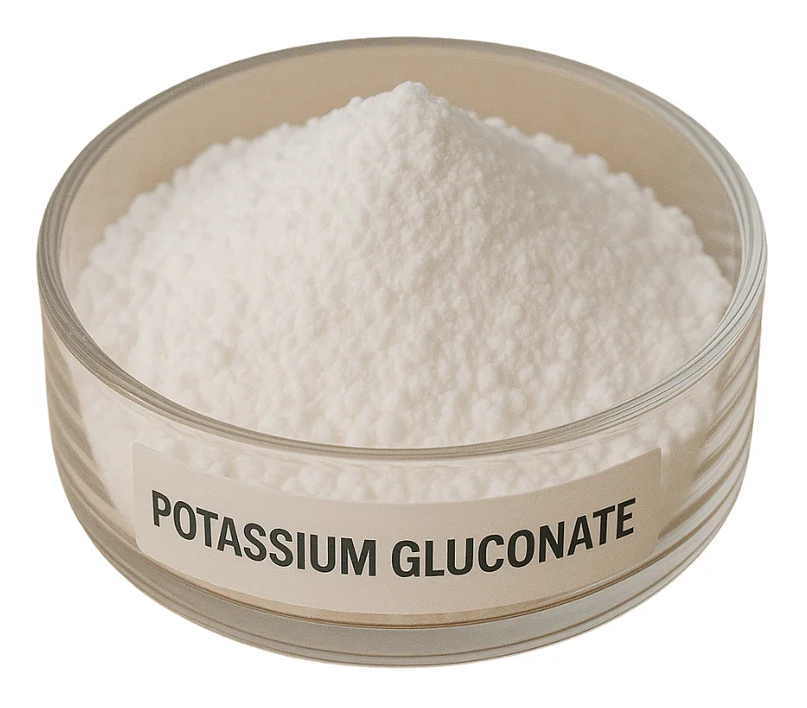
POTASSIUM GLUCONATE
| Heading | Information |
|---|---|
| Product Name | Potassium Gluconate |
| Synonyms | D-Gluconic acid, monopotassium salt; Potassium D-gluconate |
| CAS Number | 299-27-4 |
| EC Number | 206-074-2 |
| Molecular Formula | C₆H₁₁KO₇ (anhydrous) |
| Molecular Weight | 234.25 g/mol (anhydrous) 252.26 g/mol (monohydrate) |
| Food Codex Code | E 577 |
1. TECHNICAL SPECIFICATIONS
| Parameter | Specification | Description / Reference Standard |
|---|---|---|
| Appearance | White or slightly yellowish crystalline powder or granules | Free flowing |
| Odor | Odorless | |
| Taste | Slightly bitter | |
| Assay (Purity) | ≥ 97.0% - 103.0% (on dried basis) | Complies with USP, FCC, EP, EU 231/2012 standards |
| Potassium Content | Approx. 16.5% - 16.69% | 1 g of potassium gluconate provides approx. 0.165 g of elemental potassium. |
| Solubility | Soluble in water: > 900 g/L (at 20°C) Soluble in glycerin Slightly soluble in ethanol, insoluble in ether |
|
| pH (1% Solution) | 7.0 - 8.3 | Slightly alkaline |
| Melting Point | 178 - 183 °C (decomposition) | |
| Density | ~1.73 g/cm³ | |
| Optical Rotation | [α]²⁰/D +11.5° to +14.5° (c=1.2, H₂O) | |
| Loss on Drying | ≤ 3.0% (for anhydrous form) | |
| Heavy Metals (as Pb) | ≤ 2 mg/kg (ppm) | FCC Standard |
| Storage Conditions | Store in a cool (<25°C), dry place, protected from light, in a tightly closed container. | |
| Shelf Life | 24 months when stored under appropriate conditions. |
2. REGULATORY AND COMPLIANCE STATUS
-
Food Additive: Permitted for use in foods as an acidity regulator, sequestrant, and yeast nutrient under the code E 577. Compliant with the Turkish Food Codex.
-
Food Supplements: Suitable for use within the scope of the Turkish Food Codex Regulation on Food Supplements.
-
International Standards: Complies with FCC (Food Chemicals Codex), USP (United States Pharmacopeia), EP (European Pharmacopoeia), and JECFA (Joint FAO/WHO Expert Committee on Food Additives) specifications.
-
Legal Status: Listed on the FDA's Everything Added to Food in the United States (EAFUS) inventory. Approved as a food additive in the EU.
3. SAFETY AND HANDLING
Potassium Gluconate is not classified as hazardous when used with standard industrial hygiene practices. However, the following precautions are recommended:
-
Personal Protective Equipment (PPE): Use of a dust mask, safety glasses, and gloves is generally recommended.
-
General Handling Precautions:
-
Avoid formation of dust and do not inhale dust.
-
Avoid contact with skin, eyes, and clothing.
-
Do not eat, drink, or smoke during handling.
-
Wash hands thoroughly after handling.
-
-
First Aid Measures:
-
Inhalation: Move to fresh air.
-
Skin Contact: Wash off with plenty of soap and water.
-
Eye Contact: Rinse cautiously with plenty of water for at least 15 minutes, keeping eyelids open. Seek medical attention.
-
Ingestion: Rinse mouth with water and seek medical attention.
-
-
Toxicological Information: No significant adverse effects have been observed in chronic animal studies. Reproductive studies are negative.
4. MAIN APPLICATION AREAS
-
Food and Beverage Industry:
-
Potassium Source: Used as a nutrient fortifier in dairy products, infant formulas, sports drinks, and other functional foods.
-
Acidity Regulator and Buffer: Used to maintain pH balance in food products.
-
Sequestrant: Binds metal ions to prevent undesirable reactions.
-
-
Pharmaceuticals and Dietary Supplements:
-
Widely used as an active ingredient in dietary supplements and pharmaceuticals to treat or prevent potassium deficiency (hypokalemia).
-
-
Other Industrial Uses:
-
As a sequestering agent in textile processing, leather treatment, and galvanic surface treatments.
-
As a nutrient source in yeast production.
-
5. PACKAGING AND LOGISTICS
-
Standard Packaging: Generally packaged in 25 kg net weight kraft paper bags with an inner PE liner or in cardboard drums.
-
Storage and Transportation: The product should be stored and transported in a cool, dry, well-ventilated area, protected from direct sunlight and moisture.
6. CONTACT AND DISCLAIMER
This technical data sheet has been prepared for informational purposes only based on the most current and reliable information available. The data provided reflects typical properties and does not constitute a product specification or warranty. It is the user's responsibility to test the product for their specific application and to comply with all applicable laws and regulations.SECTORAL APPLICATIONS AND FUNCTIONS
Potassium Gluconate is utilized across a wide range of industries, from health and nutrition to industrial processes. The applications are grouped below based on their function.
| Sector | Application Examples | Function / Description |
|---|---|---|
| Pharmaceuticals & Dietary Supplements | Tablets, powders, liquids, or extended-release formulations. | Used to treat or prevent potassium deficiency (hypokalemia). |
| Food & Beverage | Sports drinks, energy bars, fortified foods, dairy products, and infant formulas. | Acts as an electrolyte balancer, mineral supplement, and pH regulator. Also functions as a sequestrant (metal binder). |
| Cosmetics & Personal Care | Skincare products and certain personal care formulations. | Functions as a mineral source and pH adjuster. Market analysis identifies this as a significant application area. |
| Animal Feed | Pet food and livestock feed. | Used to support nutritional balance and overall health in animals. |
| Industrial Applications | Metal surface treatments, textile and leather processing, high-alkalinity bottle cleaners, cement setting retarders. | Acts as a powerful sequestering agent. It binds metal ions to act as a stabilizer in textile bleaching and as a scale remover in cleaning products. |
ALTERNATIVE NAMES AND SYNONYMS
Potassium Gluconate may be referred to by various names in different sectors or scientific literature. The most common synonyms are listed below.
| Category | Names |
|---|---|
| Food Code | E577 |
| Systematic Chemical Names | D-Gluconic acid, potassium salt; D-Gluconic acid, monopotassium salt; Gluconic acid potassium salt; Monopotassium D-gluconate |
| Other Commercial/Generic Names | Potassium D-gluconate, Potassuril, Kaon, Katorin, Sirokal, Kalium-beta |
| IUPAC Name | Potassium (2R,3S,4R,5R)-2,3,4,5,6-pentahydroxyhexanoate |
ALTERNATIVES AND COMPARISONS
Potassium Gluconate is not the only form available for potassium supplementation. Alternative chemical forms exist, each with distinct advantages and disadvantages. Below is a comparison of the most common alternatives.
| Alternative | Elemental Potassium Content | Key Characteristics | Comparison with Potassium Gluconate |
|---|---|---|---|
| Potassium Chloride (KCl) | Approx. 52% (by weight) | The most common and cost-effective form. High absorption; often the first choice for treating deficiency. | Higher likelihood of gastric irritation compared to gluconate. Taste profile is inferior (bitter/metallic). |
| Potassium Citrate | Variable | Has an alkalizing effect. Helps prevent kidney stone formation by making urine more alkaline. Preferred in cases of metabolic acidosis. | Gluconate generally has a more neutral taste and is better tolerated by individuals with sensitive stomachs. |
| Natural Dietary Sources | Variable | Foods such as bananas, avocados, spinach, chard, sunflower seeds, and artichokes are rich in potassium. | Provides a lower dose and slower absorption compared to supplements. Ideal for general healthy nutrition but may not suffice for clinical deficiency treatment. |