We unleash your business potential by maximize the business innovation.
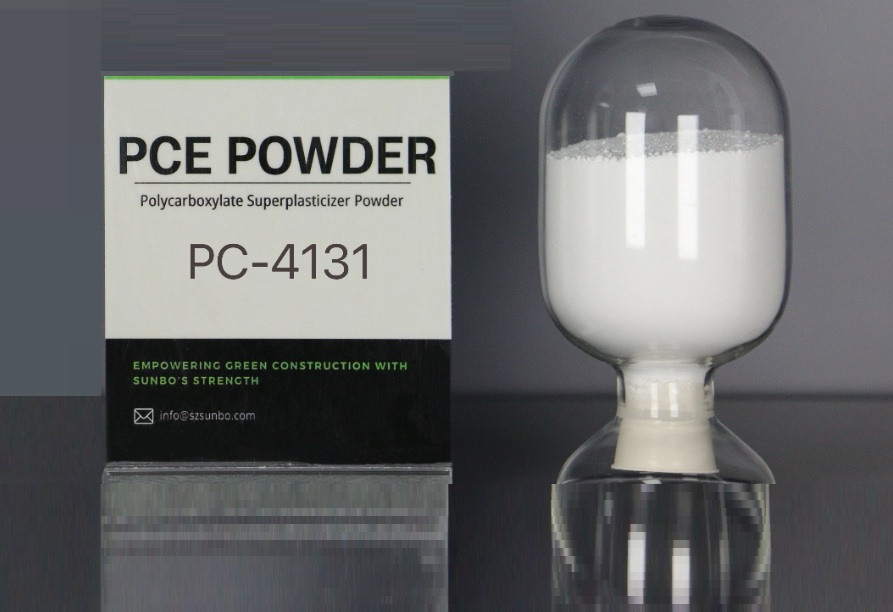
Send EmailPolycarboxylate Ether Superplasticizer, Slump Retention PCE, Concrete Slump Retention, PCE Concrete Additive, Slump Retention PCE, PC-4131, 37199-81-8, 27599-56-0
CONCRETE SLUMP RETENTION PCE ADMIXTURE
Product Name: Polycarboxylate Ether Superplasticizer (Slump Retention Type)
Other Names: Slump Retention PCE, Concrete Slump Retention Admixture, PC-4131, PCE Concrete Additive
CAS Numbers: 37199-81-8 (primary), 27599-56-0
Chemical Class: Polycarboxylate Ether (PCE) – Synthetic water-soluble polymer
SECTION 1: PRODUCT IDENTIFICATION AND DEFINITION
| Parameter | Information |
|---|---|
| Product Name | Polycarboxylate Ether Superplasticizer (Slump Retention Type) |
| Other Names | Slump Retention PCE, Concrete Slump Retention Admixture, PC-4131, PCE Concrete Additive |
| CAS Numbers | 37199-81-8 (primary PCE registration) 27599-56-0 (Poly(acrylic acid), sodium salt-graft-poly(ethylene oxide)) |
| Chemical Class | Polycarboxylate Ether (PCE) – Synthetic water-soluble polymer |
| Appearance | Liquid (typically) or powder |
| Color | Clear to light yellow or white to light yellow (powder) |
| Primary Function | Maintains concrete workability (slump) over extended periods; prevents slump loss during transport and placement |
SECTION 2: DEFINITION AND IMPORTANCE
2.1. What is Slump?
| Term | Definition |
|---|---|
| Slump | Standard test measuring the workability (fluidity) of fresh concrete; indicates how much concrete spreads under its own weight from a cone-shaped mold |
| Slump Retention | The ability of concrete to maintain its workability (slump value) over time after mixing |
2.2. Why is Slump Retention Important?
| Factor | Importance |
|---|---|
| Ready-Mix Concrete | Prevents workability loss during long-distance transport to job sites |
| Hot Weather Conditions | Prevents rapid slump loss due to high temperatures |
| Pumping | Maintains pumpability and ease of placement |
| SCC (Self-Compacting Concrete) | Critical for maintaining flowability and stability |
| Precast Concrete | Extends mold filling time; ensures proper consolidation |
| Quality Assurance | Guarantees consistent concrete quality from plant to placement |
2.3. Example
| Scenario | Without Slump Retention | With Slump Retention |
|---|---|---|
| Initial Slump | 20 cm | 20 cm |
| After 1-2 Hours | 5-10 cm (significant loss) | 18-20 cm (maintained) |
SECTION 3: CHEMICAL COMPOSITION AND MECHANISM
3.1. Chemical Structure
| Parameter | Information |
|---|---|
| Chemical Name | Polycarboxylate Ether (PCE) |
| Structure | Comb-shaped polymer with carboxylate backbone and polyethylene oxide side chains |
| Molecular Weight | High (typically 20,000 – 100,000 g/mol) |
| Charge Type | Anionic (negatively charged) |
3.2. Mechanism of Action
| Mechanism | Description |
|---|---|
| Electrostatic Repulsion | Negatively charged carboxylate groups adsorb onto positively charged cement particles, creating repulsion |
| Steric Hindrance | Long polyethylene oxide side chains create a physical barrier, preventing particle agglomeration over time |
| Dispersion Effect | Both mechanisms work together to keep cement particles dispersed, maintaining fluidity |
| Delayed Adsorption | Slump retention PCE is designed to adsorb gradually over time, maintaining dispersion for extended periods |
3.3. Key Difference from Standard PCE
| Feature | Standard PCE (High Water Reduction) | Slump Retention PCE (PC-4131) |
|---|---|---|
| Primary Function | Maximum water reduction (≥25%) | Long-term workability retention |
| Adsorption Rate | Fast | Controlled/delayed |
| Slump Retention | Limited (30-60 minutes) | Extended (90-120+ minutes) |
SECTION 4: TYPICAL PROPERTIES
| Property | Liquid Form | Powder Form |
|---|---|---|
| Appearance | Clear to light yellow liquid | White to light yellow powder |
| pH | 6.0 – 8.0 | 6.0 – 8.0 (1% solution) |
| Solid Content | 30 – 50% | ≥ 90% |
| Specific Gravity | 1.05 – 1.15 g/cm³ | 0.6 – 0.8 g/cm³ |
| Chloride Content | None (chloride-free) | None (chloride-free) |
| Alkali Content | ≤ 0.5% | ≤ 0.5% |
| Formaldehyde Content | None | None |
| Shelf Life | 24 months (unopened) | 24 months (unopened) |
SECTION 5: PERFORMANCE BENEFITS
| Benefit | Description |
|---|---|
| Extended Workability | Maintains slump for 1-2 hours or more, even in hot weather |
| Prevents Slump Loss | Prevents rapid setting and loss of fluidity during transport |
| Improved Pumpability | Ensures easy pumping and placement at job site |
| Consistent Quality | Guarantees uniform concrete quality from plant to pour |
| Excellent Dispersion | Maintains cement particle dispersion over time |
| Reduced Water Demand | Allows lower w/c ratio while maintaining workability |
| Enhanced Strength | Contributes to higher final strength through improved hydration |
| Compatibility | Compatible with most concrete admixtures (air-entraining, retarders, etc.) |
SECTION 6: APPLICATION AREAS
| Application | Description |
|---|---|
| Ready-Mix Concrete | Ideal for long-distance transport to job sites |
| Self-Compacting Concrete (SCC) | Maintains flowability and passing ability |
| Precast Concrete | Extends mold filling time; ensures proper consolidation |
| Hot Weather Concreting | Prevents rapid slump loss in high temperatures |
| Pumped Concrete | Maintains pumpability over extended periods |
| High-Performance Concrete (HPC) | Enhances both workability and durability |
| Large Volume Pours | Ensures consistent workability throughout the pour |
SECTION 7: TYPICAL DOSAGE AND APPLICATION
7.1. Recommended Dosage
| Parameter | Value |
|---|---|
| Typical Dosage Range | 0.08 – 0.15% of cement weight |
| Optimal Dosage | Determined by trial mixes; depends on mix design and temperature |
| Maximum Dosage | Not to exceed manufacturer's recommendation |
7.2. Application Instructions
| Step | Description |
|---|---|
| 1 | Add the PCE admixture to the concrete during mixing (with the mix water) |
| 2 | Ensure thorough mixing (minimum 60 seconds after addition) |
| 3 | For optimal results, add after 50-70% of water has been added |
| 4 | Adjust dosage based on field conditions (temperature, transport time) |
SECTION 8: TECHNICAL COMPARISON
8.1. PC-1162 vs PC-4131 Comparison
| Parameter | PC-1162 (High Water Reduction) | PC-4131 (Slump Retention) |
|---|---|---|
| Primary Function | High water reduction (≥25%) | Slump retention (workability maintenance) |
| Form | Powder (white – light yellow) | Liquid (powder versions also available) |
| Dosage Range | 0.06 – 2.0% of cement weight | 0.08 – 0.15% of cement weight (typical) |
| Advantages | - Reduces w/c ratio - Increases early & final strength - Suitable for RMC, SCC, precast |
- Maintains workability long-term - Prevents slump loss during transport & hot weather - Ideal for pumped concrete & SCC |
| Application Areas | Ready-mix concrete, pumped concrete, SCC, precast, high-strength concrete | Ready-mix concrete (long-distance transport), SCC, precast concrete |
| Shelf Life | 24 months | 24 months |
8.2. Comparison with Other Leading Brands
| Parameter | PC-1162 | PC-4131 | Sika ViscoCrete® | BASF Liquiment® | BASF Melflux® | GCP ADVA® | Mapei Dynamon® |
|---|---|---|---|---|---|---|---|
| Primary Function | High water reduction (≥25%) | Slump retention | High water reduction & slump retention | General purpose PCE | Dry mortar systems, screed, grout | Slump retention & high water reduction | Slump retention & water reduction |
| Form | Powder | Liquid | Liquid | Liquid | Powder | Liquid | Liquid |
| Dosage Range | 0.06 – 2.0% | 0.08 – 0.15% | 0.5 – 2.0% | 0.05 – 1.0% | 0.05 – 2.0% | 0.5 – 1.5% | 0.5 – 1.5% |
| Applications | RMC, SCC, precast, high-strength concrete | RMC (long transport), SCC, precast | SCC, precast, RMC | Cement admixtures, RMC | Mortars, repair compounds | RMC, SCC, precast | RMC, SCC, precast |
| CAS Number | 37199-81-8 | 37199-81-8 / 27599-56-0 | 37199-81-8 | 37199-81-8 | 37199-81-8 | 37199-81-8 | 37199-81-8 |
SECTION 9: QUALITY SPECIFICATIONS
| Parameter | Specification |
|---|---|
| Appearance | Clear to light yellow liquid or white to light yellow powder |
| Solid Content (Liquid) | 30 – 50% |
| Solid Content (Powder) | ≥ 90% |
| pH | 6.0 – 8.0 |
| Chloride Content | ≤ 0.1% |
| Alkali Content | ≤ 0.5% |
| Formaldehyde Content | None |
| Heavy Metals | ≤ 10 ppm |
| Water Reduction | Up to 25-30% (when used as water reducer) |
| Slump Retention | ≥ 90% of initial slump after 60-90 minutes |
SECTION 10: TROUBLESHOOTING GUIDE
| Problem | Causes | Solutions |
|---|---|---|
| Excessive Slump Loss | - High temperature - Long transport time - Cement-admixture incompatibility |
- Increase PC-4131 dosage - Use retarder combination - Optimize transport schedule |
| Excessive Slump (Over-dosed) | - Dosage too high - Overmixing |
- Reduce dosage - Adjust mixing time |
| Setting Delay | - Excessive dosage - Interaction with retarders |
- Reduce dosage - Check compatibility - Use with accelerator if needed |
| Segregation | - Very high slump - Inadequate fines content |
- Reduce water content - Increase stabilizer dosage - Adjust aggregate gradation |
SECTION 11: STORAGE AND SHELF LIFE
| Parameter | Information |
|---|---|
| Storage Conditions | Cool (5-35°C), dry, well-ventilated area |
| Container Requirements | Tightly closed, original packaging |
| Protect From | Moisture, heat, direct sunlight, freezing |
| Shelf Life (Liquid) | 12-24 months (unopened original packaging) |
| Shelf Life (Powder) | 24 months (unopened original packaging) |
SECTION 12: PACKAGING OPTIONS
| Packaging Type | Quantity | Material |
|---|---|---|
| Plastic Container (Liquid) | 25 kg | HDPE |
| Plastic Drum (Liquid) | 250 kg | HDPE |
| IBC Tote (Liquid) | 1000 – 1400 kg | HDPE |
| Multilayer Bag (Powder) | 25 kg | PE-lined kraft paper |
| Big-Bag (Powder) | 500 – 1000 kg | Polypropylene (with PE liner) |
SECTION 13: SAFETY AND HEALTH INFORMATION
13.1. Classification
| Parameter | Information |
|---|---|
| GHS Classification | Not classified as hazardous |
| Eye Irritation | Mild irritant |
| Skin Irritation | Mild irritant |
| Inhalation | May cause respiratory irritation (powder form) |
13.2. Precautionary Statements
| Code | Statement |
|---|---|
| P261 | Avoid breathing dust or spray |
| P280 | Wear protective gloves and eye protection |
| P305+P351+P338 | IF IN EYES: Rinse cautiously with water for several minutes |
SECTION 14: FREQUENTLY ASKED QUESTIONS (FAQs)
Q1: What is the difference between PC-4131 and PC-1162?
| PC-1162 | PC-4131 |
|---|---|
| High water reduction (≥25%) | Slump retention (workability maintenance) |
| Maximizes strength and durability | Maintains workability over time |
| For standard ready-mix, SCC, high-strength concrete | For long-distance transport, hot weather, SCC |
Q2: Is PC-4131 compatible with other admixtures?
Yes, PC-4131 is generally compatible with most concrete admixtures (air-entraining agents, retarders, accelerators, etc.). However, field trials are recommended to confirm compatibility.
Q3: Which projects is PC-4131 best suited for?
-
Ready-mix concrete (long-distance transport)
-
Hot weather concreting
-
Self-compacting concrete (SCC)
-
Precast concrete (extended mold filling time)
-
Large volume pours requiring consistent workability
Q4: What is the shelf life of PC-4131?
24 months when stored in original packaging under proper conditions (cool, dry, protected from sunlight and moisture).
Q5: Can PC-4131 be used in cold weather?
Yes, but dosage adjustment may be necessary. In cold weather, lower dosages are typically sufficient. Consult the manufacturer's technical data sheet for specific recommendations.
Q6: Does PC-4131 contain chlorides?
No, PC-4131 is chloride-free and safe for reinforced concrete.
SECTION 15: SUMMARY AND CRITICAL NOTES
Product Summary
| Parameter | Value |
|---|---|
| Product | Polycarboxylate Ether Superplasticizer (Slump Retention Type) |
| Product Code | PC-4131 |
| CAS Number | 37199-81-8 / 27599-56-0 |
| Primary Function | Slump retention (workability maintenance) |
| Typical Dosage | 0.08 – 0.15% of cement weight |
| Slump Retention | ≥ 90% of initial slump after 60-90 minutes |
Critical Notes
-
Slump Retention Defined: The ability of concrete to maintain its workability (slump value) over time after mixing.
-
Key Application: Essential for ready-mix concrete with long transport times, hot weather conditions, SCC, and precast applications.
-
Mechanism: PCE provides both electrostatic repulsion and steric hindrance, with controlled adsorption for extended dispersion.
-
PC-4131 vs. PC-1162: PC-1162 is for high water reduction; PC-4131 is specifically designed for long-term slump retention.
-
Dosage Control: Typical dosage is 0.08-0.15% of cement weight; always conduct trial mixes for optimal dosage.
-
Compatibility: Generally compatible with most admixtures; field trials recommended.
-
Chloride-Free: Safe for reinforced concrete; contains no chlorides.
-
Shelf Life: 24 months when stored properly.
-
Storage: Store in cool, dry conditions away from direct sunlight and moisture.
IMPORTANT DECLARATION: This Technical Data Sheet (TDS) is for informational purposes only and has been prepared based on available technical data. The user is responsible for determining the product's suitability for their specific application and for complying with all local, national, and international regulations. For complete safety, storage, use, transport, waste, and regulatory compliance information, refer to the official Safety Data Sheet (SDS/MSDS) provided by the manufacturer/supplier.