We unleash your business potential by maximize the business innovation.
Send EmailWater-reducing Polycarboxylate Superplasticizer Powder, Polycarboxylate Superplasticizer, PCE Superplasticizer, PCE, PCE-1162, PCE-4131, 37199-81-8
POLYCARBOXYLATE ETHER (PCE) SUPERPLASTICIZER
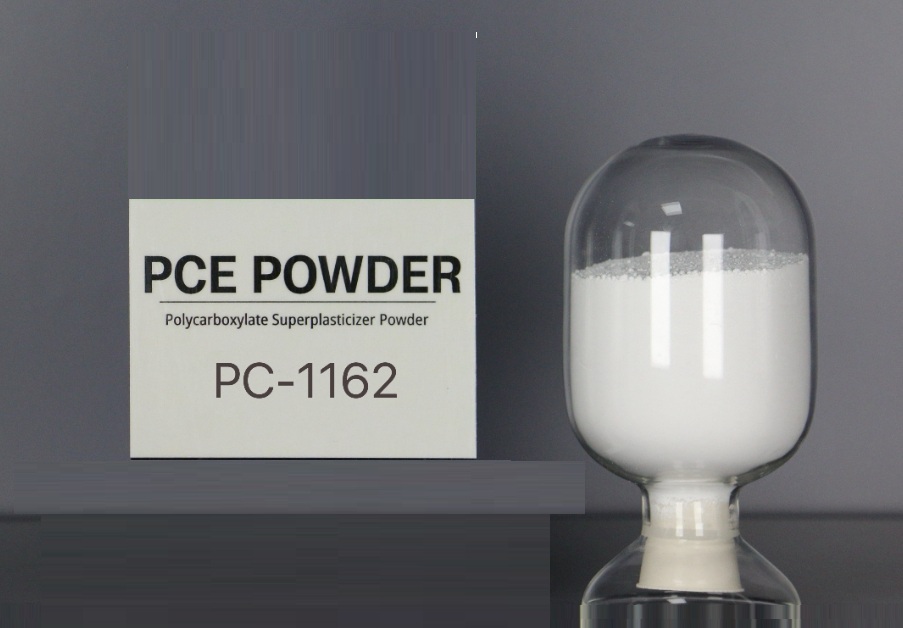
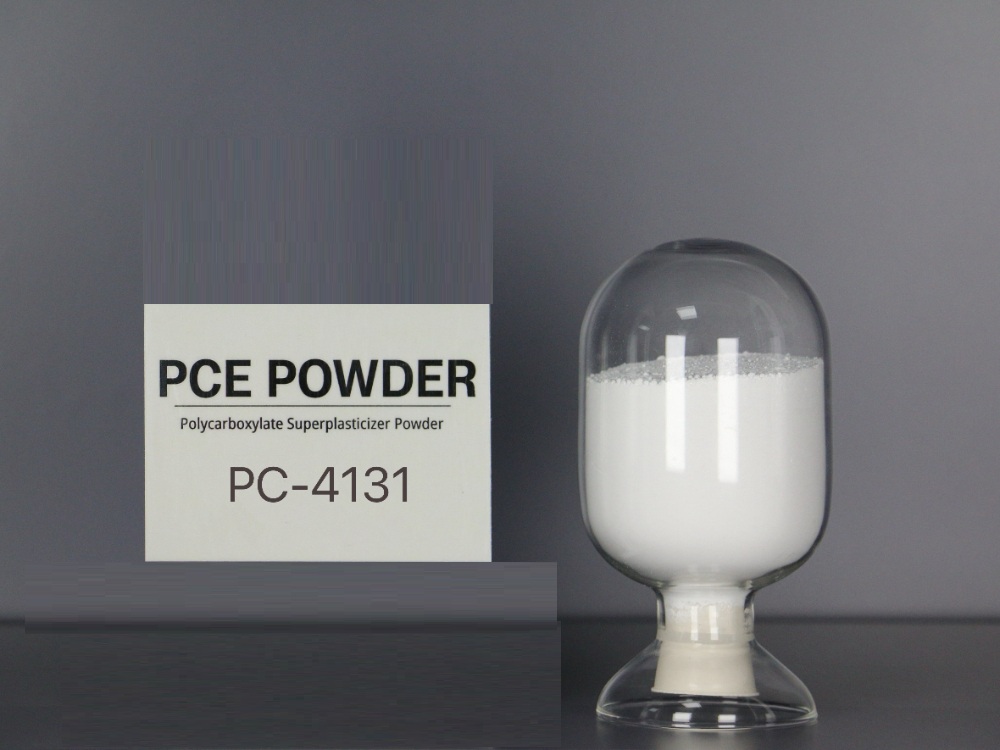
Product Names: PCE-1162, PCE-4131
Chemical Family: Polycarboxylate Ether (PCE)
CAS Number: 37199-81-8 (general PCE registration)
Chemical Class: Modified water-soluble polymer
SECTION 1: PRODUCT IDENTIFICATION AND CHEMICAL IDENTITY
| Parameter | PCE-1162 | PCE-4131 |
|---|---|---|
| Chemical Family | Polycarboxylate Ether | Polycarboxylate Ether |
| Monomer Base (Typical) | TPEG / HPEG | EPEG / VPEG (Modified) |
| Product Positioning | General Purpose / Standard Performance | High Performance / Early Strength |
| Physical Form | White – light yellow powder | White – light cream powder |
| Typical CAS No | 37199-81-8 | 37199-81-8 |
SECTION 2: PHYSICAL AND CHEMICAL PROPERTIES
| Property | PCE-1162 | PCE-4131 |
|---|---|---|
| Appearance | White – light yellow powder | White – light cream powder |
| Bulk Density (g/L) | 400 – 700 | 450 – 750 |
| Moisture Content (%) | ≤ 5.0 | ≤ 4.0 |
| pH (20% solution, 20°C) | 7.0 – 9.0 | 6.5 – 8.5 |
| Chloride Ion (%) | ≤ 0.05 | ≤ 0.03 |
| Water Solubility | Good | Very good (rapid) |
SECTION 3: PERFORMANCE COMPARISON
| Performance Criteria | PCE-1162 | PCE-4131 | Traditional PCE Group (Market Average) | PCE-4131 Advantage |
|---|---|---|---|---|
| Water Reduction Rate | ≥ 25% | ≥ 30% (very high) | 20 – 28% | +5-10% higher water reduction |
| Recommended Dosage (% cement weight) | 0.06 – 2.0 | 0.05 – 1.5 | 0.10 – 2.5 | 20-40% lower dosage for same performance |
| Early Strength Development (1 day) | Good (reference) | Very Good / High | Moderate-Good | 15-25% higher early strength |
| Final Strength (28 days) | Good (reference) | High | Moderate-Good | 10-15% higher final strength |
| Slump Retention (25°C) | 60 – 90 minutes | 90 – 120 minutes | 45 – 90 minutes | 30-60 minutes longer workability |
| Low w/c Ratio Tolerance (<0.30) | Limited | Excellent | Limited-Moderate | Superior dispersion in extremely low w/c |
| Clay & Fines Compatibility | General purpose, good | Modified, very good | Moderate | Effective even with high clay aggregates |
| Concrete Viscosity Control | Moderate | Very good (low viscosity) | Moderate | More flowable, easier to pump |
SECTION 4: ADVANTAGES OVER MARKET EQUIVALENTS
| Criteria | PCE-1162 | PCE-4131 |
|---|---|---|
| Main Advantage | • Balanced price-performance ratio • Wide application range • Sufficient performance in standard concrete grades • More economical than premium PCE group |
• 30-40% higher water reduction compared to standard TPEG/HPEG products • Superior early strength due to EPEG/VPEG modified structure • Same workability with lower dosage • Excellence in challenging weather and long-distance pumping |
| Main Disadvantage | • Limited performance at very low w/c ratios (<0.30) • Shorter slump retention than EPEG/VPEG premium products • Additional dosage may be required for high clay aggregates |
• Higher unit cost than standard TPEG-based products • High dosage sensitivity; overdose may cause setting delay • Cost advantage not realized for low-strength concrete classes (below C25) |
| Competitive Advantage Summary | Cost-effectiveness and broad application compatibility | High water reduction, early strength, and slump retention |
SECTION 5: ADVANTAGES OVER OTHER ADMIXTURE TYPES
| Comparison | PCE-1162 & PCE-4131 | SNF-based Superplasticizers | Modified Lignosulfonates (MLS) |
|---|---|---|---|
| Water Reduction | 25 – 40% | 15 – 25% | 8 – 15% |
| Slump Retention | 60 – 120 minutes | 30 – 60 minutes | 15 – 30 minutes |
| Strength Increase | Very High | Moderate-High | Low-Moderate |
| Setting Delay | Controlled, low | Moderate | None / Slight |
| Color & Appearance | White/cream; suitable for architectural concrete | Dark brown; color issues | Dark brown; color issues |
| Air Entrainment | Low and controlled | Moderate-High | High |
| Shrinkage Control | Good | Moderate | Poor |
| PCE Advantage Summary | Next-generation technology | 40-60% more effective water reduction than SNF | 2-3 times higher performance than MLS |
SECTION 6: APPLICATION AND DOSAGE COMPARISON
| Application | PCE-1162 Dosage (%) | PCE-4131 Dosage (%) | Traditional PCE Group (%) | PCE-4131 Advantage |
|---|---|---|---|---|
| Ready-Mix Concrete (C25-C50) | 0.08 – 0.20 | 0.06 – 0.15 | 0.10 – 0.25 | Lower dosage achieves similar workability |
| High-Strength Concrete (>C60) | 0.20 – 1.0 | 0.15 – 0.80 | 0.25 – 1.5 | Superior performance at very low w/c ratios |
| Self-Compacting Concrete (SCC) | 0.20 – 1.0 | 0.15 – 0.80 | 0.25 – 1.2 | Better flow and segregation resistance |
| Precast Concrete Elements | 0.10 – 0.25 | 0.08 – 0.20 | 0.10 – 0.30 | Early high strength, reduced formwork removal time |
| Dry Mortar / Grout / SLU | Not suitable / Moderate | 0.05 – 0.15 | – | Excellent flowability and smooth surface |
SECTION 7: PREPARATION, USE AND STORAGE CONDITIONS
| Process Step | PCE-1162 | PCE-4131 |
|---|---|---|
| Solution Preparation | Slowly add powder to clean water under mechanical stirring. 20-40% stock solution can be prepared. | Same procedure. Shorter dissolution time due to finer particle structure. |
| Addition to Concrete | Added with mixing water or as solution to wet concrete. | Same as PCE-1162. Faster effect onset. |
| Storage & Shelf Life | 24 months in original closed packaging, dry and cool conditions. | 24 months under same conditions. More resistant to caking due to lower moisture content (<4%). |
SECTION 8: MARKET POSITION AND TECHNOLOGICAL CLASSIFICATION
PCE superplasticizers are classified by monomer base and performance level:
| Class | Monomer Base | Performance Level | Comparison with PCE-1162 & PCE-4131 |
|---|---|---|---|
| Standard / Economy PCE | TPEG / MPEG | Moderate | PCE-1162 is in the upper segment of this group, offering higher water reduction and better slump retention |
| High-Performance PCE | HPEG / EPEG | High | PCE-4131 belongs to this group, providing superior early strength and lower dosage advantage with modified polymer structure |
| Ultra High-Performance PCE | VPEG / Special modified | Very High | PCE-4131 performs close to this group; however, special VPEG-based products are more suitable for ultra-high-strength (>C100) concrete |
SECTION 9: GENERAL ADVANTAGES OF PCE TECHNOLOGY
-
Third Generation Technology: PCE superplasticizers are the most advanced concrete admixtures after lignosulfonates (1st generation) and SNF/SMF (2nd generation).
-
Superior Water Reduction: Up to 40% water reduction compared to traditional admixtures, significantly improving concrete strength and durability.
-
Lower Dosage: 20-50% less dosage required for the same workability compared to conventional products.
-
Extended Workability: Slump retention up to 2 hours, ideal for hot weather and long-distance pumping.
-
Architectural Concrete: White/cream color makes it suitable for architectural and decorative concrete applications without discoloration.
-
Low Air Entrainment: Controlled air content optimizes freeze-thaw resistance.
-
Environmentally Friendly: Achieves equivalent strength with less cement; reduces carbon footprint.
SECTION 10: SAFETY AND REGULATORY INFORMATION
| Parameter | Information |
|---|---|
| GHS Classification | Not classified as hazardous substance or mixture according to CLP regulation. |
| Safety Precautions | As with all fine powders, avoid inhalation. Use protective gloves, goggles, and dust mask when handling large quantities. |
| Environmental Precautions | PCE polymers have low toxicity to aquatic organisms. Prevent undiluted product from entering waterways, sewers, or soil. |
| Transportation | Not classified as dangerous goods. |
SECTION 11: FREQUENTLY ASKED QUESTIONS
Q1: What is the main difference between PCE-1162 and PCE-4131 compared to other PCE products on the market?
PCE-1162 is positioned in the upper segment of standard TPEG/HPEG-based products, offering balanced price-performance ratio with a wide application range. PCE-4131, with its modified EPEG/VPEG structure, provides 30-40% higher water reduction, 15-25% higher early strength, and 30-60 minutes longer slump retention compared to standard market products.
Q2: Why should PCE-1162 and PCE-4131 be preferred over SNF-based superplasticizers?
PCE-based products offer 40-60% more water reduction, longer workability retention, higher strength increase, and suitable color for architectural concrete applications compared to SNF. They also achieve the same performance with lower dosage, providing cost-effectiveness.
Q3: When should PCE-1162 be preferred over PCE-4131?
For low-strength concrete classes (C25-C40), standard ready-mix applications, and cost-sensitive projects, PCE-1162 is the more suitable choice.
Q4: Why is PCE-4131 dosage more sensitive?
Due to its modified polymer structure, the active ingredient efficiency is very high. Exceeding the recommended upper limit may cause excessive setting delay or segregation. Therefore, precise determination of optimal dosage through preliminary mix trials is critical.
Q5: What monomer bases are PCE products classified by in the market?
TPEG, MPEG, HPEG, APEG, and EPEG-based PCE products are available. TPEG and HPEG-based products are most common (>85% market share); EPEG/VPEG-based products are newer generation, preferred for high-performance applications.
Q6: What should be considered when choosing between PCE powder and liquid forms?
Powder form offers longer shelf life, lower transportation costs, and advantages for international trade. Liquid form is practical for daily use in ready-mix plants and allows direct dosage. Liquid form is more common with 64% market share, but powder form is growing faster.
SECTION 12: SUMMARY AND CRITICAL NOTES
Product Summary
| Parameter | PCE-1162 | PCE-4131 |
|---|---|---|
| Product Code | PCE-1162 | PCE-4131 |
| Chemical Family | Polycarboxylate Ether | Polycarboxylate Ether |
| Monomer Base | TPEG / HPEG | EPEG / VPEG (Modified) |
| Water Reduction | ≥ 25% | ≥ 30% |
| Dosage Range | 0.06 – 2.0% | 0.05 – 1.5% |
| Slump Retention | 60 – 90 minutes | 90 – 120 minutes |
| Primary Application | General-purpose, cost-effective | High-performance, early strength |
Critical Notes
-
Third Generation Technology: PCE superplasticizers are the most advanced generation of concrete admixtures, offering superior water reduction, workability control, and durability enhancement compared to traditional admixtures.
-
PCE-1162 Positioning: Standard-performance PCE with balanced price-performance ratio, suitable for a wide range of ready-mix and precast applications. Offers ≥25% water reduction and 60-90 minutes slump retention.
-
PCE-4131 Positioning: High-performance PCE with modified EPEG/VPEG structure, providing ≥30% water reduction, 90-120 minutes slump retention, and significantly higher early and final strength.
-
Monomer Classification: TPEG, MPEG, HPEG, APEG, and EPEG-based PCEs are available. TPEG/HPEG products (>85% market share) are most common; EPEG/VPEG products are newer generation for high-performance applications.
-
Dosage Efficiency: PCEs require 20-50% lower dosage than traditional superplasticizers, achieving the same workability with improved concrete properties.
-
Architectural Applications: White/cream color of PCE powders makes them suitable for architectural and decorative concrete without discoloration concerns.
-
Storage: PCE powders should be stored in dry, cool conditions. Shelf life is 24 months in unopened original packaging.
IMPORTANT DECLARATION: This Technical Data Sheet (TDS) is for informational purposes only and has been prepared based on available technical data. The user is responsible for determining the product's suitability for their specific application and for complying with all local, national, and international regulations. For complete safety, storage, use, transport, waste, and regulatory compliance information, refer to the official Safety Data Sheet (SDS/MSDS) provided by the manufacturer/supplier.