We unleash your business potential by maximize the business innovation.
Send EmailSodium Isopropyl Xanthate, Sodium Isopropyl Dithiocarbonate, Sodium Isopropyl Xanthogenate, SIPX, 140-93-2
Chemical Identity
-
Name: Sodium Isopropyl Xanthate
-
CAS No: 140-93-2
-
Formula: (CH₃)₂CHOCSSNa
-
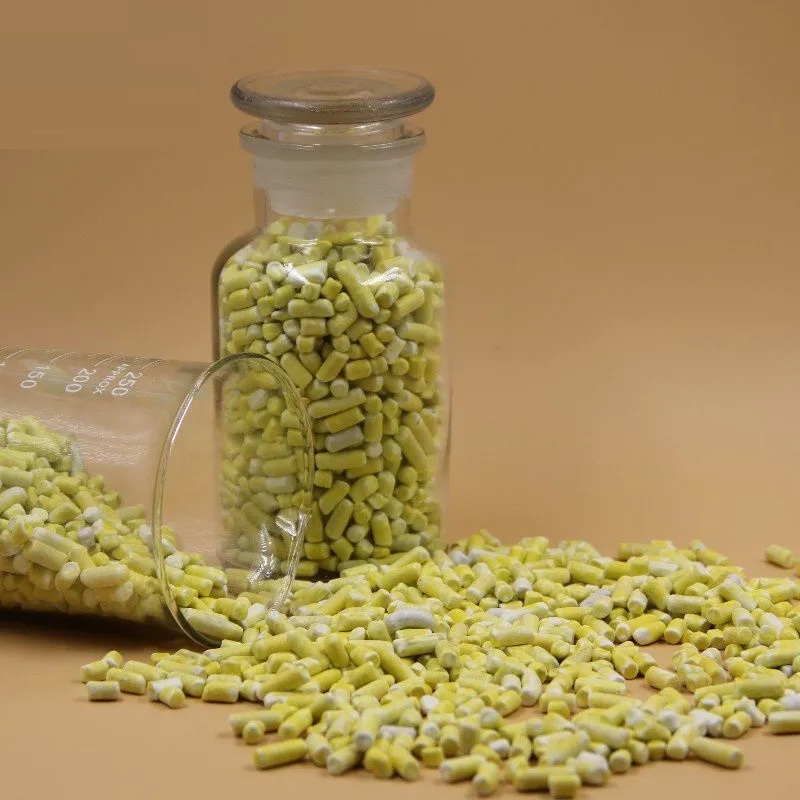
Appearance: Yellowish powder or pellets, pungent odor, freely soluble in water.
-
Other Names: Isopropylxanthic acid sodium salt, Sodium isopropyl dithiocarbonate.
Mechanism of Action in Flotation
-
SIPX is a collector reagent in mineral flotation.
-
It adsorbs onto sulfide mineral surfaces (gold, copper, lead, zinc), forming a hydrophobic film.
-
Hydrophobic particles attach to air bubbles and float, separating from gangue.
-
Compared to SEX/KEX, SIPX has a longer isopropyl chain, giving it stronger collecting power and broader mineral affinity.
Applications
-
Gold ores → widely used in flotation of gold-bearing sulfides.
-
Copper ores → chalcopyrite and other copper sulfides.
-
Lead & zinc ores → galena, sphalerite.
-
Hydrometallurgy → sometimes used as a precipitant.
-
Rubber industry → sulfidation promoter.
Advantages
-
Strong collector → effective for difficult sulfide ores.
-
Versatile → used in both mining and chemical industries.
-
Broad mineral affinity → suitable for mixed sulfide ores.
Limitations
-
Less selective than short-chain xanthates (SEX/KEX).
-
Environmental risks → degradation can release carbon disulfide (CS₂), toxic to humans and environment.
-
Hazardous substance → requires strict handling and storage protocols
SIPX – Detailed Properties Table
| Property | Description |
|---|---|
| Chemical Name | Sodium Isopropyl Xanthate |
| CAS No | 140-93-2 |
| Formula | (CH₃)₂CHOCSSNa |
| Appearance | Yellowish powder or pellets, pungent odor |
| Solubility | Freely soluble in water, forms alkaline solution |
| Other Names | Sodium isopropyl dithiocarbonate, Sodium isopropyl xanthogenate |
| Flotation Mechanism | Adsorbs onto sulfide mineral surfaces, creates hydrophobic film, enables attachment to air bubbles |
| Application Areas | Gold ores, copper sulfides (chalcopyrite), lead (galena), zinc (sphalerite), mixed sulfide ores |
| Advantages | Strong collector, broad mineral affinity, effective in difficult flotation conditions |
| Limitations | Less selective than SEX/KEX, environmental risk (CS₂ release), hazardous substance requiring strict handling |
| Summary | Medium-chain, strong flotation collector; widely used in gold and copper ores; powerful but less selective |
Xanthate – Sectoral Suitability Table
| Xanthate Type | CAS No | Suitable Sectors | Application Area | Notes |
|---|---|---|---|---|
| Sodium Ethyl Xanthate (SEX) | 140-90-9 | Mining, Metallurgy | Copper, lead, zinc sulfide ores | Shortest chain, fast and selective |
| Potassium Ethyl Xanthate (KEX) | 140-89-6 | Mining, Metallurgy | Copper, zinc ores | Potassium salt of SEX, more stable |
| Sodium Isopropyl Xanthate (SIPX) | 140-93-2 | Mining, Metallurgy | Gold, copper sulfide ores | Strong collector, broad mineral affinity |
| Sodium Isobutyl Xanthate (SIBX) | 25306-75-6 | Mining, Metallurgy | Lead, zinc sulfide ores | Balanced strength and selectivity |
| Potassium Amyl Xanthate (PAX) | 140-93-2 | Mining, Metallurgy | Gold, copper, nickel, pyrite | Most widely used, very strong collector |
| Sodium Hexyl Xanthate (SHX) | 35042-31-6 | Mining, Metallurgy | Refractory ores, difficult flotation | Long chain, strong hydrophobicity |