We unleash your business potential by maximize the business innovation.
Send EmailAmmonium Cerium Sulfate, Ceric Ammonium Sulfate, Diammonium Cerium Sulfate, 10378‑47‑9
AMMONIUM CERIUM SULFATE – AMMONIUM CERIUM SULFATE
1. CHEMICAL IDENTITY AND DEFINITION
| Parameter | Information |
|---|---|
| Chemical Name (IUPAC) | Diammonium Cerium(IV) Sulfate |
| Other Names | Ammonium Cerium Sulfate, Ceric Ammonium Sulfate, Diammonium Cerium Sulfate |
| Chemical Formula | (NH₄)₄Ce(SO₄)₄·2H₂O |
| Molecular Weight | ~632 g/mol |
| CAS Number | 10378-47-9 |
| EC Number (EINECS) | 233-782-9 |
| HS Code | 283429 |
| Purity | ≥ 98.5% (analytical reagent grade) |
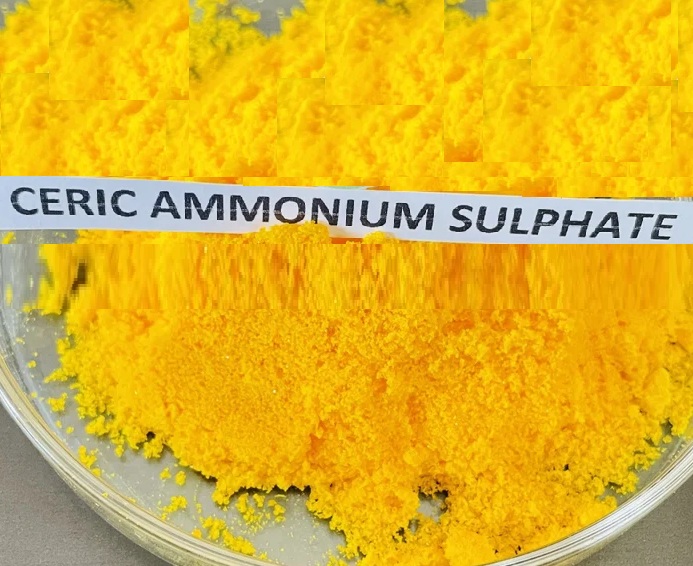
| Appearance | Light yellow-orange crystalline solid |
| Odor | Odorless |
| Physical State (20°C) | Solid (crystalline) |
| Chemical Class | Inorganic salt (cerium compound, sulfate) |
2. WHAT IS AMMONIUM CERIUM SULFATE?
Ammonium cerium sulfate is an inorganic salt composed of cerium(IV), ammonium, and sulfate ions. It appears as light yellow-orange crystals and is soluble in water. Its most important property is being a strong oxidizing agent. Due to this property, it is used as a standard reagent in cerimetry titrations in analytical chemistry, as an oxidizing agent in organic synthesis, and as a catalyst precursor in polymerization reactions. It is sensitive to moisture and light, thus requiring special packaging and storage conditions.
3. PHYSICAL PROPERTIES
| Property | Value |
|---|---|
| Appearance | Light yellow-orange crystalline solid |
| Chemical Formula | (NH₄)₄Ce(SO₄)₄·2H₂O |
| Molecular Weight | ~632 g/mol |
| Density | ~2.3 g/cm³ |
| Melting Point | ~300 °C (decomposes) |
| Solubility in Water | Soluble |
| Color | Light yellow-orange |
| Odor | Odorless |
| Hygroscopicity | Hygroscopic (absorbs moisture) |
| Crystal Structure | Monoclinic |
4. CHEMICAL PROPERTIES
| Property | Information |
|---|---|
| Chemical Formula | (NH₄)₄Ce(SO₄)₄·2H₂O |
| CAS Number | 10378-47-9 |
| EC Number | 233-782-9 |
| Cerium Content | ~22.2% |
| Oxidizing Properties | Strong oxidizing agent |
| Reactivity | Reacts with organic substances and reducing agents |
| Stability | Must be protected from moisture and light |
| Heating Behavior | Decomposes when heated |
| pH (Aqueous Solution) | Acidic |
| Redox Potential | Ce⁴⁺/Ce³⁺ (strong oxidizing agent) |
5. CHEMICAL STRUCTURE AND REDOX REACTION
Structure Formula:
(NH₄)₄ [Ce(SO₄)₄] · 2H₂O
Ionic Structure:
-
Cerium(IV) ion: Ce⁴⁺
-
Ammonium ion: NH₄⁺
-
Sulfate ion: SO₄²⁻
-
Water of crystallization: 2H₂O
Redox Reaction (Cerimetry):
Ce⁴⁺ + e⁻ → Ce³⁺
This reaction forms the basis of cerimetric titrations in analytical chemistry. The Ce⁴⁺ ion is reduced to Ce³⁺ by accepting one electron, during which a color change is observed.
6. APPLICATIONS
6.1. Analytical Chemistry (Cerimetry)
| Application | Description |
|---|---|
| Titration Reagent | Standard oxidizing agent in redox titrations |
| Cerimetry | Analysis via cerium(IV) titration |
| Iron Determination | Used in Fe²⁺ determination |
| Arsenic Determination | In As(III) determination |
| Organic Compounds | Oxidation of organic compounds |
6.2. Organic Synthesis
| Application | Description |
|---|---|
| Oxidizing Agent | Oxidizing agent in organic synthesis |
| Alcohol Oxidation | Oxidation of alcohols |
| Sulfoxide Synthesis | Oxidation of sulfur compounds |
| Quinone Synthesis | Synthesis of quinones and derivatives |
6.3. Catalyst
| Application | Description |
|---|---|
| Polymerization | Catalyst precursor in polymerization reactions |
| Fine Chemicals | Catalyst in fine chemical processes |
| Oxidation Catalyst | In oxidation reactions |
6.4. Electronics and Optics
| Application | Description |
|---|---|
| Special Material Production | Optical and electronic material production |
| Semiconductors | Semiconductor material synthesis |
| Coatings | Specialty coating processes |
6.5. Metal and Surface Treatment
| Application | Description |
|---|---|
| Specialty Coating | Metal surface treatment |
| Catalytic Processes | Catalytic surface treatments |
7. SECTOR APPLICATION TABLE
| Sector / Application | Suitability | Description |
|---|---|---|
| Textile | ❌ | No application area |
| Food | ❌ | Prohibited as food additive or in food contact materials |
| Cosmetics | ❌ | Prohibited in cosmetic formulations under CLP/REACH |
| Metal / Surface Treatment | ✅ | Used in specialty coating and catalytic processes |
| Ceramics / Glass | ✅ | Limited use in advanced material production |
| Laboratory / Research | ✅ | Widely used reagent in analytical chemistry and organic synthesis |
| Electronics / Optics | ✅ | Limited use in specialty material production |
| Construction Chemicals | ❌ | No application area |
8. SAFETY AND HEALTH INFORMATION
| Parameter | Value |
|---|---|
| Toxicity | Harmful |
| Oral LD50 (Rat) | Not available |
| Skin Contact | May cause irritation |
| Eye Contact | May cause irritation |
| Inhalation | Dust may cause respiratory irritation |
| Ingestion | Harmful if swallowed |
| Oxidizing | Strong oxidizing agent; fire risk |
| Carcinogenicity | Not classified |
| Mutagenicity | Not classified |
8.1. GHS CLASSIFICATION (CLP)
| Hazard Category | Description |
|---|---|
| Oxidizing Solid | Category 2 (H272) |
| Acute Toxicity | Category 4 (H302) |
Hazard Statements:
-
H272: May intensify fire; oxidizer
-
H302: Harmful if swallowed
-
H315: Causes skin irritation
-
H319: Causes serious eye irritation
-
H335: May cause respiratory irritation
8.2. FIRST AID MEASURES
| Route of Exposure | Action |
|---|---|
| Inhalation | Remove to fresh air. If respiratory irritation, seek medical attention. |
| Skin Contact | Wash with plenty of soap and water. |
| Eye Contact | Rinse thoroughly with water for at least 15 minutes. Seek medical attention. |
| Ingestion | Rinse mouth. Seek medical attention. |
9. STORAGE AND HANDLING
| Parameter | Information |
|---|---|
| Storage Conditions | Cool, dry, well-ventilated area |
| Container Requirements | Tightly closed, protected from moisture |
| Protect From | Moisture, light, heat, organic substances, reducing agents |
| Shelf Life | ~2 years (with proper storage) |
| Special Note | Strong oxidizing agent; keep away from combustible materials |
10. TRANSPORT INFORMATION
| Parameter | Information |
|---|---|
| UN Number | 3085 (Oxidizing Solid) |
| Hazard Class | 5.1 (Oxidizer) |
| Packing Group | II |
| ADR/RID | 5.1 |
| IMDG Code | 5.1 |
| IATA (Air) | 5.1 |
11. PACKAGING OPTIONS
| Packaging Type | Quantity | Material |
|---|---|---|
| Plastic Bottle | 100-500 g | HDPE |
| Plastic Bucket | 1-5 kg | HDPE |
| Plastic Drum | 5-25 kg | HDPE |
12. REGULATORY STATUS
| Region / Authority | Status |
|---|---|
| European Union (REACH) | Registered substance |
| USA (EPA TSCA) | Listed on TSCA inventory |
| Turkey (KKDIK) | Registered substance |
| Food | Not suitable |
| Cosmetics | Not suitable |
13. OTHER NAMES AND SYNONYMS
| Type | Name |
|---|---|
| Turkish Names | Amonyum Seryum Sülfat, Serik Amonyum Sülfat, Diamonyum Seryum Sülfat |
| English Names | Ammonium Cerium Sulfate, Ceric Ammonium Sulfate, Diammonium Cerium Sulfate |
| CAS Number | 10378-47-9 |
| EC Number | 233-782-9 |
14. SUMMARY AND CRITICAL WARNINGS
Product Summary
| Parameter | Value |
|---|---|
| Product | Ammonium Cerium Sulfate |
| CAS Number | 10378-47-9 |
| Formula | (NH₄)₄Ce(SO₄)₄·2H₂O |
| Molecular Weight | ~632 g/mol |
| Appearance | Light yellow-orange crystals |
| Primary Applications | Analytical chemistry, organic synthesis, oxidizing agent |
CRITICAL WARNINGS
1. STRONG OXIDIZER: May intensify fire. Keep away from combustible materials and reducing agents. Ensure proper storage conditions for oxidizing substances.
2. HYGROSCOPIC: Absorbs moisture. Store in tightly closed, moisture-protected containers.
3. LIGHT SENSITIVITY: Sensitive to light. Store in amber or light-protected containers.
4. HEALTH: Harmful if swallowed. Dust inhalation may cause respiratory irritation. Use protective equipment.
5. FOOD AND COSMETICS: Not suitable for food and cosmetic applications. Usage is prohibited.
6. TRANSPORT: UN 3085, Class 5.1 (Oxidizer). Packing Group II.
7. STORAGE: Store in a cool, dry, well-ventilated area in tightly closed containers. Keep away from organic substances and reducing agents.
8. PPE: Use protective gloves, safety goggles, and appropriate respiratory protection when handling.
9. ANALYTICAL CHEMISTRY: Widely used as a standard oxidizing agent in cerimetric titrations. Operates via Ce⁴⁺/Ce³⁺ redox system.
10. SHELF LIFE: Approximately 2 years under proper conditions. Should be used promptly after opening.
IMPORTANT DISCLAIMER: This Technical Data Sheet (TDS) is for informational purposes only and is prepared based on available technical data. The user is responsible for determining the suitability of the product for their specific application and for complying with all local, national, and international regulations. For complete safety, storage, use, handling, disposal, and regulatory compliance information, refer to the official Safety Data Sheet (SDS/MSDS) provided by the manufacturer/supplier. This document is not a substitute for professional or medical advice.