We unleash your business potential by maximize the business innovation.
Send EmailZinc Oxide, Zinc White, Chinese White, 1314-13-2
ZINC OXIDE (ZnO)
PRODUCT IDENTIFICATION INFORMATION
| Parameter | Information |
|---|---|
| Product Name | Zinc Oxide |
| Chemical Name (IUPAC) | Zinc Oxide |
| Synonyms (Turkish) | Çinko Oksit, Çinko Beyazı, Çinko Oksit Tozu, Aktif Çinko Oksit |
| Synonyms (English) | Zinc Oxide, Zinc White, Philosopher's Wool, Chinese White, Calamine |
| CAS Number | 1314-13-2 |
| EC Number (EINECS) | 215-222-5 |
| Molecular Formula | ZnO |
| Molecular Weight | 81.38 g/mol |
| Appearance | White to slightly yellowish amorphous powder |
CHEMICAL STRUCTURE
Zinc Oxide (ZnO)
Zn⁺² — O⁻²
Molecular Formula: ZnO
SMILES: [Zn]=O
InChI: InChI=1S/O.Zn
Structure: Hexagonal wurtzite crystal structure (most stable form); cubic zinc blende structure also exists.
SECTION 1: CHEMICAL IDENTITY AND DESCRIPTION
| Parameter | Information |
|---|---|
| Product Name | Zinc Oxide |
| Chemical Name (IUPAC) | Zinc Oxide |
| Synonyms (Turkish) | Çinko Oksit, Çinko Beyazı, Çinko Oksit Tozu, Aktif Çinko Oksit |
| Synonyms (English) | Zinc Oxide, Zinc White, Philosopher's Wool, Chinese White, Calamine |
| CAS Number | 1314-13-2 |
| EC Number (EINECS) | 215-222-5 |
| Molecular Formula | ZnO |
| Molecular Weight | 81.38 g/mol |
| Chemical Class | Inorganic compound; Metal oxide; Amphoteric oxide |
| Physical State (20°C) | Solid powder |
| Odor | Odorless |
| Color | White to slightly yellowish |
| Taste | Sweetish and astringent (experimental; do not ingest) |
SECTION 2: PHYSICAL AND CHEMICAL PROPERTIES
| Property | Value | Test Method / Note |
|---|---|---|
| Appearance | White to slightly yellowish, non-caking powder | Visual |
| Odor | Odorless | Olfactometric |
| Molecular Weight | 81.38 g/mol | Calculated |
| Density (20°C) | 5.61 g/cm³ | ASTM D4052 |
| Melting Point | 1,975°C (melts without decomposition) | DSC |
| Boiling Point | 2,360°C (sublimes) | - |
| Solubility in Water | Insoluble (0.0004 g/100 mL) | General Method |
| Solubility in Acids | Soluble (forms zinc salts in acids) | General Method |
| Solubility in Alkalis | Soluble (amphoteric; forms sodium zincate) | General Method |
| Solubility in Ethanol | Insoluble | General Method |
| pH (Suspension) | Neutral to slightly alkaline (~7-8) | pH Meter |
| Decomposition | Does not decompose upon heating; sublimes | - |
| Crystal System | Hexagonal (wurtzite) | XRD |
| Hygroscopicity | Not hygroscopic | - |
| Thermal Stability | Stable up to high temperatures | - |
| Amphoteric Character | Reacts with both acids and strong alkalis | - |
| Semiconductivity | N-type semiconductor (wide band gap 3.37 eV) | - |
SECTION 3: CHEMICAL PROPERTIES AND REACTIVITY
| Parameter | Information |
|---|---|
| Chemical Character | Inorganic amphoteric metal oxide; n-type semiconductor; strong UV absorber |
| Stability | Very stable under normal conditions; Reacts with acids and alkalis; Sublimes at high temperatures |
| Reactivity | Reacts with acids to form zinc salts; Reacts with strong alkalis to form zincates; Not oxidizing/reducing |
| Incompatible Materials | Strong acids, strong alkalis (zincate formation), aluminum and magnesium powders (at high temperatures) |
| Polymerization | Does not polymerize |
| Decomposition Products (Heating) | Does not decompose; sublimes |
| Acid Reaction | ZnO + 2HCl → ZnCl₂ + H₂O (zinc chloride and water) |
| Alkali Reaction | ZnO + 2NaOH + H₂O → Na₂[Zn(OH)₄] (sodium zincate) |
| Carbonation | Reacts slowly with CO₂ to form basic zinc carbonate |
| Photocatalytic Activity | Can generate reactive oxygen species (ROS) under UV light |
| Precipitation | Reacts with sulfides to form zinc sulfide (ZnS) (pigment and luminescence) |
SECTION 4: ZINC COMPOUNDS COMPARISON
| Property | Zinc Oxide (ZnO) | Zinc Sulfate (ZnSO₄) | Zinc Chloride (ZnCl₂) | Zinc Oxide (Active) |
|---|---|---|---|---|
| CAS Number | 1314-13-2 | 7733-02-0 | 7646-85-7 | 1314-13-2 |
| Formula | ZnO | ZnSO₄ | ZnCl₂ | ZnO |
| Molecular Weight | 81.38 | 161.45 | 136.30 | 81.38 |
| Appearance | White powder | Colorless crystals | White crystalline powder | White fine powder |
| Solubility in Water | Insoluble | Very soluble | Very soluble | Insoluble |
| Zinc Valence | Zn(II) | Zn(II) | Zn(II) | Zn(II) |
| Primary Use | Rubber, ceramics, cosmetics | Fertilizer, supplement | Soldering, galvanized steel | Rubber, electronics |
SECTION 5: PRODUCTION METHODS
Method 1: Direct (American) Process
Reaction: Zn(vapor) + O₂ → ZnO
Description: Zinc metal ore (zinc lead or scrap zinc) is heated with coke in a furnace; Zinc vaporizes and reacts with oxygen in the combustion chamber to form ZnO; Rapidly cooled and collected as powder. The product is of lower purity and coarser particle size.
Method 2: Indirect (French) Process
Reaction: 2Zn + O₂ → 2ZnO
Description: Metallic zinc is vaporized in a furnace; Zinc vapor reacts with hot air or oxygen to form ZnO; High purity (≥99.8%) and fine particle size product is obtained. This is the most commonly used method.
Method 3: Chemical (Wet) Process
Reaction: ZnSO₄ + Na₂CO₃ → ZnCO₃↓ + Na₂SO₄; ZnCO₃ → ZnO + CO₂ (calcination)
Description: Zinc sulfate solution is treated with sodium carbonate; Zinc carbonate is precipitated, filtered, and calcined to obtain ZnO. Provides high purity and controlled particle size.
Method 4: Hydrothermal / Sol-Gel Synthesis
Process: Zn-salt + Alkali → Zn(OH)₂ → ZnO (hydrothermal / sol-gel)
Description: Zinc salt (usually acetate or nitrate) solution is reacted with alkali to precipitate zinc hydroxide; The precipitate is washed and converted to ZnO nanoparticles via hydrothermal or sol-gel methods under controlled conditions. Used for nanotechnology and advanced applications.
SECTION 6: FUNCTIONAL PROPERTIES AND MECHANISM OF ACTION
| Property | Description |
|---|---|
| Activator / Accelerator (Rubber) | Used as an activator in rubber vulcanization (with sulfur); Increases vulcanization speed and efficiency; Improves cross-linking and enhances rubber's physical properties |
| UV Filter (Sunscreens) | Effectively absorbs and reflects UV-A and UV-B radiation; Provides broad-spectrum protection; Nano-sized ZnO offers transparent protection |
| Pigment (Paints and Coatings) | Used as an opacifying and whitening pigment; Although not as opaque as titanium dioxide (TiO₂), it is softer and more stable; Used in oil paints and art materials (Zinc White) |
| Antimicrobial Agent | Exhibits broad-spectrum antimicrobial activity; Effective against bacteria, fungi, and viruses; Mechanism: Generation of ROS (reactive oxygen species) and release of zinc ions that damage microbial cell membranes |
| Catalyst | Used as a catalyst in various chemical reactions; Photocatalytic properties (under UV) degrade organic pollutants; Serves as a catalyst in industrial processes such as methanol synthesis |
| Flux in Ceramics and Glass Glazes | Used as a flux in ceramic glazes and glass formulations; Lowers melting temperature; Provides gloss and durability in glazes |
| Electronics and Semiconductor | Exhibits n-type semiconductor properties; Used in transistors, diodes, sensors, and photodetectors; Applied in thin-film transistors (TFT) and transparent conductive oxides (TCO) |
| Abrasive and Polishing | Used as a polishing agent for glass and metal surfaces; Provides gentle abrasive action to clean and polish surfaces |
SECTION 7: MAIN APPLICATION AREAS
| Industry / Application | Function | Typical Use |
|---|---|---|
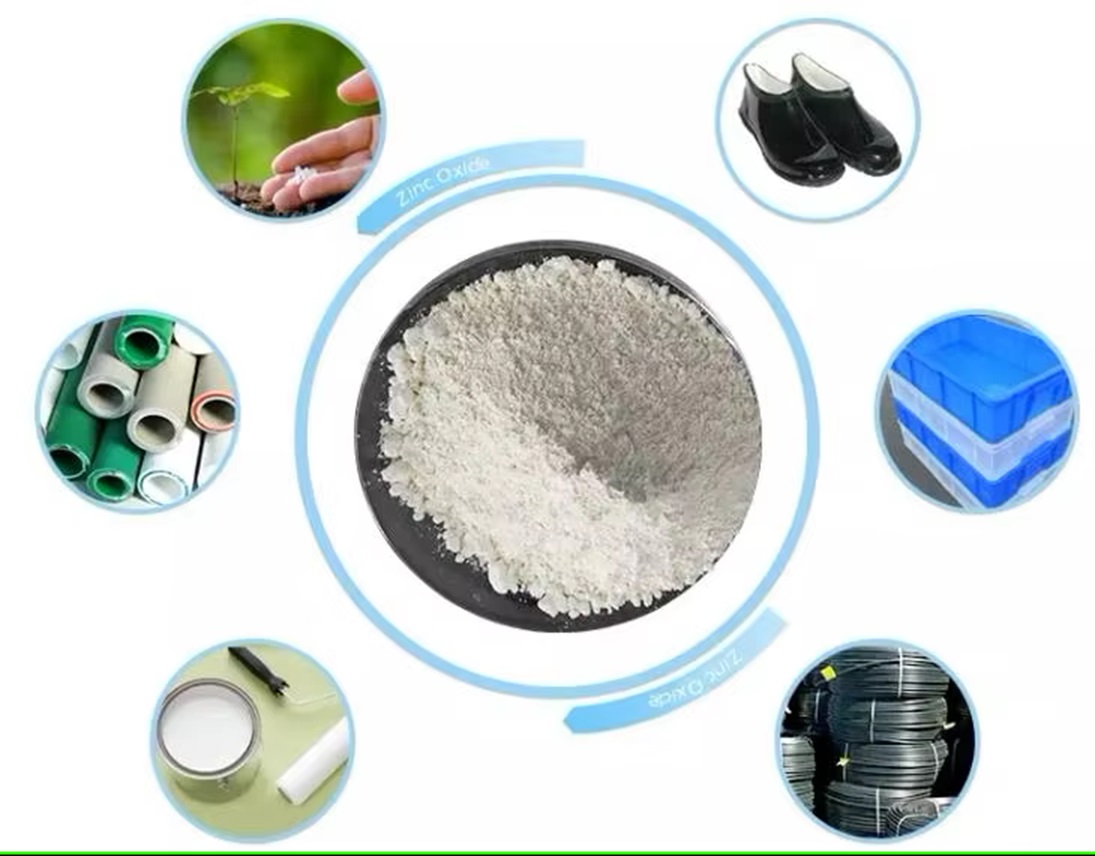
| Rubber Industry | Activator | Vulcanization accelerator; Used in all rubber products (tires, conveyor belts, shoe soles) |
| Cosmetics and Personal Care | UV filter, pigment | Sunscreens, baby powders, powders, creams, lotions, toothpastes |
| Paints and Coatings | Opacifier | White pigment (Zinc White), artists' paints, inks, enamels, protective coatings |
| Ceramics and Glass | Flux, opacifier | Glazes, enamels, glass melting, optical glasses, ceramic pigments, frit production |
| Electronics | Semiconductor | Transistors, diodes, sensors, LEDs, photodetectors, transparent electrodes |
| Agriculture | Micronutrient (fertilizer) | Used as a fertilizer additive to remedy zinc deficiency (especially for corn and wheat) |
| Chemical Catalyst | Catalyst | Methanol synthesis, desulfurization, organic synthesis reactions |
| Medical and Healthcare | Antimicrobial, antiseptic | Topical creams, ointments (zinc oxide ointment), wound healing, diaper rash prevention products |
| Textile Industry | UV protection, antimicrobial | UV-protective textiles, antimicrobial fabric finishing, moisture-wicking properties |
| Electroplating | Additive | Used as a brightening agent in zinc electroplating baths |
SECTION 8: QUALITY SPECIFICATIONS (TECHNICAL GRADE)
| Parameter | Specification | Test Method |
|---|---|---|
| Appearance | White to slightly yellowish powder | Visual |
| Assay (ZnO) | ≥ 99.0% - 99.8% | Titrimetric / ICP |
| Zinc Content (Zn) | ≥ 79.5% - 80.3% | Gravimetric / ICP |
| Water Insoluble Matter | ≤ 0.1% - 0.5% | Gravimetric |
| Loss on Drying (105°C) | ≤ 0.3% - 1.0% | Gravimetric |
| Loss on Ignition (800°C) | ≤ 0.5% - 1.5% | Gravimetric |
| pH (Suspension) | 7.0 - 8.5 (technical); 6.5 - 7.5 (pharmaceutical) | pH Meter |
| Chloride (Cl) | ≤ 0.01% - 0.05% | Titrimetric |
| Sulfate (SO₄) | ≤ 0.01% - 0.05% | Turbidimetric |
| Iron (Fe) | ≤ 0.001% - 0.005% | AAS / ICP |
| Lead (Pb) | ≤ 0.001% - 0.005% | AAS / ICP |
| Arsenic (As) | ≤ 0.0005% - 0.001% | AAS / ICP |
| Cadmium (Cd) | ≤ 0.001% - 0.005% | AAS / ICP |
| Specific Surface Area (BET) | 2 - 10 m²/g (technical); 10 - 50 m²/g (active) | BET |
| Particle Size (D50) | 0.2 - 5 µm (standard); 20 - 100 nm (nano) | Laser Diffraction / SEM |
| Tamped Density | 0.8 - 1.5 g/cm³ | ASTM D7481 |
SECTION 9: TOXICOLOGICAL PROFILE
| Parameter | Value |
|---|---|
| Acute Oral Toxicity (LD50, Rat) | > 5,000 mg/kg (low toxicity) |
| Acute Dermal Toxicity | May cause skin irritation |
| Acute Inhalation Toxicity | May cause respiratory tract irritation; Risk of metal fume fever (zinc shakes) |
| Skin Irritation | Mildly irritating |
| Eye Irritation | Causes serious eye irritation (H319) |
| Respiratory Irritation | May cause respiratory irritation; Inhalation may lead to metal fume fever |
| Chronic Toxicity | Prolonged high exposure may cause metal fume fever; Limited data |
| Carcinogenicity | IARC Group 3 (Not classifiable as carcinogenic to humans) |
| Mutagenicity | Not classified as mutagenic |
| Reproductive Toxicity | Not classified as reproductive toxic |
| Target Organs | Eyes, skin, respiratory system, lungs |
| Occupational Exposure Limit (8h TWA) | ACGIH TLV: 5 mg/m³ (respirable dust); 10 mg/m³ (total dust) |
| Special Toxicity Note | Metal fume fever (zinc shakes) may occur after inhalation, causing flu-like symptoms (transient and benign); Avoid inhalation and eye/skin contact; Nano-sized zinc oxide may exhibit higher reactivity and potential toxicity |
SECTION 10: GHS CLASSIFICATION AND LABELING
GHS Classification (in accordance with CLP and UN GHS):
| Hazard Class | Category | H-Statement |
|---|---|---|
| Skin Irritation | Category 2 | H315 |
| Eye Irritation | Category 2 | H319 |
| STOT - SE (Single Exposure) | Category 3 | H335 |
Signal Word: WARNING
Hazard Pictograms: GHS07 (Exclamation Mark)
Hazard Statements (H-Codes):
| Code | Statement |
|---|---|
| H315 | Causes skin irritation |
| H319 | Causes serious eye irritation |
| H335 | May cause respiratory irritation |
NFPA 704 Hazard Classification:
| Health | Flammability | Reactivity | Special |
|---|---|---|---|
| 2 | 0 | 0 | - |
| (Moderate health hazard) | (Will not burn) | (Stable) | (None) |
SECTION 11: PRECAUTIONARY STATEMENTS (P-CODES)
| Code | Statement |
|---|---|
| P261 | Avoid breathing dust/fume/gas/mist/vapors/spray |
| P264 | Wash hands thoroughly after handling |
| P271 | Use only outdoors or in a well-ventilated area |
| P280 | Wear protective gloves/protective clothing/eye protection/face protection |
| P302+P352 | IF ON SKIN: Wash with plenty of soap and water |
| P304+P340 | IF INHALED: Remove person to fresh air and keep comfortable for breathing |
| P305+P351+P338 | IF IN EYES: Rinse cautiously with water for several minutes. Remove contact lenses if present and continue rinsing |
| P312 | Call a POISON CENTER/doctor if you feel unwell |
| P332+P313 | If skin irritation occurs: Get medical advice/attention |
| P337+P313 | If eye irritation persists: Get medical advice/attention |
| P362+P364 | Take off contaminated clothing and wash it before reuse |
| P403+P233 | Store in a well-ventilated place. Keep container tightly closed |
| P501 | Dispose of contents/container in accordance with local/regional/national/international regulations |
SECTION 12: FIRST AID MEASURES
| Exposure Route | Action to Take |
|---|---|
| Inhalation | Remove to fresh air immediately. Rest in a position comfortable for breathing. If symptoms (cough, shortness of breath, fever) persist, seek medical attention. Monitor for metal fume fever symptoms (flu-like). |
| Skin Contact | Remove contaminated clothing. Wash skin with plenty of soap and water for at least 15 minutes. If skin irritation occurs, get medical advice/attention. |
| Eye Contact | Rinse immediately with plenty of water for at least 15 minutes. Keep eyelids open. Remove contact lenses if present. Continue rinsing. If eye irritation persists, get medical advice/attention. |
| Ingestion | Rinse mouth with water. Do NOT induce vomiting (zinc oxide is not toxic but aspiration risk exists). Drink plenty of water. If symptoms occur, seek medical attention. |
SECTION 13: FIREFIGHTING MEASURES
| Parameter | Information |
|---|---|
| Fire Hazard | Not flammable. Does not burn. However, fine dust may form explosive mixtures in air. |
| Hazards Arising from Fire | May release toxic zinc oxide fumes (ZnO fume) at high temperatures. |
| Suitable Extinguishing Media | Use extinguishing media suitable for surrounding fire. Water spray, CO₂, dry chemical powder, foam. |
| Unsuitable Extinguishing Media | None |
| Special Protective Equipment | Self-contained breathing apparatus (SCBA), full protective clothing (for surrounding fire). |
| Special Precautions | Prevent dust cloud formation. Prevent dust from entering sewers and waterways. |
SECTION 14: STORAGE AND SHELF LIFE
| Parameter | Information |
|---|---|
| Storage Conditions | Store in a cool, dry, well-ventilated area; PROTECT FROM MOISTURE (not hygroscopic but to prevent carbonation). Keep away from incompatible materials (strong acids). |
| Container Requirements | Keep in tightly closed, properly labeled containers; Must be packed to prevent dust formation. |
| Materials to Protect From | Strong acids, aluminum and magnesium powders (at high temperatures), carbon dioxide (carbonation). |
| Shelf Life | 36 - 48 months (in unopened original packaging, under proper storage conditions). |
| Stability Note | Very stable under normal conditions; Does not react with moisture and CO₂ (but carbonation may occur slowly); Avoid contact with acids. |
| Special Storage Requirements | Store separately from acids; Keep containers closed to prevent CO₂ absorption; Store in a dry and well-ventilated area. |
SECTION 15: PACKAGING OPTIONS
| Packaging Type | Quantity | Material |
|---|---|---|
| Plastic Bag | 5 kg, 10 kg, 25 kg | PE bag (inner-lined, sealed) |
| Kraft Bag | 5 kg, 10 kg, 25 kg | PE-lined kraft paper bag |
| Plastic Drum | 25 kg, 50 kg | HDPE / Polypropylene |
| Fiber Drum | 25 kg, 50 kg | PE-lined fiberboard |
| Steel Drum | 100 kg, 200 kg | Stainless steel or corrosion-resistant lined steel |
| IBC Container | 500 kg, 1000 kg | Corrosion-resistant coated HDPE / PP |
SECTION 16: TRANSPORT INFORMATION
| Parameter | Information |
|---|---|
| UN Number | Not regulated (not hazardous) - may be considered environmentally hazardous (WGK 2) |
| Hazard Class | Not applicable |
| Packing Group | Not applicable |
| ADR/RID | Not regulated |
| IMDG Code | Not regulated (not dangerous goods) |
| IATA (Air) | Not regulated |
| Marine Pollutant | No (but dust may harm aquatic ecosystems) |
| Transport Temperature | Ambient temperature; Protect from moisture. |
SECTION 17: REGULATORY STATUS
| Region / Authority | Status |
|---|---|
| European Union | REACH registered; Low hazard classification; Permitted for use in cosmetics (Annex IV / V lists). |
| USA (TSCA) | Listed (TSCA Inventory) |
| USA (FDA) | Approved for use in food additives, pharmaceuticals, and cosmetic products (21 CFR). |
| USA (EPA) | Registered as a pesticide active ingredient (antimicrobial). |
| Turkey | Industrial chemical; Subject to KKDIK regulation; Use in cosmetics and food regulated by Turkish Food Codex and cosmetic legislation. |
| IARC | Group 3 (Not classifiable as carcinogenic to humans) |
| NTP | Not listed |
| OSHA | Not regulated as toxic or carcinogenic substance |
| California (Prop 65) | Not listed |
| EU Restrictions | Not restricted under REACH Annex XVII (some limitations may apply for specific applications). |
SECTION 18: OTHER NAMES AND SYNONYMS
| Type | Name |
|---|---|
| Turkish Names | Çinko Oksit, Çinko Beyazı, Aktif Çinko Oksit, Çinko Oksit Tozu, Çinko Oksit Pigmenti |
| English Names | Zinc Oxide, Zinc White, Philosopher's Wool, Chinese White, Calamine, Zinc Monoxide, Zincite (mineral) |
| Chemical Names | Zinc Oxide; ZnO; Oxozinc; Zinco (Portuguese/Italian) |
| CAS Number | 1314-13-2 |
| EC Number | 215-222-5 |
| Molecular Formula | ZnO |
| EINECS Name | Zinc oxide |
| REACH Registration No | 01-2119463882-42-XXXX (pre-registration) |
SECTION 19: SUMMARY TABLE
| Parameter | Value |
|---|---|
| Product | Zinc Oxide (ZnO) |
| CAS Number | 1314-13-2 |
| Molecular Formula | ZnO |
| Molecular Weight | 81.38 g/mol |
| Appearance | White to slightly yellowish amorphous powder |
| Density | 5.61 g/cm³ |
| Solubility in Water | Insoluble |
| pH (Suspension) | ~7-8 |
| Primary Function | Rubber activator, UV filter, antimicrobial agent, pigment, catalyst, semiconductor |
| Main Application Areas | Rubber vulcanization, sunscreens (UV protection), cosmetics, ceramic glazes, electronics, agriculture (fertilizer), medicine (antimicrobial) |
| Shelf Life | 36 - 48 months |
| GHS Signal Word | WARNING |
| UN Number | Not regulated |
| Special Properties | Amphoteric, n-type semiconductor (wide band gap 3.37 eV), strong UV absorber, antimicrobial, photocatalytic |
SECTION 20: CRITICAL WARNINGS AND BEST PRACTICES
CRITICAL WARNINGS:
-
Causes skin irritation (H315). Avoid skin contact. Wear protective gloves.
-
Causes serious eye irritation (H319). Wear eye protection. In case of eye contact, rinse with plenty of water.
-
May cause respiratory irritation (H335). Avoid inhalation of dust. Inhalation may cause metal fume fever (zinc shakes). Use in well-ventilated areas.
-
Amphoteric. Reacts with both acids and strong alkalis. Avoid contact with incompatible substances.
-
Not hygroscopic but may carbonate with CO₂ (slowly). Keep containers closed.
-
Not flammable. However, fine dust may form explosive mixtures in air. Avoid dust formation.
-
Incompatibilities: Strong acids, strong alkalis, aluminum and magnesium powders (at high temperatures).
-
Hygiene Requirement: Wash hands thoroughly after handling. Prevent dust formation.
-
Nano-sized zinc oxide: May exhibit higher reactivity and potential toxicity. Requires special PPE and exposure control.
BEST PRACTICE RECOMMENDATIONS:
Rubber Industry: Use as an activator in rubber vulcanization; Increases vulcanization speed and efficiency; Improves cross-linking; Recommended dosage (3-10 phr ZnO per 100 phr rubber); Active zinc oxide (high surface area) provides effectiveness at lower dosages.
Cosmetics and Sunscreens: Use as a broad-spectrum UV filter (UV-A and UV-B); Nano-sized ZnO provides transparent protection, while micro-sized ZnO leaves a white residue; Used at concentrations of 10-25%; Antimicrobial properties provide preservative effects.
Paints and Coatings: Use as an opacifying white pigment (Zinc White); Preferred in oil paints, enamels, and art materials; Less opaque than TiO₂ but softer and more stable; Also used in antimicrobial coatings.
Ceramics and Glass: Use as a flux in ceramic glazes; Lowers melting temperature; Provides gloss and durability in glazes; Serves as an opacifier; Used at 1-5% in glass formulations.
Electronics: Use as an n-type semiconductor (wide band gap 3.37 eV); Used in transistors, diodes, sensors, LEDs, and photodetectors; Ideal for thin-film transistor (TFT) and transparent conductive oxide (TCO) applications; Nanoparticles used in printed electronics.
Agriculture: Use as a fertilizer additive to remedy zinc deficiency; For soil and foliar applications; Recommended application (soil): 5-10 kg/da; Foliar: 0.5-1.0% aqueous suspension.
Handling: Use in well-ventilated areas; Avoid dust formation; Wear protective gloves, safety goggles, and appropriate respiratory protection (N95/FFP2 or higher).
Personal Protective Equipment: Protective gloves (nitrile, neoprene, butyl), safety goggles (chemical splash protection), protective clothing, NIOSH-approved N95 or higher dust mask (for respirable dust), local exhaust ventilation.
Hygiene: Wash hands thoroughly after handling; Do not eat, drink, or smoke while using; Remove contaminated clothing and wash before reuse.
Storage: Store in tightly closed, properly labeled containers in dry conditions; Keep away from acids and oxidizing agents; Protect from moisture and CO₂.
Spill Management: Avoid dust formation; Vacuum or wet-sweep (to prevent dust dispersion); Place in closed containers; Do not allow entry into drains or waterways.
Disposal: Dispose of in accordance with local, regional, and national regulations; Zinc oxide is considered non-hazardous waste; Recovery is possible.
SPECIAL NOTE ON RUBBER VULCANIZATION:
Zinc oxide is an essential activator in rubber vulcanization (with sulfur):
-
Function: Activates sulfur vulcanization accelerators (e.g., MBT, CBS) and increases efficiency.
-
Mechanism: Zinc oxide reacts with stearic acid to form zinc stearate, which activates the vulcanization accelerator.
-
Dosage: 3-10 phr ZnO per 100 phr rubber (active ZnO can be used at lower dosages, 2-5 phr).
-
Advantages: Provides vulcanization at lower temperatures and shorter times; Enhanced physical properties (tensile strength, elasticity, abrasion resistance).
-
Nano ZnO: Can be used at reduced dosages (up to 50% less) due to higher surface area; Provides more homogeneous dispersion.
SPECIAL NOTE ON SUNSCREENS AND UV PROTECTION:
Zinc oxide is widely used as a broad-spectrum UV filter in sunscreens:
-
Mechanism: Absorbs and reflects UV-A (315-400 nm) and UV-B (280-315 nm) radiation. Provides broad-spectrum protection.
-
Concentration: Typically 10-25%.
-
Nano vs. Micro: Nano ZnO provides transparent protection with no white residue; Micro ZnO gives a white color (Zinc White) and provides higher reflection.
-
Advantages: More stable, photostable, lower allergenic potential than chemical UV filters, provides antimicrobial protection.
-
Safety: FDA and EU approved; Very low systemic absorption; Considered safe on the skin.
LEGAL DISCLAIMER:
The information provided in this document is based on our current knowledge and experience and is presented in good faith. However, as all conditions of use are beyond our control, it does not constitute a binding specification or warranty. This Technical Data Sheet is for informational purposes only. Users are responsible for testing the suitability for their own applications. For complete safety, storage, use, handling, waste, and regulatory compliance information, please refer to the official Safety Data Sheet (SDS/MSDS) provided by the manufacturer/supplier.