We unleash your business potential by maximize the business innovation.
Send EmailZinc Oxide, Pigment White 4, Zinc White, Activox, Gold Seal, White Seal, Florescent White, 1314-13-2
ZINC OXIDE (ZnO)
1. PRODUCT DEFINITION AND CHEMICAL IDENTITY
| Parameter | Description |
|---|---|
| Chemical Name | Zinc Oxide |
| Molecular Formula | ZnO |
| CAS Number | 1314-13-2 |
| EC Number | 215-222-5 |
| Molecular Weight | 81.38 g/mol |
| Other Names | Pigment White 4, Zinc White, Activox, Gold Seal, White Seal, Florescent White |
| Appearance | White, fine, odourless powder |
2. PHYSICAL AND CHEMICAL PROPERTIES
| Parameter | Value |
|---|---|
| Appearance | White, fine, odourless powder |
| Melting Point | 1975 °C (sublimes) |
| Density (20 °C) | 5.68 g/cm³ |
| Solubility in Water | Very low (1.2 – 2.9 mg/L) |
| pH (10% suspension) | 7 – 8 (neutral) |
| Particle Size | Micro: 0.5 – 5 µm / Nano: 20 – 100 nm |
| BET Surface Area | Micro: 1-5 m²/g / Nano: >10-50 m²/g |
| Refractive Index | 2.01 (high opacity) |
| Dielectric Constant | ~8.5 |
3. TYPICAL SPECIFICATIONS (Common Values for Different Types)
| Parameter | Limit / Value |
|---|---|
| Purity (ZnO) | ≥99.0% – 99.9% (grade dependent) |
| Pb (Lead) | ≤10 – 20 ppm |
| Cd (Cadmium) | ≤5 – 10 ppm |
| As (Arsenic) | ≤3 – 5 ppm |
| Hg (Mercury) | ≤1 ppm |
| Moisture (Loss) | ≤0.5% |
| Acid Insoluble | ≤0.02% |
| Coating Type (optional) | Silica, stearic acid, simethicone |
4. GRADE COMPARISON TABLE (Grade / Purity / Suitability)
| Grade / Type | Purity (%) | Surface Area (m²/g) | Suitable Sectors | Suitability Status | Critical Notes |
|---|---|---|---|---|---|
| Low Grade / Technical | 50-70 | 1-2 | General industrial filler, low-cost pigment | Limited | Definitely not suitable for cosmetic/pharma |
| Agricultural Grade | 70-85 | 2-4 | Agriculture (fertilizer, foliar spray, soil conditioner) | Suitable | Zn micronutrient, more tolerant heavy metal limits |
| Feed Grade (Low Purity) | 80-90 | 2-5 | Animal feed premix | Suitable | Heavy metals (Pb, Cd) must be strictly controlled |
| Industrial Standard (White Seal) | ≥99.0 | 3-6 | Rubber vulcanization, plastics, paint, ceramics | Suitable | Most common industrial grade |
| High Purity (Gold Seal) | ≥99.5 | 4-10 | Cosmetics, pharmaceuticals, advanced ceramics | Suitable | Compliant with GMP/cosmetic regulations |
| Pharma/Cosmetic Grade | ≥99.7 – 99.9 | 5-12 | Medicine (ointment), sunscreens, baby powder | Suitable | US USP, EU 1223/2009 compliant |
| Nano Grade (Coated/Uncoated) | ≥99.5 | 15-50 | Transparent sunscreens, antimicrobial coatings, electronics | Suitable | "Nano" label and safety dossier mandatory |
Note: Coated forms (silica, stearate) enhance dispersion and reduce photocatalytic activity (preferred for formulation stability).
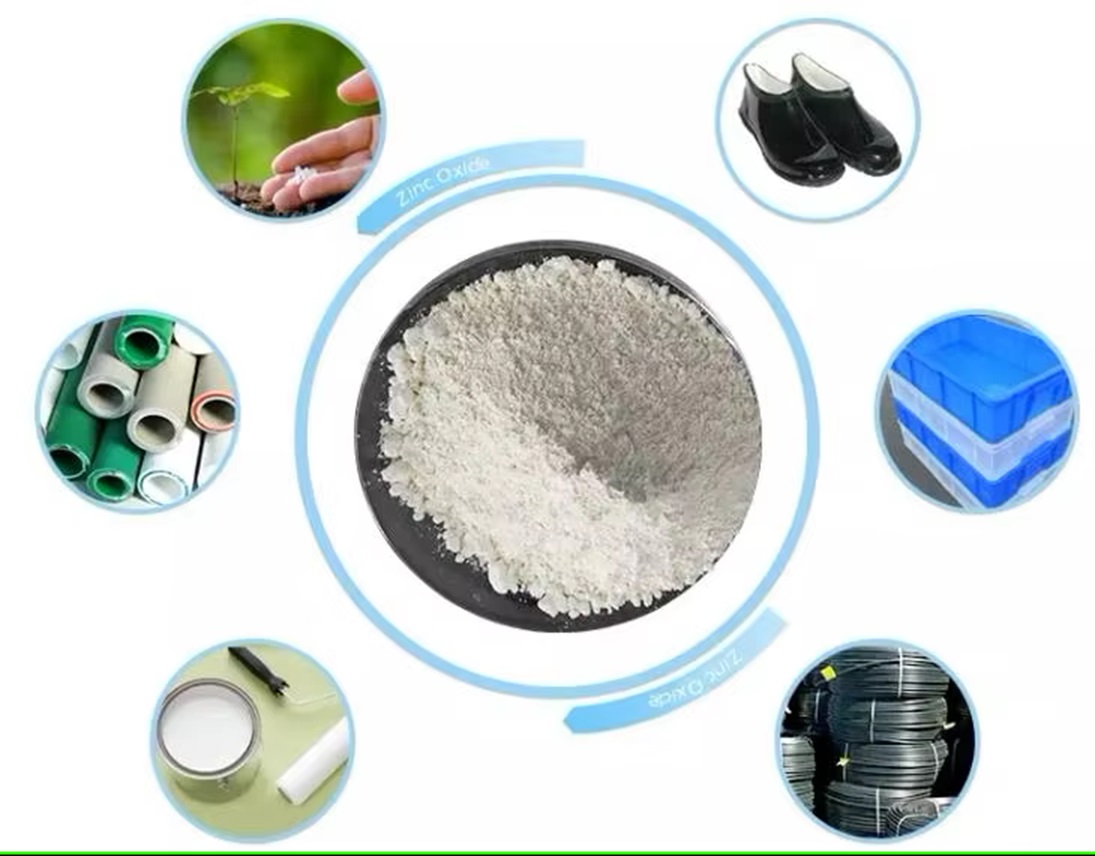
5. APPLICATION AREAS AND USAGE RATES (Sectoral)
| Sector / Application | Suitability | Typical Usage Rate | Technical Note |
|---|---|---|---|
| Sunscreens | Suitable | 5 – 25% | Nano/coated form; "nano" label required |
| Baby Powder / Diaper Rash Creams | Suitable | 5 – 20% | Gold Seal or pharma grade |
| Deodorant / Soap | Suitable | 1 – 10% | Odour control, antimicrobial |
| Rubber (Vulcanization) | Suitable | 3 – 5 phr | Activator (zinc stearate formation) |
| Paint / Coatings | Suitable | 5 – 15% | UV absorber, corrosion inhibitor, opacifier |
| Ceramics / Glass | Suitable | 2 – 10% | Flux, thermal shock resistance, gloss |
| Plastics / Polymers | Suitable | 0.5 – 5% | UV stabilizer, antioxidant, antimicrobial |
| Textiles (Finishing) | Suitable | 1 – 5% | Antimicrobial finish, whiteness |
| Agriculture (Fertilizer) | Suitable | 0.1 – 0.5% Zn | Foliar or soil application |
| Animal Feed | Suitable | 0.02 – 0.2% Zn | Immunity and growth support |
| Electronics (Varistors) | Suitable | 1 – 10% | Piezoelectric, semiconductor |
| Flame Retardant | Suitable | 2 – 10% | Reduces flammability in plastics/coatings |
| Ink / Pigment | Suitable | 5 – 20% | White pigment (oil paint, offset) |
| Catalyst Support | Suitable | 1 – 10% | Nanostructured forms preferred |
6. EXAMPLE FORMULATIONS
A. Sunscreen (Nano ZnO, SPF 30+)
| Ingredient | Ratio (%) |
|---|---|
| Nano ZnO (coated, 30% dispersion) | 20.0 |
| O/W emulsifier | 5.0 |
| Water | 60.0 |
| Oil phase (caprylic/capric triglyceride) | 10.0 |
| Preservative, glycerin, xanthan gum | 5.0 |
B. Baby Diaper Rash Cream
| Ingredient | Ratio (%) |
|---|---|
| ZnO (Pharma Grade) | 15.0 |
| Petrolatum | 60.0 |
| Lanolin | 15.0 |
| Zinc stearate | 5.0 |
| Vitamin E | 1.0 |
C. Rubber Vulcanization Activation (NR/BR Compound)
| Ingredient | phr |
|---|---|
| Natural Rubber (NR) | 100 |
| ZnO (Industrial Grade) | 5 |
| Stearic acid | 2 |
| Sulfur | 2.5 |
| CBS (accelerator) | 1 |
D. Antimicrobial Paint (Interior)
| Ingredient | Ratio (%) |
|---|---|
| Acrylic emulsion | 40 |
| Water | 25 |
| TiO₂ | 10 |
| ZnO (High Purity) | 5 |
| Calcite | 15 |
| Dispersant, thickener | 5 |
7. ALTERNATIVES (Compared to ZnO)
| Alternative Material | Advantages | Disadvantages | Replacement Area |
|---|---|---|---|
| TiO₂ (Titanium Dioxide) | Higher opacity, cheaper | Photocatalytic (degradation), UVB filter | Paint, plastics, sunscreen |
| Dibutyl Phthalate | Flexibility | Toxic, restricted | Plasticizer (not a replacement) |
| Zinc Stearate | Lubricity, water repellency | No UV protection like ZnO | Cosmetics, rubber mould release |
| Copper Oxide | Antimicrobial (stronger) | Coloured, higher toxicity | Agriculture, antifouling |
| Magnesium Oxide | More alkaline, non-flammable | No UV absorption | Flame retardant, pharmaceutical |
| Organic UV Filters (Avobenzone, etc.) | Transparent, high UV-A protection | Stability issue, allergy | Sunscreens |
Summary: TiO₂ is the closest alternative, but ZnO's antimicrobial and UV-A+UV-B balance along with its soft texture make it indispensable in baby and sensitive skin products.
8. FREQUENTLY ASKED QUESTIONS (FAQ)
Q1: Is Nano ZnO safe?
The Cosmetics Regulation (EC 1223/2009) permits nano ZnO, but "nano" labelling on the packaging is mandatory. It is restricted in spray products to avoid lung inhalation. Absorption through healthy skin is negligible.
Q2: Why is ZnO insoluble in water?
ZnO's water solubility is very low (≤3 mg/L). However, it dissolves in acid or base, releasing Zn²⁺ ions (the antimicrobial effect comes from these ions).
Q3: Why do some sunscreens appear transparent even though ZnO is a white powder?
Nano-sized ZnO (20-50 nm) does not scatter light in the visible region (400-700 nm); it only absorbs UV – a "transparent" formulation is possible.
Q4: What is the shelf life, and how should it be stored?
3 years (in dry, cool, ventilated, closed packaging). It can react with moisture and CO₂ to form zinc carbonate (loss of activity).
Q5: Which grade should I choose?
-
Cosmetics & Pharma → Gold Seal or Pharma Grade (≥99.5%, low heavy metals)
-
Rubber & Industrial → Industrial Standard (≥99%)
-
Agriculture → Agricultural Grade (≥70%, economical)
-
Transparent UV protection → Nano Grade + coated
Q6: Is there a risk of metal fume fever?
Yes, if ZnO vapour is inhaled during smelting or high-temperature processes, flu-like symptoms can occur. N95 mask and local exhaust ventilation are essential for occupational health.
9. REGULATORY AND COMPLIANCE (Summary)
| Regulation | Condition / Status |
|---|---|
| EU 1223/2009 (Cosmetics) | Permitted as a UV filter; labelling mandatory for nano form |
| REACH / CLP | Registered; respirable fraction classified for powder form |
| FDA | Category I (GRASE) in OTC sunscreens |
| Food Contact | Not a direct additive; migration testing required |
| Occupational Safety | Exposure limit (TWA 8 hours): 5 mg/m³ (respirable) |
10. PACKAGING AND LOGISTICS INFORMATION
| Parameter | Detail |
|---|---|
| Packaging Types | 25 kg kraft bag (paper/PE inner liner), 500 kg big-bag, 1000 kg drum |
| Storage | Dry (≤ 60% RH), cool (10-30°C), away from sunlight, separate from acids |
| Shelf Life | 3 years (in original packaging) |
| Transport Class | UN 3077 (Environmentally hazardous solid substance), Class 9, PG III |
11. OCCUPATIONAL HEALTH AND SAFETY WARNINGS
| Hazard | Precaution |
|---|---|
| Inhalation | P95 or FFP2 mask (in case of dusting risk) |
| Gloves | Nitrile or neoprene |
| Eye Protection | Dust-proof safety goggles |
| Ventilation | Local exhaust ventilation (LEV) preferred |
| First Aid | If dust inhaled, move to fresh air; if in eyes, rinse with plenty of water |
This document serves as a comprehensive reference for Zinc Oxide (ZnO). For a specific application (e.g., approval of a recipe containing nano ZnO), verification with the relevant regulatory authority or the supplier's quality department is recommended.