We unleash your business potential by maximize the business innovation.
Send EmailTertbutyl Benzothiazole Sulfenamide, Tert-butyl Benzothiazole Sulfenamide, TBBS, TBBS-80, 95-31-8
TERT-BUTYL BENZOTHIAZOLE SULFENAMIDE (TBBS)
PRODUCT IDENTIFIER INFORMATION
| Parameter | Information |
|---|---|
| Product Name | Tert-Butyl Benzothiazole Sulfenamide (TBBS) |
| Chemical Name (IUPAC) | N-tert-Butyl-2-benzothiazole sulfenamide |
| CAS Number | 95-31-8 |
| EC Number (EINECS) | 202-409-1 |
| Molecular Formula | C₁₁H₁₄N₂S₂ |
| Molecular Weight | 238.37 g/mol |
SECTION 1: CHEMICAL IDENTITY AND DESCRIPTION
| Parameter | Information |
|---|---|
| Chemical Name (IUPAC) | N-tert-Butyl-2-benzothiazole sulfenamide |
| Systematic Name | N-(1,1-Dimethylethyl)-2-benzothiazolesulfenamide |
| Synonyms | TBBS, TBBS-80, Tert-butyl Benzothiazole Sulfenamide, N-tert-Butyl-2-benzothiazolesulfenamide, Accelerator NS, Tertbutyl Benzothiazole Sulfenamide, Tersiyerbutil Benzotiyazol Sülfenamid |
| Trade Names | Vulkacit TBBS, Rhenogran TBBS, Santocure TBBS, Altax TBBS, Accelerator NS |
| Abbreviations | TBBS, TBBS-80 (masterbatch form) |
| CAS Number | 95-31-8 |
| EC Number (EINECS) | 202-409-1 |
| Molecular Formula | C₁₁H₁₄N₂S₂ |
| Molecular Weight | 238.37 g/mol |
| Chemical Class | Sulfenamide (delayed-action accelerator for rubber vulcanization) |
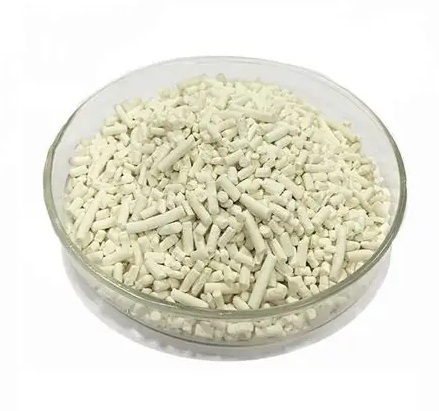
| Physical State (20°C) | Solid (light yellow-gray powder or granules) |
| Odor | Characteristic slight amine odor |
| Taste | Not applicable (industrial rubber additive) |
SECTION 2: PHYSICAL AND CHEMICAL PROPERTIES
| Property | Value | Test Method |
|---|---|---|
| Appearance | Light yellow-gray powder or granules | Visual |
| Odor | Characteristic slight amine odor | Olfactometric |
| Molecular Weight | 238.37 g/mol | Calculated |
| Melting Point | 104 – 110°C | DSC |
| Density (25°C) | ~1.29 – 1.31 g/cm³ | ASTM D4052 |
| Solubility in Water | Insoluble | General Method |
| Solubility in Organic Solvents | Soluble in chloroform, carbon disulfide, benzene; moderately soluble in ethanol, acetone | General Method |
| Active Content (TBBS-80) | ~80% (20% elastomer binder) | TGA |
| Stability | Stable under normal conditions | |
| Flash Point | >200°C | ASTM D93 |
SECTION 3: CHEMICAL PROPERTIES AND REACTIVITY
| Parameter | Information |
|---|---|
| Chemical Character | Sulfenamide; delayed-action primary accelerator for sulfur vulcanization |
| Stability | Stable under normal conditions |
| Decomposition Products (Heating) | CO, CO₂, NOx, SOx, amine compounds |
| Incompatible Materials | Strong oxidizing agents, strong acids |
| Activation Mechanism | Cleaves at sulfenamide bond upon heating; releases 2-mercaptobenzothiazole (MBT) and tert-butylamine which act as active accelerator and activator respectively |
| Delayed Action | Provides excellent processing safety with long scorch time; ideal for high-temperature processing |
| Nitrosamine Risk | Medium (may produce nitrosamines with certain secondary amine sources) |
| Hazardous Polymerization | Does not occur |
SECTION 4: RUBBER ACCELERATORS COMPARISON
| Property | TBBS | CBS | MBTS | MBT | ZDEC |
|---|---|---|---|---|---|
| CAS Number | 95-31-8 | 95-33-0 | 120-78-5 | 149-30-4 | 14324-55-1 |
| Chemical Class | Sulfenamide | Sulfenamide | Thiazole Disulfide | Thiazole | Dithiocarbamate |
| Acceleration Speed | Fast (delayed action) | Fast (delayed action) | Medium-fast | Medium-fast | Ultra-fast |
| Scorch Safety | Excellent | Excellent | Good | Good | Low (scorch risk) |
| Mechanical Properties | Excellent | Excellent | Good | Good | Good |
| Nitrosamine Risk | Medium | Low | No | No | Low |
| Activation Temperature | 140-180°C | 140-180°C | 140-170°C | 140-160°C | 80-120°C |
| Primary Use | Tires, mechanical goods, automotive | Tires, mechanical goods | General rubber, hoses, belts | General rubber | Latex, low-temp cure |
| Typical Dosage (phr) | 1.0-3.0 | 1.0-3.0 | 1.0-3.0 | 1.0-3.0 | 0.5-2.0 |
SECTION 5: FUNCTIONAL PROPERTIES AND MECHANISM OF ACTION
| Property | Description |
|---|---|
| Delayed-Action Accelerator | Provides long scorch time and excellent processing safety; ideal for high-temperature mixing and processing |
| High Mechanical Strength | Imparts excellent tensile strength, tear resistance, and abrasion resistance to vulcanizates |
| Fast Cure Rate at Temperature | Once activated at vulcanization temperature (140-180°C), provides rapid and efficient crosslinking |
| Wide Compatibility | Compatible with NR, SBR, NBR, BR, EPDM, and other general-purpose elastomers |
| Activator Release | Upon heating, releases MBT (accelerator) and tert-butylamine (activator); provides self-activating cure system |
| Reversion Resistance | Good resistance to reversion (over-cure degradation) especially in NR compounds |
| Synergy with Secondary Accelerators | Can be used with small amounts of dithiocarbamates or thiurams for faster cure without significant scorch penalty |
SECTION 6: PRIMARY APPLICATION AREAS
| Sector / Application | Function | Typical Dosage (phr) |
|---|---|---|
| Automotive Tires (Radial and Bias) | Primary accelerator | 1.0 – 3.0 |
| Technical Rubber - Gaskets, Seals | Primary accelerator, mechanical strength | 1.0 – 2.5 |
| Technical Rubber - Hoses | Primary accelerator | 1.0 – 2.5 |
| Technical Rubber - Vibration Mounts | Primary accelerator, dynamic properties | 1.0 – 2.5 |
| Conveyor Belts | Primary accelerator | 1.0 – 2.5 |
| Automotive Rubber (Non-Tire) | Primary accelerator | 1.0 – 2.5 |
| Natural Rubber (NR) Compounds | Primary accelerator | 1.0 – 3.0 |
| Synthetic Rubber (SBR, NBR, EPDM) | Primary accelerator | 1.0 – 3.0 |
| General Industrial Rubber Goods | Primary accelerator | 1.0 – 3.0 |
SECTION 7: QUALITY SPECIFICATIONS (TECHNICAL GRADE / TBBS-80 MASTERBATCH)
| Parameter | Specification | Test Method |
|---|---|---|
| Appearance | Light yellow-gray powder or granules | Visual |
| Active Content (TBBS-80) | 79 – 81% | TGA / HPLC |
| Free MBT | ≤ 1.0% | Titrimetric / HPLC |
| Melting Point (Pure TBBS) | 104 – 110°C | DSC |
| Loss on Drying (105°C, 2 hours) | ≤ 1.0% | Gravimetric |
| Ash Content (Pure TBBS) | ≤ 0.5% | Gravimetric (600°C) |
| Residue on Sieve (100 mesh) | ≤ 0.5% | Sieve Analysis |
| Binder Content (TBBS-80) | 19 – 21% (EPDM/EVA binder) | Calculated |
| Heavy Metals (as Pb) | ≤ 10 ppm | ICP-MS |
| Lead (Pb) | ≤ 2 ppm | ICP-MS |
| Cadmium (Cd) | ≤ 1 ppm | ICP-MS |
SECTION 8: TOXICOLOGICAL PROFILE
| Parameter | Value |
|---|---|
| Acute Oral Toxicity (LD50, Rat) | > 5,000 mg/kg (low toxicity) |
| Skin Irritation | Mild irritant |
| Eye Irritation | Mechanical irritant (dust) |
| Respiratory Irritation | Inhalation of dust may cause mechanical irritation |
| Skin Sensitization | Low sensitization potential |
| Carcinogenicity | Not classified |
| Mutagenicity | Negative in standard tests |
| Nitrosamine Risk | Medium (may form nitrosamines with certain secondary amines) |
| Environmental Toxicity | Harmful to aquatic organisms |
SECTION 9: GHS CLASSIFICATION AND LABELING
GHS Classification (compliant with 1272/2008/EC):
| Hazard Class | Category | H-Statement |
|---|---|---|
| Skin Irritation | Category 2 | H315 |
| Eye Irritation | Category 2 | H319 |
| STOT - SE | Category 3 | H335 |
| Aquatic Toxicity (Chronic) | Category 3 | H412 |
Signal Word: WARNING
Hazard Pictograms: GHS07 (Exclamation Mark)
Hazard Statements (H-Codes):
| Code | Statement |
|---|---|
| H315 | Causes skin irritation |
| H319 | Causes serious eye irritation |
| H335 | May cause respiratory irritation |
| H412 | Harmful to aquatic life with long lasting effects |
SECTION 10: PRECAUTIONARY STATEMENTS (P-CODES)
| Code | Statement |
|---|---|
| P261 | Avoid breathing dust |
| P264 | Wash hands thoroughly after handling |
| P271 | Use only outdoors or in a well-ventilated area |
| P280 | Wear protective gloves/eye protection |
| P302+P352 | IF ON SKIN: Wash with plenty of water and soap |
| P304+P340 | IF INHALED: Remove person to fresh air and keep comfortable for breathing |
| P305+P351+P338 | IF IN EYES: Rinse cautiously with water for several minutes. Remove contact lenses if present |
| P312 | Call a POISON CENTER/doctor if you feel unwell |
| P501 | Dispose of contents/container to approved hazardous waste facility |
SECTION 11: FIRST AID MEASURES
| Exposure Route | Action to Take |
|---|---|
| Inhalation | Move to fresh air. Seek medical attention if respiratory irritation persists. |
| Skin Contact | Wash with plenty of water and soap for at least 15 minutes. Remove contaminated clothing. |
| Eye Contact | Rinse immediately with plenty of water for at least 15 minutes. Remove contact lenses if present. Seek medical attention. |
| Ingestion | Rinse mouth with water. Do NOT induce vomiting. Drink plenty of water. Seek medical attention. |
SECTION 12: FIREFIGHTING MEASURES
| Parameter | Information |
|---|---|
| Fire Hazard | Combustible organic powder |
| Hazards During Fire | CO, CO₂, NOx, SOx, amine compounds |
| Suitable Extinguishing Media | Water mist, CO₂, dry chemical powder, foam |
| Special Protective Equipment | Self-contained breathing apparatus (SCBA), full protective clothing |
| Special Precautions | Prevent dust accumulation; avoid sparks |
SECTION 13: STORAGE AND SHELF LIFE
| Parameter | Information |
|---|---|
| Storage Conditions | Cool (15-25°C), dry, well-ventilated area; protect from direct light |
| Container Requirements | Tightly closed, moisture-proof containers |
| Keep Away From | Strong oxidizing agents, strong acids, heat sources |
| Shelf Life | 24 months (unopened original packaging under appropriate storage conditions) |
| Stability Note | Stable under normal conditions |
SECTION 14: PACKAGING OPTIONS
| Packaging Type | Quantity | Material |
|---|---|---|
| Kraft bag with PE inner liner | 25 kg | Kraft paper + PE |
| PP woven bag with PE inner liner | 25 kg | PP woven + PE |
| Fiber drum | 25-50 kg | Fiberboard + PE |
| Big-Bag | 500-1000 kg | Polypropylene (with PE inner liner) |
SECTION 15: TRANSPORTATION INFORMATION
| Parameter | Information |
|---|---|
| UN Number | Not regulated (not hazardous for transport) |
| Hazard Class | Not applicable |
| Packing Group | Not applicable |
| ADR/RID | Not regulated |
| IMDG Code | Not regulated |
| IATA (Air) | Not regulated |
| Marine Pollutant | No |
| Transport Temperature | Ambient; protect from heat and moisture |
SECTION 16: REGULATORY STATUS
| Region / Authority | Status |
|---|---|
| European Union | REACH registered; industrial rubber chemical |
| USA (TSCA) | Listed |
| FDA (Rubber Articles) | Suitable for food contact rubber articles (with limitations) |
| Turkey | Industrial chemical; subject to chemical registration regulations |
| BfR (Germany) | Suitable for food contact rubber articles (with limitations) |
SECTION 17: OTHER NAMES AND SYNONYMS
| Type | Name |
|---|---|
| Common Names | TBBS, TBBS-80, Tert-butyl Benzothiazole Sulfenamide, Accelerator NS |
| Chemical Names | N-tert-Butyl-2-benzothiazole sulfenamide, N-(1,1-Dimethylethyl)-2-benzothiazolesulfenamide |
| Trade Names | Vulkacit TBBS, Rhenogran TBBS, Santocure TBBS, Altax TBBS |
| Turkish Names | Tertbütil Benzotiyazol Sülfenamid, Tersiyerbutil Benzotiyazol Sülfenamid, N-Tersiyerbutil-2-benzotiyazol-sülfenamid |
| CAS Number | 95-31-8 |
| EC Number | 202-409-1 |
SECTION 18: ACCELERATOR COMPARISON TABLE
| Property | ZDMC | ZDEC | ZDBC | ZMBT | TBBS |
|---|---|---|---|---|---|
| CAS No. | 137-30-4 | 14324-55-1 | 136-23-2 | 155-04-4 | 95-31-8 |
| Nitrosamine Risk | Low | Low | Low | Medium | Medium |
| Curing Speed | Fast | Ultra-fast | Medium | Medium | Delayed (Fast at temp) |
| Dispersion | High (PD) | High (PD) | Medium | Medium | Medium |
| Toxicity | Low | Low | Low | Low | Low |
| Melting Point | >180°C | >180°C | ~200°C | ~250°C | 104-110°C |
SECTION 19: TBBS SECTORAL SUITABILITY TABLE
| Sector | TBBS Suitability | Description |
|---|---|---|
| Natural Rubber | Medium | Can be used as secondary accelerator |
| Synthetic Rubber (SBR, NBR) | High | Provides high performance |
| Latex Systems | Not suitable | Not suitable due to delayed vulcanization |
| Automotive Tires | High | High mechanical strength and processability |
| Medical Products | Not suitable | Not preferred due to nitrosamine risk |
| General Industrial Rubber | High | High abrasion and tear resistance |
| Technical Rubber | High | Ideal for gaskets, hoses, vibration parts |
SECTION 20: SUMMARY TABLE
| Parameter | Value |
|---|---|
| Product | Tert-Butyl Benzothiazole Sulfenamide (TBBS) |
| CAS Number | 95-31-8 |
| Molecular Formula | C₁₁H₁₄N₂S₂ |
| Molecular Weight | 238.37 g/mol |
| Appearance | Light yellow-gray powder or granules |
| Melting Point | 104 – 110°C |
| Primary Function | Delayed-action fast primary rubber vulcanization accelerator |
| Masterbatch Form | TBBS-80 (80% active) |
| Shelf Life | 24 months |
| GHS Signal Word | Warning |
SECTION 21: CRITICAL WARNINGS AND BEST PRACTICES
CRITICAL WARNINGS:
-
Not for Latex: Not suitable for latex dipping systems due to delayed vulcanization characteristics; use dithiocarbamates (ZDEC, ZDMC) instead.
-
Nitrosamine Risk: Medium nitrosamine risk; evaluate formulation carefully for sensitive applications (medical, food contact).
-
High Activation Temperature: Requires vulcanization temperatures of 140-180°C for optimal performance; ensure adequate process temperature control.
-
Dust Control: Fine powder may cause respiratory and eye irritation; use appropriate ventilation and PPE.
-
Environmental Hazard: Harmful to aquatic organisms; prevent release to the environment.
BEST PRACTICE RECOMMENDATIONS:
-
Primary Accelerator: Use at 1.0-3.0 phr as primary accelerator in NR, SBR, NBR, and EPDM compounds for high mechanical strength.
-
Automotive Tires: Preferred accelerator for tire compounds due to excellent scorch safety and mechanical properties.
-
Masterbatch Form: Prefer TBBS-80 pre-dispersed form for better dispersion and reduced dust exposure.
-
Synergy: Can be combined with small amounts (0.1-0.3 phr) of dithiocarbamates or thiurams for faster cure without significant scorch penalty.
-
Storage: Store in cool, dry environment; keep containers tightly closed to prevent moisture absorption and amine odor release.
LEGAL DISCLAIMER:
The information provided in this document is presented in good faith based on our current knowledge and experience; however, since all usage conditions are beyond our control, it does not constitute a binding specification or warranty. This Technical Data Sheet is for informational purposes only. Users are obligated to test the suitability for their own applications. For complete safety, storage, handling, transportation, disposal, and regulatory compliance information, refer to the official Safety Data Sheet (SDS/MSDS) provided by the manufacturer/supplier.