We unleash your business potential by maximize the business innovation.
Send EmailNeodymium Metal, Elemental Neodymium, 7440-00-8
NEODYMIUM METAL (ELEMENTAL NEODYMIUM)
Chemical Name: Neodymium / Elemental Neodymium
CAS Number: 7440-00-8
EC Number: 231-109-3
UN Number: 3208 (Metallic substance, water-reactive, n.o.s.)
Customs Tariff Code: 2805.30.10.00.11
1. PRODUCT IDENTIFICATION AND CHEMICAL IDENTITY
| Parameter | Description |
|---|---|
| Chemical Name | Neodymium |
| Symbol | Nd |
| CAS Number | 7440-00-8 |
| EC Number (EINECS) | 231-109-3 |
| Atomic Number | 60 |
| Atomic Weight | 144.242 g/mol ± 0.003 |
| Chemical Class | Rare earth metal (lanthanide) |
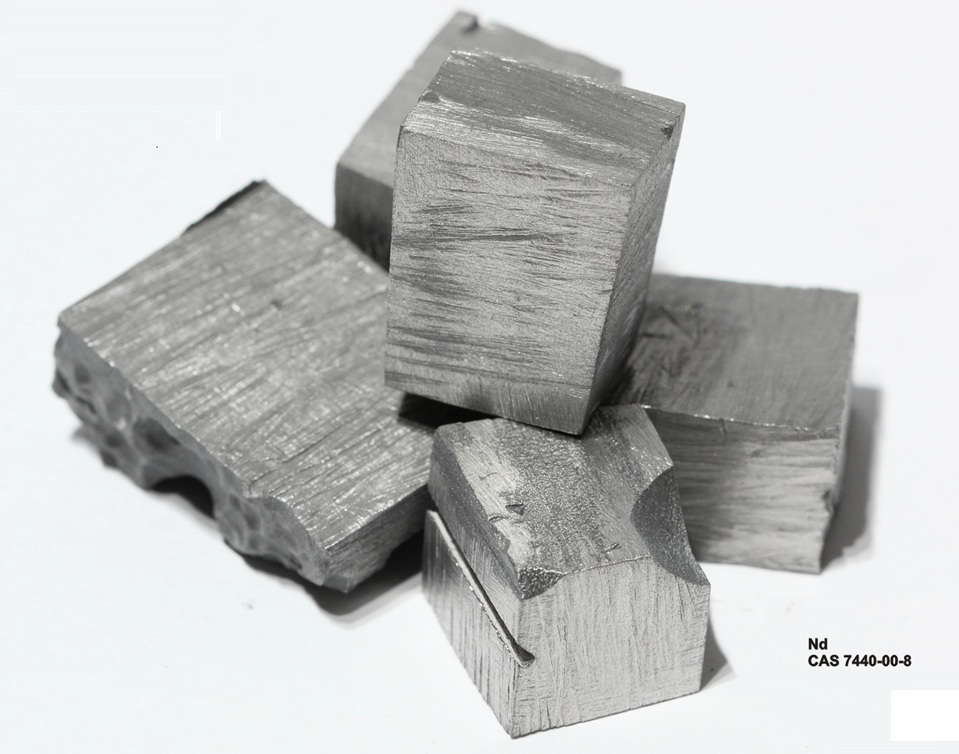
| Appearance | Bright, silvery-white metallic luster with faint yellowish/purplish tint |
| Odor | Odorless |
| Crystal Structure | Hexagonal (double hexagonal close-packed, DHCP) |
CHEMICAL STRUCTURE AND DESCRIPTION:
Neodymium is a silvery-white, lustrous rare earth metal belonging to the lanthanide series with atomic number 60. It is one of the most abundant rare earth elements, occurring in minerals such as monazite and bastnäsite. The metal exhibits a double hexagonal close-packed (DHCP) crystal structure at room temperature and transforms to body-centered cubic (BCC) at 863°C . It is highly reactive, tarnishing readily in air to form oxide and hydroxide layers, and reacts slowly with cold water but rapidly with hot water to generate hydrogen gas . Neodymium is paramagnetic at room temperature but exhibits antiferromagnetic behavior at low temperatures (Curie temperature ~19.2 K). It is the critical component in the world's strongest permanent magnets, Nd-Fe-B (neodymium-iron-boron) magnets.
Structural Features:
-
Double hexagonal close-packed (DHCP) crystal structure at room temperature
-
Transforms to body-centered cubic (BCC) at 863°C
-
Highly reactive with oxygen and moisture
-
Paramagnetic at room temperature; antiferromagnetic below 19.2 K
-
Forms characteristic purple-pink compounds in solution
2. PHYSICAL AND CHEMICAL PROPERTIES
| Property | Value |
|---|---|
| Atomic Number | 60 |
| Atomic Weight | 144.242 g/mol ± 0.003 |
| Appearance | Silvery-white lustrous metal with yellowish/purplish tint |
| Odor | Odorless |
| Density | 7.01 g/cm³ at 20°C |
| Melting Point | 1,024°C |
| Boiling Point | 3,074°C |
| Crystal Structure | Hexagonal (double hexagonal close-packed) |
| Electrical Resistivity | 64.3 µΩ·cm (room temperature) |
| Thermal Conductivity | 16.5 W/(m·K) |
| Thermal Expansion | 9.6 × 10⁻⁶/K |
| Specific Heat Capacity | 190 J/(kg·K) |
| Young's Modulus | 37.6 GPa |
| Vickers Hardness | ~343 MPa |
| Brinell Hardness | ~265 MPa |
| Electronegativity | 1.14 (Pauling scale) |
| Electron Configuration | [Xe] 4f⁴ 6s² |
| Magnetic Type | Paramagnetic (room temperature) |
| Curie Temperature | 19.2 K (antiferromagnetic transition) |
| Neutron Cross Section | 49 b (absorption) |
Neodymium is a silvery-white, lustrous metal with a density of 7.01 g/cm³, melting at 1,024°C and boiling at 3,074°C. It is moderately hard and ductile, with a double hexagonal close-packed crystal structure. The metal is paramagnetic at room temperature and becomes antiferromagnetic below 19.2 K . It has an electronegativity of 1.14 on the Pauling scale and an electron configuration of [Xe] 4f⁴ 6s².
3. REACTIVITY AND CHEMICAL BEHAVIOR
| Property | Description |
|---|---|
| Oxidation in Air | Oxidizes rapidly in air, tarnishing to yellow to dark brown/black |
| Reaction with Water | Reacts slowly with cold water; rapidly with hot water (liberates H₂) |
| Acid Dissolution | Dissolves in dilute acids releasing hydrogen |
| Halogens | Reacts vigorously with halogens |
| Oxide Formation | Forms Nd₂O₃ (neodymium sesquioxide) upon heating in air |
| Hydride Formation | Forms NdH₂ and NdH₃ upon reaction with hydrogen |
| Ignition | Finely divided powder is pyrophoric and ignites spontaneously in air |
Neodymium is a highly reactive metal that oxidizes rapidly when exposed to air, forming a yellow to dark brown/black oxide layer . It reacts slowly with cold water but rapidly with hot water, releasing hydrogen gas . The metal dissolves readily in dilute mineral acids and reacts vigorously with halogens. Finely divided neodymium powder is pyrophoric and can ignite spontaneously in air.
4. THERMAL AND MAGNETIC PROPERTIES
| Property | Value |
|---|---|
| Curie Temperature (Ferro→Para) | 19.2 K |
| Magnetic Susceptibility | χₘ = 5.48 × 10⁻⁵ (SI, room temperature) |
| Specific Heat (cp) | 190 J/(kg·K) |
| Thermal Conductivity | 16.5 W/(m·K) |
| Coefficient of Thermal Expansion | 9.6 × 10⁻⁶/K |
| Enthalpy of Fusion | 7.14 kJ/mol |
| Heat of Vaporization | 285 kJ/mol |
| Electrical Resistivity | 64.3 µΩ·cm |
5. SPECIFICATIONS (COMMERCIAL GRADES)
| Parameter | Standard Grade | High Purity Grade |
|---|---|---|
| Purity (Nd) | ≥ 99.0% | ≥ 99.5% - 99.99% |
| Appearance | Silvery-white metal (ingots, rods, lumps) | Silvery-white metal |
| Rare Earth Impurities | < 0.5% (total) | < 0.05% - 0.01% |
| Metallic Impurities | < 0.5% (total) | < 0.1% - 0.01% |
| Oxygen Content | < 0.5% | < 0.1% - 0.05% |
| Carbon Content | < 0.05% | < 0.02% |
| Nitrogen Content | < 0.05% | < 0.02% |
| Particle Size | Ingots, rods, lumps, granules, powder, turnings | |
| Packaging | Vacuum sealed in argon or mineral oil |
Neodymium metal is available in various grades from standard (≥ 99.0%) to high purity (≥ 99.99%). For Nd-Fe-B magnet production, standard grade (99.0-99.5%) is typically used. For laser crystals (Nd:YAG), high purity (99.9-99.99%) is required. The metal is supplied in various forms including ingots, rods, lumps, granules, turnings, and powder, typically packaged under vacuum or inert atmosphere (argon) to prevent oxidation.
6. APPLICATIONS AND INDUSTRIAL USES
6.1. Nd-Fe-B Permanent Magnets (Most Important Application)
| Application | Description |
|---|---|
| Nd-Fe-B Magnet Production | Primary component (approx. 25-30% Nd) in world's strongest permanent magnets |
| Electric Vehicle Motors | High-efficiency traction motors in EVs and hybrid vehicles |
| Wind Turbine Generators | Direct-drive generators with high power-to-weight ratio |
| Hard Disk Drives (HDD) | Voice coil actuators for read/write heads |
| Headphones and Speakers | High-performance audio systems |
| MRI Scanners | Superconducting magnet systems |
| Medical Devices | Magnetic resonance imaging, surgical tools |
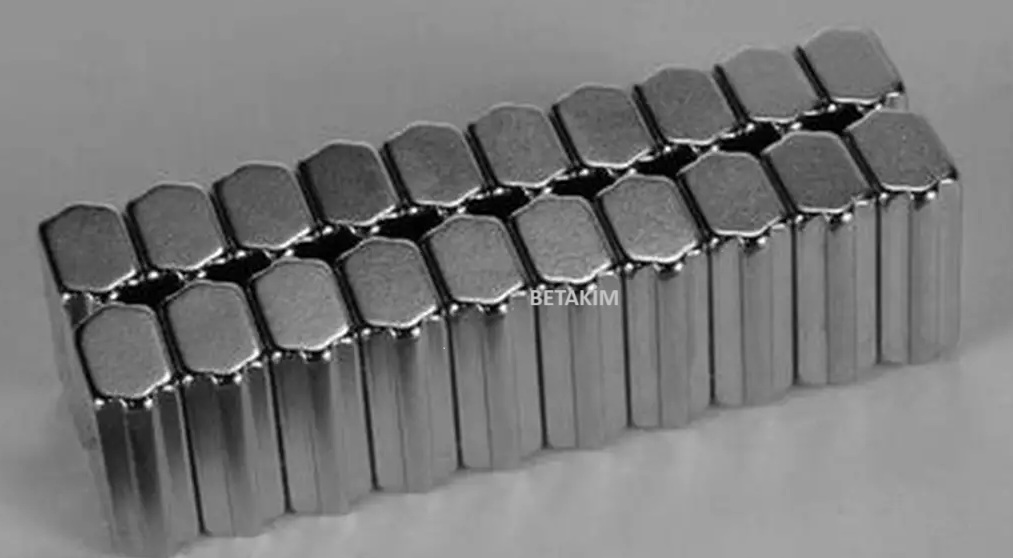
Neodymium is most famously used in Nd-Fe-B (neodymium-iron-boron) magnets, the strongest type of permanent magnets available. These magnets contain approximately 25-30% neodymium and exhibit the highest energy product (BH)max known, reaching up to 470 kJ/m³ . The combination of high magnetic strength, excellent coercivity, and relatively low cost has made them indispensable in modern technology. Applications include EV traction motors, wind turbine generators, hard disk drives, headphones, MRI scanners, and countless other devices requiring strong, compact magnetic fields.
6.2. Laser Technology
| Application | Description |
|---|---|
| Nd:YAG Lasers | Neodymium-doped yttrium aluminum garnet crystals |
| Nd:YVO₄ Lasers | Vanadate laser crystals for high-power applications |
| Nd:Glass Lasers | Solid-state lasers for scientific and industrial uses |
| Defense Lasers | Directed energy and range-finding systems |
Neodymium-doped crystals, particularly Nd:YAG (yttrium aluminum garnet) and Nd:YVO₄, are among the most widely used laser gain media. Nd:YAG lasers operate at 1,064 nm and are used extensively in industrial cutting, welding, marking, drilling, and medical applications . Nd:glass lasers are used in high-power scientific applications for inertial confinement fusion research.
6.3. Glass and Ceramics
| Application | Description |
|---|---|
| Glass Coloring | Imparts purple-pink to deep violet color to glass |
| Optical Glass | Used in special optical filters and lenses |
| Ceramic Pigments | Colorant for ceramic glazes and enamels |
| Decorative Glass | Artistic glassware and stained glass |
Neodymium compounds (primarily Nd₂O₃) are used as coloring agents for glass, giving it a characteristic purple-pink to deep violet hue . Neodymium-doped glass is also used in specialized optical applications such as astronomical filters where its sharp absorption bands provide unique spectral filtering.
6.4. Hydrogen Storage and Batteries
| Application | Description |
|---|---|
| Nickel-Metal Hydride Batteries | Alloy component for hydrogen storage |
| Hydrogen Storage Alloys | Used in hydrogen storage systems |
| Metal Hydride Systems | Hydrogen compression and storage applications |
Neodymium is used in certain hydrogen storage alloys and nickel-metal hydride (NiMH) batteries as a component of the metal hydride electrode.
6.5. Metallurgical Applications
| Application | Description |
|---|---|
| Alloying Additive | Improves high-temperature properties of alloys |
| Magnesium Alloys | Enhances strength and creep resistance |
| Aluminum Alloys | Grain refiner and deoxidizer |
Neodymium is used as an alloying element in magnesium and aluminum alloys to improve strength, high-temperature performance, and corrosion resistance.
6.6. Defense and Military Applications
| Application | Description |
|---|---|
| Laser Range-Finding | Nd:YAG lasers for targeting and distance measurement |
| Guidance Systems | Precision navigation and targeting systems |
| Radar Systems | Advanced radar and sonar components |
| Directed Energy Weapons | High-power laser weapon systems |
7. ALTERNATIVE / EQUIVALENT PRODUCTS
| Product | Description | Preference Reason |
|---|---|---|
| Praseodymium (Pr) | Magnet alloys and laser applications | Used as substitute or additive to Nd |
| Samarium (Sm) | High-temperature magnets | Superior temperature stability (>300°C) |
| Lanthanum (La) | Glass additives and alloy systems | Lower cost, different optical properties |
| Dysprosium (Dy) | Magnet additive for high-temperature applications | Improves coercivity and temperature resistance |
| Terbium (Tb) | Magnetostrictive and phosphor applications | Enhanced magnetic properties |
8. SECTOR SUITABILITY TABLE
| Sector | Suitability | Description |
|---|---|---|
| Electronics | High | Magnets, lasers, HDD, sensors, actuators |
| Defense | High | Radar, sonar, guidance, directed energy |
| Energy | High | Wind turbines, EV motors, batteries |
| Medical | High | MRI, surgical lasers, medical devices |
| Glass & Ceramics | Medium | Coloring agent, optical glass |
| Automotive | High | EV motors, sensors, hybrid systems |
| Cosmetics | Not Suitable | Direct use not recommended |
| Food & Pharmaceuticals | Prohibited | Metallic form not permitted for direct use |
9. COMMON NAMES
-
Neodymium magnet metal
-
Silvery rare earth element
-
Nd metal
-
NdFeB alloy component
-
Laser dopant metal
-
Rare earth neodymium
10. PRODUCTION PROCESS
| Stage | Description |
|---|---|
| Ore Sources | Monazite and bastnäsite (primary sources) |
| Ore Crushing | Grinding and beneficiation of ore |
| Acid Leaching | Digestion with sulfuric or nitric acid |
| Solvent Extraction | Separation of neodymium from other rare earths |
| Precipitation | Precipitation as oxalate, carbonate, or hydroxide |
| Calcination | Thermal decomposition to Nd₂O₃ |
| Electrolysis | Fused salt electrolysis of NdCl₃ or Nd₂O₃ |
| Reduction | Calcium reduction of NdF₃ or NdCl₃ |
| Vacuum Distillation | Purification by vacuum distillation |
| Forming | Casting into ingots, rods, or granulation |
Production Methods:
-
Metallothermic Reduction: NdCl₃ + 3Ca → Nd + 3CaCl₂
-
Fused Salt Electrolysis: Electrolysis of NdCl₃ in KCl/LiCl melt
Production Forms: Powder, granules, ingots, rods, lumps, turnings
Major Producing Countries: China (>85% production), United States, Australia, Myanmar
Commercial Purity: Ranges from 99% to 99.99%
11. SAFETY AND TOXICOLOGY
| Parameter | Value |
|---|---|
| GHS Classification | GHS02 (Flammable), GHS07 (Warning) |
| Hazard Statements | H228 (Flammable solid), H261 (In contact with water, releases flammable gas), H315 (Skin irritation), H319 (Eye irritation), H335 (Respiratory tract irritation) |
| Precautionary Statements | P210, P231+P232, P280, P305+P351+P338, P370+P378, P402+P404 |
| Signal Word | Danger |
| UN Number | 3208 (Metallic substance, water-reactive, n.o.s.) |
| Oral LD50 (Rat) | >5,000 mg/kg (estimated) |
| Inhalation | Respiratory tract irritation |
| Skin Irritation | Irritant |
| Eye Irritation | Irritant |
| Carcinogenicity | Not classified as carcinogenic |
SPECIAL WARNINGS: Neodymium metal is a flammable solid that reacts with water to release flammable hydrogen gas . Finely divided powder is pyrophoric and may ignite spontaneously in air. In contact with acids, it releases hydrogen gas. In case of fire, use dry sand, dry powder, or Class D extinguisher; do NOT use water, foam, or halogenated extinguishers . Chronic exposure to neodymium salts may increase blood coagulation rate, decrease cholesterol and total lipid levels . Not classified as a carcinogen.
12. TRANSPORT INFORMATION
| Parameter | Information |
|---|---|
| UN Number | 3208 (Metallic substance, water-reactive, n.o.s.) |
| Hazard Class | 4.3 (Substances which, in contact with water, emit flammable gases) |
| Packing Group | II |
| Proper Shipping Name | Metallic substance, water-reactive, n.o.s. (Neodymium) |
| Marine Pollutant | Yes |
| ADR/RID Label | 4.3 |
Neodymium metal is classified as a water-reactive substance (UN 3208, Class 4.3). Transport must be in sealed packaging under inert atmosphere or mineral oil. Fire extinguishing with water is prohibited.
13. REGULATORY INFORMATION
| Region | Status |
|---|---|
| EU | REACH registered |
| Turkey (KKDİK) | Mandatory compliance; registration required |
| USA (TSCA) | Listed |
| EINECS | 231-109-3 |
| Customs Tariff Code | 2805.30.10.00.11 |
| Other Codes | - |
Neodymium metal is registered in all major industrial markets. KKDİK registration is required for use in Turkey. It is classified under customs tariff code 2805.30.10.00.11.
14. STORAGE AND HANDLING
| Parameter | Information |
|---|---|
| Storage Conditions | Dry, well-ventilated, cool area under inert atmosphere (argon) |
| Container Requirements | Airtight, moisture-proof containers under inert gas or mineral oil |
| Special Storage | Store away from water/moisture, acids, oxidizers |
| Materials to Avoid | Water, acids, halogens, oxidizers, moisture |
| Shelf Life | Limited (oxidizes with moisture exposure) |
| Reactivity | In contact with water releases flammable hydrogen gas |
| Handling Notes | Handle under inert atmosphere; use dry techniques |
Handling Notes:
-
CRITICAL: Neodymium metal reacts with water to release flammable hydrogen gas. Handle under inert atmosphere (argon).
-
Use a glove box or dry inert atmosphere for all handling operations.
-
Avoid dust formation; fine powder is pyrophoric and may ignite spontaneously.
-
Avoid contact with water, moisture, acids, and oxidizing agents.
-
In case of fire, use dry sand or Class D extinguishers. Do NOT use water.
-
Store in airtight containers under inert gas or submerged in mineral oil.
-
Cutting, grinding, or machining generates fine particles that are pyrophoric.
-
Waste material should be placed in sealed containers under inert atmosphere.
15. FIRE-FIGHTING MEASURES
| Parameter | Information |
|---|---|
| Fire Hazard | Flammable solid; pyrophoric in powdered form |
| Extinguishing Media | Dry sand, dry powder (Class D extinguisher), soda ash, graphite powder |
| Prohibited Extinguishing Media | Water, foam, carbon dioxide (CO₂), halogenated extinguishers |
| Special Hazards | In contact with water releases flammable hydrogen gas |
| Protective Equipment | Self-contained breathing apparatus (SCBA), full protective clothing |
| Combustion Products | Neodymium oxides (Nd₂O₃), hazardous fumes |
CRITICAL FIRE SAFETY: Neodymium metal fires must NOT be extinguished with water, foam, or CO₂. Water reacts violently with the metal, releasing flammable hydrogen gas . Use only Class D dry powder extinguishers (dry sand, soda ash, graphite powder).
16. ACCIDENTAL RELEASE MEASURES
| Parameter | Information |
|---|---|
| Personal Protection | Wear appropriate PPE (self-contained breathing apparatus, protective clothing) |
| Ventilation | Increase ventilation; use inert gas purge if possible |
| Containment | Contain under inert atmosphere; prevent moisture contact |
| Cleaning Methods | Carefully collect in dry containers under inert atmosphere |
| Environmental Precautions | Prevent entry into drains, sewers, and water bodies |
| Waste Disposal | Dispose according to local regulations |
In case of spillage, appropriate personal protective equipment must be worn. Avoid moisture contact. Clean up using dry methods under inert atmosphere. Environmental release must be prevented.
17. FIRST AID MEASURES
| Exposure Route | Action |
|---|---|
| Inhalation | Move person to fresh air. If respiratory irritation persists, seek medical attention. |
| Skin Contact | Wash with plenty of water and soap; remove contaminated clothing. If irritation persists, seek medical attention. |
| Eye Contact | Rinse immediately with plenty of water for at least 15 minutes. Remove contact lenses if present. Seek medical attention. |
| Ingestion | Rinse mouth with water. Do NOT induce vomiting. Seek medical attention immediately. |
Special Notes:
-
Neodymium salts may increase blood coagulation rate
-
Medical personnel should be informed about heavy metal exposure
-
In case of ingestion, do not induce vomiting due to possible aspiration risk
18. RAW MATERIALS AND DOWNSTREAM PRODUCTS
18.1. Raw Materials (Upstream)
| Raw Material | Description |
|---|---|
| Monazite Sand | Rare earth phosphate mineral (5-20% Nd₂O₃) |
| Bastnäsite | Rare earth fluorocarbonate mineral (3-10% Nd₂O₃) |
| Neodymium Oxide (Nd₂O₃) | Intermediate for metal production |
| Neodymium Chloride (NdCl₃) | Electrolysis feed material |
| Neodymium Fluoride (NdF₃) | Reduction feed material |
18.2. Downstream Products
| Product | Application |
|---|---|
| Nd-Fe-B Magnets | Motors, generators, HDDs, sensors |
| Nd:YAG Crystals | Lasers for medical, industrial, defense |
| Nd:YVO₄ Crystals | Solid-state lasers |
| Neodymium Glass | Optical filters, decorative glass |
| Neodymium Alloys | Magnesium, aluminum, and cobalt alloys |
| Hydrogen Storage Alloys | Battery and energy storage systems |
19. QUALITY CONTROL PARAMETERS
| Parameter | Analytical Method | Description |
|---|---|---|
| Purity | ICP-OES / ICP-MS | Determination of total rare earth content |
| Rare Earth Impurities | ICP-OES / ICP-MS | Detection of other lanthanides (La, Ce, Pr, Sm, etc.) |
| Metallic Impurities | ICP-OES / ICP-MS | Fe, Ca, Mg, Al, Cu, Zn, etc. |
| Oxygen Content | Inert Gas Fusion | Determination of oxygen content |
| Carbon Content | Combustion Analysis | Determination of carbon content |
| Nitrogen Content | Inert Gas Fusion | Determination of nitrogen content |
| Particle Size | Sieve Analysis / Laser Diffraction | For powder and granular forms |
| Appearance | Visual | Surface condition and color |
| Density | Archimedes | Bulk density measurement |
| Hardness | Vickers/Brinell | Mechanical property verification |
20. SUMMARY AND CRITICAL WARNINGS
SUMMARY:
Neodymium (Nd, CAS 7440-00-8) is a silvery-white, lustrous rare earth metal with atomic number 60 and atomic weight of 144.242 g/mol. It has a density of 7.01 g/cm³, melts at 1,024°C, and boils at 3,074°C. The metal exhibits a double hexagonal close-packed crystal structure at room temperature and transforms to body-centered cubic at 863°C . It is paramagnetic at room temperature and becomes antiferromagnetic below 19.2 K. Neodymium is highly reactive, rapidly oxidizing in air and reacting with water to release hydrogen gas. Finely divided powder is pyrophoric and ignites spontaneously in air.
Its most important application is in Nd-Fe-B permanent magnets, the strongest type of permanent magnets with energy products reaching up to 470 kJ/m³ . These magnets contain approximately 25-30% neodymium and are essential in electric vehicle motors, wind turbine generators, hard disk drives, headphones, MRI scanners, and countless other modern technologies. Neodymium is also critical in laser technology as the dopant in Nd:YAG and Nd:YVO₄ crystals used for industrial, medical, and defense applications . Additional uses include glass coloring, ceramic pigments, and hydrogen storage alloys.
The metal is classified as a water-reactive dangerous substance (UN 3208, Class 4.3) and is flammable with GHS02 and GHS07 classifications. It has hazard statements H228 (Flammable solid), H261 (In contact with water releases flammable gas), H315 (Skin irritation), H319 (Eye irritation), and H335 (Respiratory tract irritation) . Storage must be under inert atmosphere (argon) in airtight containers away from moisture, acids, and oxidizers. Fire-fighting with water is strictly prohibited; only Class D dry powder extinguishers should be used.
Key Properties:
| Property | Value |
|---|---|
| Appearance | Silvery-white lustrous metal |
| Atomic Number | 60 |
| Symbol | Nd |
| Atomic Weight | 144.242 g/mol |
| CAS Number | 7440-00-8 |
| EC Number | 231-109-3 |
| Density | 7.01 g/cm³ |
| Melting Point | 1,024°C |
| Boiling Point | 3,074°C |
| Crystal Structure | Hexagonal (DHCP) |
| Electronegativity | 1.14 (Pauling) |
| Magnetic Type | Paramagnetic (room temp) |
| Primary Use | Nd-Fe-B magnets, Nd:YAG lasers |
Major Application Areas:
| Sector | Applications |
|---|---|
| Electronics | Nd-Fe-B magnets, HDDs, speakers, sensors |
| Energy | EV motors, wind turbines, batteries |
| Defense | Radar, sonar, guidance, directed energy |
| Medical | MRI, lasers, surgical instruments |
| Glass & Ceramics | Coloring, optical filters |
| Automotive | Hybrid/EV motors, sensors |
Key Safety Points:
-
FLAMMABLE: H228 (Flammable solid)
-
WATER-REACTIVE: H261 (In contact with water releases flammable gas)
-
IRRITANT: H315, H319, H335
-
UN 3208: Class 4.3, Packing Group II
-
PROHIBITED EXTINGUISHING: Water, foam, CO₂
-
APPROVED EXTINGUISHING: Dry sand, Class D powder
-
STORAGE: Inert atmosphere (argon), airtight, dry
-
HANDLING: Inert atmosphere, avoid moisture, dust, and ignition sources
CRITICAL WARNINGS:
-
WATER-REACTIVE HAZARD (H261): Neodymium metal reacts with water to release flammable hydrogen gas. Fire-fighting with water is strictly prohibited. Use only dry sand, Class D dry powder, soda ash, or graphite powder. Water can cause violent reactions and hydrogen gas explosions.
-
PYROPHORIC POWDER: Finely divided neodymium powder is pyrophoric and may ignite spontaneously in air. Cutting, grinding, or machining operations generate fine particles that present a fire and explosion hazard. Such operations must be performed under inert atmosphere or with proper dust control.
-
Nd-Fe-B MAGNET CRITICALITY: Neodymium is essential for Nd-Fe-B magnets, the strongest permanent magnets, containing 25-30% neodymium. These magnets are critical to EV traction motors, wind turbine generators, and countless high-efficiency technologies.
-
LASER CRITICALITY: Neodymium is essential for Nd:YAG and Nd:YVO₄ laser crystals, the most widely used solid-state laser gain media. High purity (99.9-99.99%) is required for laser applications.
-
SUPPLY CHAIN CRITICALITY: China controls >85% of neodymium production. The metal is classified as a critical raw material by the EU, US, and other major economies due to supply risk and economic importance.
-
CUSTOMS CLASSIFICATION: The correct customs tariff code is 2805.30.10.00.11. Correct classification is essential for international trade, with potential country-specific restrictions for rare earth metals.
-
STORAGE: Store under inert atmosphere (argon) in airtight containers away from moisture, acids, halogens, and oxidizers. For long-term storage, submersion in mineral oil is recommended for small quantities.
-
HANDLING: All handling operations must be performed under inert atmosphere using a glove box or dry inert gas environment. Containers must be opened only in dry environments under inert gas.
-
CHRONIC TOXICITY: Chronic exposure to neodymium salts may increase blood coagulation rate, decrease cholesterol and total lipid levels, and cause skin lesions. Long-term health effects are not well characterized for neodymium compounds.
-
ENVIRONMENT: Neodymium is not known to be highly toxic to the environment, but it should not be released into water bodies or soil. Waste disposal should follow local regulations for rare earth metals.
Important Disclaimer: This Technical Data Sheet (TDS) is for informational purposes only. The information provided is based on available data and is believed to be accurate. However, the user is solely responsible for determining the suitability of the product for their specific applications and for complying with all applicable regulations and safety requirements. For complete safety, handling, storage, and regulatory compliance information, always refer to the official Safety Data Sheet (SDS/MSDS) provided by the manufacturer/supplier. Users are responsible for testing the product in their own processes and applications. All local, national, and international regulations must be followed when working with Neodymium metal. Due to its flammability, water reactivity, and strategic importance, a detailed risk assessment and handling procedure must be established prior to use.