We unleash your business potential by maximize the business innovation.
Send EmailCerium Bromide, Cerous Bromide, Cerium (III) Bromide, 14457-87-5
CERIUM BROMIDE (CERIUM(III) BROMIDE)
Chemical Name: Cerium(III) Bromide / Cerium Tribromide
CAS Number: 14457-87-5
EC Number: 238-447-0
UN Number: Not classified as dangerous goods for transport
1. PRODUCT IDENTIFICATION AND CHEMICAL IDENTITY
| Parameter | Description |
|---|---|
| Chemical Name (IUPAC) | Cerium(III) bromide |
| Other Names | Cerium Bromide, Cerous Bromide, Cerium Tribromide, Cerium(III) Bromide |
| CAS Number | 14457-87-5 |
| EC Number (EINECS) | 238-447-0 |
| Molecular Formula | CeBr₃ |
| Molecular Weight | 379.83 g/mol |
| Chemical Class | Inorganic bromide / Rare earth metal halide |
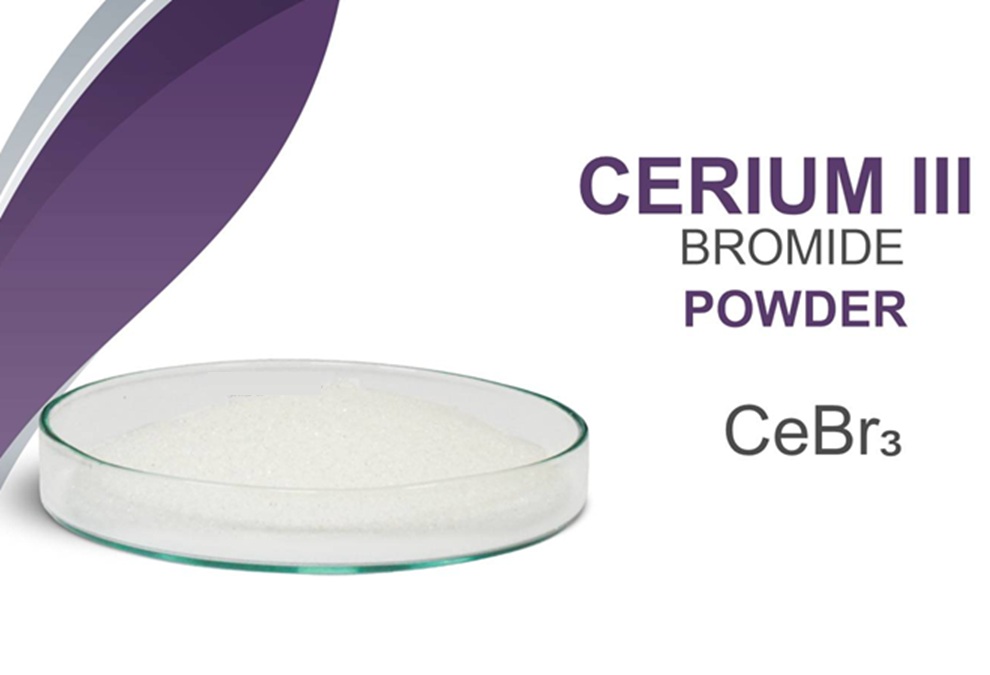
| Appearance | White to pale gray crystalline powder |
| Odor | Odorless |
| Crystal Structure | Hexagonal (UCl₃ type, space group P6₃/m) |
CHEMICAL STRUCTURE AND DESCRIPTION:
Cerium Bromide (CeBr₃) is the bromide salt of cerium in the +3 oxidation state. The anhydrous form adopts a hexagonal UCl₃-type crystal structure, where each Ce³⁺ ion is 9-coordinate in a tricapped trigonal prismatic geometry . The compound is highly hygroscopic and readily absorbs moisture from air, forming hydrated species. High-purity anhydrous Cerium Bromide is of significant interest as a component of scintillation counters for gamma-ray spectroscopy due to its excellent energy resolution, fast decay time, and extremely low intrinsic background .
Structural Features:
-
Hexagonal UCl₃-type crystal structure (space group P6₃/m)
-
9-coordinate Ce³⁺ ions in tricapped trigonal prismatic geometry
-
Highly hygroscopic
-
Soluble in water and alcohol
-
Self-activated by Ce³⁺ ion (no dopant required)
2. PHYSICAL AND CHEMICAL PROPERTIES
| Property | Value |
|---|---|
| Molecular Formula | CeBr₃ |
| Molecular Weight | 379.83 g/mol |
| Appearance | White to pale gray crystalline powder |
| Odor | Odorless |
| Density | 5.10-5.23 g/cm³ |
| Melting Point | 722-733°C |
| Boiling Point | 1457-1560°C |
| Crystal Structure | Hexagonal (UCl₃ type) |
| Solubility in Water | Soluble (4.56 mol/kg, 153.8 g/100g) |
| Hygroscopicity | Highly hygroscopic |
| Refractive Index | 2.09 (at emission wavelength) |
| Photon Yield | ~60,000 photons/MeV |
| Decay Time | 18-25 ns |
| Maximum Emission | 370-380 nm |
| Energy Resolution | 3.8-4% FWHM at 662 keV |
| Intrinsic Background | ≤0.002 c/s/cm³ (Ac-227 complex) |
Cerium Bromide is a highly hygroscopic, white to pale gray crystalline solid with a density of 5.10-5.23 g/cm³ and a melting point of 722-733°C . It is soluble in water. For scintillation applications, it offers exceptional properties: ~60,000 photons/MeV light yield, 18-25 ns decay time, and 3.8-4% energy resolution at 662 keV . A key advantage is its extremely low intrinsic background (≤0.002 c/s/cm³ from Ac-227 complex) and absence of lanthanum-138 background found in lanthanum halide scintillators .
3. SOLUBILITY PROFILE
| Solvent | Solubility | Conditions |
|---|---|---|
| Water | Soluble (4.56 mol/kg) | All temperatures |
| Ethanol | Soluble | - |
| Acetone | Soluble | - |
| Organic Solvents | Limited | - |
Cerium Bromide is soluble in water and polar organic solvents such as ethanol and acetone.
4. CHEMICAL PROPERTIES AND REACTIONS
| Property | Description |
|---|---|
| Chemical Class | Inorganic bromide / Rare earth metal halide |
| Oxidation State | Ce³⁺ (+3) |
| Hygroscopicity | Highly hygroscopic; absorbs moisture from air |
| Lewis Acidity | Functions as a Lewis acid |
| Hydrolysis | Upon heating, hydrolysis yields CeOBr |
| Dehydration | Dehydration of hydrated form to anhydrous is challenging |
Cerium Bromide is a typical rare earth halide. Its highly hygroscopic nature requires handling and storage under inert atmosphere. Hydrated forms, when heated, may undergo hydrolysis to form cerium oxybromide (CeOBr) . Dehydration of the hydrated salt to anhydrous form is challenging and can be achieved by heating with ammonium bromide (NH₄Br) under dynamic vacuum .
5. SPECIFICATIONS (TECHNICAL AND HIGH PURITY)
| Parameter | Technical Grade | High Purity |
|---|---|---|
| Purity | ≥ 99.0% | ≥ 99.9% - 99.99% |
| Appearance | White to pale gray powder | White to pale gray powder |
| Other Rare Earth Elements | ≤ 0.5% | ≤ 0.01% - 0.001% |
| Metal Impurities | ≤ 0.01% | ≤ 0.001% |
| Water Content | - | < 0.1% (ultra dry) |
| Packaging | Standard | Sealed ampoule under argon |
Cerium Bromide is available in various grades from technical to high purity (≥ 99.9% - 99.99%) . High purity grades are essential for scintillation applications where trace impurities directly affect light yield and energy resolution. Ultra dry grades with water content <0.1% are available for moisture-sensitive applications.
6. APPLICATIONS AND INDUSTRIAL USES
6.1. Scintillation Crystals and Radiation Detection (Most Important Application)
| Application | Description |
|---|---|
| Gamma-Ray Spectroscopy | Superior energy resolution (4% FWHM at 662 keV) |
| Nuclear Medicine (TOF-PET) | Fast decay time (18-25 ns), high light yield |
| Nuclear Security | Isotope identification with clean spectral background |
| Space Missions | Radiation measurement in space exploration |
| Environmental Monitoring | Low-activity source characterization |
Cerium Bromide is a state-of-the-art scintillation detector material for gamma-ray spectroscopy. It delivers 4% energy resolution at 662 keV compared to ~7% for NaI(Tl), and 3% at 1332 keV compared to 5.5% for NaI(Tl) . The material is self-activated by Ce³⁺ ions, requiring no dopant. A key advantage is the absence of ¹³⁸La intrinsic background, making CeBr₃ superior to LaBr₃(Ce) for low-background applications .
6.2. Organic Synthesis and Catalysis
| Application | Description |
|---|---|
| Lewis Acid Catalyst | Functions as a mild Lewis acid in organic reactions |
| Chemical Reagent | Cerium source in organometallic synthesis |
6.3. Vacuum Systems and Coatings
| Application | Description |
|---|---|
| Evaporation Source | Used in vacuum deposition systems |
| Thin Film Coatings | Optical and electronic thin film production |
6.4. Research and Laboratory Applications
| Application | Description |
|---|---|
| Analytical Reagent | Used in rare earth element analysis |
| Materials Synthesis | Precursor for advanced materials |
7. ALTERNATIVE / EQUIVALENT PRODUCTS
| Product | Description | Preference Reason |
|---|---|---|
| Cerium Chloride (CeCl₃) | Similar solubility and catalytic properties | Lower cost, less hygroscopic |
| Lanthanum Bromide (LaBr₃) | Similar optical and spectroscopic applications | Higher light yield, but has ¹³⁸La background |
| Cerium Fluoride (CeF₃) | Optical glass and coating applications | UV transmittance |
8. SECTOR SUITABILITY TABLE
| Sector | Suitability | Description |
|---|---|---|
| Radiation Detection | High | Scintillation crystal for gamma spectroscopy |
| Laboratory & R&D | High | Reagent and analytical standard |
| Organic Chemistry | Medium | Lewis acid catalyst |
| Vacuum & Coating | Medium | Evaporation and thin film applications |
| Defense | High | Spectroscopic systems |
| Cosmetics | Not Suitable | Direct use not recommended |
| Food & Pharmaceuticals | Prohibited | Not permitted for direct use |
9. COMMON NAMES
-
Cerium salt
-
Cerium tribromide
-
White bromide crystal
-
Scintillation additive
-
Cerium bromide powder
-
Cerous bromide
-
Rare earth bromide
10. PRODUCTION PROCESS
| Stage | Description |
|---|---|
| Starting Material | Cerium carbonate (Ce₂(CO₃)₃·H₂O) or cerium oxide |
| Acid Dissolution | Reaction with hydrobromic acid: Ce₂(CO₃)₃·H₂O + 6HBr → 2CeBr₃ + 3CO₂↑ + (x+3)H₂O |
| Crystallization | Crystallization of CeBr₃·6H₂O or CeBr₃·7H₂O |
| Mixing with NH₄Br | Mixing with NH₄Br in 1:0.8 ratio |
| Stepwise Heating | Programmed heating under vacuum (room temperature → 410°C) |
| Heating Program | 180°C (2h) → 300°C (4h) → 360°C (2h) → 410°C (6-6.3h) |
| Cooling | Natural cooling to 50°C |
| Packaging | Vacuum packaging under inert atmosphere |
Reaction Equations:
Acid Dissolution:
Ce₂(CO₃)₃·xH₂O + 6HBr → 2CeBr₃ + 3CO₂↑ + (x+3)H₂O
Dehydration (NH₄Br Method):
CeBr₃·6H₂O + NH₄Br → NH₄CeBr₄·xH₂O → CeBr₃ + NH₄Br↑ + H₂O↑
Production Types: Technical, high purity, and ultra dry grades
Major Producing Countries: China, India, United States
Commercial Purity: Ranges from 99% to 99.99%
11. SAFETY AND TOXICOLOGY
| Parameter | Value |
|---|---|
| GHS Classification | GHS07 (Warning) |
| Hazard Statements | H315 (Skin irritation), H319 (Serious eye irritation), H335 (May cause respiratory irritation) |
| Precautionary Statements | P261, P280, P302+P352, P304+P340, P305+P351+P338 |
| Signal Word | Warning |
| Skin Irritation | Irritant |
| Eye Irritation | Irritant |
| Inhalation | Respiratory tract irritation |
| Carcinogenicity | Not classified |
| Transport | Not dangerous goods |
SPECIAL WARNINGS: Cerium Bromide causes skin irritation, serious eye irritation, and may cause respiratory irritation . Due to its highly hygroscopic nature, it must be handled under inert atmosphere. Aqueous solutions may cause irritation upon skin and eye contact. Chronic exposure to cerium salts may increase blood coagulation rate and cause skin lesions . Not classified as a carcinogen.
12. TRANSPORT INFORMATION
| Parameter | Information |
|---|---|
| UN Number | None (Not dangerous goods) |
| Hazard Class | None |
| Packing Group | None |
| Proper Shipping Name | None |
| Marine Pollutant | No |
Cerium Bromide is not classified as dangerous goods for transport . Due to moisture sensitivity, shipping must be in sealed ampoules or airtight containers under inert atmosphere.
13. REGULATORY INFORMATION
| Region | Status |
|---|---|
| EU | REACH registered |
| Turkey (KKDİK) | Mandatory compliance; registration required |
| USA (TSCA) | Listed |
| EINECS | 238-447-0 |
| Customs Tariff Code | 2846.90.00.00.19 |
Cerium Bromide is registered in all major industrial markets. KKDİK registration is required for use in Turkey. It is classified under customs tariff code 2846.90.00.00.19.
14. STORAGE AND HANDLING
| Parameter | Information |
|---|---|
| Storage Conditions | Under inert gas (nitrogen/argon), 2-8°C |
| Container Requirements | Airtight, moisture-proof containers |
| Special Storage | Use glove bag or dry box for handling |
| Materials to Avoid | Moisture, air, oxidizing agents |
| Shelf Life | Limited (decomposes with moisture exposure) |
| Hygroscopicity | Highly hygroscopic |
| Packaging Options | 1 g, 5 g, 10 g, 25 g, 100 g sealed ampoules |
Handling Notes:
-
CRITICAL: This compound is highly hygroscopic and must be handled under inert atmosphere
-
Use a glove bag or dry box for all handling operations
-
Use airtight, moisture-proof containers after opening
-
Avoid skin and eye contact (use protective gloves and safety goggles)
-
Avoid dust formation and inhalation
-
Store under nitrogen or argon
-
Use in well-ventilated areas or under fume hood
-
For scintillation applications, crystals are delivered hermetically sealed
15. FIRE-FIGHTING MEASURES
| Parameter | Information |
|---|---|
| Fire Hazard | Not flammable |
| Extinguishing Media | Water spray, CO₂, dry chemical powder |
| Special Hazards | May release toxic bromide fumes at high temperatures |
| Protective Equipment | Self-contained breathing apparatus (SCBA), full protective clothing |
| Decomposition Products | Hydrobromic acid fumes, cerium oxides |
Cerium Bromide is not a flammable substance. In case of fire, protective clothing and SCBA must be used. Thermal decomposition may release toxic hydrobromic acid fumes and cerium oxides.
16. ACCIDENTAL RELEASE MEASURES
| Parameter | Information |
|---|---|
| Personal Protection | Wear appropriate PPE (dust mask, safety goggles, protective clothing, gloves) |
| Ventilation | Increase ventilation |
| Containment | Prevent dust dispersion; contain spill |
| Cleaning Methods | Carefully sweep or vacuum; place in appropriate disposal container |
| Environmental Precautions | Prevent entry into drains, sewers, and water bodies |
| Waste Disposal | Dispose according to local regulations |
In case of spillage, appropriate personal protective equipment must be worn. Clean up using dry methods under inert atmosphere to prevent decomposition.
17. FIRST AID MEASURES
| Exposure Route | Action |
|---|---|
| Inhalation | Move person to fresh air. If respiratory irritation persists, seek medical attention. |
| Skin Contact | Wash with plenty of water and soap; remove contaminated clothing. If irritation persists, seek medical attention. |
| Eye Contact | Rinse immediately with plenty of water for at least 15 minutes. Remove contact lenses if present. Seek medical attention. |
| Ingestion | Rinse mouth with water. Drink plenty of water. Do NOT induce vomiting. Seek medical attention. |
Special Notes:
-
Bromide salts are generally of low acute toxicity
-
Medical personnel should be informed about bromide salt exposure
-
In case of ingestion, do not induce vomiting due to possible aspiration risk
18. RAW MATERIALS AND DOWNSTREAM PRODUCTS
18.1. Raw Materials (Upstream)
| Raw Material | Description |
|---|---|
| Monazite Sand | Rare earth element ore containing cerium |
| Bastnäsite | Rare earth carbonate mineral |
| Cerium Carbonate (Ce₂(CO₃)₃) | Starting material for acid dissolution |
| Hydrobromic Acid (HBr) | Bromide source |
| Ammonium Bromide (NH₄Br) | Used for dehydration |
18.2. Downstream Products
| Product | Application |
|---|---|
| CeBr₃ Scintillation Crystals | Radiation detection, nuclear medicine |
| Cerium Oxide (CeO₂) | Optics, catalysts, CMP |
| Organocerium Reagents | Organic synthesis |
| CeBr₃-doped Materials | Special optical applications |
19. QUALITY CONTROL PARAMETERS
| Parameter | Analytical Method | Description |
|---|---|---|
| Purity | Titration / ICP | Complexometric titration or ICP analysis |
| Cerium Content | Gravimetric / ICP | Elemental analysis |
| Bromide Content | Titration | Argentometric titration |
| Rare Earth Impurities | ICP-MS / ICP-OES | Detection of other lanthanides |
| Metal Impurities | ICP-MS / ICP-OES | Fe, Ca, Mg, Na, Zn, Cu, etc. |
| Water Content | Karl Fischer | <0.1% target |
| Appearance | Visual | White to pale gray |
| Scintillation Performance | Light Yield / Energy Resolution | 4% FWHM at 662 keV |
20. SUMMARY AND CRITICAL WARNINGS
SUMMARY:
Cerium Bromide (CeBr₃, CAS 14457-87-5) is a white to pale gray, highly hygroscopic crystalline solid. It is the bromide salt of cerium in the +3 oxidation state with a molecular weight of 379.83 g/mol. The compound has a melting point of 722-733°C, density of 5.10-5.23 g/cm³, and is soluble in water and polar organic solvents. It adopts a hexagonal UCl₃-type crystal structure.
Its most important application is as a scintillation detector for gamma-ray spectroscopy. CeBr₃ delivers 3.8-4% energy resolution at 662 keV, ~60,000 photons/MeV light yield, and 18-25 ns decay time . A key advantage is the absence of intrinsic ¹³⁸La background found in lanthanum halide scintillators, making it ideal for low-background applications such as nuclear non-proliferation, environmental monitoring, and space missions . It is also used as a Lewis acid catalyst and chemical reagent in organic synthesis.
The compound is classified as GHS07 (Warning) with H315, H319, and H335 hazard statements . It is not classified as dangerous goods for transport. Due to its highly hygroscopic nature, it must be handled and stored under inert atmosphere (nitrogen/argon) in airtight containers .
Key Properties:
| Property | Value |
|---|---|
| Appearance | White to pale gray crystalline powder |
| Chemical Formula | CeBr₃ |
| Molecular Weight | 379.83 g/mol |
| CAS Number | 14457-87-5 |
| EC Number | 238-447-0 |
| Melting Point | 722-733°C |
| Density | 5.10-5.23 g/cm³ |
| Water Solubility | Soluble |
| Hygroscopicity | Highly hygroscopic |
| Light Yield | ~60,000 photons/MeV |
| Decay Time | 18-25 ns |
| Primary Use | Scintillation crystals, chemical reagent |
Major Application Areas:
| Sector | Applications |
|---|---|
| Radiation Detection | Gamma spectroscopy, nuclear medicine (TOF-PET), security |
| Organic Chemistry | Lewis acid catalyst |
| Laboratory & R&D | Analytical reagent, materials synthesis |
| Vacuum & Coating | Evaporation and thin film applications |
| Defense | Spectroscopic systems |
Key Safety Points:
-
IRRITANT: Skin, eye, and respiratory tract irritation (H315, H319, H335)
-
HIGHLY HYGROSCOPIC: Must be stored under inert atmosphere
-
TRANSPORT: Not dangerous goods
-
STORAGE: Inert atmosphere, airtight, 2-8°C
-
PROTECTIVE EQUIPMENT: Gloves, safety goggles, dust mask
CRITICAL WARNINGS:
-
SCINTILLATION PERFORMANCE: CeBr₃ is a state-of-the-art scintillator with exceptional energy resolution (4% FWHM at 662 keV), fast decay time (18-25 ns), and high light yield (~60,000 photons/MeV). It outperforms NaI(Tl) and offers no intrinsic ¹³⁸La background, making it superior to LaBr₃(Ce) for low-background applications .
-
HIGHLY HYGROSCOPIC: Cerium Bromide is highly hygroscopic and must be handled under inert atmosphere. Scintillation crystals are delivered in hermetically sealed housings to prevent moisture damage .
-
DEHYDRATION CHALLENGE: Dehydration of hydrated CeBr₃ to anhydrous form is challenging due to hydrolysis. NH₄Br-assisted methods under dynamic vacuum are required .
-
NO LANTHANUM BACKGROUND: CeBr₃ contains no lanthanum and therefore carries no La-138 signature. This provides clean spectral baselines and precise isotope identification, especially in the 1.4-2.2 MeV range .
-
CUSTOMS CLASSIFICATION: The correct customs tariff code is 2846.90.00.00.19. Correct classification is essential for international trade.
-
HANDLING: All handling operations must be performed under inert atmosphere using glove bag or dry box. Containers must be opened only in dry environments and resealed immediately .
-
STORAGE: Store locked up in a well-ventilated place. Keep container tightly closed. Store under inert gas at 2-8°C .
Important Disclaimer: This Technical Data Sheet (TDS) is for informational purposes only. The information provided is based on available data and is believed to be accurate. However, the user is solely responsible for determining the suitability of the product for their specific applications and for complying with all applicable regulations and safety requirements. For complete safety, handling, storage, and regulatory compliance information, always refer to the official Safety Data Sheet (SDS/MSDS) provided by the manufacturer/supplier. Users are responsible for testing the product in their own processes and applications. All local, national, and international regulations must be followed when working with Cerium Bromide. For scintillation applications, high purity and moisture control are critical.